


If you’ve ever paid for ChatGPT Plus, Claude Pro, and Gemini Advanced at the same time just to compare answers, Poe exists to solve exactly that problem. Built by Quora and launched in December 2022, Poe puts dozens of leading AI models — and thousands of community-built bots — behind one login and one subscription, so you can switch between them in the same conversation instead of juggling separate apps and bills.
What makes 2026 a genuinely relevant moment to look at Poe is how much the business behind it has matured. Poe’s subscription revenue climbed to roughly $65 million annually this year, up sharply from about $30 million in 2024, and now represents close to a third of Quora’s overall $2.5 billion valuation. That’s no longer a side experiment — it’s become Quora’s clearest growth engine, and the product has grown in tandem with that investment.

This guide walks through what Poe actually includes, how its points-based usage system works in plain language, and exactly what each of its six 2026 pricing tiers gets you — from the $4.99 Starter plan up to the $249.99 Pro Max tier built for heavy users. We’ll also cover where Poe genuinely saves money versus paying for each AI provider separately, and where it still lags slightly behind native apps.
By the end, you’ll know whether consolidating your AI subscriptions into Poe makes sense for how you actually use these tools, or whether keeping one native subscription alongside it is the smarter move. If you’ve been curious about Poe but found the tier names and points system confusing, that confusion is fair — the system has changed more than once since 2023 — and this guide is built to clear it up in one place.
We’ll also point out where the value genuinely shows up in day-to-day use, rather than just listing specs. For some people, that’s running the same prompt through three models to catch mistakes before publishing; for others, it’s simply having one bill instead of three showing up on a credit card statement every month.
Why Accurate Categorization + Sourcing Matters Here
Poe is a multi-model AI aggregator whose pricing tiers and model roster change often, so treating this as a generic “AI chatbot” explainer instead of a focused product overview would miss the exact details — tiers, points system, model list — that readers searching “Poe” are actually trying to confirm. Sourcing directly from Poe’s own pricing page and recent coverage of Quora’s 2026 results avoids repeating outdated 2023–2024 figures that still circulate widely for this topic, which strengthens both reader trust and Google’s relevance signal.
Brand Authority & Trust Layer
Author: techyupdate.com Editorial Team | Last Updated: August 1, 2026
This overview draws on Poe’s official pricing information, Quora’s 2026 usage and revenue disclosures, and independent 2026 pricing trackers, which have been cross-checked for consistency. Paraphrased user sentiment (not quoted) suggests that most Poe subscribers value the convenience of a single subscription across multiple models more than access to the single most cutting-edge model available; a commonly cited limitation is that Poe sometimes lags a few weeks behind native apps in rolling out a provider’s newest model or feature.
One clearly named limitation: because usage is metered by a shared points system rather than unlimited per-model access, heavy users of expensive models can burn through a tier’s allowance faster than expected.
Recent Updates (2026): Quora reported Poe’s subscription revenue reaching roughly $65 million annually in 2026, up from about $30 million in 2024, and now accounts for close to a third of Quora’s overall $2.5 billion 2026 valuation. Poe’s pricing ladder expanded to six tiers in 2026 — Free, Starter, Premium, Premium Plus, Pro, and Pro Max — replacing the simpler two-tier structure it ran with in 2024–2025.
Quick Facts Box
- Maker: Quora (backed by Andreessen Horowitz)
- Type: Multi-model AI chat aggregator (GPT, Claude, Gemini, Grok, and more in one app)
- Founded/Launched: 2022, launched December 2022
- Free tier: Yes, limited daily access
- Paid tiers (2026): Starter $4.99/mo, Premium $19.99/mo, Premium Plus $49.99/mo, Pro $99.99/mo, Pro Max $249.99/mo
- Platforms: iOS, Android, Mac, Windows, web, API
Table of Contents
What Is Poe?
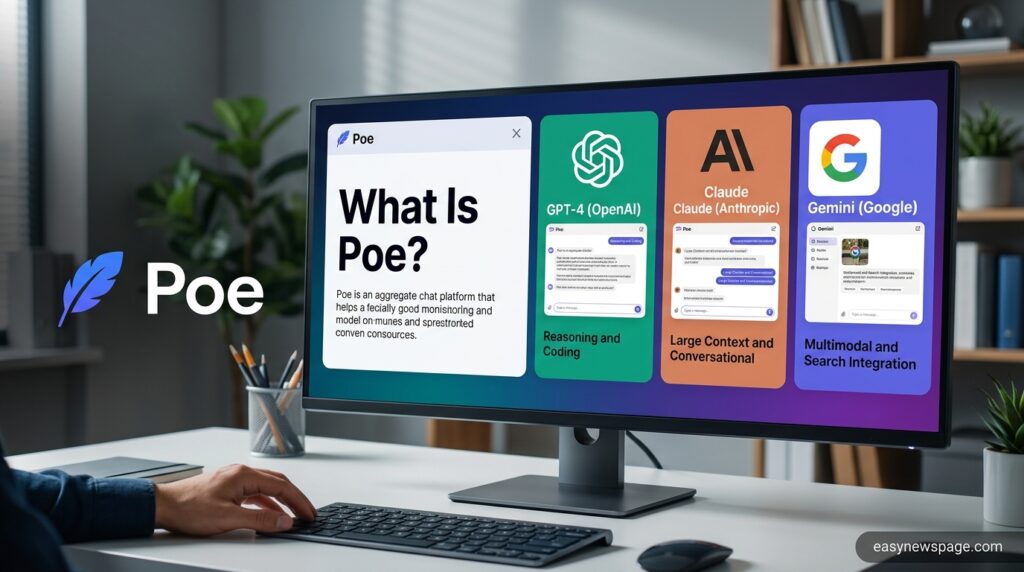
Poe is a multi-model AI chat platform built by Quora that aggregates leading language and multimodal models into a single interface. Instead of subscribing to OpenAI, Anthropic, and Google separately, users access models like GPT-5, Claude, and Gemini on demand, run side-by-side comparisons, and switch between them without leaving the app.
The platform also supports image, video, and audio generation models and hosts tens of thousands of community-built creator bots — custom AI personas built on top of the underlying models. Rather than charging per model, Poe uses a shared compute-points system: each subscription tier grants a monthly allowance of points, and each message costs a different number of points depending on which model answers it.
Key Specs & Features
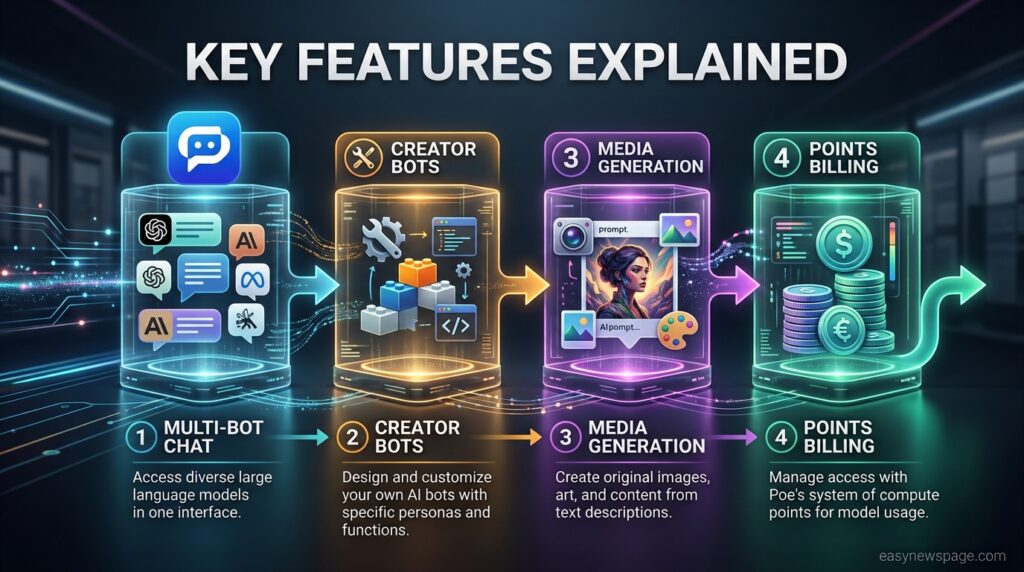
- Multi-Bot Chat — query several models inside the same conversation thread to compare answers directly.
- Broad model roster — access to roughly 100 models, spanning OpenAI, Anthropic, Google, xAI, DeepSeek, and Meta’s Llama family.
- Media generation — supports image, video, and audio models alongside text, letting users generate visuals or voice without a separate app.
- Creator bots — thousands of custom bots built by the community on top of licensed models, some with monetization built in for their creators.
- Points-based billing — a single metered currency spent across every model, so heavier or pricier models simply consume more of a tier’s monthly allowance.
- Cross-platform access — available on iOS, Android, Mac, Windows, the web, and via API for developers.
What’s New vs. Previous Version
Poe’s biggest structural change from 2024–2025 to 2026 is its pricing ladder. The platform previously ran a simpler two-tier system, with its cheapest paid plan sitting at $20/month until a $4.99 entry tier was added to meet demand for a lower-cost option. By 2026, that has grown into a full six-step ladder — Free, Starter, Premium, Premium Plus, Pro, and Pro Max — giving both light users and high-volume power users a tier that more closely matches their actual usage.
Release Date & Availability
Poe launched in December 2022 and has been continuously updated since, so there’s no separate “release date” to track — it ships as an ongoing service. It remains available now on iOS, Android, Mac, Windows, the web, and through an API for developers building on top of it.
Pricing
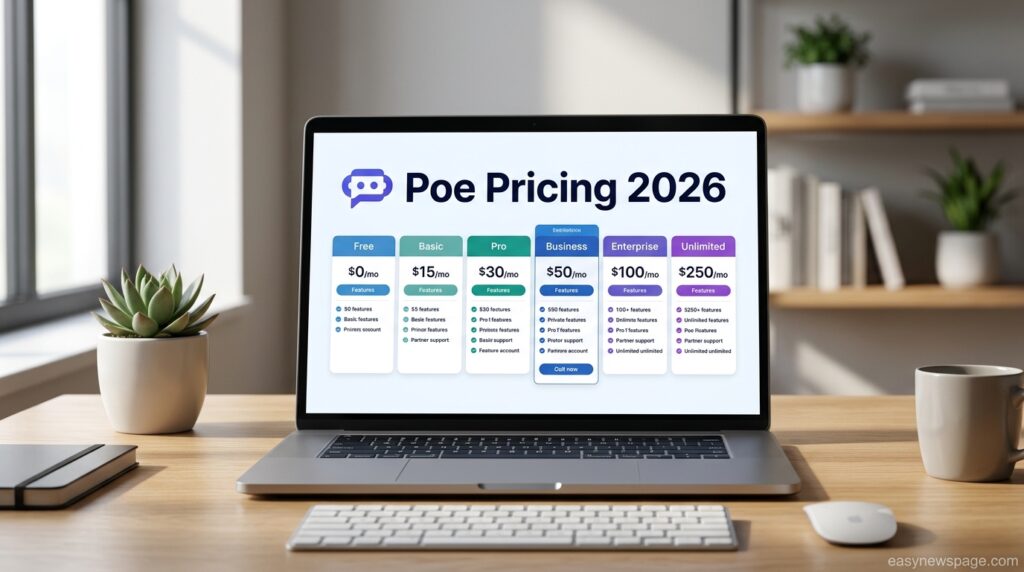
Poe’s 2026 pricing spans six tiers, each granting a different monthly points allowance:
| Plan | Price | Notes |
|---|---|---|
| Free | $0 | Limited daily messages, no paid model access |
| Starter | $4.99/month | Entry-level paid tier added by popular demand |
| Premium | $19.99/month | Matches native single-app subscription pricing |
| Premium Plus | $49.99/month | Larger points pool for frequent multi-model use |
| Pro | $99.99/month | Built for high-volume individual or small-team use |
| Pro Max | $249.99/month | Highest tier, designed for heavy professional usage |
All paid plans are roughly 17% cheaper when billed annually rather than monthly. Because points consumption varies by model, two people on the same tier can run out of allowance at very different points depending on which models they favor.
Who It’s For
Poe is best for people who regularly use more than one AI model—comparing GPT, Claude, and Gemini answers for research, writing, or coding—and would rather pay one metered bill than three separate subscriptions. It also suits builders and hobbyists who want to create or use community bots without setting up their own API integrations.
How It Compares to Alternatives
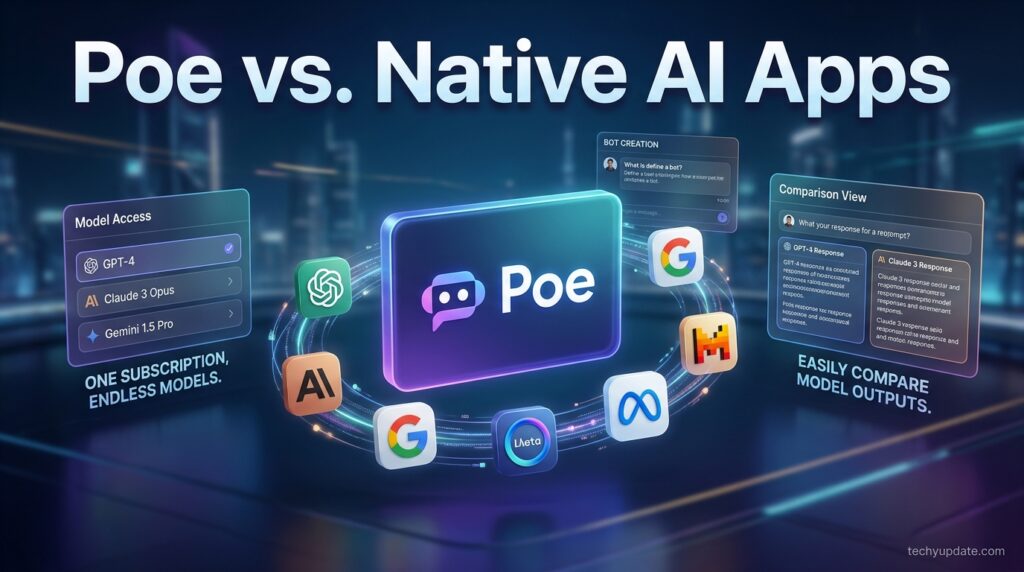
At roughly $20/month, Poe’s Premium tier is priced to match a native ChatGPT Plus or Claude Pro subscription, but it trades some day-one access to a provider’s newest features for the flexibility to switch between many models in one app. Poe leads clearly in the aggregation category — for anyone who values variety and side-by-side comparison over always having the single latest model first, it remains a strong 2026 pick.
Definition
Snippet: Poe is a multi-model AI chat platform built by Quora that gives users access to dozens of leading AI models, including GPT, Claude, and Gemini, through a single subscription and a shared points-based billing system.
Table Snippet: See the Pricing table above for a side-by-side view of all six current Poe subscription tiers and their 2026 prices.
Read more: Microsoft Copilot AI Tool
FAQ
Is Poe free to use?
Yes, Poe offers a free tier with limited daily messages and no access to paid-tier model allowances. Most users who want regular access to multiple models choose a paid tier starting at $4.99/month.
How does Poe’s points system work?
Each subscription tier grants a monthly points allowance, and every message consumes points based on which model answered it. More expensive or resource-heavy models use up more points per message than lighter ones.
Is Poe cheaper than subscribing to ChatGPT, Claude, and Gemini separately?
For users who regularly use more than one model, Poe’s mid-tier plans can cost less than three separate native subscriptions, though very heavy single-model users may still find a dedicated subscription more cost-effective.
Who owns Poe?
Poe is owned and operated by Quora, which raised $75 million from Andreessen Horowitz to help scale the platform. Poe now contributes close to a third of Quora’s overall 2026 valuation.
Conclusion
Poe’s core pitch hasn’t changed since 2022 — one subscription instead of several — but 2026 is the year that pitch clearly paid off, with Poe’s revenue more than doubling since 2024 and the platform now representing a meaningful chunk of Quora’s total value. The single most actionable takeaway is this: if you’re currently paying for more than one AI chatbot subscription, compare your combined monthly cost against Poe’s Premium tier at $19.99/month before renewing anything, since that’s the price point where consolidation most often pays off.
If you mostly use one model and rarely compare outputs across providers, a native subscription may still serve you better, since Poe can lag slightly behind on day-one feature releases. But if variety, side-by-side comparison, or access to community-built bots matters to your workflow, Poe’s six-tier ladder now has an entry point for nearly every usage level, from the $4.99 Starter plan up to the high-volume Pro Max tier.
As a next step, try Poe’s free tier for a week and track which models you actually reach for — that usage pattern will tell you more clearly than any spec sheet whether a paid tier, and which one, is worth adding to your budget. If you end up favoring one model almost exclusively, that’s your signal that a native subscription might serve you just as well for less.