

The Future of Blogging Is AI-Driven
The blogging landscape in 2026 has evolved into a highly intelligent, AI-powered ecosystem where speed, precision, and personalization define success. We now operate in a digital environment where AI-driven content creation, optimization, and publishing workflows are no longer optional they are essential for ranking and authority.
To stay ahead, we must leverage AI tools strategically, transforming raw ideas into high-performing, SEO-optimized articles that dominate search engine results. This guide outlines a complete, future-ready workflow designed to maximize productivity, engagement, and rankings.
Clickable Table of Contents
- Introduction to AI Blogging
- What is AI in 2026
- Current Trends in AI Blogging
- Best AI Tools for Blogging
- Step-by-Step Guide to Using AI Tools
- Real-World Use Cases
- Benefits of AI Blogging
- Limitations and Challenges
- Pro Tips for Better Results
- Common Mistakes to Avoid
- Expert Insights
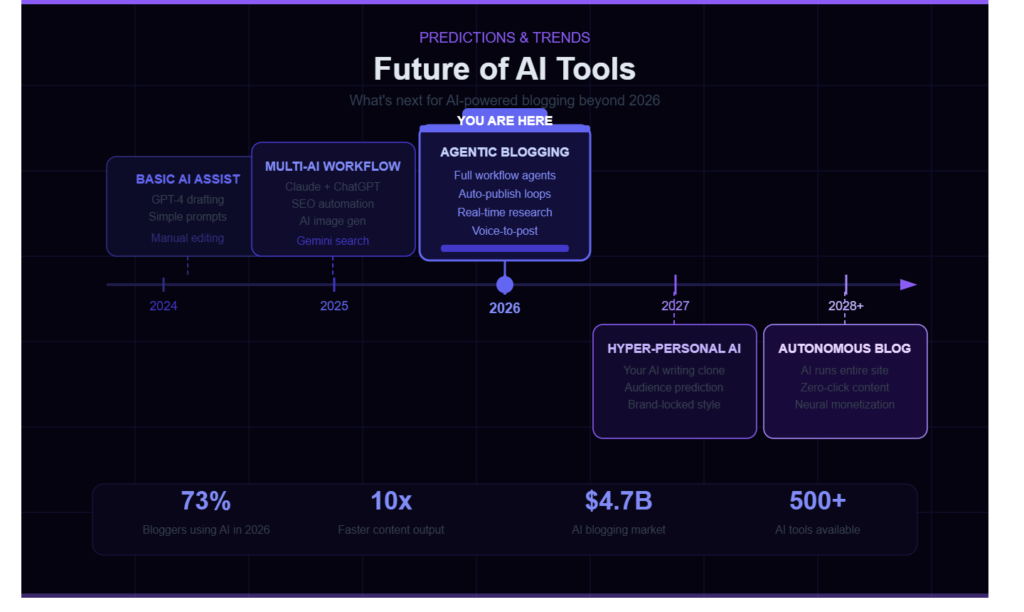
- Future Trends of AI Blogging
- Quick Summary
AI Blogging
If you’ve ever wondered how to use AI tools for blogging, you’re not alone. In 2026, blogging is no longer just about writing it’s about strategically using artificial intelligence to create smarter, faster, and more optimized content. AI tools have evolved from simple text generators into full-fledged content assistants capable of research, SEO optimization, tone adjustment, and even audience targeting.
Think of AI as your co-writer who never gets tired. You bring the ideas, creativity, and direction, while AI handles the heavy lifting like structuring articles, suggesting keywords, and refining readability. This shift is especially powerful for bloggers, students, and professionals who want to produce high-quality content consistently without burnout.
Using AI tools doesn’t mean replacing human creativity. Instead, it enhances your workflow. You still control the narrative, but AI helps you polish it to perfection. Whether you’re running a tech blog, affiliate site, or personal brand, learning how to use AI tools effectively can dramatically increase your reach and rankings.
AI-Powered Drafts: Creating High-Quality Content Faster
Generating Blog Ideas with AI Intelligence
Modern AI tools analyze search intent, trending keywords, and user behavior to generate blog topics that align perfectly with audience demand. We can instantly uncover:
- High-traffic keyword opportunities
- Content gaps competitors have missed
- Emerging trends before they peak
By feeding AI-targeted prompts, we generate data-driven blog ideas primed for ranking.
What is AI in 2026
Artificial Intelligence in 2026 is far more advanced than it was just a few years ago. It’s not just about generating text anymore, it’s about understanding context, intent, and user behavior. Modern AI systems can analyze search intent, predict trending topics, and even suggest content structures optimized for search engines.
When discussing how to use AI tools for blogging, it’s important to understand that AI now works with Natural Language Processing (NLP) and semantic SEO. This means it doesn’t just focus on keywords but also understands relationships between words and topics. For example, if you write about “blogging tools,” AI knows related terms like “content automation,” “SEO optimization,” and “keyword research.”
AI tools today can:
- Generate long-form articles
- Optimize content for voice search
- Suggest headlines with high CTR
- Analyze competitors
- Improve readability and tone
This level of intelligence enables bloggers to create content that not only ranks but also deeply engages readers.
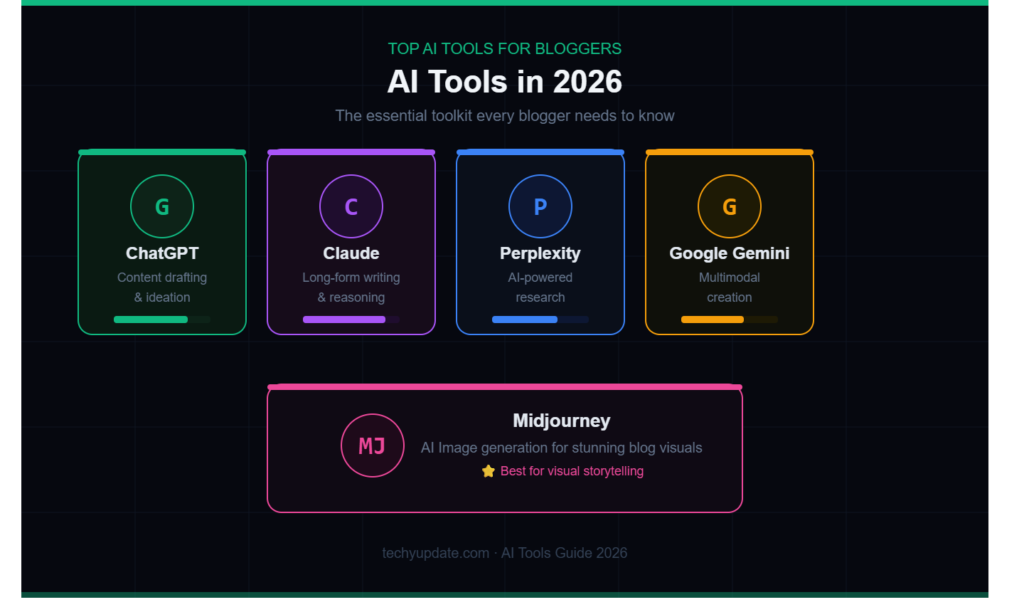
TOP AI TOOLS FOR BLOGGERS IN 2026
The Essential AI Toolkit Every Blogger Needs to Master
In 2026, blogging success is no longer about writing alone it’s about leveraging a powerful AI ecosystem that enhances creativity, accelerates workflows, and delivers high-ranking, engaging content. The modern blogger relies on a carefully selected suite of AI tools that streamline everything from ideation to publishing.
Below is a complete breakdown of the most essential AI tools for bloggers in 2026, each playing a critical role in building a smarter, faster, and more profitable blogging workflow.
1. ChatGPT Content Drafting & Ideation Powerhouse
ChatGPT stands at the core of modern blogging workflows, enabling us to generate high-quality content ideas and structured drafts within seconds.
Key Capabilities:
- Instant blog topic generation based on trending keywords
- Creation of SEO-optimized outlines and full articles
- Ability to adapt tone, style, and audience targeting
- Generating meta descriptions, headlines, and CTAs
Why It Matters:
We use ChatGPT to eliminate writer’s block and produce consistent, scalable content that aligns with search intent. Its ability to understand context ensures that every piece of content feels natural, engaging, and human-like.
2. Claude Long-Form Writing & Deep Reasoning
Claude is designed for handling complex, long-form content with exceptional clarity and depth. It excels where detailed explanations and structured thinking are required.
Key Capabilities:
- Producing in-depth articles and research-backed content
- Maintaining logical flow across long documents
- Handling complex instructions and layered prompts
- Refining content for clarity and coherence
Why It Matters:
For bloggers aiming to create authoritative content, Claude ensures depth and accuracy, making it ideal for guides, tutorials, and analytical posts that demand high-quality reasoning.
3. Perplexity AI-Powered Research Engine
Perplexity transforms how we conduct research by delivering real-time, AI-curated answers with source-backed insights.
Key Capabilities:
- Fast access to reliable, summarized research
- Ability to explore multiple perspectives on a topic
- Source citations for credible content creation
- Real-time updates on trending information
Why It Matters:
We rely on Perplexity to ensure our content is accurate, up-to-date, and trustworthy, which is critical for building authority and ranking higher on search engines.
4. Google Gemini Multimodal Content Creation
Google Gemini represents the next evolution of AI by combining text, images, and data processing into one powerful platform.
Key Capabilities:
- Creating text, visuals, and data-driven insights simultaneously
- Enhancing blog posts with rich multimedia content
- Integrating seamlessly with Google ecosystem tools
- Supporting advanced SEO and search optimization
Why It Matters:
Gemini allows us to produce dynamic, visually engaging content that appeals to both users and search engines, improving user experience and engagement metrics.
5. Midjourney AI Image Generation for Stunning Visuals
Midjourney is the go-to tool for creating high-quality, unique visuals that elevate blog content.
Key Capabilities:
- Generating custom, eye-catching images
- Creating feature images, thumbnails, and illustrations
- Enhancing brand identity with a consistent visual style
- Producing high-resolution graphics for professional use
Why It Matters:
Visual content plays a crucial role in engagement. With Midjourney, we can create scroll-stopping visuals that increase click-through rates and time on page.
Read More: AI Tools for Blogging 2026
How to Combine These Tools for Maximum Impact
To achieve the best results, we integrate these tools into a seamless blogging workflow:
- Start with ChatGPT for ideation and drafting
- Use Perplexity to gather accurate research and data
- Refine with Claude for depth and long-form quality
- Enhance with Google Gemini for multimedia content
- Add visuals using Midjourney for engagement
This workflow ensures every blog post is:
- Well-researched and authoritative
- SEO-optimized and structured
- Visually appealing and engaging
- Efficiently produced at scale
Current Trends in AI Blogging
The landscape of AI blogging is evolving rapidly, and staying updated is essential if you want to master how to use AI tools for blogging. One of the biggest trends in 2026 is AI-assisted content personalization. Instead of writing generic posts, bloggers now tailor content based on audience preferences, behavior, and demographics.
Another major trend is the integration of AI with SEO tools. Platforms now integrate keyword research, competitor analysis, and content generation into a single ecosystem. This means you can plan, write, and optimize your blog post without switching tools.
Voice search optimization is also becoming crucial. With the rise of smart assistants, AI tools now help you write in a conversational tone, making your content more accessible and engaging.
Here’s what’s trending:
- AI-generated outlines based on search intent
- Automated internal linking suggestions
- Real-time SEO scoring
- AI-powered content updates for old posts
These trends show that blogging is no longer manual work, it’s a data-driven strategy powered by AI.
Writing First Drafts with Precision
AI writing assistants in 2026 can produce human-like, context-aware drafts that require minimal editing. These tools help us:
- Generate structured, coherent articles
- Maintain consistent tone and voice
- Reduce writing time by up to 80%
We focus on guiding AI with clear instructions, ensuring that every draft aligns with SEO intent and audience expectations.
Enhancing Content Depth and Value
To outperform competitors, we refine AI drafts by adding:
- Real-world examples
- Actionable insights
- Expert-level explanations
This combination ensures that content is not only optimized but also valuable and authoritative, meeting modern search engine standards.
Optimize SEO & Engagement: Ranking Smarter, Not Harder
Advanced Keyword Optimization
AI tools now perform semantic SEO analysis, helping us optimize beyond basic keywords. We strategically include:
- Primary keywords in headings and introduction
- LSI (Latent Semantic Indexing) keywords throughout the content
- User intent phrases for voice and AI search
This ensures our content aligns with search engine algorithms and AI-driven search systems.
AI-Driven Content Structuring
Proper structure is critical for both users and search engines. AI helps us create:
- Clear heading hierarchies (H1, H2, H3)
- Readable paragraphs with logical flow
- Featured snippet-ready sections
By structuring content effectively, we improve dwell time, readability, and ranking potential.
AI-Driven Content Structuring
Proper structure is critical for both users and search engines. AI helps us create:
- Clear heading hierarchies (H1, H2, H3)
- Readable paragraphs with logical flow
- Featured snippet-ready sections
By structuring content effectively, we improve dwell time, readability, and ranking potential.
Optimizing for AI Search and Voice Queries
Search in 2026 is heavily influenced by AI assistants and voice queries. We optimize content by:
- Using natural language and conversational tone
- Answering specific questions clearly
- Structuring content for quick answers and summaries
This ensures visibility across AI-powered search engines and smart devices.
Publish Smarter Workflow: Automating Success
AI Content Editing and Proofreading
Before publishing, AI tools refine content by:
- Correcting grammar and syntax errors
- Improving clarity and readability
- Ensuring tone consistency
This results in polished, professional articles that build credibility and trust.
Automated Publishing Systems
AI-driven CMS platforms allow us to:
- Schedule posts at optimal times
- Automatically format content for SEO and mobile responsiveness
- Integrate multimedia elements seamlessly
This reduces manual effort and ensures efficient content delivery.
AI-Powered Performance Tracking
Once published, AI analytics tools monitor:
- Traffic sources
- User engagement metrics
- Keyword rankings
We use these insights to continuously refine and improve content strategy, ensuring long-term growth.
Building a High-Performance AI Blogging Workflow
1: Research and Planning
We begin with AI tools that identify:
- Trending topics
- Search intent
- Competitive analysis
This ensures every article is backed by data-driven insights.
2: Draft Creation
Using AI, we generate:
- Comprehensive outlines
- Detailed first drafts
- Keyword-rich content
This accelerates the writing process without sacrificing quality.
3: Optimization
We refine the content by:
- Enhancing SEO structure
- Adding internal and external linking strategies
- Improving readability and engagement
4: Publishing and Promotion
AI tools help us:
- Publish across multiple platforms
- Optimize for search engines and social media
- Automate content distribution
5: Continuous Improvement
We analyze performance and:
- Update content based on new trends
- Improve rankings with fresh optimization
- Expand content with new insights
The Role of AI in Content Authority and Trust
To rank in 2026, content must demonstrate:
- Expertise
- Authority
- Trustworthiness
AI helps us maintain these standards by ensuring:
- Accurate, well-researched information
- Consistent content quality
- Regular updates and improvements
Common Mistakes to Avoid in AI Blogging
Even with advanced tools, we must avoid:
- Over-reliance on AI without human refinement
- Ignoring search intent
- Producing generic, low-value content
Success lies in combining AI efficiency with human expertise.
Future Trends: Where AI Blogging Is Heading
The next evolution of blogging includes:
- Hyper-personalized content experiences
- Real-time AI content adaptation
- Integration with immersive technologies
We must stay ahead by continuously adopting new AI innovations.
Best AI Tools for Blogging
When learning how to use AI tools for blogging, choosing the right tools is critical. Not all AI tools are created equal some focus on writing, while others specialize in SEO or research.
Popular categories of AI blogging tools include:
| Tool Type | Purpose | Example Use |
| Writing Assistants | Generate content | Blog drafts |
| SEO Tools | Optimize keywords | Ranking improvement |
| Research Tools | Find data | Topic discovery |
| Editing Tools | Improve grammar | Readability boost |
Some tools help you generate entire articles, while others refine your content to make it more engaging and SEO-friendly. The best approach is to combine multiple tools for a complete workflow.
For example, you might use one tool to generate ideas, another to write content, and a third to optimize SEO. This layered strategy ensures that your blog posts are not only well-written but also search-engine-friendly.
Step-by-Step Guide to Using AI Tools
Understanding how to use AI tools for blogging becomes much easier when you follow a structured process. Instead of randomly generating content, you should approach AI blogging like a system.
Building a High-Performance AI Blogging Workflow
1: Keyword Research
Start by identifying your primary keyword. AI tools can suggest high-volume, low-competition keywords that align with your niche.
Research and Planning
We begin with AI tools that identify:
- Trending topics
- Search intent
- Competitive analysis
This ensures every article is backed by data-driven insights.
2: Content Outline
Use AI to generate a structured outline. This ensures your article covers all important topics and ranks better.
This accelerates the writing process without sacrificing quality.
3: Content Generation
Let AI create the first draft. Don’t expect perfection—this is just the foundation.
4: Human Editing
Refine the content by adding your voice, examples, and insights.
5: SEO Optimization
Use AI to optimize headings, keyword density, and readability.
Optimization
We refine the content by:
- Enhancing SEO structure
- Adding internal and external linking strategies
- Improving readability and engagement
6: Publishing & Updating
Publish your post and use AI tools to update it regularly based on performance.
AI tools help us:
- Publish across multiple platforms
- Optimize for search engines and social media
- Automate content distribution
7: Continuous Improvement
We analyze performance and:
- Update content based on new trends
- Improve rankings with fresh optimization
- Expand content with new insights
8: Draft Creation
Using AI, we generate:
- Comprehensive outlines
- Detailed first drafts
- Keyword-rich content
This accelerates the writing process without sacrificing quality.
Real-World Use Cases
AI blogging isn’t just a theory; it’s actively used by professionals across industries. If you’re exploring how to use AI tools for blogging, real-world examples can help you understand their impact.
For instance, affiliate marketers use AI to quickly generate product reviews. Tech bloggers use AI to summarize complex topics into easy-to-read guides. Even students use AI to create educational blog posts.
Here are a few practical examples:
- A tech blogger generating weekly AI tool reviews
- A business owner creating SEO blogs for lead generation
- A student running a niche blog using AI for content ideas
These examples show that AI tools are versatile and adaptable to different blogging styles.
Benefits of AI Blogging
One of the biggest reasons people want to learn how to use AI tools for blogging is the massive list of benefits. AI doesn’t just save time, it transforms the entire content creation process.
AI blogging allows you to:
- Create content faster
- Maintain consistency
- Improve SEO performance
- Reduce writer’s block
- Scale your blog effortlessly
Imagine writing 10 articles in the time it used to take for one. That’s the power of AI. It also ensures your content remains optimized for search engines, increasing your chances of ranking higher.
The Role of AI in Content Authority and Trust
To rank in 2026, content must demonstrate:
- Expertise
- Authority
- Trustworthiness
AI helps us maintain these standards by ensuring:
- Accurate, well-researched information
- Consistent content quality
- Regular updates and improvements
Limitations and Challenges
Despite its advantages, AI blogging isn’t perfect. Understanding the limitations is essential when learning how to use AI tools effectively.
AI-generated content can sometimes lack originality or depth. It may also produce generic or repetitive content if not guided properly. Another challenge is over-reliance—depending too much on AI can reduce your creativity.
To overcome these issues:
- Always edit AI-generated content
- Add personal insights
- Fact-check information
- Maintain your unique voice
Balancing AI efficiency with human creativity is the key to success.
Pro Tips for Better Results
✔ Pro Tips
Mastering how to use AI tools for blogging requires more than just basic usage. Here are some advanced tips:
- Use detailed prompts for better output
- Combine multiple AI tools
- Focus on user intent, not just keywords
- Regularly अपडेट old content
- Add storytelling elements
These strategies help you create content that stands out in a competitive market.
Common Mistakes to Avoid
Even experienced bloggers make mistakes when learning how to use AI tools. Avoiding these can save you time and effort.
Common mistakes include:
- Publishing AI content without editing
- Ignoring SEO optimization
- Overusing keywords
- Not understanding audience intent
Fixing these mistakes can significantly improve your blog’s performance.
- Over-reliance on AI without human refinement
- Ignoring search intent
- Producing generic, low-value content
Success lies in combining AI efficiency with human expertise.
Future Trends of AI Blogging
The future of blogging is deeply connected with AI. As technology evolves, learning how to use AI tools for blogging will become even more essential.
Upcoming trends include:
- AI-generated video blogs
- Voice-first content
- Hyper-personalized articles
- Real-time content optimization
These advancements will make blogging more interactive and dynamic.
The next evolution of blogging includes:
- Hyper-personalized content experiences
- Real-time AI content adaptation
- Integration with immersive technologies
We must stay ahead by continuously adopting new AI innovations.
POLICY + TECHNOLOGY: Government & AI Collaboration in 2026
Shaping the Future of Responsible AI in Public Sectors
In 2026, the intersection of government policy and artificial intelligence defines how nations innovate, regulate, and protect their citizens. Governments are no longer passive observers they are active architects of AI ecosystems, building frameworks that balance innovation, ethics, and public trust.
The emergence of a unified Government AI Hub marks a strategic shift toward centralized coordination, ensuring that AI technologies are deployed responsibly, securely, and efficiently across public sectors.
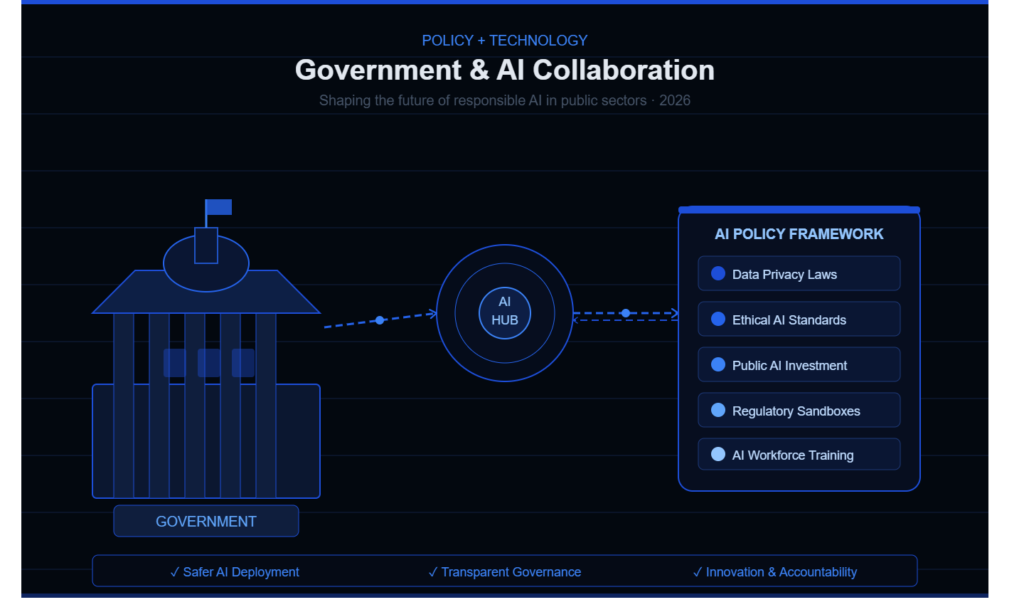
GOVERNMENT AI HUB: The Core of Digital Transformation
The Government AI Hub serves as a centralized platform where policymakers, technologists, and institutions collaborate to:
- Develop national AI strategies
- Standardize AI deployment protocols
- Share data, tools, and infrastructure
- Monitor AI system performance and risks
This hub accelerates innovation while maintaining regulatory oversight, ensuring that AI adoption aligns with national priorities and global standards.
AI POLICY FRAMEWORK: Building the Foundation of Trust
A robust AI Policy Framework is essential for guiding the development and deployment of artificial intelligence systems. In 2026, governments are focusing on structured policies that ensure accountability, transparency, and fairness.
Key Pillars of the AI Policy Framework
1. Data Privacy Laws
Data is the backbone of AI, making data privacy laws a top priority. Governments are enforcing:
- Strict data protection regulations
- User consent and data ownership rights
- Secure data storage and processing standards
These laws ensure that AI systems operate without compromising individual privacy or security.
2. Ethical AI Standards
Ethics play a critical role in AI governance. Governments are implementing:
- Bias detection and mitigation policies
- Transparent decision-making processes
- Accountability for AI-driven outcomes
Ethical standards ensure that AI systems remain fair, inclusive, and non-discriminatory, fostering public confidence.
3. Public AI Investment
To remain competitive, governments are significantly increasing public investment in AI:
- Funding research and innovation centers
- Supporting AI startups and enterprises
- Building national AI infrastructure
These investments drive economic growth, technological leadership, and job creation.
4. Regulatory Sandboxes
Regulatory sandboxes provide a controlled environment for testing AI innovations without the full constraints of regulation.
Benefits include:
- Encouraging safe experimentation
- Accelerating AI product development
- Allowing policymakers to adapt regulations in real time
This approach ensures that innovation continues while maintaining risk management and oversight.
5. AI Workforce Training
A skilled workforce is essential for sustainable AI adoption. Governments are prioritizing:
- AI education and training programs
- Upskilling and reskilling initiatives
- Collaboration with universities and tech institutions
This ensures a workforce capable of developing, managing, and regulating AI systems effectively.
Government & AI Collaboration: A Strategic Partnership
The collaboration between governments and AI developers is transforming public services in key areas:
Healthcare
- AI-driven diagnostics and predictive analytics
- Improved patient care through automation and data insights
Education
- Personalized learning powered by adaptive AI systems
- Enhanced access to education through digital platforms
Public Safety
- AI-based surveillance and threat detection
- Faster emergency response through real-time data analysis
Smart Cities
- Intelligent infrastructure management
- Optimized traffic systems and energy efficiency
Balancing Innovation with Regulation
The challenge in 2026 is achieving the right balance between rapid innovation and responsible regulation. Governments are adopting a proactive approach by:
- Continuously updating AI policies
- Collaborating with private sector leaders
- Aligning with international AI standards
This ensures that AI technologies evolve within a secure, ethical, and sustainable framework.
The Future of Responsible AI Governance
Looking ahead, the role of government in AI will continue to expand. Key trends include:
- Global AI policy harmonization
- Increased focus on AI transparency and explainability
- Expansion of cross-border AI collaborations
Governments that successfully integrate policy with technology will lead the future of responsible AI innovation.
Quick Summary
AI blogging in 2026 is all about working smarter, not harder. By understanding how to use AI tools for blogging, you can create high-quality, SEO-optimized content faster than ever.
Conclusion
Blogging has entered a new era where AI plays a central role in content creation. Learning how to use AI tools for blogging is no longer optional; it’s a necessity for anyone who wants to stay competitive. The key is to use AI as a помощник, not a replacement. Combine its efficiency with your creativity, and you’ll create content that ranks, engages, and converts.
The most successful bloggers are those who embrace AI-powered workflows to create, optimize, and publish content with precision. By leveraging AI tools effectively, we produce high-quality, SEO-optimized, and engaging articles that outperform competitors and dominate search rankings.
The bloggers who dominate search rankings in 2026 are those who embrace AI as a strategic partner, not just a tool. By combining the strengths of ChatGPT, Claude, Perplexity, Google Gemini, and Midjourney, we create a high-performance content engine that consistently produces top-ranking, high-converting blog posts.
In 2026, government and AI collaboration is the cornerstone of a secure and innovative digital future. By establishing strong policy frameworks, investing in technology, and prioritizing ethics, governments are shaping an AI landscape that benefits society as a whole.
The path forward lies in continuous collaboration, adaptive regulation, and responsible innovation, ensuring that AI remains a force for progress, trust, and global advancement.
FAQs
1. How to use AI tools for blogging effectively?
Use AI for research, outlining, and drafting, but always edit and personalize the content.
2. Are AI tools good for SEO blogging?
Yes, they help with keyword optimization, readability, and content structure.
3. Can beginners use AI tools for blogging?
Absolutely, AI tools are beginner-friendly and simplify the entire blogging process.
4. Do AI-generated blogs rank on Google?
Yes, if properly optimized and edited for quality and originality.
5. Is AI blogging the future?
Yes, AI is shaping the future of content creation and digital marketing.