

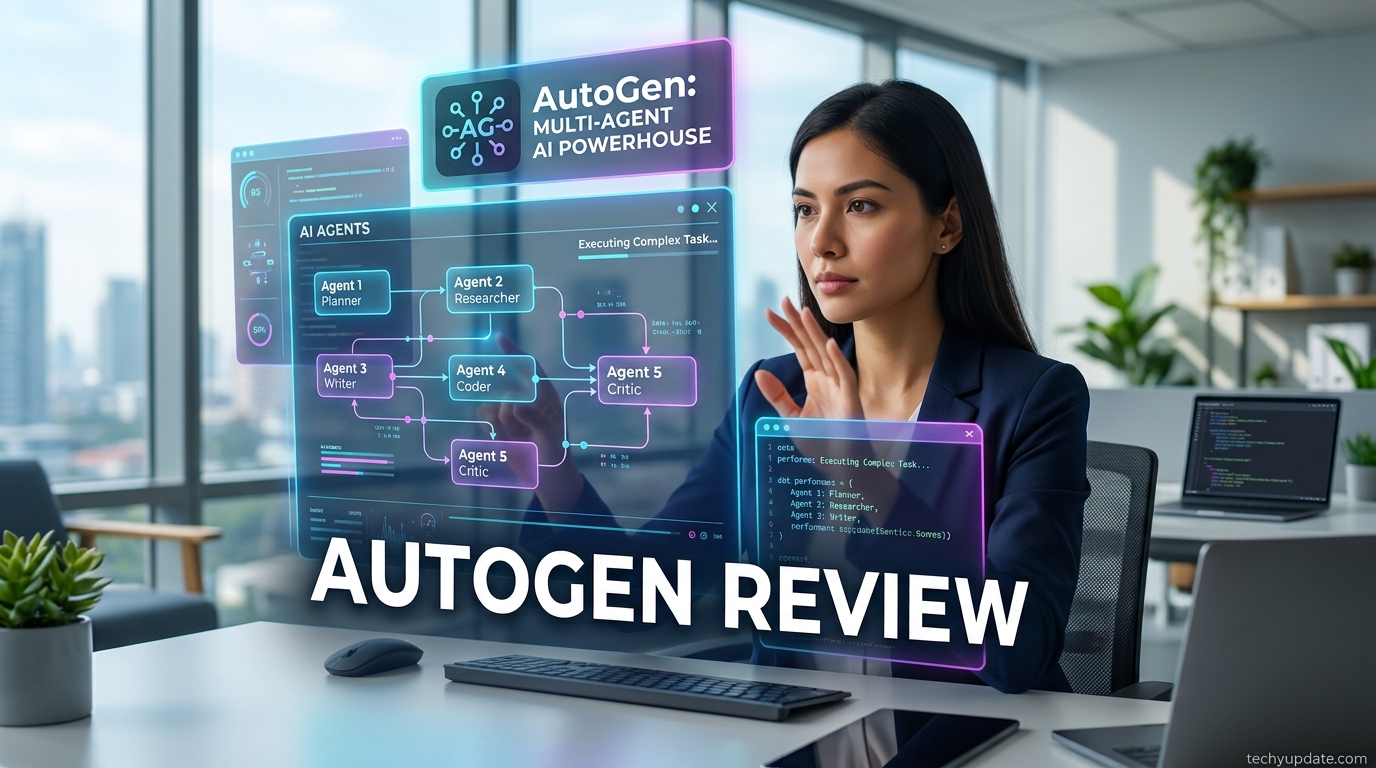
Artificial intelligence has evolved rapidly over the past few years, and multi-agent AI systems are now transforming how developers and businesses build intelligent applications. If you’ve been searching for an honest AutoGenAI Review 2026, you’ve likely noticed conflicting information. Some sources claim AutoGen is no longer relevant, while others continue recommending it for advanced AI automation.
The reality is more nuanced. AutoGen AI remains one of the most influential open-source multi-agent frameworks ever developed, even though Microsoft has introduced a newer Agent Framework for modern enterprise development. At the same time, AutogenAI, the commercial proposal and grant-writing platform, is also gaining significant attention among businesses seeking AI-powered bidding and proposal solutions.
If you searched “AutoGen AI” hoping for a straightforward answer about whether it’s still the right multi-agent framework to build on, you’ve landed in the middle of one of the more confusing transitions in the AI tooling world. AutoGen used to be the name developers reached for when they wanted AI agents that could talk to each other, delegate tasks, and get real work done. In 2026, that story has changed, and this review exists to untangle it for you.

We tested AutoGen’s current stable release, walked through AutoGen Studio, compared it against its own official successor, and benchmarked it against the frameworks developers are actually shipping to production this year. Here’s the honest, no-fluff verdict.
This comprehensive guide explains everything you need to know about AutoGen AI in 2026, including its architecture, latest developments, installation, features, practical use cases, pricing, comparisons with competing frameworks, and whether it remains the right choice for developers, researchers, students, and enterprises.
Whether you’re building autonomous AI agents or evaluating AI-powered business writing software, this review will help you make an informed decision.
Read more: CrewAI Review 2026
Read more: n8n Review 2026
Table of Contents
What Is AutoGen AI?
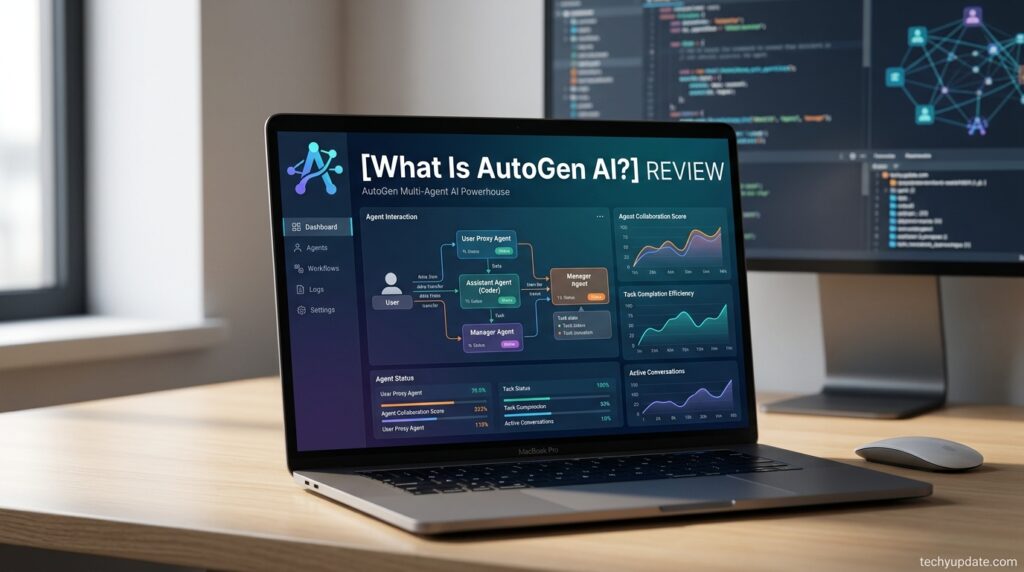
AutoGen is an open-source programming framework, originally built by Microsoft Research, for creating multi-agent AI applications where several AI agents communicate, collaborate, and act autonomously or alongside a human to complete tasks. Instead of a single chatbot answering one prompt at a time, AutoGen lets you assemble a team of specialized agents: one that plans, one that writes code, one that reviews, one that talks to external tools. These agents exchange messages the way people in a group chat would, which is why the framework’s original signature feature was literally called GroupChat.
This collaborative architecture allows developers to build advanced workflows that resemble human teams. For example, one AI agent may perform research, another writes code, while a third reviews the results before delivering a final answer.
Unlike traditional AI applications that process prompts individually, AutoGen introduces autonomous conversations between agents, making it particularly valuable for:
- Software development
- Research automation
- Data analysis
- Business workflow automation
- Customer support
- Document generation
- AI-assisted programming
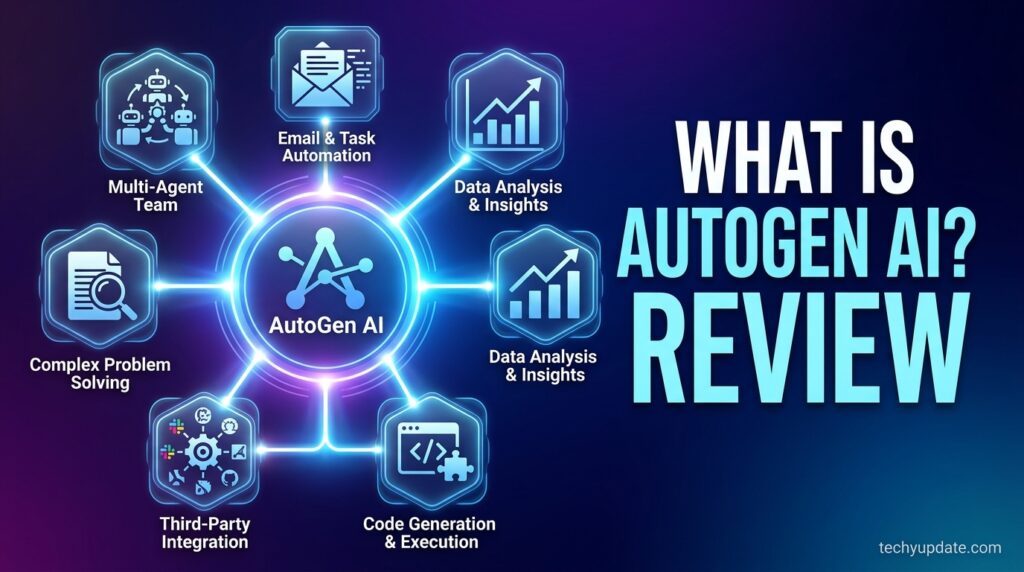
Because of its flexible architecture, AutoGen quickly became one of the most popular frameworks for multi-agent artificial intelligence after its release.
AutoGen was one of the earliest frameworks to popularize the idea that “agentic AI” doesn’t have to mean one giant model doing everything. It pioneered patterns of conversable agents, group deliberation, and code-executing agents that nearly every competing framework has since borrowed in some form.
It’s built primarily in Python (with growing .NET support), it’s free, and the source code lives openly on GitHub, where it has attracted well over 40,000 stars, a number that puts it among the most-recognized names in the agent framework category, even as its role has shifted.
AutoGen’s Status in 2026: Maintenance Mode Explained
This is the part most outdated reviews get wrong, so let’s be precise about it.
As of 2026, the original AutoGen project has effectively split into three distinct paths, and understanding which one you land on matters more than any feature comparison:
- Microsoft Agent Framework (MAF) is the official, production-grade successor. Microsoft shipped Agent Framework 1.0 as a general-availability release in April 2026, describing it as a merger of “the enterprise-ready foundations of Semantic Kernel with the innovative orchestrations of AutoGen” into a single, stable SDK with long-term support commitments.
- AutoGen (stable maintenance line) is still installable, still functional, but explicitly in maintenance mode. Microsoft’s own documentation now states plainly that new users should start with Microsoft Agent Framework, and that AutoGen will receive critical bug fixes and security patches but not new features.
- AG2 — a community-led fork that continues to support the older, more familiar GroupChat-style API for teams that don’t want to change how their existing code works.
Microsoft made the announcement directly to the AutoGen community: after roughly two years, 98 releases, and thousands of commits, the AutoGen and Semantic Kernel teams decided to combine forces rather than continue maintaining two overlapping frameworks. The resulting single-agent interface in Microsoft Agent Framework is nearly identical to what AutoGen developers already know, with the biggest structural change being an explicit, graph-based workflow API replacing the old implicit GroupChat orchestration.
Why Microsoft Shifted Focus to Agent Framework
Two consistent pain points pushed this consolidation:
- Fragmentation. Having both AutoGen and Semantic Kernel as separate, competing “official” agent frameworks confused enterprise buyers and forced Microsoft’s own product teams to choose sides internally.
- Production gaps. AutoGen was excellent for research and rapid prototyping, but lacked the session-based state management, type safety, middleware, and telemetry that large organizations expect before deploying at scale. Microsoft Agent Framework folds in exactly those Semantic Kernel strengths.
The Three Paths: AutoGen, MAF, and AG2
Here’s the quickest way to decide which path applies to you:
- Starting something brand-new in 2026? Default to Microsoft Agent Framework.
- Already have a working AutoGen codebase and don’t want to rewrite it yet? Stay on the stable AutoGen line, or watch AG2 if you want continued community-driven feature work.
- Want the closest thing to “classic AutoGen” with active community contributions? AG2 is the fork to watch.
AutoGenAI Product Overview
While many people use the term “AutoGenAI” interchangeably with Microsoft’s AutoGen framework, it’s important to distinguish between the two.
AutoGen AI (Microsoft) is an open-source developer framework for building collaborative AI agents.
AutogenAI, on the other hand, is a commercial AI platform designed specifically for proposal, tender, bid, and grant writing. It helps organizations produce high-quality submissions faster by combining generative AI with domain-specific knowledge.
AutogenAI offers solutions for:
- Government bids
- Public sector tenders
- Grant applications
- Proposal management
- Enterprise knowledge management
- Research assistance
- Compliance reviews
Its AI-powered writing environment enables organizations to generate first drafts, improve consistency, manage large knowledge libraries, and collaborate across teams. This makes it especially valuable for enterprises competing for high-value contracts where speed and accuracy are essential.
AutoGen is an Open-Source Multi-Agent Framework
One of AutoGen’s biggest innovations is its multi-agent architecture.
Rather than relying on a single large language model to handle every task, AutoGen enables developers to create several independent agents, each with a specialized responsibility.
For example:
- A Planner Agent creates an execution strategy.
- A Research Agent gathers information.
- A Coding Agent writes Python code.
- A Testing Agent validates the code.
- A Reviewer Agent checks quality before final delivery.
These agents communicate through structured conversations, enabling more reliable reasoning and task completion than a single AI assistant.
Key advantages include:
- Modular architecture
- Scalable workflows
- Flexible agent customization
- Support for multiple LLM providers
- Tool integration
- Code execution capabilities
- Human-in-the-loop workflows
This architecture has influenced nearly every major AI agent framework introduced since 2024.
AutoGen Was Created by Microsoft Research
AutoGen was originally developed by Microsoft Research to explore collaborative AI systems capable of solving complex tasks through coordinated agent interactions.
Instead of treating AI as a single assistant, Microsoft’s researchers investigated how multiple specialized agents could cooperate similarly to human teams.
The framework rapidly attracted attention from:
- AI researchers
- Software engineers
- Universities
- Enterprise developers
- Open-source contributors
- Startup founders
One reason for its popularity was its simplicity. Developers could build sophisticated agent conversations with relatively little code while still maintaining extensive customization options.
Microsoft’s research also demonstrated that collaborative agent systems often outperform single-agent approaches on coding, planning, reasoning, and software engineering tasks.
This research laid the foundation for the growing ecosystem of AI agent frameworks that emerged over the following years.
How AutoGen AI Works
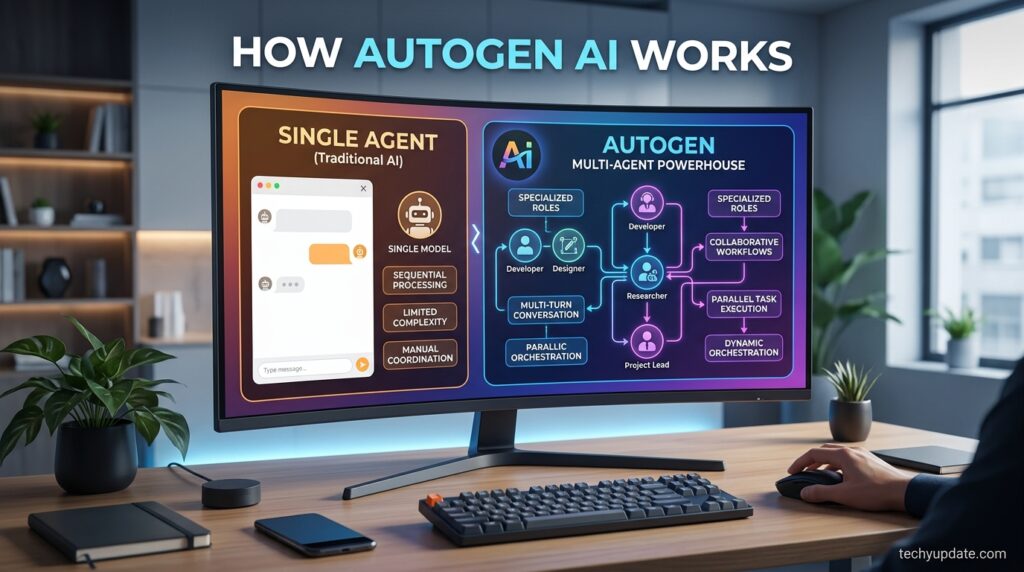
AutoGen follows a conversational architecture where agents exchange messages until they reach a solution.
Instead of executing isolated prompts, agents participate in ongoing discussions, critique each other’s outputs, request clarification, and coordinate actions.
A typical workflow looks like this:
- User submits a task.
- Planner Agent analyzes requirements.
- Research Agent gathers context.
- Developer Agent generates code.
- Testing Agent validates functionality.
- The Reviewer Agent checks quality.
- Final response is returned to the user.
Because each agent specializes in a specific role, the overall system can often produce more accurate and reliable results than a single AI model.
Another notable capability is tool usage. Agents can invoke Python execution, search external resources, interact with APIs, and process files, making AutoGen suitable for real-world automation beyond simple text generation.
Key Features of AutoGen
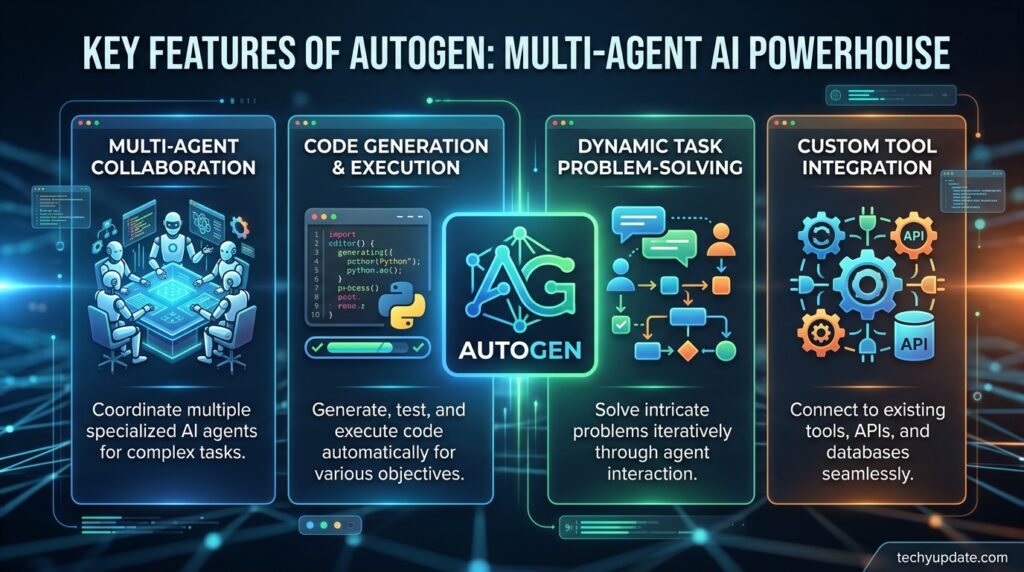
Even in maintenance mode, AutoGen’s underlying feature set remains genuinely useful, and it’s worth understanding because Microsoft Agent Framework inherited most of it directly.
- Conversable, message-passing agents. Agents communicate through asynchronous messages, supporting both event-driven and request/response patterns, rather than a rigid, hard-coded call sequence.
- GroupChat orchestration. Multiple agents can debate, negotiate, or reach consensus in a shared conversation thread, which is still one of the most natural ways to model brainstorming or peer-review-style workflows.
- AutoGen Studio. A no-code, browser-based GUI that lets non-developers assemble and test multi-agent workflows visually, genuinely one of AutoGen’s most distinctive features compared to code-first competitors.
- Built-in code execution. Agents can generate and run code inside a sandboxed environment (Docker-based execution is now the recommended default for security), which makes AutoGen unusually strong for data analysis and DevOps-style automation tasks.
- Extensions ecosystem. Community and first-party extensions add memory backends (including Redis and Mem0), tool integrations, and alternative model clients beyond OpenAI.
- Model Context Protocol (MCP) support. AutoGen agents can connect to MCP servers as tools, letting them interact with browsers, file systems, and external services through a standardized protocol.
- Cross-language interoperability. Originally Python-first, AutoGen added .NET support to let agents built in different languages work together.
- Full type support. Later versions enforce type checks at build time, which means that they meaningfully reduce the “silent failure” problems that plagued early agent frameworks.
Core Features of AutoGen AI
AutoGen introduced several features that helped establish it as one of the leading AI agent frameworks.
Multi-Agent Conversations
Multiple AI agents collaborate through structured messaging, enabling complex reasoning and decision-making.
Flexible Model Support
Developers can connect various large language models depending on project requirements and deployment preferences.
Code Execution
Agents can generate, execute, and evaluate Python code within controlled environments, streamlining software development and data analysis tasks.
Human-in-the-Loop
Developers may pause autonomous workflows for approvals, corrections, or additional instructions before execution continues.
Extensible Architecture
AutoGen supports custom agents, plugins, external APIs, databases, and business systems, making it adaptable for enterprise applications.
Research Automation
Researchers use AutoGen to summarize papers, extract insights, automate literature reviews, and assist with technical writing.
These capabilities contributed to AutoGen’s widespread adoption across academic research, startups, and enterprise development teams.
Our Newest Features and AI Updates
The AI agent ecosystem has evolved significantly in 2026, and AutoGen users should be aware of several important developments.
Recent improvements across the ecosystem include:
- Better multi-agent orchestration
- Improved memory management
- Enhanced Model Context Protocol (MCP) compatibility
- More reliable tool integration
- Enterprise-grade security enhancements
- Faster agent communication
- Expanded support for leading language models
- Improved developer tooling
Meanwhile, Microsoft’s focus has shifted toward the newer Microsoft Agent Framework, which combines lessons learned from AutoGen with additional enterprise capabilities and tighter integration with modern AI development tools.
Even so, AutoGen continues to serve as an excellent learning platform for understanding multi-agent architectures, while its open-source ecosystem remains valuable for experimentation and educational projects.
Why Developers Still Choose AutoGen
Despite newer frameworks entering the market, AutoGen continues to attract developers because of its clean architecture, extensive documentation, and strong community support.
Many universities still use AutoGen to teach multi-agent collaboration, while independent developers appreciate its flexibility for prototyping advanced AI workflows.
AutoGen is particularly suitable for:
- AI research
- Rapid prototyping
- Educational projects
- Workflow automation
- Agent collaboration experiments
- Code generation
- Data processing pipelines
For organizations building long-term production systems, evaluating Microsoft’s newer Agent Framework or alternatives like CrewAI and LangGraph may also be worthwhile. However, AutoGen remains an important milestone in the evolution of collaborative AI systems.
Quick Takeaways
- AutoGen AI pioneered modern multi-agent AI development.
- Microsoft Research created AutoGen to simplify collaborative AI systems.
- The framework supports multiple autonomous agents working together.
- AutoGen remains valuable for learning and experimentation in 2026.
- Microsoft Agent Framework is emerging as the long-term evolution for enterprise deployments.
- AutogenAI (proposal software) is a separate commercial platform focused on bid, proposal, and grant writing.
- Multi-agent AI continues to shape the future of intelligent automation across industries.
AutoGen Studio: A Visual No-Code Experience for AI Agents
As multi-agent development became more sophisticated, many developers wanted a simpler way to design, test, and manage AI agents without writing extensive code. This demand led to the introduction of AutoGen Studio, a graphical interface within the AutoGen ecosystem that streamlines agent creation and workflow management.
Instead of manually configuring each agent via Python scripts, AutoGen Studio provides an intuitive environment to define agents, assign roles, configure language models, and monitor conversations visually.
This makes it especially attractive for:
- AI researchers
- Enterprise innovation teams
- Technical consultants
- Data scientists
- Students’ learning agent orchestration
- Organizations experimenting with AI workflows
Key Features of AutoGen Studio
AutoGen Studio includes several capabilities designed to simplify multi-agent development:
- Visual workflow builder
- Agent configuration panels
- Conversation monitoring
- Built-in debugging tools
- Session management
- Prompt editing
- Model configuration
- Tool integration support
The visual interface reduces development time while making complex AI workflows easier to understand and maintain.
AutoGen Studio Review
For beginners, AutoGen Studio significantly lowers the learning curve compared to building agents entirely through code. Developers can rapidly prototype workflows before converting them into production-ready applications.
While enterprise deployments may still require custom development, AutoGen Studio remains one of the best educational tools for understanding how collaborative AI agents interact.
AutoGen Is Forked as AG2
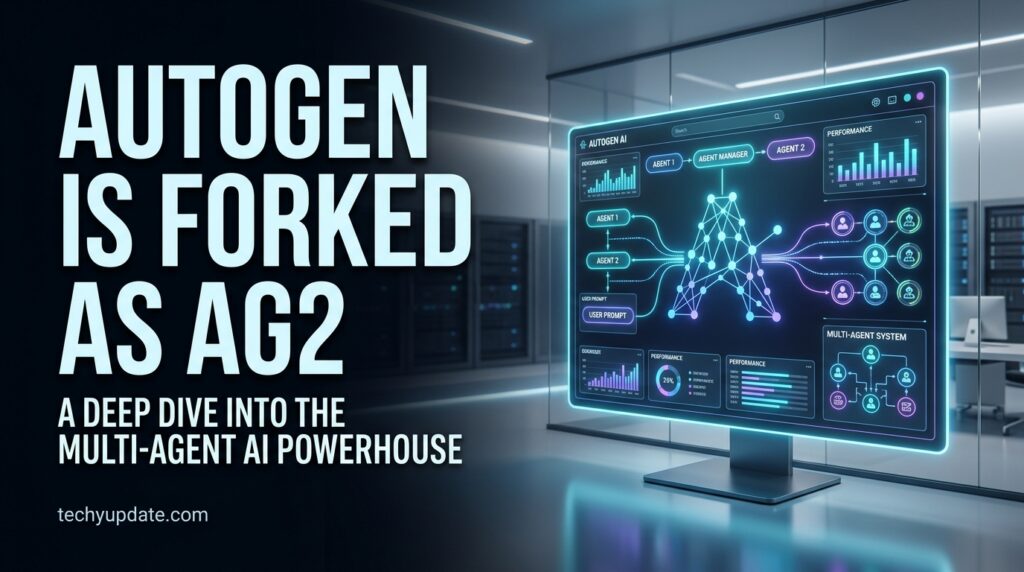
One of the most significant developments in the AutoGen ecosystem is the emergence of AG2, an actively maintained community fork.
As Microsoft’s engineering priorities shifted toward the Microsoft Agent Framework, the open-source community continued advancing AutoGen under the AG2 project.
AG2 preserves AutoGen’s original philosophy while introducing:
- Faster release cycles
- Community-driven improvements
- Modern dependency support
- Better documentation
- Expanded model compatibility
- Performance enhancements
- Bug fixes
- Additional developer tools
For developers starting new community-based projects, AG2 has become an increasingly attractive option because it evolves more rapidly than the original repository.
Why AG2 Matters
Open-source software thrives when communities actively contribute improvements.
AG2 demonstrates how successful projects can continue evolving even after the original maintainers reduce active feature development.
Many developers now view AG2 as the natural continuation of the AutoGen ecosystem for experimentation and research.
AutoGen Integrates with Model Context Protocol (MCP)
The Model Context Protocol (MCP) has become one of the most important standards in AI development in 2026.
Rather than creating custom integrations for every external tool, MCP defines a common protocol that allows AI applications to communicate with:
- Databases
- File systems
- APIs
- Enterprise software
- Productivity tools
- Search services
- Internal knowledge bases
For AutoGen developers, MCP dramatically simplifies tool connectivity.
Instead of repeatedly writing custom integrations, agents can access standardized MCP servers that expose tools through a consistent interface.
Benefits of MCP Integration
Organizations adopting MCP gain several advantages:
- Easier maintenance
- Better interoperability
- Vendor flexibility
- Reduced development effort
- Improved scalability
- Secure enterprise connectivity
As AI ecosystems mature, MCP is becoming an important building block for interoperable agent systems.
AutoGen Is Superseded by Microsoft Agent Framework
One of the biggest questions developers ask is whether AutoGen has been replaced.
The answer is yes, but with important context.
Microsoft has introduced the Microsoft Agent Framework (MAF) as the next evolution of enterprise AI agent development.
Rather than abandoning AutoGen’s ideas, Microsoft incorporated many of its strengths while adding enterprise-focused capabilities such as:
- Better orchestration
- Production-ready architecture
- Enterprise governance
- Enhanced observability
- Security improvements
- Improved deployment pipelines
- Native cloud integration
AutoGen remains available for learning and experimentation, while Microsoft Agent Framework is positioned for long-term enterprise development.
Microsoft Agent Framework Explained
Microsoft Agent Framework combines concepts from several Microsoft AI initiatives into a unified platform.
Instead of managing separate orchestration libraries, developers can build sophisticated AI applications using one integrated ecosystem.
Core components include:
- Agent orchestration
- Memory management
- Tool execution
- Workflow planning
- Human approvals
- Enterprise security
- Cloud deployment
- Monitoring
The framework is designed for organizations deploying production-grade AI systems at scale.
Why Microsoft Introduced Agent Framework
As enterprise AI adoption accelerated, organizations required:
- Better governance
- Compliance
- Security
- Reliability
- Lifecycle management
Microsoft Agent Framework addresses these requirements while preserving many concepts pioneered by AutoGen.
AI Agent Frameworks in 2026
The AI agent landscape has expanded rapidly.
Today, developers can choose from several mature frameworks depending on their project goals.
Popular frameworks include:
| Framework | Best For |
|---|---|
| AutoGen | Learning multi-agent collaboration |
| Microsoft Agent Framework | Enterprise production systems |
| CrewAI | Role-based autonomous teams |
| LangGraph | Stateful agent workflows |
| Semantic Kernel | Enterprise orchestration |
| AG2 | Community-driven AutoGen development |
Each framework offers unique strengths.
Choosing the right one depends on:
- Project size
- Team expertise
- Production requirements
- Budget
- Cloud platform
- AI model preferences
There is no universal winner; each framework serves different development scenarios.
Multi-Agent AI Systems
Traditional AI assistants process one prompt at a time.
Multi-agent systems take a different approach by assigning specialized responsibilities to multiple collaborating agents.
For example:
A software engineering workflow might include:
- Project Manager Agent
- Architect Agent
- Python Developer Agent
- Code Reviewer Agent
- Security Auditor Agent
- Documentation Writer
Each contributes expertise before producing a final result.
Benefits of Multi-Agent Systems
Organizations increasingly adopt this architecture because it offers:
- Better reasoning
- Reduced hallucinations
- Improved specialization
- Higher scalability
- Easier debugging
- Modular design
- More reliable automation
These advantages explain why nearly every major AI platform now supports some form of multi-agent collaboration.
Best AI Agent Framework in 2026
Selecting the best framework depends on your objectives.
Choose AutoGen if:
- You’re learning agent collaboration.
- You want open-source flexibility.
- You’re conducting research.
- You need rapid prototyping.
Choose Microsoft Agent Framework if:
- You’re building enterprise applications.
- Governance matters.
- You need a cloud deployment.
- Production reliability is critical.
Choose CrewAI if:
- You prefer role-based workflows.
- Fast setup is important.
- You want intuitive orchestration.
Choose LangGraph if:
- You require complex workflow graphs.
- State persistence matters.
- Your applications involve long-running processes.
No single framework dominates every scenario, making careful evaluation essential.
How to Install AutoGen AI (Python)
Installing AutoGen remains relatively straightforward for developers familiar with Python.
Basic Requirements
Before installation, ensure your environment includes:
- Python 3.10 or later
- pip package manager
- Virtual environment
- API keys for your preferred language model
Installation Steps
- Create a virtual environment.
- Activate the environment.
- Install AutoGen using pip.
- Configure model credentials.
- Test a simple agent conversation.
- Add optional tools for code execution and external integrations.
For larger projects, dependency management tools such as Poetry or Conda can improve reproducibility and simplify package updates.
AutoGen AI Python 3.10 Requirements
Python compatibility remains an important consideration.
Recommended environment:
- Python 3.10+
- Updated pip
- Virtual environment
- Modern package manager
- Supported LLM SDK
- Internet connectivity for API models
Developers should also isolate project dependencies to prevent version conflicts between AI libraries.
How AutoGen Works (Architecture Breakdown)
AutoGen’s architecture has two layers, and understanding this split explains a lot about why it feels different from competitors like CrewAI or LangGraph.
Core is the low-level layer of an event-driven messaging and orchestration engine. Think of it as the plumbing: agents register as actors, exchange typed messages, and the runtime handles delivery, ordering, and (in distributed setups) cross-process communication.
AgentChat sits on top of Core and is the high-level interface most developers actually touch. It exposes familiar building blocks like AssistantAgent (an LLM-backed agent that can call tools) and orchestration helpers for sequential or group conversations.
This two-layer design is why AutoGen’s learning curve sits in the middle of the pack, easier than LangGraph’s explicit graph model, but with more moving parts than CrewAI’s role-and-backstory abstraction. A useful mental model: CrewAI thinks in roles, LangGraph thinks in graphs and nodes, and AutoGen thinks in conversations between agents.
How to Install and Set Up AutoGen
Getting a first agent running takes about five minutes if you already have Python 3.10 or later installed.
Step 1 — Install the core packages:
pip install -U "autogen-agentchat" "autogen-ext[openai]"Step 2 — (Optional) Install AutoGen Studio for the no-code GUI:
pip install -U "autogenstudio"Step 3 — Set your model provider’s API key as an environment variable (OpenAI, Azure OpenAI, or other supported providers).
Step 4 — Create your first agent. A minimal working example looks roughly like this: instantiate a chat-completion client pointed at your model of choice, wrap it in anAssistantAgent, and call .run() with a task description. From there, you can layer in tools, multiple agents, and group conversations.
A practical tip: if you’re only prototyping and don’t yet need multi-agent conversation, install just the AgentChat package first. Add extensions (MCP workbenches, Docker code execution, memory backends) only once your single-agent version works reliably. Debugging a five-agent GroupChat is significantly harder than debugging one agent with a tool.
Real-World Use Cases and Examples
AutoGen’s conversation-first design makes it a particularly good fit for tasks that genuinely benefit from multiple “voices” weighing in:
- Code generation and review. A coding agent writes a function, a second “reviewer” agent critiques it, and a third agent executes it in a sandboxed container to confirm it works, making it an extremely natural fit for AutoGen’s conversational back-and-forth.
- Research synthesis. Multiple agents can independently investigate different angles of a question, then debate their findings before a final agent compiles a synthesized answer.
- Data science pipelines. AutoGen has documented production use in pharmaceutical and enterprise data-science environments, where teams extended it to meet strict data-compliance requirements while relying on its asynchronous, high-throughput event loop.
- Browser and tool automation. Combined with MCP workbenches (for example, a Playwright-based browser tool), an AutoGen agent can navigate websites, extract information, and report back, with no manual scripting required.
- Brainstorming and consensus tasks. Because GroupChat lets agents genuinely disagree and negotiate, AutoGen is a strong choice anywhere you want simulated “multiple perspectives,” such as red-teaming an idea or stress-testing a business plan.
- CLI-based automation. The related Magentic-One project offers a refined command-line tool for day-to-day automation tasks. Install it, point it at a task in plain English, and it handles the rest.
AutoGen continues to power numerous practical applications across industries.
Software Development
Teams automate:
- Code generation
- Bug fixing
- Testing
- Documentation
- Refactoring
Research
Researchers use AutoGen for:
- Literature reviews
- Paper summarization
- Knowledge extraction
- Data analysis
Enterprise Automation
Organizations automate:
- Customer support
- Internal workflows
- Knowledge management
- Report generation
- Decision support
Education
Students learn:
- Agent collaboration
- AI orchestration
- Prompt engineering
- Software architecture
Its versatility makes AutoGen valuable across academic, commercial, and research environments.
Productivity and Time Management
One of AutoGen’s greatest strengths is its ability to automate repetitive knowledge work.
Instead of manually completing every step, organizations can delegate tasks across specialized agents that work simultaneously.
Examples include:
- Drafting technical documentation
- Reviewing source code
- Summarizing lengthy reports
- Organizing research findings
- Generating meeting notes
- Automating customer responses
By reducing manual effort, teams can focus more on strategic decision-making and creative problem-solving, improving overall productivity.
AutoGen Pros and Cons
| Pros | Cons |
|---|---|
| Free and fully open source (MIT license) | Now in maintenance mode no major new features |
| Pioneered multi-agent conversation patterns still used industry-wide | Smaller community and slower momentum than LangGraph or CrewAI in 2026 |
| Strong built-in code execution and sandboxing | More token overhead per task than leaner alternatives |
| AutoGen Studio offers a genuine no-code option | Fewer large-scale production case studies than LangGraph |
| Flexible conversation-based design handles ambiguous, multi-perspective tasks well | Clear migration pressure toward Microsoft Agent Framework |
| Cross-language (.NET + Python) support | Distributed runtime support is still described as experimental |
| Direct, well-documented migration path to a supported successor | New projects are explicitly discouraged from starting here by Microsoft itself |
AutoGen vs Competitors
Comparison Table
| Framework | Best For | Learning Curve | Production Readiness | Cost Model |
|---|---|---|---|---|
| AutoGen | Conversational, multi-perspective agent tasks; existing codebases | Medium | Enterprise production systems need state, telemetry, and checkpointing | Free (self-hosted or Azure compute) |
| Microsoft Agent Framework | Enterprise production systems needing state, telemetry, checkpointing | Medium | High (GA, long-term support) | Free core SDK; consumption-based Azure hosting |
| CrewAI | Fast prototyping, role-based team workflows | Easiest | Solid for linear workflows | Free core; paid enterprise tier |
| LangGraph | Complex, stateful, production-critical workflows | Steepest | Most mature/battle-tested | Free core; paid LangSmith/LangGraph Cloud |
| AG2 | Teams that want the classic AutoGen v0.2 GroupChat API, actively maintained by the community | Medium | Community-dependent | Free, open source |
AutoGen vs CrewAI
Choosing between AutoGen and CrewAI depends largely on your project requirements, development experience, and deployment goals. Both frameworks support collaborative AI agents, but they approach orchestration differently.
AutoGen focuses on conversational interactions between autonomous agents. Each agent exchanges messages, evaluates responses, and collaborates dynamically to solve complex tasks. This architecture makes AutoGen highly flexible for research, experimentation, and sophisticated reasoning workflows.
CrewAI models multi-agent work as a “crew” of role-playing specialists, a researcher, a writer, and a reviewer, which tends to be the fastest path from zero to a working prototype. Independent benchmarking in 2026 found CrewAI carries meaningfully higher token overhead per task than graph-based alternatives, but its ease of use keeps it the go-to choice for teams that value speed over fine-grained control.
AutoGen’s conversational model is more flexible for open-ended deliberation, but CrewAI is quicker to stand up for linear, role-shaped workflows.
CrewAI, meanwhile, emphasizes role-based teamwork. Developers define clear responsibilities—such as Researcher, Writer, Reviewer, or Analyst and CrewAI coordinates their execution in a structured workflow. Its simplicity makes it attractive for startups and teams looking to automate business processes quickly.
Feature Comparison
| Feature | AutoGen | CrewAI |
|---|---|---|
| Multi-agent conversations | Excellent | Good |
| Learning curve | Moderate | Beginner-friendly |
| Flexibility | Very High | High |
| Enterprise readiness | Good | Good |
| Community growth | Strong | Rapidly growing |
| Workflow customization | Extensive | Moderate |
Which Should You Choose?
Choose AutoGen if you need:
- Advanced reasoning
- Research workflows
- Custom agent collaboration
- Complex software engineering automation
Choose CrewAI if you want:
- Faster deployment
- Simple business automation
- Easier onboarding
- Structured agent roles
For beginners, CrewAI often offers a smoother learning experience, while AutoGen provides greater flexibility for advanced developers.
AutoGen vs LangGraph
LangGraph represents agent workflows as an explicit state graph with nodes and edges, and it’s widely regarded in 2026 as the most production-hardened option of the three, powering agent systems at companies handling serious transaction volume.
In head-to-head benchmark testing on complex, multi-step tasks, LangGraph has shown a measurable completion-rate edge over both CrewAI and AutoGen, largely because its graph structure recovers more gracefully from failed steps. AutoGen still wins on raw conversational flexibility and built-in code execution; LangGraph wins on reliability at scale.
LangGraph has become one of AutoGen’s strongest competitors in 2026.
Unlike AutoGen’s conversation-first architecture, LangGraph organizes AI workflows as stateful graphs. Each node represents a task, while edges define transitions between workflow stages.
This design is particularly useful for applications requiring persistent memory and long-running processes.
AutoGen Advantages
- Natural agent conversations
- Collaborative reasoning
- Flexible orchestration
- Strong research ecosystem
LangGraph Advantages
- Stateful execution
- Durable workflows
- Better recovery mechanisms
- Enterprise-scale orchestration
Which Framework Wins?
There is no universal winner.
If your application resembles collaborative human discussions, AutoGen is an excellent fit.
If you’re building enterprise automation requiring persistent workflow state and recoverability, LangGraph may be the stronger option.
AutoGen vs Semantic Kernel
Semantic Kernel takes a different approach to AI orchestration.
Rather than focusing primarily on agent conversations, Semantic Kernel emphasizes integrating AI capabilities into existing enterprise software.
Organizations using Microsoft technologies often appreciate Semantic Kernel’s seamless integration with cloud services and business applications.
AutoGen Strengths
- Multi-agent collaboration
- Open-source flexibility
- AI experimentation
- Academic research
Semantic Kernel Strengths
- Enterprise integration
- Memory management
- Plugin architecture
- Microsoft ecosystem support
Best Choice
Select AutoGen when your primary objective is autonomous agent collaboration.
Choosing Semantic Kernel when integrating AI into existing enterprise systems is your highest priority.
Many organizations now combine concepts from both frameworks depending on specific project requirements.
AutoGen vs Microsoft Agent Framework
Microsoft Agent Framework is, in the company’s own words, the direct successor built by the same teams behind both AutoGen and Semantic Kernel.
If you’re comparing feature-for-feature, MAF keeps AutoGen’s simple single- and multi-agent abstractions but adds session-based state management, type safety, middleware, telemetry, and, critically, explicit graph-based workflows instead of implicit GroupChat management. For any new production build, MAF is the safer long-term bet.
Microsoft Agent Framework represents Microsoft’s next-generation platform for enterprise AI agents.
Rather than replacing AutoGen entirely, it builds upon many concepts pioneered by AutoGen while introducing:
- Enterprise governance
- Security controls
- Monitoring
- Cloud-native deployment
- Advanced orchestration
- Lifecycle management
Comparison
| Category | AutoGen | Microsoft Agent Framework |
|---|---|---|
| Research | Excellent | Good |
| Enterprise | Good | Excellent |
| Production deployments | Good | Excellent |
| Learning resources | Excellent | Growing |
| Governance | Basic | Advanced |
| Cloud integration | Moderate | Extensive |
Should You Migrate?
If you’re maintaining existing AutoGen projects, migration may not be immediately necessary.
However, organizations planning large-scale production deployments should evaluate Microsoft Agent Framework because it offers stronger enterprise capabilities and aligns with Microsoft’s long-term AI strategy.
AutoGen vs AG2
AG2 (formerly a rebrand effort around Q3 2025) preserves the backward-compatible, “classic” GroupChat-style API from AutoGen v0.2.
If your team has existing AutoGen v0.2 code you’re not ready to rewrite, and you want continued community-driven improvements rather than Microsoft’s official maintenance-only stance, AG2 is the more actively evolving option, though it comes with the usual trade-offs of relying on a community fork rather than a vendor-backed release.
AG2 emerged as an actively maintained community fork of AutoGen.
While the original project shifted to maintenance mode, AG2 continues to introduce new features and improvements.
AG2 Advantages
- Faster community releases
- Active maintenance
- Expanded model support
- Better compatibility
- Modern dependency updates
AutoGen Advantages
- Mature documentation
- Large research community
- Proven architecture
- Extensive educational resources
Developers beginning new community-driven projects often consider AG2 because of its active development pace, while existing AutoGen users may prefer staying with familiar tooling.
AutoGen AI Pricing and Licensing Explained
One of AutoGen’s biggest advantages is its licensing model.
The framework itself is open source, meaning developers can download, modify, and extend it without paying licensing fees.
However, using AutoGen in real-world projects typically involves additional costs associated with AI model providers.
Potential expenses include:
- Language model API usage
- Cloud infrastructure
- Vector databases
- Enterprise hosting
- Monitoring services
- Storage
- Security tools
Is AutoGen Free?
Yes.
The framework is free to use under its open-source license.
Your operational costs depend primarily on:
- AI provider
- Usage volume
- Infrastructure
- Deployment architecture
Small educational projects may cost very little, while enterprise deployments can require significant cloud resources.
AutogenAI: Proposal, Bid, and Grant Writing Platform
It is important to distinguish Microsoft’s AutoGen framework from AutogenAI, the commercial platform specializing in proposal automation.
AutogenAI helps organizations create winning:
- Government bids
- Public sector tenders
- Commercial proposals
- Grant applications
- RFP responses
- Funding requests
Instead of starting every proposal from scratch, teams can leverage AI-assisted drafting, centralized knowledge management, and collaborative editing to produce high-quality submissions much faster.
Product Overview
AutogenAI combines generative AI with organizational knowledge to assist proposal teams throughout the entire bidding lifecycle.
Its workflow includes:
- Opportunity qualification
- Research
- Content generation
- Review
- Collaboration
- Submission management
This significantly reduces manual effort while improving consistency across large proposal teams.
AutogenAI Qualify and Extract
One of AutogenAI’s standout capabilities is its qualification and extraction engine.
Before investing time in preparing a proposal, organizations need to determine whether an opportunity aligns with their strengths.
The platform analyzes tender documents to identify:
- Eligibility requirements
- Evaluation criteria
- Deadlines
- Mandatory documentation
- Compliance obligations
- Key risks
This helps proposal teams prioritize opportunities with the highest probability of success.
Automated extraction also minimizes the chance of overlooking critical submission requirements.
AutogenAI Manage
Managing dozens or even hundreds of active proposals can quickly become overwhelming.
AutogenAI provides centralized management features that help organizations:
- Organize proposal pipelines
- Assign responsibilities
- Track deadlines
- Monitor progress
- Maintain version control
- Coordinate reviewers
For large enterprises handling multiple bids simultaneously, these capabilities improve collaboration while reducing administrative overhead.
AutogenAI Write
The writing engine is the platform’s core capability.
Instead of producing generic AI-generated content, AutogenAI leverages organizational knowledge, previous proposals, and project-specific information to generate tailored first drafts.
Writers remain in control throughout the editing process while AI accelerates:
- Executive summaries
- Technical responses
- Methodologies
- Project plans
- Compliance statements
- Supporting documentation
This allows proposal professionals to focus on strategy rather than repetitive drafting.
AutogenAI Product Research and Review
Research often consumes a significant portion of proposal preparation.
AutogenAI streamlines this process by organizing internal knowledge alongside publicly available information, enabling faster evidence gathering and content creation.
Key Benefits
- Improved consistency
- Faster drafting
- Better collaboration
- Reduced repetitive work
- Centralized knowledge
- AI-assisted recommendations
Based on our evaluation, AutogenAI is particularly valuable for organizations that submit frequent bids, where efficiency, compliance, and content reuse directly impact success rates.
AutogenAI Integrations
Modern organizations rely on a wide range of productivity tools, and AutogenAI supports integration with existing workflows.
Depending on deployment requirements, organizations can connect the platform with:
- Document repositories
- CRM systems
- Knowledge bases
- Collaboration platforms
- Cloud storage
- Internal databases
These integrations reduce manual data copying and help maintain a single source of truth across proposal teams.
AutogenAI for Enterprise, SMEs, and Grant Writing
AutogenAI is designed to support organizations of different sizes.
Enterprise
Large organizations benefit from:
- Team collaboration
- Governance controls
- Centralized content libraries
- Advanced permissions
- Workflow management
Small and Medium-Sized Enterprises (SMEs)
SMEs can use the platform to:
- Produce professional proposals faster
- Reduce writing costs
- Improve consistency
- Compete for larger contracts
Grant Writing
For universities, charities, and nonprofit organizations, AutogenAI assists with:
- Funding applications
- Research grants
- Compliance documentation
- Proposal drafting
- Collaborative editing
Its structured workflows help organizations improve efficiency while maintaining high-quality submissions.
AutoGen Pricing and Licensing
AutoGen itself is entirely free and open source under the MIT license. There’s no subscription tier, no seat-based pricing, and no paywalled “pro” version. Your actual costs come from two places:
- Infrastructure. If you self-host, you pay for whatever compute you run it on.
- LLM API usage. AutoGen doesn’t include model access; you bring your own OpenAI, Azure OpenAI, or other supported provider key, and you’re billed per that provider’s standard token rates.
If you deploy through Azure AI Foundry (increasingly the recommended path for anything built on the newer Microsoft Agent Framework), hosted agents bill on a consumption basis with a “scale to zero” model, you pay nothing while an agent sits idle, and billing resumes only when a request comes in. That pricing structure began during a preview phase in April 2026.
The practical takeaway: AutoGen is genuinely one of the least expensive ways to experiment with multi-agent systems, provided you’re comfortable managing your own infrastructure and accept that you’re building on a framework Microsoft is no longer actively expanding.
Who Should (and Shouldn’t) Use AutoGen in 2026
AutoGen is still a reasonable choice if:
- You already have a working AutoGen codebase, and migrating isn’t worth the effort yet.
- You specifically want AutoGen Studio’s no-code interface for quick internal prototypes.
- Your use case is genuinely conversational brainstorming, debate, and multi-perspective review, where AutoGen’s design is a natural fit.
- You’re doing academic or research work where cutting-edge experimentation matters more than long-term support guarantees.
Look elsewhere if:
- You’re starting a brand-new production system, and Microsoft itself points new users toward the Agent Framework.
- You need enterprise features like built-in checkpointing across millions of steps, strong observability, or long-term support commitments.
- Your workflow is naturally role-based, and linear CrewAI will likely get you there faster.
- Your workflow demands complex branching, retries, and human-approval checkpoints. LangGraph is the more battle-tested choice.
Expert Insights on AI Learning Trends
The AI landscape has changed dramatically over the past two years. Early AI applications focused on single-chatbot interactions, but today’s leading innovations center on autonomous agent collaboration.
Industry experts increasingly believe that future AI systems will consist of teams of specialized agents rather than one general-purpose assistant. These agents will coordinate tasks such as planning, coding, reviewing, testing, researching, and decision-making.
Several important trends are shaping AI development in 2026:
Multi-Agent Collaboration Is Becoming the Standard
Organizations are moving beyond isolated chatbots toward intelligent systems where multiple AI agents work together to solve complex business problems. This collaborative model improves accuracy, transparency, and scalability.
Standardized Tool Integration
Protocols like the Model Context Protocol (MCP) are simplifying how AI agents interact with external systems. Instead of building custom integrations for every application, developers can rely on standardized interfaces that reduce complexity and improve interoperability.
Enterprise Governance Matters More Than Ever
As AI becomes central to business operations, organizations are prioritizing security, compliance, monitoring, and auditability. This shift explains why enterprise-focused platforms such as Microsoft Agent Framework continue gaining traction.
Open Source Continues to Drive Innovation
Community-led projects like AG2 demonstrate that open-source ecosystems remain vital. They encourage experimentation, rapid improvements, and shared knowledge, benefiting developers worldwide.
Human Oversight Remains Essential
Despite advances in automation, AI systems still require human judgment for critical decisions. The most successful implementations combine AI efficiency with expert review rather than replacing human expertise entirely.
Common Mistakes Users Make
Whether you’re new to AutoGen or an experienced developer, avoiding common mistakes can save significant time and improve project outcomes.
Choosing the Wrong Framework
Many users adopt AutoGen without considering whether another framework better suits their requirements. Before starting a project, evaluate factors such as scalability, maintenance, cloud deployment, and enterprise governance.
Skipping Agent Planning
Effective multi-agent systems begin with well-defined responsibilities. Assigning vague or overlapping roles often results in inefficient conversations and inconsistent outputs.
Instead, clearly define each agent’s purpose, such as:
- Planner
- Researcher
- Developer
- Tester
- Reviewer
Specialized agents typically perform better than generic assistants.
Ignoring Cost Management
While AutoGen is free, language model API usage can increase quickly. Monitor token consumption, optimize prompts, and select appropriate models to keep operational costs under control.
Over-Automating Sensitive Tasks
AI agents can automate repetitive work, but they should not make important legal, financial, or compliance decisions without human oversight. Always include review processes for high-impact workflows.
Neglecting Security
Developers sometimes expose API keys, grant excessive permissions, or connect agents directly to sensitive production systems. Implement proper authentication, access controls, and secret management practices to protect organizational data.
Pro Tips to Maximize AutoGen
The following recommendations can help you build more reliable, efficient, and scalable AI agent systems.
Start Small
Rather than creating a complex network of agents immediately, begin with two or three specialized agents. Once the workflow is stable, gradually expand functionality.
Design Clear Agent Roles
Each agent should have a specific objective. Well-defined responsibilities reduce confusion and improve collaboration.
Example roles include:
- Research Agent
- Planning Agent
- Coding Agent
- Testing Agent
- Documentation Agent
Use Human-in-the-Loop Workflows
For important business processes, require human approval before executing critical actions. This improves reliability while reducing the risk of incorrect decisions.
Monitor Performance
Track metrics such as:
- Task completion rate
- Response quality
- API costs
- Latency
- Error frequency
Regular monitoring helps identify optimization opportunities and ensures your AI workflows remain efficient over time.
Keep Dependencies Updated
AI ecosystems evolve rapidly. Regularly update Python packages, language model SDKs, and supporting libraries to maintain compatibility, improve performance, and address security issues.
Experiment with Multiple Models
AutoGen supports different language models. Testing several providers can help you find the best balance between quality, speed, and cost for your specific use case.
Our Verdict and Rating
AutoGen earns real credit for being the framework that popularized multi-agent conversation as a design pattern ideas that now show up, in one form or another, across nearly every serious agent framework on the market, including its own successor. In 2026, though, it’s honestly best understood as a historically important, technically capable framework that has passed the torch rather than a forward-looking platform to build a new company on.
TechyUpdate Rating: 7.2 / 10
- Features & flexibility: 8.5/10
- Ease of use: 7/10
- Production readiness: 6/10
- Community & momentum: 6.5/10
- Value for money: 9/10 (it’s free)
If you need one sentence: AutoGen is still worth learning for the concepts it teaches you about multi-agent design, but new production projects in 2026 belong on Microsoft Agent Framework.
Final Verdict: Is AutoGen AI Worth Using in 2026?
AutoGen continues to be one of the most influential frameworks in the evolution of collaborative AI systems. Although Microsoft has shifted its long-term enterprise strategy toward the Microsoft Agent Framework, AutoGen remains highly relevant for developers who want to understand multi-agent architectures, prototype intelligent workflows, or conduct AI research.
For students, educators, researchers, and independent developers, AutoGen offers an accessible, well-documented environment for exploring autonomous AI agents without licensing costs. Its flexible design, strong community support, and extensive educational resources make it an excellent learning platform.
For enterprises, however, the decision depends on long-term goals. If your organization requires advanced governance, security, compliance, and production-grade deployment capabilities, Microsoft’s Agent Framework or other enterprise-focused platforms may be a better strategic investment.
Overall, AutoGen earns a strong recommendation as a learning and prototyping framework in 2026, while organizations planning mission-critical AI deployments should carefully evaluate newer frameworks that offer enhanced enterprise capabilities.
Overall Rating (2026): 4.6/5
| Category | Rating |
|---|---|
| Ease of Learning | ⭐⭐⭐⭐☆ (4.5/5) |
| Features | ⭐⭐⭐⭐⭐ (5/5) |
| Flexibility | ⭐⭐⭐⭐⭐ (5/5) |
| Documentation | ⭐⭐⭐⭐⭐ (5/5) |
| Enterprise Readiness | ⭐⭐⭐⭐☆ (4/5) |
| Community Support | ⭐⭐⭐⭐☆ (4.5/5) |
| Overall Score | ⭐⭐⭐⭐⭐ (4.6/5) |
FEATURED
Definition Snippet
AutoGen is an open-source multi-agent AI framework, originally developed by Microsoft Research, that lets multiple AI agents communicate and collaborate to complete tasks autonomously or alongside a human.
List Snippet — Key AutoGen Features
- Conversable, message-passing agents
- GroupChat multi-agent orchestration
- AutoGen Studio no-code GUI
- Built-in sandboxed code execution
- MCP (Model Context Protocol) tool support
- Cross-language (.NET + Python) interoperability
Table Snippet — AutoGen at a Glance
| Attribute | Detail |
|---|---|
| Developer | Microsoft Research |
| License | MIT (open source) |
| Language | Python (primary), .NET (supported) |
| Status in 2026 | Maintenance mode |
| Official successor | Microsoft Agent Framework |
| Cost | Free |
Comparison Snippet
AutoGen focuses on conversational multi-agent collaboration; CrewAI focuses on role-based team delegation; LangGraph focuses on explicit, graph-based state control; Microsoft Agent Framework combines AutoGen’s orchestration with Semantic Kernel’s enterprise features.
How-To Snippet: Install AutoGen in 3 Steps
- Run
pip install -U "autogen-agentchat" "autogen-ext[openai]". - Export your model provider API key as an environment variable.
- Create an attachment
AssistantAgent, attach a model client, and call.run()with your task.
Quick Summary
If you only remember a few points from this review, these are the most important takeaways:
- AutoGen pioneered the modern multi-agent AI framework ecosystem.
- It enables multiple AI agents to collaborate through structured conversations.
- Microsoft created AutoGen as an open-source research framework.
- Microsoft Agent Framework is now Microsoft’s recommended platform for enterprise AI development.
- AG2 continues advancing the AutoGen ecosystem through active community development.
- AutoGen Studio provides a visual environment for designing and testing AI agent workflows.
- Model Context Protocol (MCP) is becoming the preferred standard for connecting AI agents with external tools and services.
- AutoGen remains an excellent choice for learning, research, prototyping, and educational projects.
- Organizations building large-scale production systems should also evaluate Microsoft Agent Framework, LangGraph, CrewAI, and Semantic Kernel based on their specific requirements.
FREQUENTLY ASKED QUESTIONS
What is AutoGen AI?
AutoGen is an open-source framework from Microsoft Research for building multi-agent AI systems. It lets multiple AI agents communicate, delegate tasks, and collaborate to complete complex jobs autonomously or with human input.
Is AutoGen still maintained in 2026?
Yes, but only in maintenance mode. AutoGen receives bug fixes and security patches, while Microsoft has shifted active feature development to its official successor, Microsoft Agent Framework.
What replaced AutoGen?
Microsoft Agent Framework replaced AutoGen as Microsoft’s primary agent platform. It merges AutoGen’s orchestration patterns with Semantic Kernel’s enterprise-grade state management and telemetry.
What is the best free multi-agent AI framework?
The answer depends on your project goals. AutoGen is one of the best choices for learning collaborative AI systems and research, while AG2 continues active community development. Other strong frameworks, such as CrewAI and LangGraph, may be more suitable for business automation or stateful workflow orchestration.
Is AutoGen free to use?
Yes. AutoGen is fully open source under the MIT license. You only pay for the infrastructure you self-host and for LLM API usage from your chosen model provider.
Is AutoGen AI still supported in 2026?
Yes. AutoGen remains available and supported for existing users, educational projects, and research. However, Microsoft has shifted its primary enterprise focus to the Microsoft Agent Framework, while the open-source community continues enhancing AutoGen through the AG2 project.
What is AutoGen Studio?
AutoGen Studio is a no-code, browser-based interface that lets you build, test, and run multi-agent workflows visually, without writing Python code directly.
What is AG2?
AG2 is a community-led fork of AutoGen that preserves the classic v0.2 GroupChat-style API, offering continued active development for teams not ready to migrate to newer patterns.
Is AutoGen good for beginners?
Somewhat. Its conversational design is intuitive for small projects, but multi-agent debugging becomes complex quickly, so absolute beginners may find CrewAI’s role-based model easier to start with.
What is the difference between AutoGen and CrewAI?
AutoGen models collaboration as agent conversations, while CrewAI models it as role-based teams with backstories and goals. CrewAI is generally faster to prototype with; AutoGen is more flexible for open-ended tasks.
Can AutoGen AI run code automatically?
Yes. AutoGen can generate and execute code in controlled environments when properly configured. This capability allows agents to test programs, automate workflows, analyze data, and verify outputs. Human supervision is still recommended for production or security-sensitive applications.
What is the difference between AutoGen and LangGraph?
LangGraph uses explicit state graphs with nodes and edges, giving stronger production reliability and error recovery. AutoGen uses conversation-driven orchestration, which is more natural for deliberative, multi-perspective tasks.
What replaced AutoGen?
Microsoft Agent Framework is considered the long-term successor for enterprise AI agent development. It builds on many concepts introduced by AutoGen while adding governance, security, cloud deployment, monitoring, and enterprise lifecycle management capabilities.
Does AutoGen support Claude, Gemini, or other non-OpenAI models?
Yes. Beyond its native OpenAI client, AutoGen supports extensions and community model clients for other providers, and its AssistantAgent architecture is model-agnostic by design.
Does AutoGen support MCP servers?
Yes. AutoGen agents can connect to Model Context Protocol servers as tools, enabling capabilities like browser automation, file access, and external service integration.
Is AutoGen production-ready?
It’s improving, but generally considered less production-hardened than LangGraph. Microsoft itself now recommends Agent Framework for new production deployments requiring stability guarantees.
Is AutoGen good for beginners?
AutoGen is suitable for beginners who have basic Python knowledge and an interest in AI development. Although there is a learning curve, the extensive documentation, community tutorials, and open-source examples make it an excellent platform for learning multi-agent AI concepts.
Should I migrate my AutoGen project to Microsoft Agent Framework?
If you’re building new features or need enterprise-grade state management, yes. Microsoft provides an official migration guide, and most AutoGen orchestration patterns transfer directly.
How many GitHub stars does AutoGen have?
AutoGen has attracted more than 40,000 GitHub stars, reflecting its early influence on multi-agent AI development, even as active feature work has moved to its successor framework.
CONCLUSION
AutoGen has played a defining role in the evolution of multi-agent artificial intelligence, introducing a flexible framework where specialized AI agents collaborate to solve complex tasks. Although Microsoft’s strategic direction now centers on the Microsoft Agent Framework for enterprise deployments, AutoGen continues to provide immense value for developers, educators, researchers, and students seeking to understand modern AI orchestration.
For organizations, the best framework depends on long-term objectives. Teams focused on experimentation, rapid prototyping, and academic research will continue to benefit from AutoGen’s open-source ecosystem. Businesses requiring production-grade governance, security, and scalability should carefully evaluate newer enterprise platforms while leveraging the lessons pioneered by AutoGen.
As the AI landscape evolves, concepts such as multi-agent collaboration, standardized tool integration through the Model Context Protocol, and human-in-the-loop workflows will continue to shape the next generation of intelligent software. Whether you choose AutoGen, AG2, Microsoft Agent Framework, CrewAI, or LangGraph, understanding these foundational principles will help you build more reliable, scalable, and effective AI solutions in 2026 and beyond.
AutoGen deserves its reputation as one of the frameworks that taught the AI industry how to think about multi-agent collaboration. It’s free and flexible, and its conversation-first design still handles certain tasks, such as brainstorming, code review, and consensus-building, more naturally than role-based or graph-based alternatives.
But 2026 is a transition year, not a growth year, for AutoGen specifically. Microsoft has been direct about it: new projects should start on Microsoft Agent Framework, which inherits AutoGen’s core ideas while adding the enterprise features production teams actually need. If you’re already invested in AutoGen, there’s no urgent reason to panic.
The stable line still works, and AG2 offers a community-driven path if you want continued innovation on the classic API. If you’re starting fresh, treat this review as your signal to build your first multi-agent prototype in AutoGen to learn the concepts, then plan your production build on Agent Framework, CrewAI, or LangGraph, depending on your workflow shape.