

The Best AI Writing Tools Review 2026 (Free vs Paid Comparison) is essential for anyone looking to improve content creation in today’s digital world. AI writing tools have transformed how students, bloggers, marketers, and professionals write content.
In 2026, these tools aren’t just about grammar correction they help generate ideas, create full articles, and even optimize content for search engines. Whether you’re writing essays, blog posts, or marketing copy, AI tools can save time and boost productivity.
AI Writing Tools in 2026 mark a significant turning point in how people create content. Whether you’re a student, blogger, or business professional, AI writing tools have become an essential part of daily productivity.
In 2026, these tools are no longer just optional, they’re becoming a necessity. From drafting emails to writing full-length articles, AI is helping users save time, improve quality, and work smarter. And honestly, once you start using them, it’s hard to go back.
What Are AI Writing Tools?
In 2026, AI writing tools represent advanced software systems powered by large language models (LLMs), natural language processing (NLP), and machine learning algorithms that can generate, refine, and optimize written content with human-like fluency.
We define AI writing tools as intelligent platforms that transform simple user inputs—such as prompts, keywords, or short instructions—into structured, meaningful, and context-aware text. These systems are no longer limited to basic sentence generation. Instead, they function as full-scale content assistants, supporting ideation, drafting, editing, summarization, and SEO optimization.
Modern AI writing tools can:
- Generate long-form articles, blogs, and reports
- Create marketing copy, emails, and social media content
- Improve grammar, tone, and readability in real time
- Optimize content for search engines and audience engagement
- Adapt writing style based on industry, intent, and platform
We now operate in an environment where AI writing tools act as collaborative partners, enabling faster, smarter, and more efficient communication across industries.
Evolution of AI Writing Technology (2020–2026)
The evolution of AI writing technology between 2020 and 2026 has been rapid, transformative, and foundational to modern digital communication. What began as experimental text generation has now matured into highly intelligent, context-aware writing systems.
2020: The Foundation Era
In 2020, the release of early large language models marked a breakthrough in AI capabilities. These systems demonstrated the ability to generate coherent paragraphs, but still struggled with long-term consistency and factual reliability. However, they introduced the concept of AI-assisted writing at scale.
2021–2022: Mainstream Adoption
During this period, AI writing tools became widely accessible. Businesses began integrating them into workflows for content marketing, customer communication, and automation. The launch of conversational AI platforms accelerated global adoption, making AI writing a mainstream productivity tool.
2023: Multimodal Intelligence
AI systems evolved beyond text-only capabilities. They began processing images, structured data, and complex prompts, allowing for more advanced content generation. Writing tools became more accurate, context-aware, and versatile.
2024: Industry Integration
AI writing tools were embedded directly into productivity software, content management systems, and enterprise platforms. This integration allowed seamless content creation within existing workflows, reducing friction and increasing efficiency.
2025: Agentic AI Systems
A major shift occurred as AI transitioned to agent-based systems capable of autonomously executing multi-step tasks. Writing tools began planning content strategies, generating outlines, and optimizing entire campaigns with minimal human input.
2026: Intelligent Content Ecosystems
In 2026, AI writing tools will have evolved into fully intelligent ecosystems. They not only generate content but also analyze performance, predict audience engagement, and adapt writing styles dynamically. We now see AI as a strategic content partner rather than a simple writing assistant.
This evolution highlights a clear trajectory: from basic text generation to autonomous, adaptive, and intelligent content creation systems.
Why AI Writing Tools Matter Today
In today’s digital economy, content is the foundation of visibility, branding, and communication. AI writing tools matter because they directly address the most pressing challenges individuals and organizations face: speed, scalability, quality, and personalization.
1. Speed and Efficiency
We live in a fast-paced environment where content must be produced quickly to stay relevant. AI writing tools allow us to generate high-quality content in minutes rather than hours or days, significantly improving productivity.
2. Scalability of Content Production
Businesses are expected to maintain a constant flow of content across multiple platforms. AI tools enable us to scale production without proportionally increasing resources, making large-scale content strategies feasible.
3. Improved Quality and Consistency
AI systems ensure that content remains grammatically correct, well-structured, and stylistically consistent. This reduces human error and maintains a unified brand voice across all communication channels.
4. SEO and Digital Visibility
Search engine optimization is critical for online success. AI writing tools help us identify relevant keywords, structure content effectively, and improve readability, resulting in better search rankings and increased organic traffic.
5. Cost Optimization
By automating repetitive writing tasks, AI reduces the need for large content teams, lowering operational costs while maintaining high output levels.
6. Enhanced Creativity
Rather than replacing creativity, AI enhances it. We use these tools to generate ideas, explore different angles, and overcome creative blocks, allowing us to focus on strategic storytelling.
7. Personalization at Scale
Modern audiences expect tailored content. AI enables us to create personalized messages for different user segments, improving engagement and conversion rates.
In essence, AI writing tools matter today because they bridge the gap between demand and capability in modern content creation.
Who Should Use AI Writing Tools?
AI writing tools are designed for a broad audience, spanning individuals, professionals, and enterprises. In 2026, their use is no longer optional for many—it is a strategic necessity.
1. Content Creators and Bloggers
We use AI tools to generate ideas, write articles, and maintain consistent publishing schedules. This helps creators focus on audience engagement and brand growth rather than repetitive writing tasks.
2. Digital Marketers and SEO Experts
Marketers rely on AI for keyword optimization, ad copy creation, email campaigns, and landing page content. These tools significantly improve campaign efficiency and performance.
3. Business Owners and Entrepreneurs
For businesses, AI writing tools simplify communication, enabling the creation of website content, proposals, product descriptions, and marketing materials without extensive resources.
4. Students and Researchers
AI assists in structuring essays, summarizing information, and improving grammar. It acts as a learning support system that enhances academic productivity.
5. Freelancers and Copywriters
Freelancers use AI to efficiently manage multiple clients, generate content variations quickly, and meet tight deadlines without compromising quality.
6. E-commerce Professionals
Online sellers rely on AI to create product descriptions, promotional content, and SEO-friendly listings, thereby improving visibility and sales.
7. Corporate Teams and Professionals
In corporate environments, AI tools streamline the creation of reports, emails, presentations, and internal documentation, improving workplace efficiency.
8. Social Media Managers
We use AI to generate captions, hashtags, and post ideas, ensuring consistent engagement across platforms.
9. Non-Native English Speakers
AI writing tools help individuals improve grammar, clarity, and fluency, enabling effective global communication.
10. Startups and Growing Companies
Startups benefit from AI by rapidly producing branding materials, marketing content, and business documentation, allowing them to scale faster with limited resources.
Understanding How AI Writing Tools Work
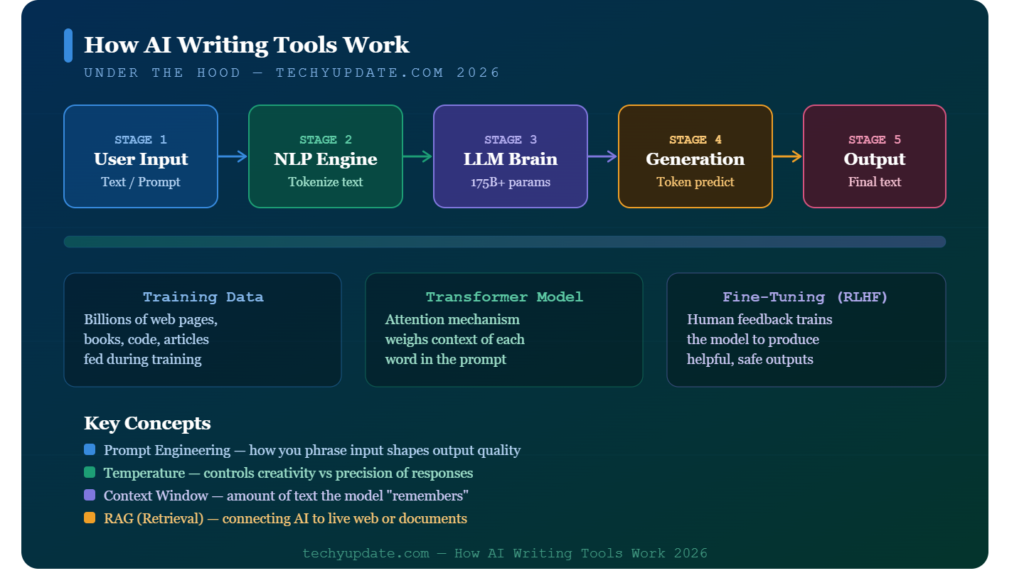
AI writing tools may feel magical on the surface, but under the hood, they rely on structured technologies that allow machines to understand and generate human-like language. To truly use these tools effectively, it helps to know what is happening behind the scenes. This section breaks down the core mechanics in a simple, practical way.
Basics of Natural Language Processing (NLP)
Natural Language Processing (NLP) is the foundation of all AI writing tools. It is the branch of artificial intelligence that teaches computers how to understand, interpret, and respond to human language.
How NLP Works in Simple Terms
NLP breaks language into smaller parts so machines can analyze it. This includes:
- Words and sentences
- Grammar structure
- Context and meaning
- The intent behind the message
For example, when you type “Write a blog about healthy eating”, NLP helps the system understand:
- “Write” = action
- “blog” = content type
- “healthy eating” = topic
Why NLP Matters
Without NLP, AI would only see text as random symbols. Instead, it can:
- Understand meaning
- Detect tone (formal, casual, emotional)
- Respond in a human-like way
In simple words, NLP is what allows AI to “read” and “understand” you.
Machine Learning and Content Generation
Machine Learning (ML) is the engine that powers content creation in AI writing tools. It allows systems to learn patterns from massive datasets and improve over time.
How Machine Learning Works
AI writing tools are trained on billions of words from:
- Books
- Articles
- Websites
- Conversations
By studying this data, the system learns:
- Sentence structures
- Writing styles
- Common phrases
- Contextual meaning
Content Generation Process
When you give a prompt, the AI:
- Analyzes your input
- Predicts the next most likely words
- Builds sentences step-by-step
- Forms a complete response
Why It Feels Human
Because it is not copying text, it is predicting language patterns based on training.
It does not “think” like humans. It simply calculates the probabilities of the words that fit together best.
Role of Large Language Models (LLMs)
Large Language Models (LLMs) are the core systems behind modern AI writing tools such as ChatGPT.
What Are LLMs?
LLMs are deep learning models trained on enormous amounts of text data. They are designed to:
- Understand context across long conversations
- Generate coherent and structured text
- Handle multiple writing tasks
Key Features of LLMs
- Context awareness: remembers what you said earlier
- Multi-task ability: can write, summarize, explain, and more
- Language flexibility: supports multiple writing styles
Why LLMs Are Important in 2026
In 2026, LLMs have become:
- More accurate
- Faster in response
- Better at understanding intent
Simply put, LLMs are the “brain” behind AI writing tools.
Limitations of AI Writing Technology
Even though AI writing tools are powerful, they are not perfect. Understanding their limitations is important for responsible use.
1. Lack of True Understanding
AI does not actually “understand” meaning. It predicts text based on patterns, which can sometimes lead to:
- Incorrect facts
- Misinterpretations
- Shallow explanations
2. Dependence on Training Data
AI tools rely on existing data. If the data is outdated or biased, the output may also reflect those issues.
3. Creativity Limitations
While AI can generate ideas, it may struggle with:
- Deep emotional storytelling
- Highly original concepts
- Cultural sensitivity
4. Context Errors
Sometimes AI may:
- Misunderstand complex prompts
- Miss subtle instructions
- Provide irrelevant answers
5. No Real-Time Awareness
Most AI writing tools do not “know” current events unless updated with external data sources.
Free vs Paid AI Writing Tools: Core Differences
Definition of Free AI Writing Tools
Free AI writing tools are platforms that allow users to generate or improve written content at no cost. These tools are typically designed to provide basic-level functionality, making them accessible to beginners, students, and casual users.
We define free AI writing tools as systems that offer limited but functional AI-powered writing capabilities, often with restrictions such as usage caps, fewer features, or fewer options for output quality.
Key Characteristics of Free AI Writing Tools:
- No subscription or payment required
- Limited number of daily or monthly generations
- Basic grammar correction and text generation features
- Restricted access to advanced models or premium templates
- Often supported by ads or upselling prompts
Free tools are ideal for light use, experimentation, and learning, but they may not fully support professional or large-scale content needs.
Definition of Paid AI Writing Tools
Paid AI writing tools are subscription-based platforms that provide advanced, high-performance writing capabilities in exchange for a fee. These tools are designed for professionals, businesses, and serious content creators who require consistency, scalability, and premium-quality output.
We define paid AI writing tools as feature-rich AI systems that unlock full access to advanced language models, customization options, and enterprise-level functionality.
Key Characteristics of Paid AI Writing Tools:
- Full access to advanced AI models
- Higher or unlimited content generation capacity
- Enhanced writing quality and contextual accuracy
- Priority processing speed and performance
- Advanced SEO, tone control, and formatting tools
- Integration with business workflows and APIs
Paid tools are built for professional-grade content production and commercial use cases.
Feature Comparison Overview
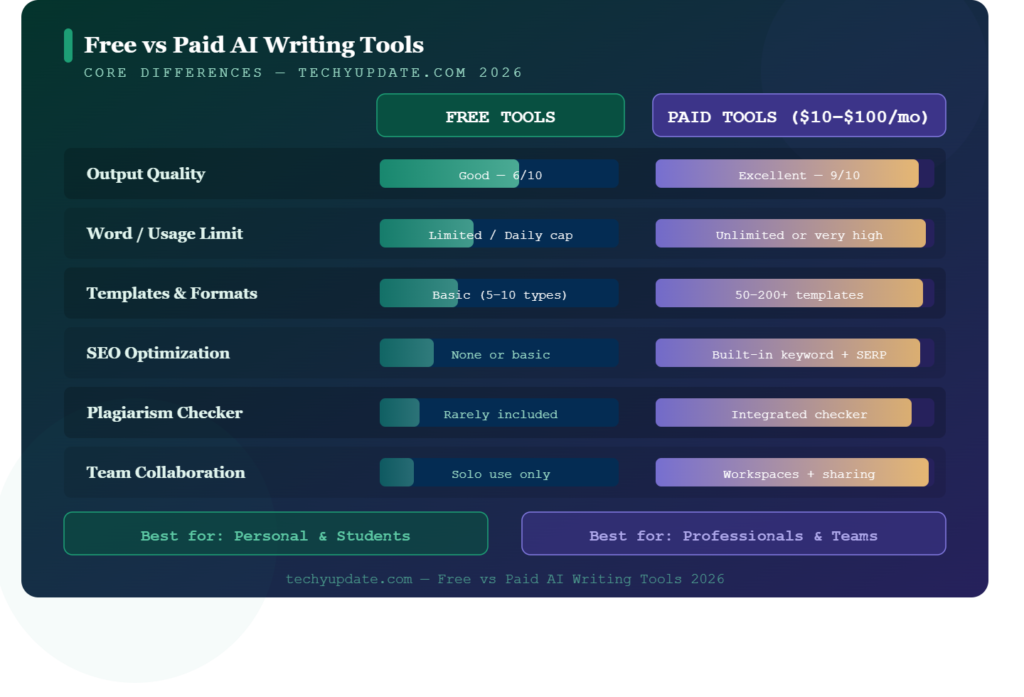
When comparing free and paid AI writing tools, the differences become clear in terms of capabilities, flexibility, and depth of functionality.
Free AI Writing Tools:
- Basic text generation
- Limited templates and writing styles
- Simple grammar correction
- Restricted customization options
- Lower priority processing
Paid AI Writing Tools:
- Advanced long-form content generation
- SEO optimization features (keywords, meta tags, structure)
- Tone, style, and audience customization
- AI-assisted rewriting and content enhancement
- Integration with marketing and productivity platforms
In essence, free tools focus on simplicity and accessibility, while paid tools prioritize performance and professional output.
READ MORE: ChatGPT Review 2026
Performance and Output Quality Differences
One of the most significant distinctions between free and paid AI writing tools is output quality and consistency.
Free Tools Performance:
Free AI tools often rely on limited access to models or on simplified versions of AI systems. As a result:
- Outputs may be more generic or repetitive
- Context understanding can be limited
- Long-form content may lack depth or structure
- Occasional grammatical or logical inconsistencies may appear
These tools are sufficient for quick drafts or basic writing tasks, but may require manual refinement.
Paid Tools Performance:
Paid AI writing tools leverage advanced models and optimized infrastructure, resulting in:
- Highly coherent and structured long-form content
- Better understanding of context and intent
- Improved creativity and variation in writing style
- More accurate tone adaptation and audience targeting
We observe that paid tools consistently produce near-professional-level content with minimal editing required, making them suitable for business and commercial use.
Scalability and Usage Limits
Scalability is a major factor that separates free and paid AI writing tools.
Free AI Writing Tools:
Free tools typically impose strict limitations, such as:
- Limited daily or monthly word counts
- Restricted number of prompts or generations
- Slower response times during peak usage
- Limited batch processing capabilities
Because of these restrictions, free tools are best suited for individual or occasional use rather than large-scale operations.
Paid AI Writing Tools:
Paid tools are designed for high-volume and scalable content production, offering:
- High or unlimited word generation limits
- Faster processing speeds
- Priority server access
- Ability to handle multiple projects simultaneously
- API access for automation and integration
This makes paid tools ideal for agencies, businesses, and content-heavy workflows.
Key Features to Look for in AI Writing Tools
Choosing the right AI writing tool is not just about automation—it is about selecting a system that enhances productivity, content quality, and strategic output. In 2026, AI writing tools vary significantly in capability, and understanding the core features is essential for making the right choice.
Below are the most important features we should evaluate before adopting any AI writing platform.
Content Generation Capabilities
The most fundamental feature of any AI writing tool is its ability to generate high-quality content efficiently.
We should look for tools that can:
- Produce long-form articles, blogs, and reports
- Generate short-form content like ads, captions, and emails
- Create structured outlines and drafts instantly
- Maintain coherence across multiple paragraphs
- Understand context and user intent accurately
Advanced content generation ensures that the tool is not just producing text but creating meaningful, usable content ready for publishing or editing.
SEO Optimization Features
SEO capability is critical for anyone working in digital content creation. A strong AI writing tool should support search engine optimization at every stage of content development.
Key SEO features include:
- Keyword integration and suggestions
- Meta title and description generation
- Heading structure optimization (H1, H2, H3 formatting)
- Readability scoring and improvement suggestions
- Content optimization for search intent
We prioritize tools that help improve search visibility, organic traffic, and ranking performance, making SEO integration a core requirement.
Tone and Style Customization
Every audience requires a different communication style. A high-quality AI writing tool must allow for flexible adjustments to tone and style.
We should look for the ability to:
- Switch between formal, informal, persuasive, or technical tones
- Match brand voice consistently across content
- Adjust writing style based on audience type
- Maintain emotional consistency in storytelling
- Customize output for different platforms (blogs, ads, emails, etc.)
This feature ensures that content is not only correct but also aligned with brand identity and audience expectations.
Multilingual Support
In a global digital environment, multilingual capabilities are essential. AI writing tools should support content creation in multiple languages without losing meaning or quality.
Important multilingual features include:
- Accurate translation with contextual understanding
- Ability to generate original content in different languages
- Preservation of tone and intent across translations
- Support for regional variations and dialects
- Seamless switching between languages within workflows
This feature enables businesses and creators to reach international audiences effectively and efficiently.
Integration with Other Platforms
Modern workflows depend heavily on interconnected tools. A powerful AI writing system should offer smooth integration with other digital platforms.
We should prioritize tools that integrate with:
- Content management systems (CMS)
- Google Docs and Microsoft Word
- Marketing and email automation tools
- SEO platforms and analytics dashboards
- APIs for custom applications and automation
Integration ensures that AI writing tools become part of a larger productivity ecosystem rather than isolated applications.
User Interface and Ease of Use
Even the most advanced AI tool is ineffective if it is difficult to use. A clean, intuitive interface is essential for maximizing productivity.
We should evaluate:
- Simplicity of navigation and layout
- Speed of content generation workflow
- Availability of templates and quick-start options
- Minimal learning curve for new users
- Clear editing and customization options
A well-designed interface ensures that users can focus on content creation rather than technical complexity.
Comparison Table: Free vs Paid AI Writing Tools
Free and paid AI writing tools differ significantly in terms of features, performance, usability, and scalability. While free tools are ideal for beginners and light usage, paid tools are designed for professional-grade content creation, SEO optimization, and large-scale workflows. The table below provides a clear side-by-side comparison.
Feature-by-Feature Comparison
| Feature | Free AI Writing Tools | Paid AI Writing Tools |
|---|---|---|
| Content Generation | Basic short-form and simple long-form drafts | Advanced long-form content with deeper context and structure |
| SEO Optimization | Limited or no SEO features | Full SEO tools (keywords, meta tags, structure optimization) |
| Tone & Style Control | Minimal customization | Advanced tone, brand voice, and audience targeting |
| Output Quality | Often generic or repetitive | High-quality, natural, and context-rich writing |
| Usage Limits | Strict daily/monthly caps | High or unlimited usage |
| Integrations | Very limited | CMS, APIs, marketing tools, workflow integration |
| Templates | Few basic templates | Extensive industry-specific templates |
| Support | Community or minimal support | Priority customer support |
Performance Benchmarks
Performance differences between free and paid AI writing tools become clear when handling real-world content demands.
| Performance Area | Free AI Tools | Paid AI Tools |
|---|---|---|
| Speed | Moderate, often delayed during peak usage | Fast and prioritized processing |
| Accuracy | Good for simple tasks, weaker in complex topics | High accuracy with better contextual understanding |
| Long-form Writing | May lose coherence in long content | Strong structure and consistency in long-form articles |
| Creativity | Limited variation in ideas | More diverse, creative, and human-like output |
| Reliability | Occasional inconsistencies | Stable and consistent performance |
Usability Comparison
Usability plays a major role in determining how effectively we can integrate AI tools into daily workflows.
| Usability Factor | Free AI Tools | Paid AI Tools |
|---|---|---|
| Learning Curve | Very easy for beginners | Easy but with advanced features to learn |
| Interface | Simple and minimal | More structured with professional dashboards |
| Workflow Efficiency | Suitable for casual use | Designed for productivity and scaling |
| Collaboration Features | Limited or unavailable | Team collaboration and shared workflows |
| Customization | Basic prompt-based control | Deep customization and automation options |
Final Verdict Table
The final comparison highlights when each type of AI writing tool is most suitable.
| Category | Free AI Writing Tools | Paid AI Writing Tools |
|---|---|---|
| Best For | Beginners, students, casual users | Professionals, businesses, agencies |
| Content Depth | Surface-level writing | Deep, structured, and optimized content |
| SEO Capability | Minimal | Advanced and fully integrated |
| Scalability | Low | High and enterprise-ready |
| Cost Efficiency | Free but limited | Paid but high ROI for professionals |
| Overall Value | Good for learning and small tasks | Best for serious content production |
Top AI Writing Tools in 2026 (Overview)
In 2026, AI writing tools will have become deeply embedded in content creation, marketing, education, and business communication. The ecosystem is no longer limited to simple text generators. Instead, it now includes specialized, intelligent platforms designed for specific writing needs, industries, and performance levels.
To understand the best tools available today, it is essential to evaluate them based on clear criteria, categorize them by use case, and distinguish between free and paid solutions.
Criteria for Selection
Selecting top AI writing tools in 2026 requires a structured evaluation framework. The most effective tools are not just those that generate text, but those that deliver accuracy, scalability, and strategic value.
We assess AI writing tools based on the following criteria:
1. Content Quality and Accuracy
The tool must produce coherent, context-aware, and grammatically correct content with minimal editing required.
2. SEO and Optimization Features
Top tools should support:
- Keyword integration
- Meta descriptions and title generation
- Content structure optimization
- Readability enhancement
3. Versatility of Use
A strong AI writing tool should handle multiple formats, including:
- Blog articles
- Marketing copy
- Emails and reports
- Social media content
4. Customization and Control
We prioritize tools that allow:
- Tone adjustment (formal, casual, persuasive, technical)
- Style consistency across content
- Audience-specific writing adaptation
5. Speed and Performance
Fast content generation with minimal lag is essential for productivity and real-time workflows.
6. Integration Capabilities
The best tools integrate seamlessly with:
- CMS platforms
- SEO tools
- Productivity apps
- APIs for automation
7. User Experience
Ease of use, clean interface design, and workflow efficiency are critical for adoption and long-term usage.
Benefits of Free AI Writing Tools
Free AI writing tools have become an important entry point into the world of AI-powered content creation. In 2026, they will be widely used by beginners, students, and casual creators who need quick and simple writing assistance without financial commitment.
Accessibility for Beginners
One of the biggest advantages of free AI writing tools is their ease of access.
We can start using them immediately without:
- Subscriptions
- Credit card requirements
- Technical setup
Most platforms are designed with simple interfaces and conversational prompts, making them ideal for users new to AI. This accessibility allows beginners to quickly understand how AI-generated writing works and how to interact with it effectively.
Cost Efficiency
Free AI writing tools provide zero-cost access to writing assistance, making them highly valuable for users with limited budgets.
We benefit from:
- No financial investment required
- Free access to basic writing capabilities
- Reduced dependency on paid services
This makes them especially useful for individuals, students, and small projects where budget constraints are a key consideration.
Ideal Use Cases for Free Tools
Free AI writing tools are best suited for lightweight and non-professional writing tasks.
We commonly use them for:
- Brainstorming content ideas
- Writing short blog drafts
- Creating social media captions
- Generating email responses
- Summarizing basic information
They are highly effective when the goal is speed and convenience rather than advanced content quality or SEO optimization.
Common Limitations of Free Versions
Despite their benefits, free AI writing tools come with several important limitations.
We often face:
- Limited daily or monthly usage quotas
- Restricted access to advanced AI models
- Basic or generic content output
- Lack of SEO optimization features
- Slower performance during peak usage
These limitations make free tools less suitable for professional writing, large-scale content production, or business applications.
Benefits of Paid AI Writing Tools
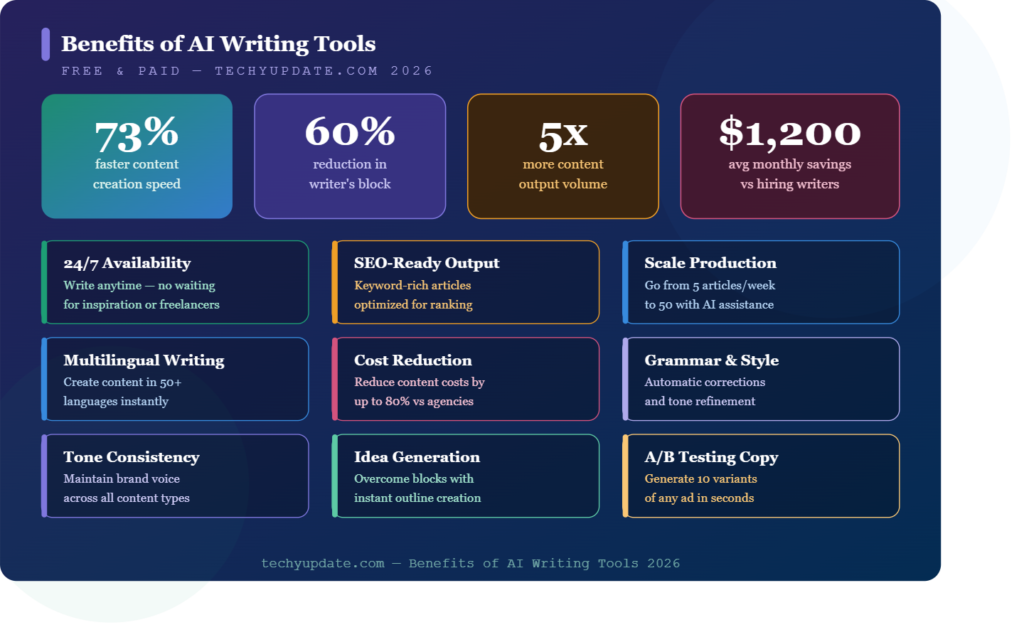
Paid AI writing tools represent the professional-grade evolution of AI-powered content creation, offering significantly enhanced capabilities for businesses, marketers, and serious content creators.
A. Advanced Features and Customization
Paid AI writing tools provide a wide range of advanced features that go far beyond basic text generation.
We gain access to:
- Tone and style customization (formal, persuasive, technical, etc.)
- Brand voice consistency tools
- SEO optimization modules
- Content rewriting and enhancement tools
- Workflow automation features
These capabilities enable us to create highly tailored, strategic content that aligns with specific goals and audiences.
Higher Accuracy and Content Depth
One of the strongest advantages of paid tools is their ability to produce more accurate, detailed, and context-aware content.
We experience:
- Better understanding of complex prompts
- Improved logical flow in long-form content
- Reduced repetition and generic phrasing
- More natural and human-like writing
This makes paid tools ideal for professional publishing, marketing campaigns, and business communication.
Faster Processing and Priority Access
Paid AI writing tools are optimized for speed and reliability, especially under heavy usage.
We benefit from:
- Faster response times
- Priority server access during peak demand
- Stable performance without interruptions
- Ability to handle bulk content generation
This ensures smooth workflows, especially for users who rely on AI tools for daily or high-volume content production.
Professional Use Cases
Paid AI writing tools are designed for serious, large-scale, and revenue-driven applications.
We use them for:
- SEO-optimized blog content and article writing
- Marketing campaigns and advertising copy
- E-commerce product descriptions
- Business reports and proposals
- Agency-level content production
They are essential for professionals who need consistent quality, scalability, and strategic content performance.
Categorization by Use Case
AI writing tools in 2026 are no longer one-size-fits-all solutions. They are now categorized based on specific use cases and industry needs.
1. Content Creation Tools
These tools are designed for bloggers, writers, and publishers.
We use them for:
- Long-form article generation
- Blog writing and ideation
- Storytelling and editorial content
They focus heavily on creativity, structure, and readability.
2. Marketing and Copywriting Tools
These tools are optimized for conversion-driven content.
Key applications include:
- Ad copy generation
- Landing page writing
- Email marketing campaigns
- Sales copy creation
Their primary goal is to increase engagement and conversion rates.
3. SEO-Focused Writing Tools
SEO tools are designed to improve search engine visibility and ranking performance.
They provide:
- Keyword research and integration
- SEO-friendly structuring
- Content scoring and optimization
- SERP-aligned writing suggestions
These tools are essential for digital marketers and content strategists.
4. Academic and Research Writing Tools
These tools assist students and researchers in producing structured and informative content.
We use them for:
- Essay writing
- Research summaries
- Citation support
- Academic formatting
They prioritize clarity, structure, and accuracy.
5. Business Communication Tools
Designed for corporate environments, these tools streamline internal and external communication.
They help generate:
- Reports and proposals
- Emails and memos
- Presentation content
- Documentation
The focus here is on professional tone and clarity.
6. Social Media Content Tools
These tools are optimized for platforms like Instagram, LinkedIn, and X (Twitter).
We use them for:
- Captions and hashtags
- Post ideas and scheduling content
- Engagement-focused writing
They emphasize conciseness and virality.
Free vs Paid Tool Segmentation
AI writing tools in 2026 are broadly divided into free and paid categories, each serving different user needs and performance levels.
1. Free AI Writing Tools
Free tools are designed for basic usage and entry-level access.
Key Characteristics:
- Limited daily or monthly usage
- Basic content generation features
- Restricted access to advanced models
- Simple SEO and editing tools
- May include ads or upgrade prompts
Best For:
- Beginners
- Students
- Casual users
- Testing and experimentation
Free tools are useful for light tasks, but they are not ideal for professional or high-volume content production.
2. Paid AI Writing Tools
Paid tools offer advanced capabilities and premium performance designed for professionals and businesses.
Key Characteristics:
- High or unlimited content generation
- Advanced AI models with better accuracy
- Full SEO optimization features
- Tone, style, and audience customization
- Faster processing and priority access
- Integration with business systems
Best For:
- Content creators and marketers
- Agencies and enterprises
- E-commerce businesses
- SEO professionals
Paid tools are built for scalability, precision, and commercial-grade output.
Detailed Review of Free AI Writing Tools
Free AI writing tools in 2026 have become surprisingly powerful, offering solid writing assistance, brainstorming capabilities, and basic content generation without requiring a subscription. They still have important limitations that set them apart from premium platforms.
A. Best Free Tools for Beginners
In 2026, several free AI writing tools stand out for accessibility, ease of use, and overall performance.
1. ChatGPT (Free Tier)
ChatGPT remains the most widely used free AI writing assistant.
We use it for:
- Blog drafting and ideation
- Email writing and rewriting
- Content brainstorming
- General explanations and summaries
It is known as a versatile, all-in-one writing assistant with strong conversational abilities.
2. Claude (Free Version)
Claude is highly regarded for producing natural, human-like long-form content.
We use it for:
- Essays and structured articles
- Deep explanations
- Editing and rewriting long content
It is especially strong in tone quality and contextual understanding.
3. Copy.ai (Free Plan)
Copy.ai is designed mainly for short-form marketing content.
We use it for:
- Social media posts
- Product descriptions
- Email subject lines
Its free plan offers limited word credits but is useful for quick tasks.
4. Rytr
Rytr is a lightweight tool for beginners.
We use it for:
- Simple blog drafts
- Short emails
- Basic creative writing
It is easy to use but less powerful than ChatGPT or Claude.
Strengths of Free AI Platforms
Free AI writing tools offer several important advantages that make them highly valuable for beginners and casual users.
1. Zero Cost Accessibility
We can start creating content instantly without any financial investment.
2. Easy Learning Curve
Most free tools are designed with simple interfaces and conversational workflows, making them beginner-friendly.
3. Good for Basic Content Needs
They handle:
- Emails
- Short blog posts
- Ideas and outlines
- Social media captions
4. Fast Experimentation
Free tools allow us to test different writing styles, tones, and prompts without risk.
5. Growing Capabilities
Modern free AI models are now significantly more advanced than earlier versions, making them surprisingly capable for general use.
Weaknesses and Limitations
Despite their strengths, free AI writing tools have clear limitations that impact professional use.
1. Usage Restrictions
Most free tools include:
- Daily or monthly message limits
- Restricted access during peak hours
- Limited word generation capacity
These restrictions can interrupt workflow.
2. Limited Advanced Features
Free versions often lack:
- SEO optimization tools
- Advanced tone control
- Workflow automation
- File upload or research tools
3. Lower Output Consistency
We may notice:
- Generic phrasing
- Occasional repetition
- Less depth in long-form content
4. Reduced Model Power
Free tools typically run on lighter AI models, which affects accuracy and creativity in complex writing tasks.
5. Not Ideal for Professional Scaling
Free tools struggle with:
- Bulk content production
- Agency-level workloads
- Enterprise communication needs
Best Scenarios to Use Free Tools
Free AI writing tools are extremely useful when applied in the right context.
1. Learning and Practice
Perfect for:
- Students learning writing skills
- Beginners exploring AI tools
- Prompt engineering practice
2. Idea Generation
We use free tools to:
- Brainstorm blog topics
- Generate headlines
- Explore content angles
3. Light Content Creation
Best for:
- Social media captions
- Short blog drafts
- Emails and quick replies
4. Personal Use
Ideal for:
- Daily writing assistance
- Note summarization
- Casual communication
5. Testing Before Upgrading
Free tools are useful for evaluating whether AI writing fits our workflow before investing in paid plans.
Detailed Review of Paid AI Writing Tools
Paid AI writing tools represent the professional tier of content creation technology, offering advanced capabilities designed for businesses, marketers, and high-volume creators.
A. Premium Tools for Professionals
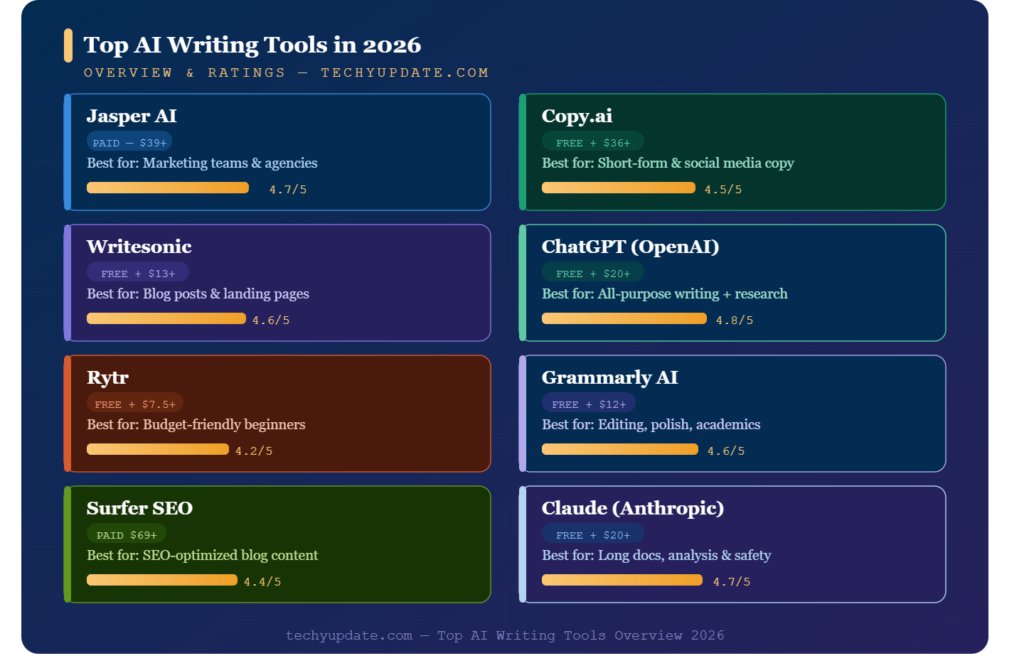
Paid AI writing platforms are built for performance, accuracy, and scalability.
We commonly see tools like:
- ChatGPT Plus / Pro tiers
- Claude Pro
- Jasper AI
- Writesonic premium versions
These tools provide enhanced intelligence, faster processing, and deeper customization.
B. Advanced Functionalities Explained
Paid AI writing tools unlock features that significantly improve productivity and content quality.
1. Advanced Language Models
We gain access to more powerful AI systems that provide:
- Better reasoning
- More accurate context handling
- Higher-quality long-form writing
2. SEO Optimization Suite
Paid tools often include:
- Keyword optimization
- SERP analysis
- Content scoring systems
- Meta tag generation
3. Workflow Automation
We can automate:
- Blog pipelines
- Marketing campaigns
- Content repurposing
- Multi-platform publishing
4. Deep Customization
Paid platforms allow:
- Brand voice training
- Audience-specific writing
- Advanced tone controls
5. Integration Capabilities
These tools integrate with:
- CMS platforms
- Google Docs and Microsoft tools
- Marketing automation systems
Pricing Models and Plans
Paid AI writing tools typically follow flexible pricing structures:
1. Subscription-Based Plans
- Monthly or yearly billing
- Common range: $10–$50/month for standard plans
2. Tiered Pricing
- Basic (individual use)
- Professional (freelancers and marketers)
- Enterprise (large organizations)
3. Usage-Based Pricing
Some platforms charge based on:
- Words generated
- API usage
- Credits consumed
ROI (Return on Investment) Analysis
Paid AI writing tools are often justified by their return on investment (ROI) rather than their upfront cost.
1. Time Savings
We save hours of manual writing per week, which translates into higher productivity.
2. Higher Content Output
Businesses can produce:
- More blog posts
- More marketing campaigns
- More SEO pages
3. Increased Revenue Potential
Better content leads to:
- Higher search rankings
- More organic traffic
- Improved conversion rates
4. Reduced Hiring Costs
Companies can reduce dependency on:
- Large writing teams
- Freelance outsourcing
- External agencies
5. Scalability Advantage
Paid tools allow us to scale content operations without increasing the workload in proportion.
Pros and Cons of AI Writing Tools
A. Advantages of Using AI Writing Tools
AI writing tools have completely changed how content is created in 2026. Their biggest strength is efficiency, but their benefits go far beyond just speed.
1. Faster Content Creation
AI can generate articles, emails, and reports in seconds, saving hours of manual work.
2. Improved Productivity
Writers, students, and marketers can focus more on ideas while AI handles repetitive writing tasks.
3. Easy for Beginners
Even users with no writing experience can produce structured, readable content.
4. SEO Optimization Support
Many tools help with keyword research, headings, and readability.
5. Multitasking Ability
From blogs to coding explanations, AI tools can handle a range of content formats.
B. Disadvantages and Risks
Despite their advantages, AI writing tools are not perfect and come with certain limitations.
1. Accuracy Issues
AI can sometimes produce incorrect or outdated information.
2. Lack of Deep Creativity
It may struggle with emotional storytelling or highly original ideas.
3. Over-Reliance Risk
Users may rely too heavily on AI and neglect their own writing skills.
4. Privacy Concerns
Some platforms may store user data to improve models.
5. Generic Outputs
Without good prompts, results can feel repetitive or robotic.
C. Common Misconceptions
Many people misunderstand what AI writing tools can actually do.
1. “AI replaces human writers.”
False AI assists, but human creativity is still essential.
2. “AI always writes perfect content.”
Incorrect AI still requires editing and fact-checking.
3. “All AI tools are the same.”
Not true, each tool has different strengths and weaknesses.
Ethical Considerations in AI Writing
A. Plagiarism and Originality Concerns
One major concern is whether AI-generated content is truly original. While AI creates new combinations of text, users must ensure:
- Content is not copied unintentionally
- Proper originality checks are done
- Sources are verified when needed
B. Responsible Use of AI Content
AI should be used as a support tool, not a replacement for responsibility. Ethical use includes:
- Editing AI-generated text
- Adding personal insights
- Avoiding misinformation
C. Transparency in AI-Generated Content
In professional environments, transparency matters. Users should:
- Disclose AI usage when required
- Avoid misleading audiences
- Maintain honesty in academic or business work
How to Choose the Best AI Writing Tool
A. Define Your Goals
Before choosing a tool, ask:
- Do I need it for blogging, studying, or business?
- Do I need SEO features or support for creativity?
B. Budget Considerations
- Free tools: good for beginners
- Paid tools: better for professionals
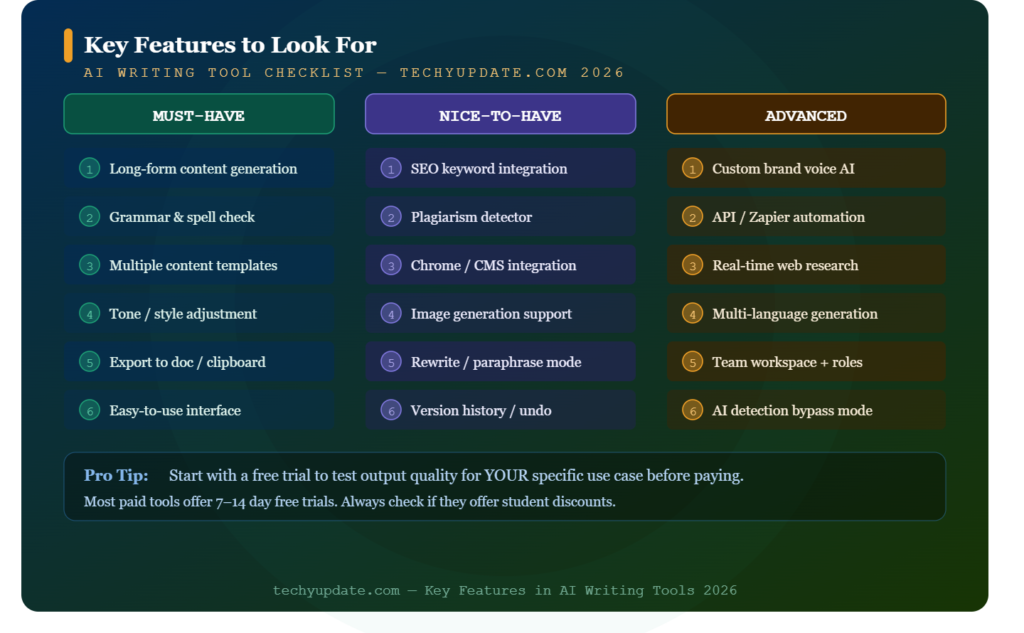
C. Feature Prioritization
Look for features like:
- SEO optimization
- Content quality
- Ease of use
- Integration option
D. Testing and Trial Strategies
Always:
- Try free versions first
- Compare multiple tools
- Test real writing tasks before committing
Tips to Use AI Writing Tools Effectively
A. Writing Better Prompts
Be specific. Instead of “write an article,” say:
- “Write a 1000-word SEO blog about fitness tips for beginners.”
B. Editing and Refining AI Output
Never publish raw AI content. Always:
- Edit grammar
- Improve tone
- Add human touch
C. Combining Human Creativity with AI
Best results come from:
- Human ideas + AI execution
- Personal experience + AI structure
D. Avoiding Over-Reliance
Use AI as:
- A helper
Not as: - A replacement for thinking
Common Mistakes to Avoid
A. Blindly Trusting AI Output
Always fact-check information before publishing.
B. Ignoring SEO Best Practices
Even AI content needs:
- Keywords
- Proper headings
- Structure
C. Using Generic Prompts
Weak prompts = weak results.
D. Overusing Automation
Too much AI reduces originality and engagement.
Future Trends in AI Writing Tools (2026 and Beyond)
A. Personalization and Adaptive AI
AI will adjust writing style based on user behavior.
B. Real-Time Content Generation
Instant content creation during live interactions.
C. Voice and Multimodal Integration
AI will combine:
- Text
- Voice
- Images
D. AI Collaboration Tools
Teams will work with AI like a digital coworker.
Case Studies and Real-World Applications
A. Students Using AI for Academic Success
Students use AI for:
- Summaries
- Essay writing
- Exam preparation
B. Businesses Scaling Content Production
Companies use AI to:
- Create marketing content faster
- Reduce writing costs
- Increase output
C. Freelancers Increasing Productivity
Freelancers benefit from:
- Completing more projects
- Meeting deadlines easily
- Improving client satisfaction
Final Comparison: Which One Should You Choose?
A. Best for Beginners
Free tools like ChatGPT basic versions are ideal.
B. Best for Professionals
Paid tools with SEO and advanced writing features.
C. Best Value for Money
Mid-range AI tools with balanced features.
D. Overall Recommendation
Start free → upgrade based on needs and workload.
Summary
A. Key Takeaways from the Review
AI writing tools are powerful assistants that improve speed, quality, and productivity.
B. Final Thoughts on Free vs Paid AI Writing Tools
Free tools are great for starting, but paid tools unlock advanced capabilities.
C. Future Outlook for AI in Writing
AI will become more personalized, interactive, and integrated into daily workflows.
FAQs
1. What is the best AI writing tool in 2026?
ChatGPT and advanced SEO-focused tools are among the top choices.
2. Are free AI writing tools sufficient for professional use?
They are useful but limited for advanced or large-scale work.
3. How do AI writing tools help with SEO?
They assist with keywords, structure, readability, and optimization.
4. Is AI-generated content safe for publishing?
Yes, but it should always be reviewed and edited.
5. Can AI writing tools replace human writers?
No, they support writers but cannot replace creativity and human judgment.
6. What should beginners look for in an AI writing tool?
Ease of use, free access, and basic writing features.
Conclusion
AI writing tools in 2026 represent a powerful convergence of automation, intelligence, and creativity. From their evolution over the past years to their current role in shaping digital communication, these tools have become essential across industries.
Understanding how AI writing tools work gives you a major advantage. NLP helps machines understand language, machine learning powers content creation, and large language models make responses intelligent and structured. However, their limitations remind us that AI is a tool, not a replacement for human thinking.
The difference between free and paid AI writing tools lies in capability, performance, and scalability. Free tools provide an entry point for beginners and casual users, offering basic functionality without cost. However, they are limited in depth, consistency, and volume.
Paid AI writing tools, on the other hand, deliver advanced features, superior output quality, and scalable performance, making them essential for professionals and businesses that rely heavily on content creation.
The effectiveness of an AI writing tool depends on more than just its ability to generate text. In 2026, the most powerful tools combine advanced content generation, SEO optimization, tone control, multilingual support, seamless integrations, and user-friendly design.
Free AI writing tools are ideal for beginners, learning, and light content tasks, offering accessibility without cost. However, they come with limitations in scalability, depth, and advanced features.
Paid AI writing tools, on the other hand, provide professional-grade performance, automation, SEO optimization, and business scalability, making them a powerful investment for serious users.
Understanding how AI writing tools work gives you a major advantage. NLP helps machines understand language, machine learning powers content creation, and large language models make responses intelligent and structured. However, their limitations remind us that AI is a tool, not a replacement for human thinking.