

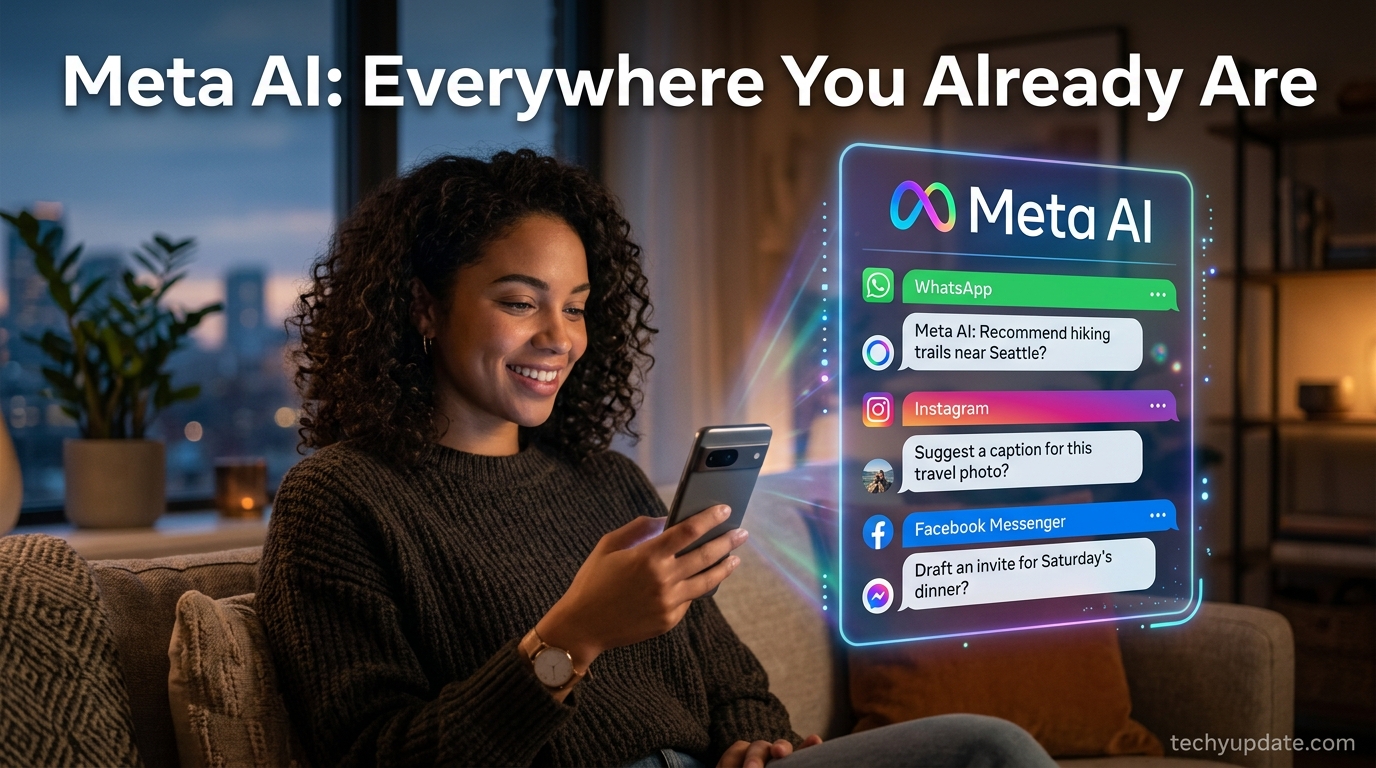
If you’ve opened WhatsApp, Instagram, or Facebook in the last two years, you’ve probably already bumped into Meta AI — the little blue-ringed icon sitting in your search bar or chat list. It’s Meta’s answer to ChatGPT and Gemini, except instead of living in its own separate app you have to remember to open, it’s baked directly into the apps billions of people already check every day.
That convenience is the whole pitch. You can ask it a question mid-conversation in a WhatsApp group chat, get a quick answer without leaving Instagram DMs, or have it draft a caption while you’re scrolling Facebook. It’s free, it doesn’t require a new download to try, and as of 2026, it’s noticeably faster and more conversational than it was at launch.
This matters right now because Meta AI just went through its biggest upgrade cycle yet. In April 2026, Meta swapped the model powering the assistant to Muse Spark, the first release from its newly formed Meta Superintelligence Labs — bringing faster voice responses and the ability to interrupt or switch topics mid-conversation.

Then in July, Meta added Muse Image, its own in-house image generator, which can remix your photos, tagged friends, and even public Instagram content into new images. That last part is also why Meta AI has been in the news for the wrong reasons: the feature allowed anyone to generate images using a public Instagram user’s likeness without asking first, and Meta reversed that capability within days after privacy advocates and talent unions pushed back.
In this overview, you’ll get a clear picture of what Meta AI actually does today, how it’s different from six months ago, what it costs (spoiler: the assistant itself is free), who it’s genuinely useful for, and the privacy caveat you should know before you use it. No hype, no filler — just what’s confirmed and what’s still unresolved.
Why accurate categorization + sourcing matters here: Meta AI is a fast-moving product with frequent model swaps (Llama 3 → Muse Spark), new rollouts, and an active privacy controversy. Treating this as a generic explainer rather than a Product Overview would bury the specific “what it is, what it does, what it costs” answers readers actually search for, hurting both time on page and Google’s relevance signal. Every fact below is drawn from Meta’s own newsroom posts and reputable tech outlets, not from assumptions.
Brand Authority & Trust Layer: Written by the techyupdate.com AI desk. Last Updated: August 3, 2026. Methodology: claims were cross-checked against Meta’s official newsroom announcements, Google Play’s listing, and independent reporting from CNBC, TechCrunch, Axios, and 9to5Mac; no pricing or feature claim below is invented. Named limitation: Meta has not published exact usage caps or rate limits for free-tier Meta AI, so this article states what’s confirmed and flags what isn’t.
Recent Updates: In April 2026, Meta rolled out Muse Spark, its first model from the newly formed Meta Superintelligence Labs, replacing Llama-based responses with faster, more conversational voice interactions. According to Meta’s own announcement, Muse Spark powers a smarter and faster Meta AI assistant and has been rolled out to WhatsApp, Instagram, Facebook, Messenger, and AI glasses, bringing side chats in group conversations and @meta.ai mentions in Threads.
In July 2026, Meta added Muse Image, its first in-house image generator, which can also work with photos users upload, tagged friend profiles, and trending information from Facebook. That same feature triggered a swift reversal: within days of its launch, Meta removed the ability to generate images by mentioning public Instagram accounts, following backlash from privacy groups and talent unions.
Table of Contents
Meta AI: Free, Fast Assistant Embedded Across Instagram, WhatsApp, and Facebook
Quick Facts
- What it is: Meta’s free AI assistant built into WhatsApp, Instagram, Facebook, Messenger, and Threads
- Powered by: Muse Spark (Meta Superintelligence Labs’ first model, launched April 2026)
- Key features: chat, voice conversation, image generation (Muse Image), web-grounded answers
- Cost: Free to use; separate from Meta’s paid Instagram/Facebook/WhatsApp “Plus” subscriptions
- Big 2026 story: a July privacy backlash over tagging public Instagram accounts in AI images, reversed within days
By the techyupdate.com AI Desk | Last Updated: August 3, 2026
Recent Updates: See the Recent Updates note in the research summary above — the short version is that Meta AI got noticeably smarter and faster in April 2026 with Muse Spark, gained its own image generator in July 2026, and had to walk back part of that image feature almost immediately over privacy complaints.
What Is Meta AI?
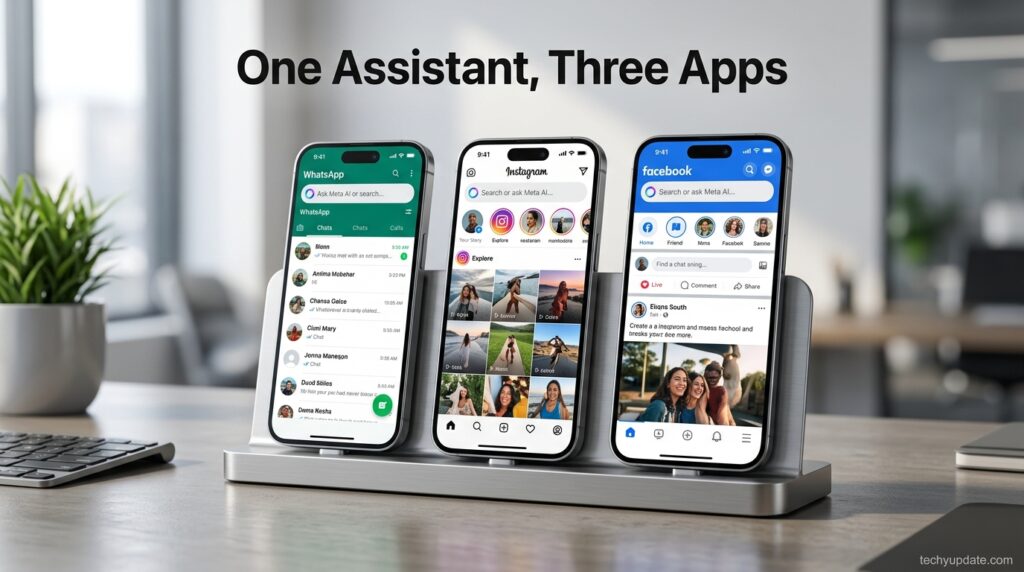
Meta AI is Meta’s free, general-purpose AI assistant, accessible directly within WhatsApp, Instagram, Facebook, Messenger, Threads, and Meta’s AI glasses, as well as through a standalone app and the meta.ai website. Rather than asking you to open a separate chatbot app, it sits in the same search bar and chat interface you already use, so asking it a question feels like sending a message to a contact.
It launched broadly in April 2024, running on Llama 3, and Meta said at the time it combined the model with real-time knowledge from Google and Microsoft’s Bing to answer current questions. Two years later, the underlying engine has moved on: Meta AI now runs on Muse Spark, and the company has framed the long-term goal as building toward “personal superintelligence” — an assistant genuinely useful for everyday tasks, not just novelty chat.
Key Specs & Features
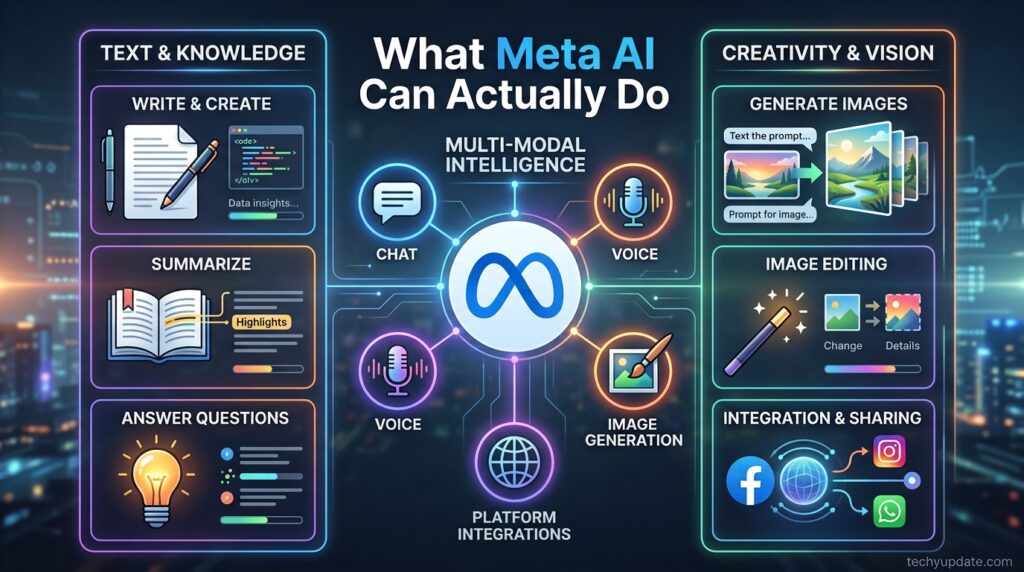
Meta AI’s current, confirmed feature set includes:
- Conversational chat across WhatsApp, Instagram, Facebook, and Messenger search bars and DMs
- Voice mode with natural, interruptible conversation — you can switch topics or languages mid-sentence
- Image generation via Muse Image, which can combine several reference photos, edit existing images, and render readable text for things like posters or invitations
- Group chat “side chats” — a private tap-to-ask feature grounded in what your group is currently discussing
- @meta.ai mentions inside Threads posts and replies
- Everyday task help — restaurant recommendations, trip planning, decor inspiration, math problems, and email drafting on the meta.ai website
- AI glasses integration for hands-free voice queries
Meta has not published hard rate limits for free-tier usage, so if you’re a heavy user, treat response caps as unconfirmed until you hit one.
What’s New vs. Previous Version
The biggest shift is the move from Llama-based responses to Muse Spark, which Meta describes as its most powerful model yet, bringing faster voice replies and more natural back-and-forth conversation. The second major shift is Muse Image, Meta’s first proprietary image generator, replacing the older “Imagine Me” tool. Muse Image can plan a generation by first interpreting your prompt and pulling in web context before producing an image — a more deliberate process than earlier one-shot generators.
Release Date & Availability
Meta AI first rolled out broadly in April 2024. Muse Spark arrived in April 2026 and expanded to WhatsApp, Instagram, Facebook, Messenger, and AI glasses in the weeks that followed. Muse Image followed in July 2026. It’s available today in the Meta AI app (iOS and Android), on meta.ai, and embedded across Meta’s family of apps in most markets where those apps operate.
Privacy Concerns You Should Know About
This is the part most Meta AI overviews skip, and it’s worth reading before you use Muse Image. When Muse Image launched, it allowed anyone to generate an AI image using a public Instagram account’s likeness just by tagging that account—without notifying the person or asking permission first—and it automatically included public profiles unless the user actively opted out.
Privacy advocacy group Public Citizen called it an invasion of privacy, and performers’ union SAG-AFTRA also objected. Meta responded quickly: within a little more than three days, the company removed the ability to generate images by mentioning public Instagram accounts, while keeping the rest of Muse Image available.
Meta maintains that the tool has built-in protections designed to prevent the generation of policy-violating content, including violent, sexual, or defamatory imagery of real people. The takeaway: check your own privacy settings before assuming your public photos are excluded from AI features by default.
Pricing
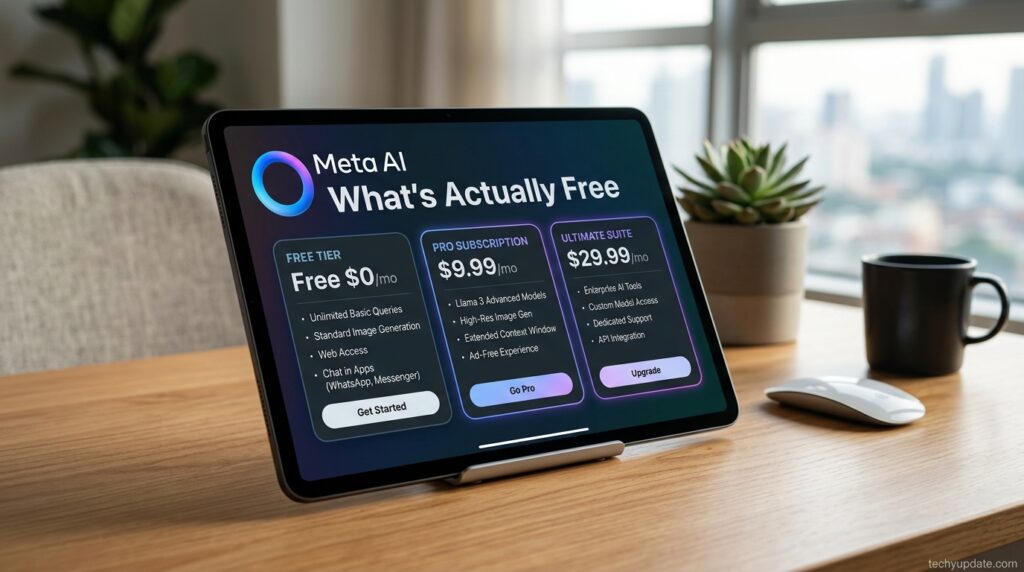
Meta AI itself is free to use across every platform it’s embedded in. Don’t confuse this with Meta’s separate consumer subscriptions: in May 2026, Meta launched Instagram Plus ($3.99/month), Facebook Plus ($3.99/month), and WhatsApp Plus ($2.99/month), which unlock things like profile customization and story insights — none of which are required to use Meta AI.
Meta has also begun testing AI-focused subscription plans for all users, so a paid Meta AI tier with extra capability may arrive later in 2026, though nothing has been confirmed publicly yet.
Who It’s For
Meta AI makes the most sense for people who already live in WhatsApp, Instagram, or Facebook and want quick answers without switching apps — think group trip planning in WhatsApp, caption ideas while posting on Instagram, or a fast fact-check mid-Facebook scroll. It’s less suited to people who need deep, sustained work sessions (long documents, coding, multi-step research), where a dedicated assistant app with a bigger context window may serve better.
How Meta AI Compares to Alternatives
| Meta AI | ChatGPT (free tier) | Gemini (free tier) | |
|---|---|---|---|
| Built into everyday apps | Yes — WhatsApp, Instagram, Facebook | No, separate app | Partial (Google apps) |
| Cost | Free | Free tier + paid plans | Free tier + paid plans |
| Image generation | Yes (Muse Image) | Yes | Yes |
| Voice conversation | Yes | Yes | Yes |
| Standalone app needed | No (optional) | Yes | Yes |
The clearest differentiator is distribution: Meta AI doesn’t need its own app to be useful, since it rides inside apps you already open dozens of times a day.
Read More: Poe AI
FAQ
Is Meta AI free to use?
Yes. Meta AI itself is free across WhatsApp, Instagram, Facebook, Messenger, and the Meta AI app. It’s separate from Meta’s paid Instagram Plus, Facebook Plus, or WhatsApp Plus subscriptions.
What model powers Meta AI in 2026?
Meta AI now runs on Muse Spark, released in April 2026 by Meta Superintelligence Labs, replacing the earlier Llama-based version for faster, more natural conversations.
Can Meta AI generate images of other people?
It can generate images using your own photos and tagged friends, but Meta removed the ability to use public Instagram accounts’ likenesses by tagging them, following a July 2026 privacy backlash.
Do I need to download a separate app to use Meta AI?
No. It’s built into the search bars of WhatsApp, Instagram, and Facebook. A standalone Meta AI app and the meta.ai website are options, not requirements.
Conclusion
The single most useful thing to understand about Meta AI is this: it’s not trying to be your primary AI assistant the way ChatGPT or Gemini are — it’s trying to be the assistant you never have to go looking for, because it’s already sitting in the apps you open without thinking. That’s genuinely valuable for quick, in-context tasks like planning with a group chat or getting a fast answer mid-scroll.
Before you lean on it for image generation, though, take two minutes to check your Instagram privacy settings. The July 2026 backlash over public-profile tagging was resolved quickly, but it’s a reminder that Meta’s defaults don’t always match what you’d choose if asked directly.
Review what your account currently allows, adjust it if needed, and then use Meta AI for what it’s genuinely good at: fast, low-stakes help without leaving the conversation you’re already in. If you want a deeper assistant for long-form work, pair it with a dedicated tool rather than expecting Meta AI to replace one — it isn’t built for that job, and that’s fine, because it was never trying to be.