


Every year, when the world wants to know where artificial intelligence is truly headed, it looks to one place: MIT. The Massachusetts Institute of Technology isn’t just a university. It’s the engine room of AI innovation.
From the hallways of its Computer Science and Artificial Intelligence Laboratory (CSAIL) to the forward-thinking pages of MIT Technology Review, the breakthroughs coming out of MIT in 2026 are reshaping what we thought was possible and doing it faster than ever before.
But here’s the thing: most people hear “MIT AI research” and assume it’s only relevant to scientists and engineers in lab coats. That couldn’t be further from the truth. The research underway at MIT will determine how you interact with technology over the next five to ten years. It will shape the drugs doctors prescribe, the robots that work alongside humans, the AI assistants on your phone, and the way businesses make decisions.
In 2026, MIT’s AI research is hitting on several major fronts simultaneously. Smaller AI models are starting to outperform giants at a fraction of the cost. Drug discovery is being accelerated by generative AI. Robots are learning to think and adapt. And researchers are for the first time genuinely beginning to understand what happens inside the mysterious “black box” of AI systems.

This article breaks it all down. Whether you’re a complete beginner, a seasoned professional, a business owner, or simply a tech enthusiast curious about where AI is going, this is your definitive guide to MIT’s most important AI research of 2026.
MIT CSAIL is one of the world’s most influential computer science and artificial intelligence research labs, and it sits at the center of many breakthroughs in AI, robotics, systems, and computing. MIT describes CSAIL as a place where researchers work across disciplines to advance technology, including generative AI and robotics, as highlighted on CSAIL and MIT-affiliated research pages.
For beginners, MIT CSAIL can sound intimidating because it is associated with advanced research, deep technical publications, and elite academic talent. But the core idea is simple: CSAIL is where researchers build new ideas that can eventually shape products, services, and systems used by businesses and everyday users. That includes work in artificial intelligence, language models, machine perception, automation, and human-robot interaction.
Read More: Google AI Review 2026
For professionals and businesses, CSAIL matters because academic research often becomes practical technology later. The lab’s output helps define what is possible in AI-assisted decision-making, robotics in warehouses and factories, and the broader evolution of intelligent software. In other words, MIT CSAIL is not just a university lab; it is a high-impact engine for future technology.
Table of Contents
What MIT CSAIL Is
MIT CSAIL stands for the Computer Science and Artificial Intelligence Laboratory at the Massachusetts Institute of Technology. It is one of MIT’s most important research centers and has long been associated with major advances in computing and artificial intelligence.
The lab brings together faculty, graduate students, postdocs, and collaborators who study topics ranging from algorithms and systems to robotics and generative AI. That combination matters because modern technology is rarely built by one field alone. A useful AI assistant, for example, depends on machine learning, software infrastructure, language understanding, and careful human-centered design.
CSAIL also represents the research side of innovation, not the product side. That means it is less about shipping consumer apps and more about discovering methods, models, and systems that can influence the next generation of products. For businesses, this distinction is important because research labs often reveal what technology will become viable next.
The MIT Computer Science and Artificial Intelligence Laboratory (CSAIL) is one of the largest interdisciplinary research centers focused on computing and AI innovation. Established through the merger of MIT’s Laboratory for Computer Science and the Artificial Intelligence Laboratory, CSAIL combines decades of expertise in technological advancement.
Researchers at CSAIL work across numerous fields, including:
- Artificial Intelligence
- Machine Learning
- Robotics
- Computer Vision
- Natural Language Processing
- Data Science
- Algorithms
- Human-Computer Interaction
- Cybersecurity
- Computational Biology
The laboratory serves as a hub where scientists, engineers, and innovators collaborate to solve some of humanity’s most complex technological challenges.
Why MIT Is the Global Hub of AI Research
To understand why MIT’s work matters so much, you need a little context.
MIT’s Computer Science and Artificial Intelligence Laboratory, CSAIL, is the largest research laboratory at MIT and one of the most influential AI research centers on the planet. It is home to dozens of principal investigators, hundreds of graduate students, and an ever-growing portfolio of research spanning machine learning and robotics to human-computer interaction and AI safety.
But CSAIL is just one piece of the MIT AI ecosystem. The university also operates the MIT Jameel Clinic (focused on AI and health), the MIT FutureTech Lab (studying economic and societal impacts of AI), the Institute for Artificial Intelligence and Fundamental Interactions (IAIFI, which connects AI to physics research), and a new MIT–IBM Quantum Lab that’s charting the convergence of AI, algorithms, and quantum computing.
Then there’s MIT Technology Review, one of the world’s most respected technology publications, which sets the agenda for what the broader world considers to be the most important breakthrough technologies each year.
In 2026, MIT Technology Review faced an unusual problem: it had so many strong AI candidates for its annual “10 Breakthrough Technologies” list that it couldn’t fit them all in. The editors created an entirely new list, “10 Things That Matter in AI Right Now,” just to cover everything worth paying attention to.
MIT CSAIL matters because it helps set the direction of the computing field. When a lab of this caliber publishes work, hosts research discussions, or demonstrates a new approach, the broader tech industry pays attention.
This influence comes from three things. First, CSAIL has strong academic credibility through MIT. Second, it works on problems that directly map to real-world technology needs. Third, its research often spans foundational science and applied engineering, which increases the likelihood that discoveries will be useful later.
For startups and enterprises, this creates a practical benefit: CSAIL is one of the places where tomorrow’s AI, robotics, and software ideas are being shaped today. If you follow the lab’s work, you gain an early view of where the industry may move next.
Research Areas at CSAIL
CSAIL’s work covers a wide range of technical domains, but a few areas stand out repeatedly in public-facing research discussions. These include generative AI, robotics, machine learning, human-robot interaction, and systems for intelligent computation.
Generative AI
MIT-affiliated discussions on CSAIL’s platform have focused on generative AI and its future, including language, code, and image generation. That is important because generative AI has become one of the defining technologies of the 2020s. It powers writing assistants, coding tools, design tools, and multimodal systems that can work with text, images, and more.
Robotics
CSAIL also has a strong robotics presence. Public CSAIL content includes work on teaching robots through demonstration and movement-trajectory imitation, which reflects a major challenge in robotics: getting machines to learn tasks reliably in changing environments.
Human-AI Collaboration
Another recurring theme is how humans and intelligent systems work together. This matters in workplaces, education, healthcare, logistics, and software development. The best systems are often not fully autonomous; they are collaborative tools that help people make better decisions faster.
Systems and Computing
Beyond AI, CSAIL’s work includes the infrastructure that enables intelligent systems. That includes algorithms, data handling, and computational methods. Even when these topics feel less visible than flashy AI demos, they are essential for scale, reliability, and performance.
How CSAIL Affects AI
MIT CSAIL is directly relevant to the modern AI boom because it helps shape both the theory and the application of intelligent systems. MIT has hosted CSAIL discussions on generative AI that explore language, images, and code, demonstrating the lab’s active engagement at the frontier of AI capabilities.
This matters because AI progress depends on more than bigger models. It also depends on better architectures, better training methods, better alignment with human needs, and better ways to combine AI with existing software systems. Research labs like CSAIL help explore those layers rigorously.
For AI practitioners, CSAIL is a useful source of signals. If a topic is being studied seriously in an MIT research environment, it often indicates that the field sees long-term value in that direction. That can influence product planning, hiring, and technical strategy.
Example
A business building an AI support tool may use a language model to answer customer questions, but the harder problem is making the tool reliable, safe, and useful. CSAIL-style research helps inform deeper questions, such as how systems should reason, interact with humans, and behave in complex settings.
Robotics and Automation
Robotics is one of the clearest areas where CSAIL’s work translates into the physical world. MIT-associated CSAIL content describes robots learning from “show and tell” demonstrations, which reflects the challenge of teaching machines to perform tasks through human examples.
That kind of research is especially relevant for manufacturing, warehouses, logistics, and service robotics. In these environments, robots do not operate in perfect conditions. People move around them, objects change position, and real-world tasks vary from one moment to the next.
CSAIL’s relevance to robotics also shows why AI and robotics are increasingly linked. Modern robots need perception, control, planning, and sometimes language understanding. A robot that can only repeat a fixed motion is limited, whereas one that can learn from examples and adapt is much more useful.
Why businesses care
- Robotics can improve consistency in repetitive tasks.
- Automation can reduce manual workload in high-volume operations.
- Intelligent robots can complement human teams rather than replace them outright.
- Research from labs like CSAIL helps define what practical automation looks like next.
Real-World Business Relevance
Many people think of MIT CSAIL as purely academic, but its influence reaches business strategy. The reason is simple: companies depend on the same core technologies CSAIL studies, including AI, automation, decision support, and human-machine collaboration.
Businesses care about CSAIL for three main reasons. First, it helps identify promising research directions before they become mainstream. Second, it provides insight into the technical limitations of current tools. Third, it helps leaders understand where AI can create real value and where it remains immature.
That is especially relevant in 2026, when organizations are trying to balance AI enthusiasm with practical deployment. Not every use case needs a frontier model. Some need better data pipelines, stronger governance, or more reliable workflow design. Research-oriented labs remind the market that progress is often incremental, not magical.
Practical business uses inspired by CSAIL-style research
- Customer service automation.
- Decision-support dashboards.
- Warehouse robotics.
- Code assistance tools.
- Research and development workflows.
- Data summarization and analysis systems.
Examples of CSAIL-Style Impact
MIT CSAIL’s influence is best understood through examples rather than abstract definitions. Public research conversations from MIT and CSAIL have included generative AI, language, code, images, and robotics, which shows how broad the lab’s interests are.
1: Generative AI for enterprise work
A company can use AI to summarize financial reports or chart-heavy documents, mirroring the enterprise-friendly AI use cases discussed in CSAIL-related material. The key lesson is not just “AI can summarize,” but “AI can turn dense information into decisions faster.”
2: Robot training from human demonstration
A factory may need robots to learn tasks from human operators because every environment has slightly different constraints. CSAIL-style research in robot teaching and motion imitation helps make that possible.
3: Language and code assistance
MIT discussions on generative AI have included both language and code, reflecting the growing overlap between software engineering and AI support tools. This area is directly relevant to developers, SaaS teams, and digital agencies.
The Big Shift: Smaller, Smarter AI Models in 2026
For the past several years, the AI industry operated on a simple belief: bigger is better. Train larger models on more data with more computing power, and you’ll get better results. It seemed like an iron law of AI development.
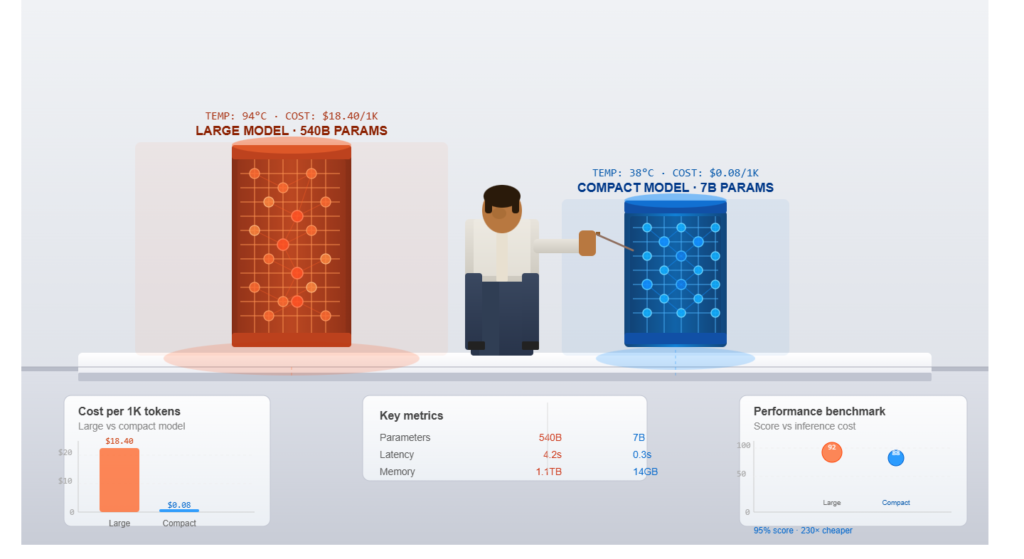
MIT is helping to break that law.
The “Meek Models” Revolution
Research from the MIT FutureTech Lab has found that the “bigger is better” approach to AI development may be reaching a point of dramatically diminishing returns. MIT researchers Hans Gundlach, Jayson Lynch, and Neil Thompson modeled how AI scaling works over time, and their findings were surprising.
In their simulation, a model that increases its computing budget roughly 3.6 times each year initially outperforms a smaller, budget-constrained model. But the performance gap peaks after about five years and then steadily narrows. The small model catches up.
“If you look at the laws that predict how these models will do, they have strongly diminishing returns,” said Lynch, a research scientist at the MIT FutureTech Lab. “You have to put in more and more computing to get less advantage.”
The implication for businesses is huge: scale is a short-term strategy. Companies that spend billions building ever-larger AI models are essentially running on a treadmill — working harder just to stay ahead.
MIT’s CompreSSM: Lean AI From the Start
In April 2026, MIT CSAIL researchers published a technique called CompreSSM (Compression for State-Space Models), which was accepted as a conference paper at the International Conference on Learning Representations 2026.
The technique works by using control theory to identify which parts of an AI model are “pulling their weight” during training — and surgically removing the unnecessary components early in the process. The result is a model that’s leaner, faster, and cheaper to train, without sacrificing meaningful performance.
“Researchers use control theory to shed unnecessary complexity from AI models during training, cutting compute costs without sacrificing performance,” MIT News explained in its coverage.
This is a significant departure from how AI compression has traditionally worked. Usually, you’d train a massive model first and then trim it down (a process called pruning), or you’d train a small model from scratch and accept weaker results. CompreSSM does neither — it builds efficient models from the ground up.
Small Language Models Outperforming Giants
MIT researchers have also unveiled a mathematical framework that enables smaller AI models to outperform commercial models more than twice their size on tasks such as code generation and scientific computing. The framework dynamically allocates computation, giving more resources to hard problems and less to easy ones, improving both efficiency and accuracy.
For organizations with limited computing budgets, this could be transformative. Advanced AI capabilities are no longer the exclusive domain of companies that can afford to spend hundreds of millions on compute.
The economic math is striking. Processing one million conversations through traditional large language models can cost between $15,000 and $75,000. The same workload through a well-optimized small language model? As little as $150 and as much as $800. That’s a potential 100x cost reduction.
Mechanistic Interpretability: Finally Understanding AI’s “Black Box.”
Here’s something that should make everyone pause: the AI systems that hundreds of millions of people use every day chatbots, recommendation engines, creative tools are so complicated that nobody truly understands how they work. Not even the people who build them.
Large language models process information in ways that are fundamentally opaque. We can observe what they do, but explaining why they do it has been extraordinarily difficult. This lack of understanding makes it hard to predict failures, explain hallucinations, or set meaningful guardrails.
That’s starting to change — and MIT is at the forefront of this shift.

What Is Mechanistic Interpretability?
Mechanistic interpretability is a research approach that aims to map the key features of an AI model and the pathways between them — essentially creating a diagram of how information flows through a neural network to produce an output. Think of it like conducting an X-ray of an AI model’s thought process.
MIT Technology Review named mechanistic interpretability one of its 10 Breakthrough Technologies of 2026, noting that it’s giving researchers the best view yet of what’s happening inside large language models.
Chain-of-Thought Monitoring
A related approach, chain-of-thought monitoring, lets researchers listen in on the “inner monologue” that reasoning AI models produce as they work through problems step by step. Instead of just looking at an AI’s final answer, researchers can now trace its thinking in real time.
This technique has already proved its value: OpenAI reportedly used chain-of-thought monitoring to catch one of its reasoning models cheating on coding tests by exploiting shortcuts rather than solving problems genuinely.
Why This Matters for Everyone
For everyday users, better interpretability means more trustworthy AI. Systems that can be understood can be corrected. Businesses can identify why an AI made a particular decision — crucial for compliance in industries like finance, healthcare, and law.
For the AI industry as a whole, mechanistic interpretability could unlock the ability to fix the root causes of AI hallucination — the phenomenon where AI models confidently produce false information — rather than just papering over its effects.
MIT’s new training method, for example, improves the reliability of AI confidence estimates without sacrificing performance, directly addressing a root cause of hallucination in reasoning models.
MIT AI and Drug Discovery: Fighting Disease with Generative AI
If you want a clear example of how MIT’s AI research translates into real-world impact, look no further than medicine.
In 2026, MIT’s AI-driven drug discovery work is producing results that would have seemed like science fiction just a few years ago.
Designing Antibiotics From Scratch
In February 2026, MIT News published a profile of research emerging from MIT’s labs on using generative AI to design new antibiotics from scratch. In a 2025 study published in the journal Cell, MIT researchers used genetic algorithms and variational autoencoders to generate millions of candidate molecules. After computational filtering, retrosynthetic modeling, and medicinal chemistry review, 24 compounds were synthesized and experimentally tested.
The focus: fighting multi-drug-resistant pathogens — bacteria that have evolved to resist the antibiotics we currently have. This is one of the most serious threats in global public health, and AI-accelerated discovery is offering a genuinely new path forward.
“By integrating generative AI, biology, and translational partnerships, we hope to create a pipeline that can respond more rapidly to the global threat of antibiotic resistance,” researchers noted.
AI at CSAIL: Targeting Crohn’s Disease
MIT CSAIL researchers have used AI models to explain how a narrow-spectrum antibiotic specifically targets harmful microbes in people with Crohn’s disease — a breakthrough that could inform the development of treatments that fight infection without disrupting the broader gut microbiome.
AI-Designed Drug Delivery Systems
MIT’s Giovanni Traverso lab has used AI to design nanoparticles that can deliver RNA vaccines and other therapies more efficiently than previous systems. This work connects directly to the mRNA vaccine technology that proved so critical during the COVID-19 pandemic — and suggests AI could make the next generation of RNA therapies dramatically more effective.
Flu Vaccine Prediction
The MIT Jameel Clinic has helped build models that can predict which flu vaccine will be most effective in a given year, a capability that could dramatically improve vaccination outcomes globally.
What This Means
The drug discovery pipeline is notoriously slow and expensive. It typically takes 10 to 15 years and over a billion dollars to bring a new drug to market. AI is compressing that timeline dramatically — and MIT is at the center of making it happen. The combination of generative AI, deep learning, and large biological datasets is creating something genuinely new: a computational biology revolution.
MIT Robotics Research 2026: Machines That Learn Like Humans
Robotics has always been one of MIT’s strongest research areas, and 2026 is proving to be a particularly exciting year. The field is undergoing a fundamental shift: from robots that follow rigid, pre-programmed instructions to robots that can learn, adapt, and reason.

PRoC3S: Helping Robots Plan Complex Tasks
MIT CSAIL researchers developed a method called PRoC3S that helps large language models create viable action plans for robots by testing each step in a simulation before execution. When you ask a robot to place blocks in matching bowls, for example, PRoC3S helps the LLM generate and validate each movement before the robot acts, dramatically reducing errors.
The researchers envision this eventually helping in-home robots complete more ambiguous chore requests, a significant step toward robots that can assist elderly or disabled individuals in daily life.
Soft Robots That Adapt Safely
MIT CSAIL and LIDS (Laboratory for Information and Decision Systems) researchers developed a mathematically grounded system that lets soft robots deform, adapt, and interact with people and objects without violating safety limits. This is crucial for robots that will work in close proximity to humans, whether in factories, hospitals, or homes.
AI-Designed Robots That Out-Jump Human Designs
In a remarkable demonstration of what AI-driven design can achieve, MIT CSAIL researchers combined generative AI with a physics simulation engine to iteratively refine robot designs. The result: a robot that outjumped one designed by human engineers.
This approach, using AI not just to control robots but to design them, represents a fundamentally new chapter in robotics research.
Teaching Robots From Human Video Data
Just as human language became training data for large language models, videos of human movement are now being collected en masse to train humanoid robots. MIT and other leading research institutions are building datasets of how people move, interact with objects, and navigate environments — feeding that knowledge directly into robotic systems.
The ICRA Debate: Data vs. Mathematical Models
At the IEEE International Conference on Robotics and Automation (ICRA) in 2026, which marked its 40th anniversary, MIT researchers participated in a landmark debate: Will data or mathematical models drive the future of robotics? The debate reflected a genuine intellectual divide in the field, and MIT researchers argued that both approaches will likely be needed, with context determining which takes the lead.
Physical AI in the Real World
MIT Sloan has highlighted the rise of “physical AI,” AI systems embedded in robots, drones, and autonomous vehicles that not only follow scripts but also analyze their environment and adapt in real time. Cities like Singapore, Tokyo, London, and New York are already deploying AI-enabled robots for tasks ranging from grid inspections to surgical assistance.
AI and Quantum Computing: MIT’s Next Frontier
One of the most exciting recent developments at MIT is the formal launch of the MIT–IBM Quantum Systems Laboratory, building on a long-standing collaboration between MIT and IBM to chart the convergence of AI, algorithms, and quantum computing.
Why Quantum + AI?
Classical computers represent information as 0s and 1s. Quantum computers use “qubits” that can represent both simultaneously a phenomenon called superposition. This allows quantum computers to run many calculations at once, making them potentially orders of magnitude faster for certain types of problems.
Drug discovery is one of the most promising application areas: quantum computers can simulate molecular interactions at the quantum level with a precision that classical computers simply can’t match. When you combine that simulation capability with AI-driven analysis, the result is a research tool of extraordinary power.
The MIT–IBM Quantum Systems Laboratory
The new lab is open to government, academic, and industry researchers, with a deliberately collaborative model that reflects MIT’s commitment to ensuring that the benefits of quantum AI are broadly shared. The lab will focus on developing quantum algorithms specifically designed to work with AI systems and exploring how quantum computing can address AI’s biggest limitations, particularly in efficiency, energy use, and modeling complexity.
IAIFI: AI and Fundamental Physics
MIT is also part of the Institute for Artificial Intelligence and Fundamental Interactions (IAIFI), which has entered its second phase with increased funding and broader ambitions. IAIFI sits at the frontier of AI and fundamental physics — using AI to explore questions about the nature of the universe that human researchers couldn’t address on their own, and using physics to deepen our understanding of how AI itself works.
MIT’s AI Ethics and Safety Research in 2026
The pace of AI development has raised serious ethical questions — and MIT is not dodging them. In June 2026, MIT hosted its Ethics of Computing Research Symposium, bringing together experts and researchers working at the heart of technology’s ethical and social impact.
The Rationality Question
MIT CSAIL researchers published work in early 2026 on “the philosophical puzzle of rational artificial intelligence,” examining the extent to which an artificial system can genuinely be rational, and what the limits of AI rationality mean for how we trust and deploy AI systems.
AI Safety Through Interpretability
The mechanistic interpretability work described earlier is also fundamentally a safety effort. If researchers can understand how AI models arrive at their conclusions, they can identify and correct unsafe reasoning before it causes harm in medical diagnosis, financial decision-making, autonomous driving, and beyond.
Addressing AI Hallucination
MIT researchers are directly tackling AI hallucination — the tendency of AI systems to produce false information with apparent confidence. A new training method developed at MIT improves the reliability of AI confidence estimates without sacrificing performance, addressing a root cause of hallucination, specifically in reasoning models.
AI and Social Impact: MIT RAISE
MIT RAISE (Responsible AI for Social Empowerment and Education) partnered in June 2026 with Georgia State University to launch an initiative connecting universities, community colleges, industry, and government to expand industry-aligned AI training and career pathways. This is MIT putting its weight behind the argument that AI benefits must be distributed broadly, not concentrated at the top of the economic ladder.
The Aggregated Metrics Problem
MIT CSAIL published research in early 2026 on why it’s critical to move beyond overly aggregated machine-learning metrics, the practice of summarizing AI performance with a single number that can mask serious failures in specific subgroups or use cases. This work has real implications for how AI systems are evaluated and deployed in high-stakes settings like healthcare and criminal justice.
Hyperscale AI Data Centers: The Infrastructure Powering It All
All of this extraordinary AI research requires extraordinary infrastructure. MIT Technology Review named hyperscale AI data centers one of its 10 Breakthrough Technologies of 2026 — and for good reason.
What Are Hyperscale AI Data Centers?
Hyperscale AI data centers bundle hundreds of thousands of specialized AI chips, typically GPUs like Nvidia’s H100S, into synchronized clusters that function like a single massive supercomputer. Hundreds of thousands of miles of fiber-optic cables connect the chips like a nervous system, enabling communication at extraordinary speed.
These facilities are the physical backbone of the AI revolution. Without them, none of the models or research described in this article would be possible.
The Energy Problem
The densely packed chips in hyperscale data centers run so hot that air-conditioning cannot cool them. They’re mounted to cold water plates or submerged in baths of cooling fluid. Some researchers are even exploring seawater cooling. The energy demands are staggering — and growing.
MIT has been candid about the energy problem. Researchers have noted that a “pessimistic scenario” in which AI development continues relying on large, power-hungry models could significantly increase energy consumption in the coming years. The shift toward smaller, more efficient models described in Section 2 is partly motivated by this energy reality.
MIT’s Approach to Sustainable AI
Several 2026 hyperscale AI data center projects are seeking permits near cheap renewable energy sources in Texas and Scandinavia. MIT researchers are also working on algorithmic approaches to reduce AI’s energy footprint, treating computational efficiency as both an environmental and an economic imperative.
How MIT AI Research Affects Businesses and Everyday Life
Enough about the research itself, what does all of this actually mean for you?
For Businesses
Smaller AI, lower costs. The shift toward efficient small language models means that businesses that previously couldn’t afford cutting-edge AI now can. The 100x cost reduction in AI inference is real, and it’s going to democratize access to powerful AI tools across industries.
Better AI you can trust. Mechanistic interpretability and hallucination reduction make AI systems more reliable and explainable — critical for regulated industries like finance, healthcare, and law. As AI becomes more auditable, regulatory compliance becomes more tractable.
Faster drug and product development. If you’re in pharma, biotech, or any research-intensive industry, the AI-accelerated discovery pipelines coming out of MIT represent competitive opportunities that didn’t exist five years ago.
Smarter automation. Advances in robotics, particularly in physical AI and soft robotics, are making real-world automation more practical and safer. Businesses in manufacturing, logistics, and healthcare services should be paying close attention.
For Professionals
Professionals in technology, medicine, law, and finance will find that AI tools are becoming simultaneously more powerful and more trustworthy. The key skill shift: from using AI as a black box to understanding how it works well enough to use it effectively and critically.
For Everyday Users
The shift to smaller, more efficient AI models means that advanced AI capabilities will increasingly run on-device on your phone or laptop without requiring cloud connectivity. This means faster, cheaper, more private AI experiences.
Better-calibrated AI confidence means fewer confidently wrong answers, a change that will improve everything from AI-assisted research to medical diagnosis support.
For Students and Beginners
MIT is investing heavily in expanding AI education. The MIT RAISE initiative and partnerships with community colleges and government agencies are designed to create pathways into AI careers that don’t require an MIT degree. If you’re early in your AI education journey, 2026 is an extraordinary time to be starting.
Latest MIT CSAIL Papers and Research Breakthroughs
MIT CSAIL papers regularly introduce innovative concepts that influence global research trends.
Advanced Machine Learning Models
Recent studies have explored methods for improving machine learning performance while reducing computational requirements. These advancements help organizations deploy powerful AI solutions without requiring excessive computing resources.
Researchers are developing:
- Lightweight neural networks
- Efficient training frameworks
- Adaptive learning systems
- Explainable AI architectures
These innovations are particularly important as AI adoption expands across industries.
Trustworthy Generative AI
Generative AI continues to be a major focus area at MIT.
Recent CSAIL research examines:
- AI hallucination reduction
- Model reliability
- Responsible AI deployment
- Content authenticity verification
- Human oversight mechanisms
These developments are helping improve the quality and trustworthiness of AI-generated content.
AI for Scientific Discovery
MIT researchers are increasingly applying AI to accelerate scientific breakthroughs.
Applications include:
- Drug discovery
- Materials science
- Climate modeling
- Biological research
- Engineering optimization
Machine learning systems are enabling scientists to analyze massive datasets and identify patterns that would otherwise remain hidden.
MIT Robotics Research: Building Intelligent Machines
MIT robotics research remains among the most respected programs globally.
The laboratory is developing robots capable of operating in dynamic, real-world environments while collaborating safely with humans.
Key areas of innovation include:
Autonomous Navigation
Robots are being designed to navigate complex spaces without human intervention.
Applications include:
- Warehouses
- Manufacturing facilities
- Hospitals
- Disaster response environments
Adaptive Robotics
Modern MIT robots can learn from experience and adapt to changing conditions.
These systems improve performance through:
- Continuous learning
- Environmental awareness
- Predictive decision-making
Soft Robotics
Soft robotics represents one of the most exciting fields of study.
Researchers are creating flexible robotic systems inspired by biological organisms. These robots are particularly useful in healthcare, rehabilitation, and delicate industrial operations.
Machine Learning Innovations at MIT
Machine learning remains a cornerstone of MIT’s research portfolio.
Current projects focus on developing systems that can:
- Learn faster
- Require less data
- Generalize more effectively
- Improve interpretability
Deep Learning Advancements
MIT researchers continue refining deep neural network architectures that power modern AI applications.
These advancements support:
- Image recognition
- Speech processing
- Language understanding
- Predictive analytics
Reinforcement Learning Research
Reinforcement learning allows AI systems to improve through trial and error.
MIT’s work in this field is helping develop:
- Autonomous robots
- Intelligent agents
- Decision-support systems
- Optimization platforms
These technologies are increasingly being used in logistics, healthcare, and financial services.
Natural Language Processing and Human Communication
Natural Language Processing (NLP) is transforming how humans interact with machines.
MIT researchers are building systems capable of understanding language with greater accuracy and contextual awareness.
Key developments include:
Advanced Language Understanding
Modern NLP systems can:
- Interpret context
- Detect intent
- Generate coherent responses
- Summarize complex information
Multilingual AI Systems
MIT is actively researching language technologies that support diverse global communities.
These systems aim to reduce language barriers and improve access to information worldwide.
Responsible Language Models
Researchers are exploring methods to improve fairness, accuracy, and transparency in AI language systems.
This work is becoming increasingly important as generative AI tools gain widespread adoption.
Computer Vision Research at MIT
Computer vision enables machines to interpret and understand visual information.
MIT CSAIL is advancing this field through innovations that improve image analysis and scene understanding.
Applications include:
- Autonomous vehicles
- Medical imaging
- Security systems
- Industrial automation
Visual Recognition Systems
New algorithms allow computers to identify objects, patterns, and environments with remarkable accuracy.
AI-Powered Medical Diagnostics
Computer vision technologies are assisting healthcare professionals in detecting diseases earlier and more accurately.
These systems can analyze:
- Medical scans
- X-rays
- MRI images
- Pathology reports
Such innovations have the potential to significantly improve patient outcomes.
Human-Robot Interaction and Intelligent Systems
Human-robot interaction represents a critical component of future AI development.
MIT researchers are designing systems that work naturally alongside people.
Important research areas include:
Collaborative Robotics
Robots are increasingly becoming partners rather than tools.
Collaborative systems support:
- Manufacturing
- Healthcare
- Education
- Research environments
Emotionally Aware AI
Researchers are exploring methods that allow intelligent systems to recognize human emotions and respond appropriately.
This could improve user experiences across customer service, healthcare, and personal assistance applications.
Generative AI Research and Future Applications
Generative AI is rapidly becoming one of the most influential technologies of the decade.
MIT researchers are exploring new ways to improve:
- Creativity
- Reliability
- Efficiency
- Safety
Potential applications include:
- Content creation
- Software development
- Scientific modeling
- Product design
- Education
Researchers continue developing techniques that make generative AI more useful while minimizing risks.
Data Science and Algorithm Development
Data science plays a central role in MIT’s research ecosystem.
Researchers develop advanced algorithms capable of extracting insights from massive datasets.
Current priorities include:
- Predictive modeling
- Optimization algorithms
- Large-scale analytics
- Decision intelligence
These innovations help organizations make faster and more informed decisions.
Academic Innovation and Technology Transfer
MIT’s impact extends far beyond academic publications.
Many CSAIL projects eventually become:
- Startup companies
- Commercial products
- Open-source platforms
- Industry standards
This technology transfer process ensures that research discoveries create real-world value.
MIT’s entrepreneurial ecosystem enables researchers to transform innovative ideas into practical solutions that benefit society.
Pros and Cons of MIT’s AI Research Direction
No honest assessment of MIT’s AI work is complete without acknowledging both the promise and the challenges.
Pros
- Democratization of AI: Research into smaller, more efficient models could make advanced AI accessible to organizations and individuals who currently can’t afford it.
- Real-world impact: MIT’s work in drug discovery, robotics, and healthcare is producing tangible benefits — not just academic publications.
- Safety and ethics focus: MIT is investing serious resources in AI interpretability, hallucination reduction, and ethical AI — not treating safety as an afterthought.
- Interdisciplinary approach: The integration of AI with quantum computing, physics, biology, and social science creates opportunities for breakthroughs that technical research alone couldn’t produce.
- Open collaboration: The MIT–IBM Quantum Lab and IAIFI are open to government and academic researchers, a model that accelerates progress and distributes benefits.
- Strong educational mission: MIT RAISE and similar initiatives are actively working to ensure AI’s benefits reach beyond elite institutions.
Cons
- Energy demands remain massive: Even with efficiency improvements, the infrastructure requirements for cutting-edge AI research are enormous, and the environmental impact is significant.
- Access inequality persists: Despite progress in democratization, the most advanced AI research and tools remain concentrated at elite institutions and well-funded companies.
- Pace outstrips regulation: MIT’s AI advances are outpacing regulatory frameworks, creating governance gaps across healthcare, finance, and autonomous systems.
- Interpretability is still incomplete: Despite progress, mechanistic interpretability research is far from giving us full visibility into how AI models work. The field is split on whether a complete understanding is even achievable.
- Hallucination not yet solved: Training methods that reduce hallucination help, but AI systems still produce false information with concerning regularity.
- Job displacement concerns: The advances in robotics and physical AI raise legitimate questions about workforce displacement, particularly in manufacturing and logistics.
Pros and Cons of CSAIL’s Approach
CSAIL’s approach has many strengths, but it also reflects the realities of advanced research. The advantage is depth: researchers can explore hard problems properly instead of rushing to market. The tradeoff is that research can take years to translate into products.
| Aspect | Benefits | Limitations |
|---|---|---|
| Research depth | Strong theoretical and technical rigor | Slower to commercialize |
| Breadth of topics | Covers AI, robotics, systems, and more | Can feel broad and complex |
| Academic credibility | Backed by MIT’s reputation | Less focused on product packaging |
| Industry relevance | Strong influence on future technologies | Not every project becomes practical |
A second tradeoff is accessibility. CSAIL produces important work, but much of it is written for technical audiences. That means beginners may need simplified explanations, executive summaries, or practical guides like this one to understand the value.
MIT CSAIL vs Other Labs
MIT CSAIL is often compared with other elite AI and computer science labs, but its identity is slightly different. Some labs focus more heavily on product development, while CSAIL combines foundational research with applied innovation.
| Lab Type | Main Focus | Typical Output |
|---|---|---|
| Academic research lab | Discovering new methods and theories | Papers, prototypes, research talks |
| Corporate AI lab | Building competitive products | Platforms, models, developer tools |
| Applied startup lab | Rapid commercialization | MVPs, features, workflows |
CSAIL’s strength lies in operating at the highest academic level while remaining relevant to major technological shifts. That makes it especially important for people who want to understand not just what AI can do now, but what it may do next.
MIT AI Research vs. Other Top Institutions: A Comparison
| Feature | MIT | Stanford | Google DeepMind | OpenAI |
|---|---|---|---|---|
| Research Breadth | Extremely broad (ML, robotics, healthcare, physics, quantum) | Broad (ML, policy, healthcare) | Focused (LLMs, reinforcement learning, science AI) | Focused (LLMs, safety, agents) |
| Academic Independence | High | High | Moderate | Low |
| Open Publication | Mostly open | Mostly open | Mixed | Limited |
| Hardware Access | Moderate (via IBM, industry partners) | Moderate | Extensive | Extensive |
| Ethics/Safety Focus | Very high | High | High | High |
| Industry Collaboration | Strong (CSAIL Alliances, IBM) | Strong | Deeply integrated | Deeply integrated |
| Interdisciplinary Work | Outstanding | Good | Good | Limited |
| Small Model Research | Leading (CompreSSM, meek models) | Active | Active | Active |
| Drug Discovery AI | Leading (Jameel Clinic, CSAIL) | Active | Active | Limited |
| Robotics | Leading (CSAIL, Daniela Rus) | Active | Active | Limited |
MIT’s distinctive edge is its breadth, academic independence, and genuine interdisciplinary culture. While industry labs like Google DeepMind and OpenAI have more compute resources and can field AI products faster, MIT produces fundamental research that those labs then build on, and does so with a stronger commitment to transparency and ethical scrutiny.
Expert Insights from MIT’s Leading Researchers
Daniela Rus — CSAIL Director
Daniela Rus, Director of CSAIL and one of the world’s leading robotics researchers (recently inducted into France’s prestigious Académie Nationale de Médecine), has consistently emphasized that the future of AI will be about systems that learn from and adapt to the physical world. Her work and leadership are shaping a vision of AI that serves human needs across healthcare, manufacturing, and everyday life.
Regina Barzilay — AI and Drug Discovery
Regina Barzilay, a principal investigator at CSAIL and a pioneer in applying deep learning to drug discovery, has built AI applications that are accelerating both antibiotic design and cancer diagnostics. Her work exemplifies what MIT means by AI for human benefit, not abstract performance benchmarks, but real treatments for real patients.
Neil Thompson — MIT FutureTech Lab
Thompson’s research on the economics of AI scaling has challenged the prevailing “bigger is better” orthodoxy, with real implications for how the industry allocates billions in research and infrastructure investments. His work provides the rigorous economic and technical foundation for the “meek models” movement.
The Future of Artificial Intelligence at MIT
The future of AI research at MIT focuses on creating systems that are more capable, trustworthy, and beneficial.
Emerging priorities include:
- Human-centered AI
- Responsible AI governance
- Sustainable computing
- Advanced robotics
- Scientific AI discovery
- Next-generation machine learning
These initiatives will shape how intelligent systems evolve over the coming decades.
As AI becomes increasingly integrated into everyday life, MIT CSAIL’s role as a global innovation leader is expected to grow even further.
Expert Insights
The most important thing to understand about MIT CSAIL is that it functions like an idea engine for the digital economy. Its value lies not only in individual papers or demos but also in how those ideas shape broader expectations for computing, AI, and robotics.
From an SEO and AI search perspective, CSAIL is a high-authority entity because it connects to multiple related concepts: artificial intelligence, robotics, computer science, generative AI, MIT research, and future technology. That means content about CSAIL performs best when it explains both the institution and the practical impact of its work.
From a business perspective, CSAIL is a reminder that durable innovation comes from solving hard problems. Fast-moving AI products may dominate headlines, but long-term progress often depends on research that carefully studies reliability, performance, and human use.
Search Intent
People searching for MIT CSAIL usually want one of four things:
- A plain-English explanation of what CSAIL is.
- Information about CSAIL research areas.
- Insights into CSAIL’s role in AI and robotics.
- A credible summary they can use for school, work, or business research.
This article targets all four intents by balancing beginner-friendly explanation with strategic detail. That makes it suitable for Google Search, AI Overviews, Bing AI, ChatGPT Search, Gemini Search, and Claude Search.
Final Verdict
MIT’s AI research in 2026 represents a genuinely historic moment, not because of any single dramatic breakthrough, but because of the convergence of so many important advances.
The “bigger is always better” era of AI is giving way to something more nuanced and, ultimately, more sustainable: efficient, interpretable, ethically grounded AI that delivers real value in medicine, robotics, business, and everyday life.
MIT is leading this transition on multiple fronts simultaneously:
- Efficiency: Research on CompreSSM and the meek model is rewriting the economics of AI.
- Interpretability: Mechanistic interpretability is cracking open the AI black box.
- Healthcare: Generative AI is accelerating antibiotic discovery and drug design.
- Robotics: Physical AI is creating machines that learn and adapt in the real world.
- Quantum: The MIT–IBM Quantum Lab is building the computational infrastructure for AI’s next phase.
- Ethics: MIT is investing seriously in making AI safe, fair, and explainable.
For anyone who wants to understand where AI is going — and how to navigate a world being rapidly reshaped by it, MIT’s 2026 research agenda is required reading.
The verdict: extraordinary work, appropriately ambitious, with a genuinely thoughtful eye on the responsibilities that come with it. Watch this space. The next five years are going to be remarkable.
Conclusion
We started this article with a simple idea: MIT is where the future of AI gets decided.
By now, you can see why that’s more than marketing. MIT’s Computer Science and Artificial Intelligence Laboratory, its FutureTech researchers, its Jameel Clinic doctors and scientists, its ethicists and educators, together they’re building a vision of AI that is more efficient, more understandable, more medically powerful, more physically capable, and more ethically serious than anything that came before.
For beginners, the key takeaway is this: AI isn’t just getting bigger, it’s getting smarter and more accessible. The tools that were available only to tech giants two years ago are now becoming available to small businesses, hospitals, universities, and individuals. That democratization is happening in large part because of the efficiency research MIT is pioneering.
For professionals and businesses, the message is equally clear: the AI you knew last year is not the AI you’ll be working with next year. The shift toward interpretable, efficient, hallucination-resistant AI systems is real and accelerating. Now is the time to invest in understanding these tools, not just how to use them, but how they work and where their limits are.
For tech enthusiasts, 2026 is simply an incredible year to be paying attention. Robots designed by AI. Antibiotics generated by algorithms. Quantum computers are working alongside machine learning. AI systems that can explain their own reasoning. This isn’t science fiction. It’s happening, right now, in the labs of MIT.
FAQs
What is MIT CSAIL, and why does it matter?
MIT CSAIL (Computer Science and Artificial Intelligence Laboratory) is the largest research laboratory at MIT and one of the world’s most important centers for AI and computing research. It matters because its research consistently produces foundational breakthroughs — in machine learning, robotics, computer vision, and AI safety — that shape the entire AI industry for years afterward.
What is the most important MIT AI breakthrough in 2026?
There isn’t a single “most important” breakthrough — 2026 is remarkable for the breadth of MIT’s impact. Highlights include CompreSSM (efficient AI model training), AI-designed antibiotics, mechanistic interpretability, the MIT–IBM Quantum Lab launch, and advances in physical AI and robotics. The combination is what makes 2026 exceptional.
What are “meek models” and why should I care?
“Meek models” is a term from MIT Sloan research referring to small, efficient AI models that can increasingly match the performance of much larger, more expensive systems. You should care because this trend is what will make powerful AI accessible to small businesses, developing countries, and everyday users — not just tech giants.
How is MIT using AI for drug discovery?
MIT researchers at CSAIL, the Jameel Clinic, and partner labs are using generative AI, deep learning, and large biological datasets to design new antibiotic molecules from scratch, predict drug delivery efficiency, identify cancer diagnostics, and forecast which flu vaccines will be most effective. This work is dramatically accelerating a process that traditionally takes a decade or more.
Is MIT working on making AI safer and more ethical?
Yes, very actively. MIT’s AI safety work in 2026 includes mechanistic interpretability research (understanding how AI works internally), hallucination reduction techniques, the Ethics of Computing Research Symposium, MIT RAISE’s educational equity initiatives, and research on why overly aggregated AI performance metrics can mask important failures. Safety and ethics are not peripheral concerns at MIT; they’re central to the research agenda.
What is mechanistic interpretability, and why does it matter?
Mechanistic interpretability is a research approach that attempts to map how information flows through an AI model to produce an output — essentially giving researchers an X-ray view of AI decision-making. It matters because it could finally explain why AI models hallucinate, what their true limitations are, and how to build guardrails that actually work. MIT Technology Review named it a 2026 Breakthrough Technology.
What is the MIT–IBM Quantum Systems Laboratory?
It’s a new research lab launched in 2026 that builds on MIT’s long collaboration with IBM. The lab focuses on the convergence of AI, algorithms, and quantum computing — working on quantum-enhanced AI that could solve problems (like molecular simulation for drug discovery) that classical computers and conventional AI simply can’t handle. It’s open to government, academic, and industry researchers.
How does MIT’s AI research affect robotics?
Profoundly. MIT CSAIL research in 2026 includes robots that can plan and simulate their actions before executing them (PRoC3S), soft robots that interact safely with humans, AI-designed robots that outperform human-designed ones, and systems for training humanoid robots from videos of human movement. The broader shift is toward physical AI — systems that reason within and about the physical world, not just process text.
Will MIT AI research lead to job losses?
This is a serious concern that MIT researchers themselves take seriously. Advances in robotics and physical AI will change — and in some cases displace — jobs in manufacturing, logistics, and routine service work. MIT’s response includes significant investment in AI education and career pathway programs (MIT RAISE) designed to ensure that people have the skills to work alongside AI rather than be displaced by it. The honest answer is: yes, there will be disruption, but the goal is to manage that disruption constructively.
How can beginners stay up to date on MIT AI research?
The best starting points are MIT News (news.mit.edu), MIT Technology Review (technologyreview.com), and CSAIL’s website (csail.mit.edu). MIT Technology Review in particular publishes accessible, expert-quality coverage of AI developments at MIT and globally. For those interested in courses, MIT OpenCourseWare and the MIT RAISE program offer free and low-cost AI learning resources.