

What are the different types of artificial intelligence, with examples? This question sits at the core of understanding how modern technology works. From voice assistants to self-driving cars, AI shapes the way we live, work, and make decisions.
But here’s the problem: most explanations are either too technical or overly simplified. This leaves readers confused about how AI actually functions in real-world scenarios.
This guide solves that. You will learn every major type of artificial intelligence, how each works, and where they are used today. You will also discover practical examples, tools, comparisons, and expert-level insights that help you understand AI like a professional.
Understanding Artificial Intelligence in Simple Terms
Artificial Intelligence refers to machines designed to simulate human intelligence. These systems can learn, reason, and make decisions.
AI is not one single technology. It is a collection of systems and methods that work together.
Core capabilities of AI:
- Learning from data
- Recognizing patterns
- Making decisions
- Understanding language
- Solving problems
Main Types of Artificial Intelligence
To fully answer what the different types of artificial intelligence are, with examples, we divide AI into two major classifications:
- Based on Capabilities
- Based on Functionality
Types of AI Based on Capabilities
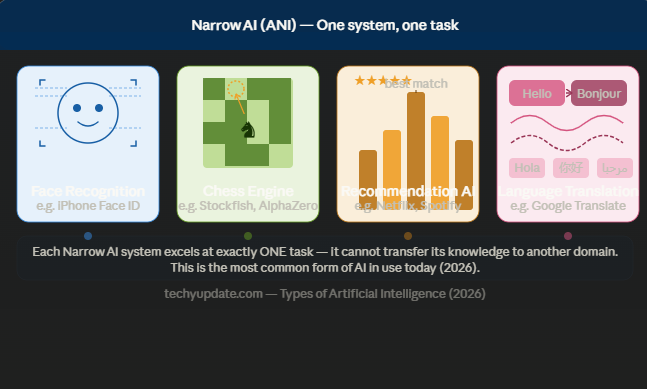
1. Narrow AI (Weak AI)
Narrow AI focuses on a specific task. It performs extremely well but cannot go beyond its programming.
Examples:
- Voice assistants like Siri or Alexa
- Recommendation systems (Netflix, YouTube)
- Chatbots for customer support
Real-world use case:
An e-commerce store uses AI to recommend products based on user behavior. This increases sales and improves user experience.
Key characteristics:
- Task-specific
- High accuracy
- No general intelligence
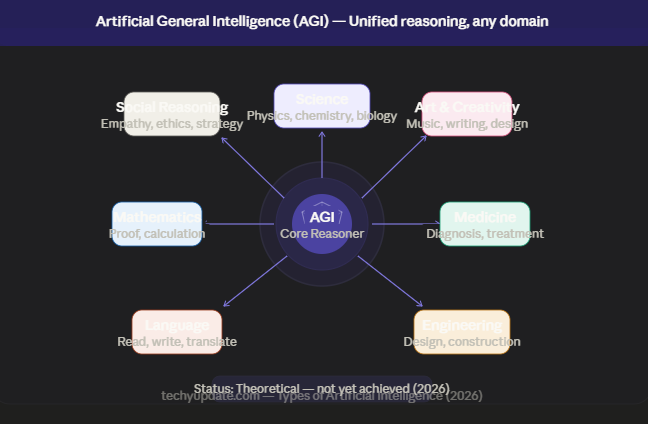
2. General AI (Strong AI)
General AI can perform any intellectual task that a human can do. It understands, learns, and adapts across different domains.
Examples:
- Currently theoretical (not fully developed)
- Research prototypes in labs
Practical insight:
General AI would be able to:
- Write code
- Diagnose diseases
- Drive cars
- Hold conversations like humans
Challenges:
- Ethical concerns
- High computational requirements
- Lack of full cognitive modeling
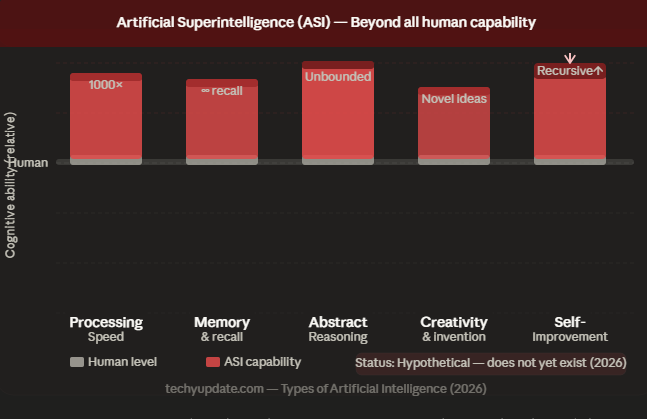
3. Super AI
Super AI surpasses human intelligence in every aspect.
Examples:
- Hypothetical systems
- Often discussed in future predictions
Potential capabilities:
- Advanced decision-making
- Emotional understanding
- Scientific breakthroughs
Risks:
- Loss of human control
- Ethical dilemmas
- Global security concerns
Types of AI Based on Functionality
1. Reactive Machines
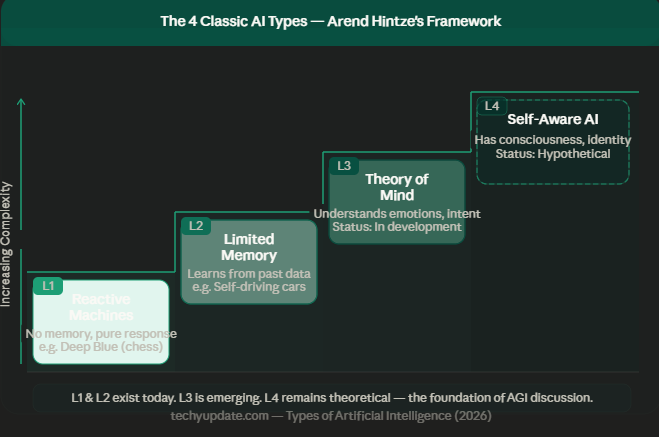
Reactive AI works only with present data. It has no memory.
Example:
IBM’s Deep Blue (chess-playing AI)
How it works:
- Analyzes the current situation
- Makes the best possible move
Limitation:
- Cannot learn from past experiences
2. Limited Memory AI
This is the most commonly used AI today.
Examples:
- Self-driving cars
- Fraud detection systems
How it works:
- Uses past data for decision-making
- Continuously improves performance
Real-world scenario:
A self-driving car:
- Tracks nearby vehicles
- Learns driving patterns
- Makes real-time decisions
3. Theory of Mind AI
This AI understands human emotions, beliefs, and intentions.
Status:
- Still in development
Potential use:
- Advanced customer service
- Emotional AI companions
- Human-like robots
4. Self-Aware AI
This is the most advanced type of AI.
Features:
- Consciousness
- Self-awareness
- Emotional intelligence
Reality:
- Does not exist yet
- Purely theoretical
Comparison Table: Types of Artificial Intelligence
| Type of AI | Capability Level | Memory Usage | Real-World Example | Current Status |
| Narrow AI | Low | Limited | Chatbots, Alexa | Widely used |
| General AI | Human-level | Advanced | Research models | In development |
| Super AI | Beyond human | Highly advanced | Hypothetical | Not developed |
| Reactive Machines | Basic | None | Chess AI | Exists |
| Limited Memory AI | Moderate | Short-term | Self-driving cars | Widely used |
| Theory of Mind | High | Emotional memory | Social robots | Experimental |
| Self-Aware AI | Very high | Full awareness | None | Theoretical |
Tools and Technologies Behind AI Types
Understanding AI requires knowing the tools that power it.
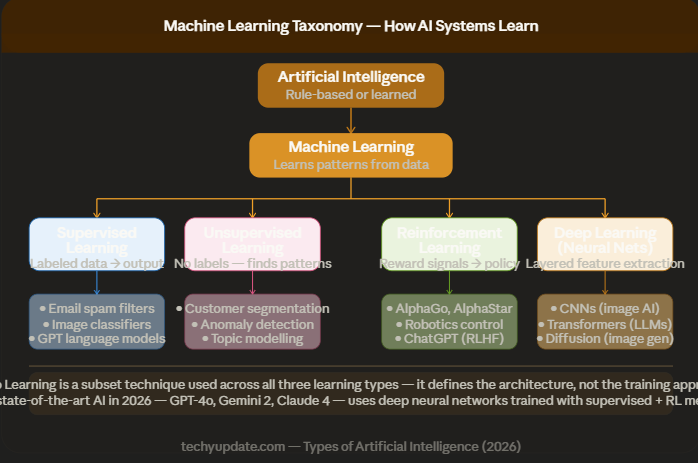
1. Machine Learning (ML)
ML allows systems to learn from data.
Example:
- Email spam filters
How it works:
- Collect data
- Train model
- Predict outcomes
2. Deep Learning
A subset of ML using neural networks.
Example:
- Image recognition systems
Real-world use:
- Medical imaging analysis
- Facial recognition
3. Natural Language Processing (NLP)
Helps machines understand human language.
Example:
- ChatGPT-like systems
- Translation tools
4. Computer Vision
Allows machines to interpret visual data.
Example:
- Security cameras
- Autonomous vehicles
Real-World Applications of AI Types
Healthcare
AI helps doctors diagnose diseases faster.
Example:
- AI scans detect cancer early
Benefit:
- Improves accuracy
- Saves lives
Finance
AI detects fraud and manages investments.
Example:
- Credit card fraud detection
E-commerce
AI personalizes shopping experiences.
Example:
- Product recommendations
Education
AI creates personalized learning paths.
Example:
- Adaptive learning platforms
Common Problems in AI and Practical Solutions
Problem 1: Data Bias
AI systems can become biased.
Solution:
- Use diverse datasets
- Regular audits
Problem 2: Lack of Transparency
AI decisions are often unclear.
Solution:
- Implement explainable AI models
Problem 3: High Costs
Developing AI is expensive.
Solution:
- Use open-source frameworks
- Cloud-based AI services
Problem 4: Security Risks
AI systems can be hacked.
Solution:
- Strong encryption
- Continuous monitoring
Advanced Insights: How AI Types Evolve
AI systems are evolving rapidly due to:
1. Increased Data Availability
More data improves AI accuracy.
2. Better Algorithms
Advanced models enhance performance.
3. Powerful Hardware
GPUs and cloud computing speed up processing.
4. Integration Across Industries
AI is now part of every major industry.
Practical Example: How AI Types Work Together
Let’s take a real scenario:
Smart Home System
- Narrow AI controls lighting and temperature
- Limited Memory AI learns your habits
- NLP AI understands voice commands
Result:
A fully automated, intelligent environment
Pros and Cons of Artificial Intelligence
Advantages
- Improves efficiency and productivity
- Reduces human error
- Automates repetitive tasks
- Enhances decision-making
- Works 24/7 without fatigue
Disadvantages
- High development cost
- Job displacement concerns
- Data privacy risks
- Lack of emotional intelligence
- Dependence on data quality
SEO Perspective: Why Understanding AI Types Matters
If you create content or run a business, knowing AI types helps you:
- Build smarter SEO strategies
- Use AI tools effectively
- Improve user experience
- Automate content workflows
Example:
AI-driven SEO tools:
- Analyze keywords
- Predict trends
- Optimize content
Voice Search Optimization Insight
People now ask questions like:
- What are the types of AI?
- How does artificial intelligence work?
To rank in voice search:
- Use natural language
- Answer questions clearly
- Keep explanations concise
Future of Artificial Intelligence
AI is moving toward:
- More human-like interaction
- Better emotional understanding
- Increased automation
- Ethical AI development
Businesses that adapt early will gain a competitive edge.
Read More: Tech Company Announcements Today
Conclusion
Understanding what are the different types of artificial intelligence, with examples, is no longer optional. It is essential for anyone working in technology, business, or digital marketing.
AI is not a single concept. It is a layered system that includes narrow intelligence, evolving general intelligence, and future superintelligence. Each type plays a unique role in shaping modern applications.
Today, most systems rely on narrow, limited-memory AI. These already power industries like healthcare, finance, and e-commerce. At the same time, research continues to push boundaries toward more advanced forms, such as Theory of Mind and self-aware AI.
The key takeaway is simple: understanding the types of AI helps you make better decisions. Whether you are building products, optimizing content, or exploring new technologies, this knowledge gives you a clear advantage.
Looking ahead, AI will become more integrated into daily life. The sooner you understand it, the better prepared you will be to use it effectively.
Start learning, experimenting, and applying AI concepts today to stay ahead in the evolving digital landscape.
FAQs
1. What are the main types of artificial intelligence?
The main types are Narrow AI, General AI, and Super AI, along with functional types like Reactive Machines and Limited Memory AI.
2. Which type of AI is used today?
Most modern applications use Narrow AI and Limited Memory AI.
3. What is an example of Narrow AI?
Voice assistants and recommendation systems are common examples.
4. Is General AI real?
General AI is still in development and has not been fully achieved yet.
5. What is the most advanced type of AI?
Super AI is considered the most advanced, but it does not exist yet.
6. How does AI learn?
AI learns using data, algorithms, and training models, such as machine learning.
7. What industries use AI the most?
Healthcare, finance, e-commerce, and education use AI extensively.
8. What are the risks of AI?
Risks include bias, security issues, job loss, and ethical concerns.
9. Can AI replace humans?
AI can automate tasks, but cannot fully replace human creativity and emotions.
10. Why is AI important in 2026?
AI drives innovation, improves efficiency, and powers modern digital systems across industries.