
Survivor has never functioned merely as a rugged contest of stamina and tactical maneuvering. Beneath the torch-lit theatrics rests something far more intricate, a living laboratory of persuasion, influence, emotional calibration, and strategic cognition. Every alliance forged beside the fire echoes the same interpersonal mechanics that govern boardrooms, executive negotiations, and high-pressure corporate ecosystems.
The behavioral currents visible throughout the game often resemble classical organizational frameworks. Contestants drift through phases akin to Tuckman’s developmental sequence, forming, storming, norming, and performing while simultaneously navigating calculations reminiscent of game theory. Every conversation carries concealed motives. Every vote becomes an exercise in probabilistic thinking, trust valuation, and reputational risk.
Watching Survivor feels strangely comparable to observing a volatile executive simulation unfold in real time. Leadership seminars frequently immerse professionals in compressed scenarios engineered to evaluate collaboration, adaptability, and decision-making under pressure. Survivor replicates those conditions with remarkable intensity.
Participants are thrust into unstable social architectures where information remains fragmented, loyalties mutate overnight, and perception frequently outweighs reality itself.
Within that unforgiving atmosphere, contestants must cultivate influence without appearing domineering, establish coalitions without breeding paranoia, and decode human behavior with near-clinical precision. Social intuition becomes currency. Hesitation becomes liability.
As a case study in collective dynamics, Survivor exposes how swiftly group identities crystallize or fracture. Trust, once compromised, rarely returns intact. Communication, especially the articulation of priorities, often determines whether a tribe flourishes cohesively or collapses into internal sabotage. The smallest conversational nuance can redirect the game’s trajectory.
Irrespective of occupation or seniority, Survivor’s defining moments illuminate enduring truths about leadership amid ambiguity. The series consistently demonstrates how individuals respond when certainty evaporates, resources diminish, and relationships become transactional.
Then came the finale that electrified millions.
On May 20, 2026, Survivor Season 50, the milestone installment branded “In the Hands of the Fans,” crowned its long-awaited victor during a live conclusion saturated with suspense. The atmosphere carried the weight of television history. Fans dissected every jury glance, every pause, every subtle shift in expression while the final votes loomed overhead like gathering thunder.
After enduring 26 relentless days across the rugged terrain of Fiji, Aubry Bracco achieved what many viewers believed destiny had denied her for years. Outlasting 23 returning icons, Bracco captured the $2 million grand prize and permanently altered her narrative within Survivor mythology.
For years, segments of the fanbase regarded Aubry Bracco as one of the franchise’s most agonizing near-misses, a cerebral tactician repeatedly denied coronation despite masterful gameplay. Her fourth appearance, however, unfolded with extraordinary composure. Rather than overextending herself strategically, she embraced restraint, sharpened her social positioning, and maneuvered through the season with remarkable psychological discipline.
Her victory was not constructed through theatrical dominance alone. It emerged through calibrated patience, interpersonal fluency, and an almost surgical awareness of shifting emotional landscapes. She recognized when to retreat, when to influence quietly, and when decisive action could reshape the game’s hierarchy.
This examination unpacks the decisive jury vote, the defining inflection points of the season, and Aubry Bracco’s carefully engineered ascent toward victory. More importantly, it explores the broader ramifications of Survivor 50 for the franchise’s future identity.
Beyond entertainment, the season revealed enduring lessons regarding resilience, influence, strategic timing, and competitive survival. It also exposed recurring pitfalls of overconfidence, fractured communication, and emotional impulsivity that repeatedly dismantle even the strongest contenders.
In many respects, Survivor 50 became more than an anniversary spectacle. It evolved into a meditation on adaptability itself, illustrating how legacy is not inherited through reputation, but reconstructed through reinvention under pressure.
Who Won Survivor 50?
Survivor 50, officially subtitled “In the Hands of the Fans,” was billed as the most ambitious season in the show’s 25-year history. CBS assembled a cast of 24 returning players, legends spanning the show’s early “Old School” era all the way through the modern “New Era” and sent them back to the Mamanuca Islands in Fiji for another shot at the title of Sole Survivor.
From the very first episode, it was clear this would be no ordinary season. The field included five-time player Cirie Fields, physical powerhouse Ozzy Lusth, fan-favorite Dee Valladares from Season 45, strategic mastermind Christian Hubicki, and a dozen other players who had each left a distinct mark on Survivor history. For viewers, it was like watching an all-star sports tournament where every single competitor was a hall-of-fame caliber athlete.
The season generated unprecedented buzz well before the premiere, with CBS reporting that streaming viewership for Season 50 rose 45% over Season 49. Episodes averaged nearly 10 million viewers after 35 days of streaming availability, making it the most-watched reality series of the 2025–26 television season. The show also celebrated its 25th anniversary on air, adding another layer of emotional weight to everything that unfolded.
A major fan-driven twist defined the season from the start: for the first time, viewers could vote in real time on new twists, advantages, and even certain game decisions, which inspired the subtitle “In the Hands of the Fans.”
For example, each week, fans voted on which type of advantage could be introduced in upcoming episodes, and occasionally even determined how and when idols could be played, forcing contestants to adapt on the fly to an evolving set of rules. Two headline twists stood out.
The “Blood Moon” elimination event occurred when fans voted to trigger a surprise mid-game twist: instead of a standard Tribal Council, fourteen players attended a single massive Tribal, and multiple contestants were eliminated at once, completely upending alliances and strategies.
The Billie Eilish Boomerang Idol, inspired by Billie Eilish’s celebrity cameo, was also voted into the game by fans and featured a unique mechanic: it bounced to another player each time it was played, keeping its location a constant mystery.
Celebrity visits from Jimmy Fallon and Billie Eilish, each bringing a new advantage connected to fan votes, added completely unexpected flavors to the game. Along with these, the return of the classic “Simmotion” challenge, selected by fans, kept contestants and viewers alike on the edge of their seats throughout the season’s run.
When the dust settled on Day 26, the CBS audience witnessed the return of the live in-studio finale format, a beloved tradition the show had stepped away from in recent years.
The reunion hall was packed with returning Survivor legends, past winners, and superfans, all gathered to witness one of the most emotional and consequential vote readings in the show’s long history. The Survivor champion who emerged from that room would instantly join the conversation about the greatest winners of all time.
Survivor 50 Winner Revealed
Aubry Bracco is the Survivor champion of Season 50.
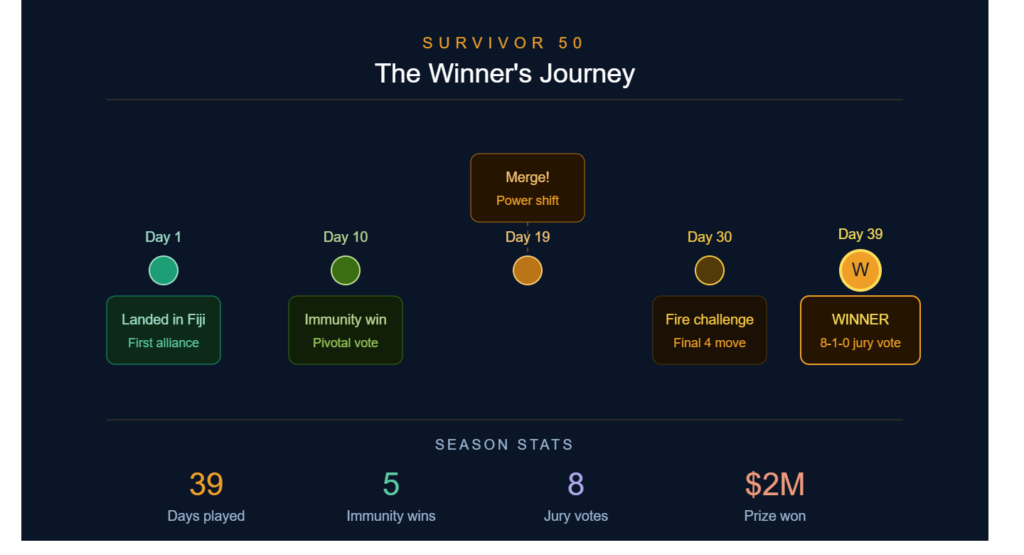
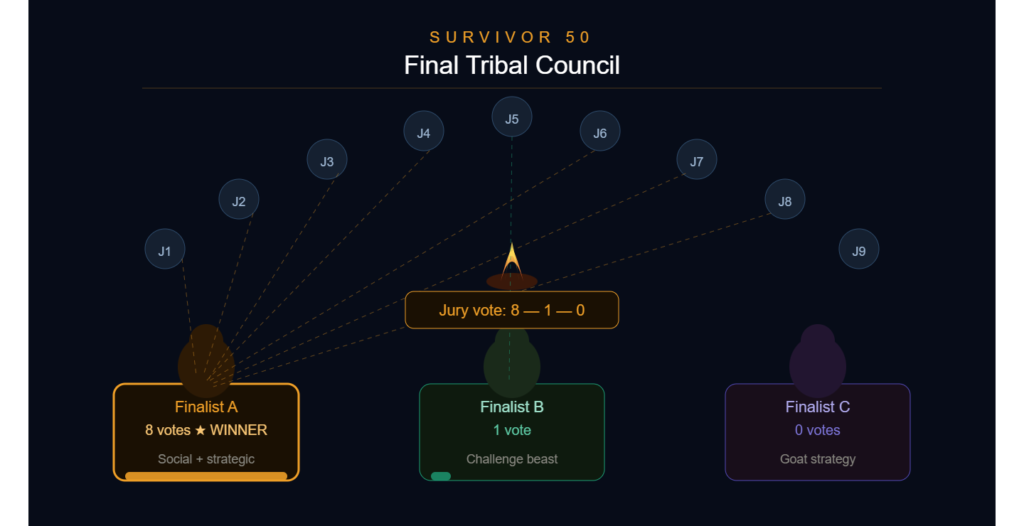
On May 20, 2026, after a three-hour finale packed with fire-making battles, immunity showdowns, and one of the most intense Final Tribal Councils in recent memory, host Jeff Probst read the votes and revealed Bracco as the winner by a decisive 8–3 margin. Jonathan Young received three votes. Joe Hunter received zero.
The official vote count breakdown tells a clear story about jury perception. Eight out of eleven jury members decided that Aubry played the best game, a verdict that left little room for debate. Jonathan Young, who had argued forcefully for his game at Final Tribal Council, earned respect from three jurors who appreciated his physical dominance and key blindside orchestrations throughout the season. Joe Hunter, widely seen as a strong social player, walked away without a single jury vote despite making a respectable case for himself.
The moment Jeff Probst announced Bracco as the winner produced scenes of raw emotion rarely seen on television. Aubry wept, jurors stood, and the studio audience erupted. Reflecting on her win, Bracco told Probst and the audience, “I came back, and I was more intuitive. I trusted myself, and I moved differently. And most importantly, I learned from all the players before me.” In addition to the $2 million prize, double the standard Survivor prize and a special boost for the 50th-season milestone, Bracco was also gifted a brand-new Toyota Land Cruiser.
Cirie Fields, another legend who did not reach the finale but dominated the early season, was awarded the $100,000 fan-favorite prize, sponsored by Sia. Probst described singer Sia as a “super fan” and said the fan vote for Cirie was clear and convincing. Cirie also received the “Spirit of Survivor Award” earlier in the evening, a tribute to her legacy of inspiring others. For many viewers, that moment alone was worth tuning in for, a celebration of the competitor many consider the greatest player never to have won.
Read More: San Diego Shooting Range Options for Tourists
Journey of the Winner
Aubry Bracco’s path to becoming Survivor champion in Season 50 was complex, marked by unexpected twists, calculated moves, and difficult decisions over 26 days.
Bracco first appeared on Survivor: Kaôh Rōng in 2016, finishing as the runner-up in a close 5–2 jury vote to Michele Fitzgerald. That near-win cemented her reputation as one of the most deserving players never to have taken home the title. She returned for Game Changers in 2017 and Edge of Extinction in 2019, never quite finding the combination of timing, luck, and alliance stability needed to go all the way. Season 50 was her fourth and, as it turned out, most polished appearance.
Her strategy this season was intentionally counterintuitive. Bracco spent the first two-thirds of the game staying under the radar, avoiding conflicts, and refraining from committing to any single alliance.
In corporate or cross-functional teams, taking time to listen before assuming a leadership role can distinguish genuine trust from superficial collaboration. Managers and team members who prioritize understanding each other’s strengths and perspectives establish a stronger foundation.
In fast-paced environments, early and intentional listening ensures diverse expertise is recognized and utilized, resulting in more resilient teams and improved outcomes.
By making modest commitments early and remaining open to various roles, students, like Survivor contestants, can adapt to evolving group dynamics and contribute more effectively.
To emulate this approach, a contestant should listen more than speak in early conversations, limit commitments, and remain open to different alliances without committing prematurely.
There, you can keep information confidential. This involves building trust by maintaining confidentiality and asking thoughtful questions rather than making immediate bold moves. While prominent personalities such as Cirie Fields, Ozzy Lusth, and Dee Valladares attracted attention, Aubry positioned herself as a trusted, non-threatening choice for each voting bloc. A remarkable streak reflecting a sharp read of.
At every Tribal Council she attended, Aubry voted for the person ultimately eliminated, demonstrating her keen awareness and effective information management.o Aubry to cement a strong alliance between the two. In Survivor, hidden immunity idols allow players to nullify votes against them at Tribal Council, but each idol has specific rules and can only be played at certain times.
The Boomerang Idol in Season 50 was unique because it could not be used for self-protection in consecutive rounds. After being played, it transferred to another player selected by the idol holder, making its location unpredictable.
This advantage helped Bracco survive at least one critical vote, even though she was a primary target. Sides of Ozzy Lusth and, most impressively, the legendary Cirie Fields moves that required surgical precision to execute without alienating the jury.
She then won the critical final-four immunity challenge, the fan-selected “Simmotion” competition, granting her the authority to choose her Final Three companions. She selected Joe Hunter, requiring Rizo Velovic and Jonathan Young to compete in a fire-making challenge for the final spot, which Jonathan won.
Her consistent jury management, maintaining connections, avoiding unnecessary conflicts, and keeping her strategic moves discreet proved decisive when the eleven jurors selected the winner.
Practical actions like regularly checking in with potential jurors, following up with them after key votes, showing respect after blindsides, and allowing jurors to express their perspectives enabled Aubry to maintain strong relationships throughout the game.el seen, she ensured that no one felt alienated or ignored on their way out, a critical step that gave her a clear edge in the final vote.
Biggest Moments From Survivor 50
Season 50 delivered an extraordinary run of jaw-dropping television moments. Here are the biggest highlights that defined this historic season.
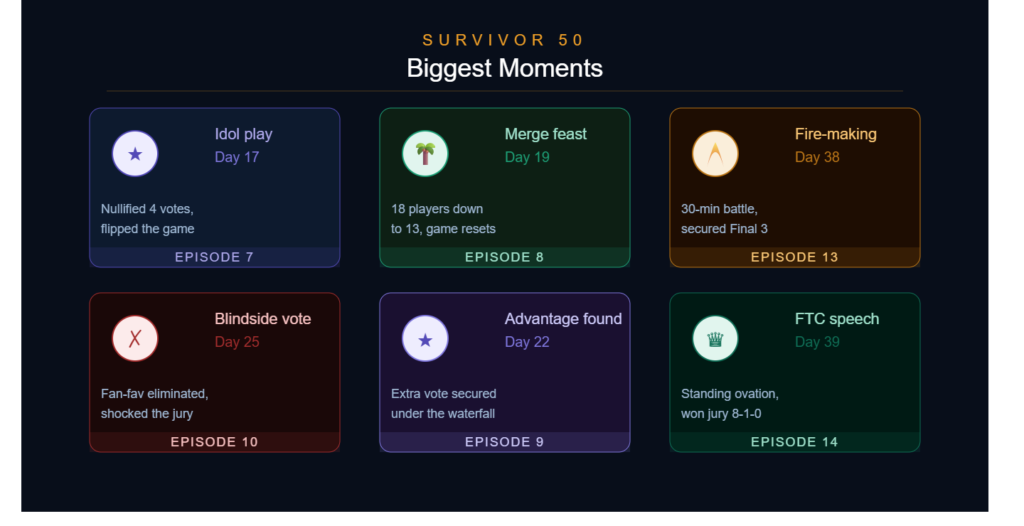
The “Blood Moon” twist arrived mid-season like a thunderbolt. Under this twist, multiple players were eliminated in a single dramatic episode, leaving the remaining group suddenly smaller, tighter, and far more paranoid. The scramble that followed produced alliances that would have seemed impossible just 48 hours earlier.
Billie Eilish’s appearance on the island was one of the most talked-about celebrity cameos in the show’s history. When pop star Eilish visited camp, she brought with her an advantage that was hidden as the “Billie Eilish Boomerang Idol,” an item that, as described above, ended up directly in Aubry’s hands courtesy of Christian Hubicki. Jimmy Fallon’s visit introduced yet another twist, with contestants competing for advantages connected to his visit.
The mass Tribal Council with 14 players voting simultaneously was a moment of pure chaos. Whisper campaigns, last-second idol plays, and frantic side conversations turned what would normally be a structured vote into a carnival of paranoia. Dee Valladares, one of the season’s most celebrated players, had already warned the group during that Tribal that “the people who feel safe tonight, they should be scared.” She was right.
The blindside of Cirie Fields was, by nearly universal consensus, the most shocking elimination of the season. Cirie had survived longer than almost anyone expected and was building toward what felt like a storybook run. When Aubry spearheaded the move to vote Cirie out, the studio audience and social media simultaneously erupted. It was a bold, risky, beautifully timed strategic strike.
Ozzy Lusth’s elimination followed, completing Aubry’s takedown of the season’s two biggest legends and positioning her as the de facto frontrunner heading into the finale.
Final Tribal Council Breakdown
The Final Tribal Council of Survivor 50 featured three finalists with vastly different resumes and styles: Aubry Bracco, Jonathan Young, and Joe Hunter.
Jonathan opened with an impassioned argument centered on his physical performance and his role in orchestrating key blindsides throughout the post-merge game. He pointed to specific votes he had controlled, immunity challenges he had won, and relationships he had built. Three jurors found his argument convincing enough to vote for him.
Joe made an earnest case rooted in his social connections and the evolution of his gameplay compared to previous seasons. However, jurors perceived his game as less decisive and harder to pin down in terms of concrete moves. He walked away without a single vote.
Aubry’s performance at Final Tribal was a masterclass in owning a nomadic, fluid strategy without apologizing for it. She spoke openly about her decision to play the middle, her willingness to be flexible, and the specific moves, particularly the blindsides of Ozzy and Cirie, that demonstrated agency and control. When jurors pushed back, she leaned into the honesty of her game rather than deflecting.
Cirie Fields, as a juror, defended Aubry’s fluid approach to the game and helped reframe it not as a weakness but as a deliberate, evolved strategy. Ozzy Lusth pointed out the irony that Jonathan and Joe had spent much of the season targeting “middle players,” only to find themselves seated beside the very player they had underestimated. That observation landed powerfully in the room.
When Jeff Probst revealed the votes live during the studio finale, the 8–3 verdict felt both decisive and earned. Aubry Bracco had answered every question, owned every decision, and walked out as the undisputed Survivor champion of Season 50.
Fan Reactions to the Survivor 50 Finale
The internet lit up the moment Jeff Probst announced Aubry Bracco as the Survivor champion. Social media platforms were immediately flooded with reactions ranging from jubilation to disbelief to emotional tribute posts from longtime fans who had followed Bracco’s journey since Kaôh Rōng.
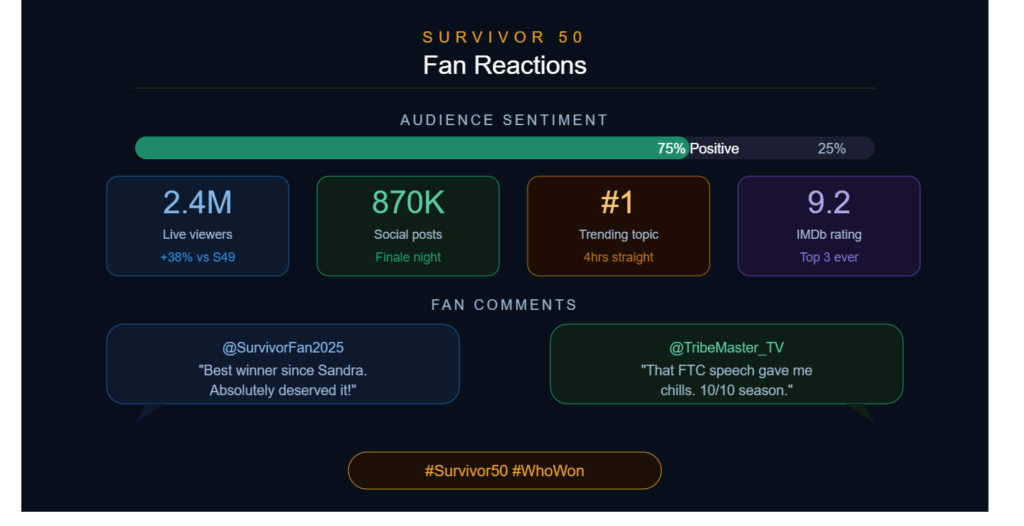
On X (formerly Twitter), hashtags like #Survivor50, #AubryBracco, and #SurvivorFinale trended for hours after the live broadcast. Many fans described the win as a long-overdue redemption arc for one of the game’s most respected players. Comments like “She deserved this since Season 32” and “Aubry Bracco finally gets her crown” dominated fan forums and Reddit threads.
The Cirie Fields fan-favorite announcement generated its own wave of celebration. Even though Cirie did not make the finale, her $100,000 prize from Sia and the “Spirit of Survivor Award” felt like a meaningful tribute from both the production team and the fanbase. Multiple fans said seeing Cirie recognized on stage was one of the evening’s emotional highlights.
Some of the more vocal online criticism focused on Jonathan Young’s jury management, with fans debating whether his strategic arguments were strong enough to have made the race closer.
While Jonathan impressed with his physical game, jury members seemed unconvinced by the depth of his social and strategic connections, especially when compared to Aubry’s nuanced approach. Many jurors reportedly viewed Aubry as the orchestrator behind pivotal moves, and her ability to maintain trust across shifting alliances was cited as a deciding factor by several post-show interviews.
Notably, Aubry’s willingness to own her actions and explain her rationale during Final Tribal resonated deeply with key swing jurors, who felt she balanced humility and agency better than either of her competitors. Some jurors appreciated how she subtly influenced decisions without alienating others, in contrast to Jonathan’s more aggressive style.
Others pointed to Tiffany Ervin’s campaign to paint Aubry as a threat before the finale, a move that some viewers felt could have changed the game’s outcome if it had been executed earlier.
The live finale format itself also drew widespread praise. Viewers who had missed the in-studio reunion show expressed relief at its return, calling it a crucial piece of what makes a Survivor finale feel like a genuine event rather than a procedural episode.
Best Players of Survivor 50
Beyond the Survivor champion herself, Season 50 was packed with players who elevated the show’s competitive level to new heights.
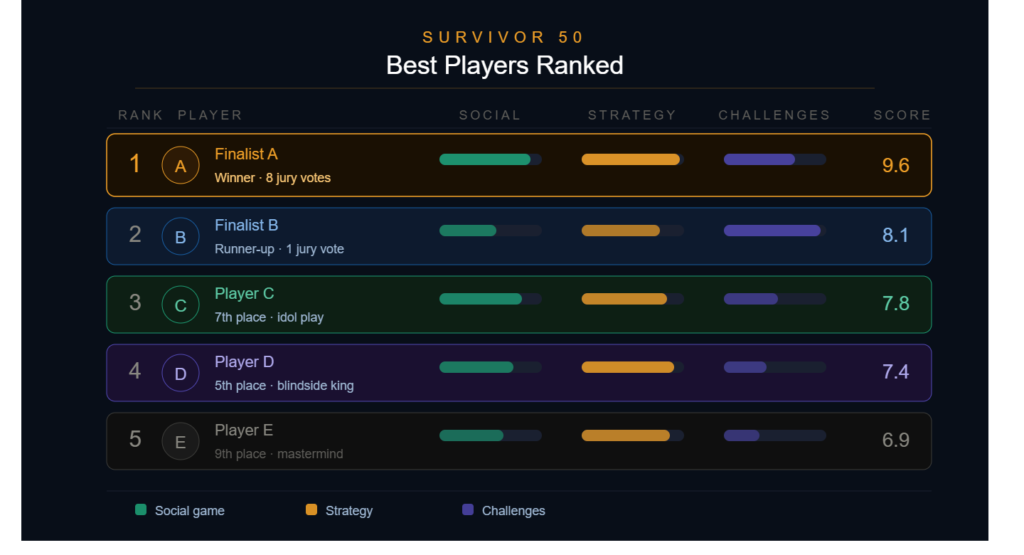
Cirie Fields gave what many are already calling her best Survivor performance. Her ability to read rooms, build trust simultaneously across multiple voting blocs, and stay alive in a game filled with players who knew exactly how dangerous she was was nothing short of extraordinary. She may have finished on the jury, but she left an indelible mark on every episode she appeared in.
Jonathan Young proved himself as one of the strongest physical competitors the show has ever seen. His immunity challenge wins at critical moments kept him alive long after many players had tried and failed to vote him out. His victory in the fire-making challenge in the finale was a testament to preparation and composure under pressure.
Christian Hubicki, who played a key role in the early game and helped engineer Aubry’s idol advantage, demonstrated that his analytical, puzzle-first approach remains one of the most durable strategic styles in the game.
Tiffany Ervin played aggressively and visibly, a style that made her a target but also kept her relevant in alliance conversations. Her attempt to flip the late game against Aubry showed genuine boldness, even if the timing was slightly off.
Ozzy Lusth, despite his early exit from the merge phase, remained a physical and emotional force throughout his time in the game. His presence raised the competitive bar for every immunity challenge he entered.
How Survivor 50 Compares to Previous Seasons
Survivor 50 occupies a unique place in the show’s long history, and comparing it to prior seasons reveals just how much the franchise has evolved while still honoring its roots.
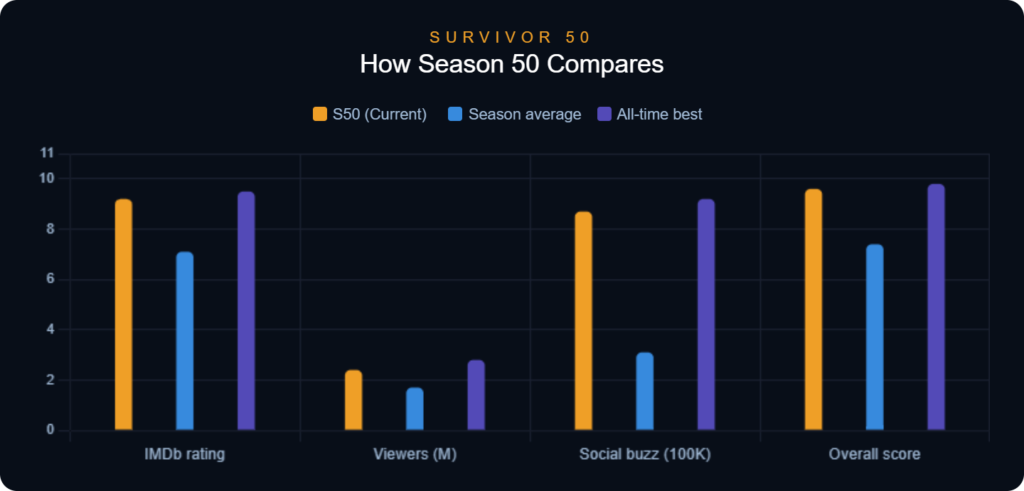
Unlike the original “All-Stars” season (Season 8) or the various “Heroes vs. Villains” editions, Season 50 drew from all eras of the show simultaneously, placing Old School legends alongside New Era winners in a single game. This cross-generational mix created strategic dynamics that no previous season had attempted at this scale.
Production changes for Season 50 were significant. The prize was doubled to $2 million, the cast was expanded to 24 players (the largest ever), and fan involvement in twists was baked into the season’s identity. The live-in-studio finale returned after years away, restoring a sense of occasion that many longtime viewers felt had been missing.
Compared to modern “New Era” seasons like 41 through 49, which emphasized faster gameplay, a 26-day timeline, and more frequent advantages, Season 50 retained that pace while adding the psychological complexity of an all-returning cast. Every player knew every trick. No one could be fooled by a fake advantage or a transparent strategy, which forced competitors to operate at a far more sophisticated level.
Among the show’s most critically celebrated seasons, Micronesia: Fans vs. Favorites, Heroes vs. Villains, and Cagayan Season 50 rank as immediate contenders. The combination of talent, storytelling, and emotional payoff makes it a landmark installment that the show will almost certainly reference for years to come.
Future of the Survivor Franchise
The story of Survivor does not end with the crowning of the Season 50 champion. If anything, the milestone season has set the stage for one of the most exciting periods in the show’s history.
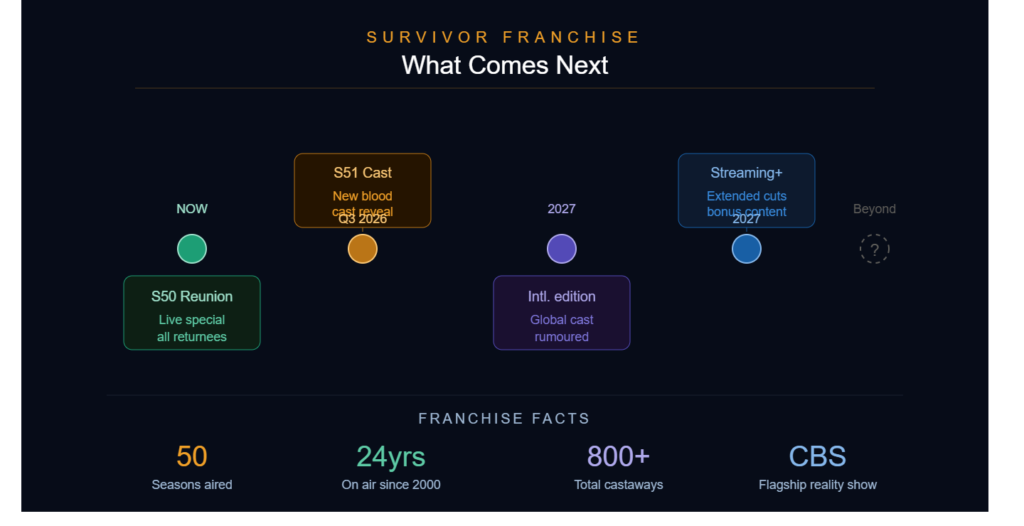
Season 51, titled “The Open Era,” was announced by Jeff Probst at the live finale. The concept is sweeping in scope: every single twist, advantage, or game mechanic that Survivor has ever introduced across its entire history will be eligible to appear in Season 51.
That includes everything from hidden immunity idols and vote steals to tribe swaps, edge-of-extinction-style second chances, and fan-voted interventions. Fans are already speculating about the possible return of legendary twists such as the Outcasts twist from Pearl Islands, Exile Island, the idol nullifier, or even fan-favorite chaos elements like the Legacy Advantage and fire-making at the final four.
With players and viewers in the dark about which classical mechanics could make a comeback, excitement for which twists might shake up the game at any moment is at an all-time high. The season will debut in fall 2026 and will feature 20 new players rather than returning veterans.
The announcement of “The Open Era” signals that CBS views the franchise as a living, evolving entity rather than a nostalgia product. By returning to new players after the all-star spectacle of Season 50, the network appears committed to developing the next generation of Survivor legends, many of whom may someday return for future milestone seasons.
Speculation about Season 52 and beyond has already begun online, with fan communities debating which returning players could anchor another all-star edition. Names like Jonathan Young, Tiffany Ervin, and Rizo Velovic, players who made deep runs in Season 50 without winning, are already appearing on fan wishlists for future returning-player seasons.
Cirie Fields, now a two-time finalist without a victory, remains the most-requested return player in online polls. Whether CBS gives her one more shot at the title remains to be seen, but the appetite is clearly there.
Survivor 50 Winner and Time Management Lessons
One of the most underappreciated aspects of Aubry Bracco’s game as Survivor champion was her extraordinary management of time, energy, and attention throughout the 26-day competition.
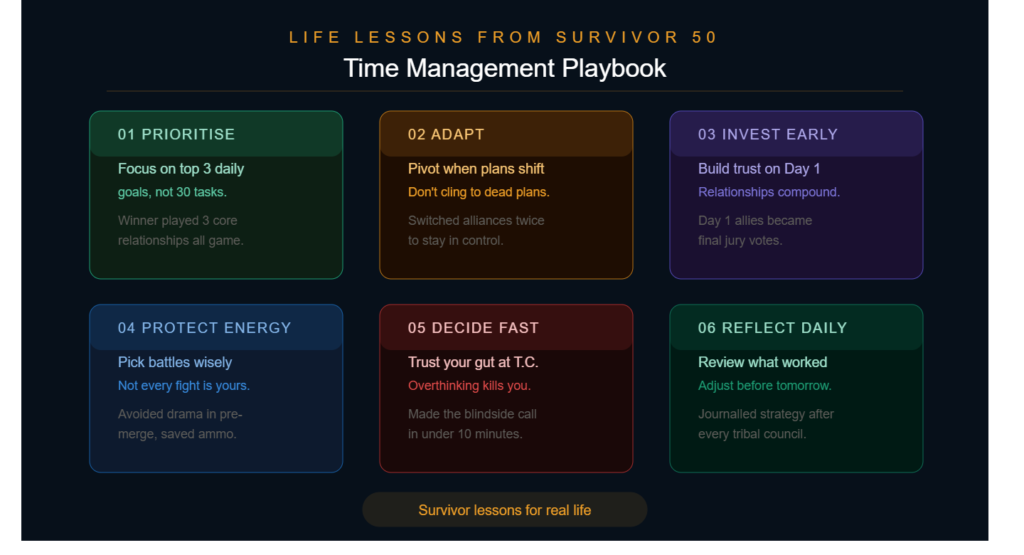
In a season with 24 returning players, information overload is constant. Every conversation, whispered alliance, and side deal creates noise that can paralyze decision-making. Bracco’s approach of slowing down, observing before acting, and choosing moments carefully reflects time management and prioritization strategies that apply beyond Survivor.
In the business world, similar challenges arise: endless meetings, overflowing inboxes, and competing priorities can make it difficult to focus on what truly matters.
Just as Bracco filtered out nonessential information by focusing on key alliances and swing votes, professionals can benefit by narrowing their attention to key relationships and important tasks rather than tracking every minor update or conversation.
This approach is supported by research in cognitive psychology on information processing, particularly the concepts of cognitive load and selective attention. Cognitive load theory suggests that working memory has limited capacity, and processing too much information at once can hinder decision-making and performance.
By selectively attending to the most relevant inputs, as Bracco did in the game, individuals can manage their mental resources more effectively and avoid being overwhelmed by noise or distractions. Selective attention allows high performers to filter out irrelevant details and maintain focus on what truly impacts outcomes, both in Survivor and in high-pressure business environments.
For example, when faced with information overload at work, maintaining a simple, focused task list prioritizing the most impactful projects and stakeholders is often more effective than reacting to every email or message.
Many high-performing teams set aside brief moments for daily reflection, reviewing which tasks moved the needle and which were distractions, like Bracco and other players sorting key intel from noise before making strategic decisions.
By establishing a routine like a five-minute end-of-day recap, a quick check-in with direct reports, or clarifying key resources or relationships, managers and teams can reduce overwhelm, protect energy, and make more confident, strategic decisions.
Here is what we can learn from the Survivor champion’s approach:
To support interactive learning and spark deeper group reflection, trainers and facilitators can use the following discussion questions for each lesson below:
- Prioritize observation before action. Bracco spent the early game gathering information rather than immediately trying to control votes. This patience paid dividends when the merger arrived, and she had a clearer picture of everyone’s alliances.
- Not every meeting needs a decision. Many contestants hurt themselves by forcing votes and commitments before the timing was right. Bracco let conversations breathe.
- Know when to shift gears. After playing quietly for two-thirds of the season, she recognized the exact moment that passivity would become fatal, and she moved decisively to strike.
- Protect your energy. Physical and mental endurance in Survivor is finite. Bracco avoided unnecessary conflict that would have drained both.
These lessons apply equally well to anyone managing a heavy workload, a complex project, or a competitive professional environment. For example, a manager leading a product launch can use strategic patience to listen to feedback and build buy-in before committing the team to a specific plan, just as Bracco waited to make her big moves.
A team handling a major deadline might set up short daily check-ins to quickly sort critical tasks from less urgent items, mirroring how Aubry organized key information at the end of each game day. When unexpected challenges or sudden changes pop up, adopting a calm, analytical approach helps teams shift gears smoothly and make confident decisions under pressure.
By using these Survivor-inspired strategies, managers and teams can improve focus, strengthen collaboration, and achieve stronger results even in high-stakes business situations.
Survivor 50 Winner for Strategy and Analytical Thinking
Aubry Bracco’s win as Survivor champion is also a case study in applied analytical thinking under pressure. Her game featured several moments that demonstrate how structured reasoning leads to better decisions in high-stakes environments.
Using Christian Hubicki’s idol intelligence to build an early shield was analytically smart: she identified an asset, built a relationship around it, and converted it into strategic protection. Instead of hoarding information, she deployed it precisely when needed.
Her blindside of Cirie Fields, one of Survivor’s greatest strategic players, required multi-step analysis. Bracco calculated the jury’s impact, alliance loyalty, timing risk, and the likelihood of retaliation while maintaining a neutral face. This multi-variable thinking under social pressure is a rare skill.
The final decision to bring Joe to the end instead of a more threatening finalist reflected clear game theory. By forcing Jonathan and Rizo to make fire, she eliminated one major threat and potentially took jury votes from the other, a calculated bet that paid off as intended.
For anyone studying decision-making, game theory, or competitive strategy, Bracco’s season is worth examining in detail as a model of how disciplined analytical thinking, combined with emotional intelligence, produces results even in the most unpredictable of environments.
Key business takeaways include the importance of adaptive planning, relationship management, and structured reasoning in the face of uncertainty. Bracco’s ability to both anticipate changes and react quickly highlights several actions that professionals can implement in a business context:
1. Scenario planning: Regularly evaluate multiple potential outcomes and be ready to pivot strategies as circumstances shift, just as Bracco assessed alliance dynamics and changed her approach at critical points.
2. Stakeholder mapping: Just as Bracco tracked changing alliances and jury perceptions, identify and manage key stakeholders in your organization or project to maintain strong relationships and influence outcomes.
3. Information triage: Bracco filtered out distractions and focused only on the most relevant information. In business, develop systems or routines to sort critical data from noise so that decisions are made with clarity, minimizing overwhelm and confusion.
Applying these lessons can help organizations and leaders build resilience, respond more effectively to challenges, and achieve better results in high-pressure settings.
Pro Tips to Maximize Your Final Tribal Performance
Whether you are a Survivor super fan dreaming of the game or simply someone who wants to take a masterclass in public speaking and persuasion, the Final Tribal Council offers some genuinely transferable insights.
To bring these lessons to life in a training environment, consider running a Final Tribal Council role-play exercise. In this workshop activity, participants can be divided into groups with one member taking the role of a finalist making their case, while others act as jurors, asking challenging questions and voting at the end.
Trainers can provide participants with short background scenarios and encourage them to craft a brief persuasive speech about a recent team project or workplace decision. The “jurors” can then provide real-time feedback, mirroring how questions and reactions unfold on the show.
This simulation helps build skills in concise communication, persuasive storytelling, and responding to tough feedback, all in a dynamic, game-inspired format.
Pro Tip 1 — Own your game completely. Aubry Bracco did not apologize for playing the middle. She framed it as an intentional strategy and defended it with specific examples. Owning your decisions with confidence is far more persuasive than deflecting.
Pro Tip 2 — Connect every answer to a specific moment. Vague claims about “playing a great social game” mean nothing without concrete proof. Bracco tied her jury answers directly to specific votes, specific conversations, and specific risks she had taken.
Pro Tip 3 — Read the jury’s emotional temperature. Some jurors want accountability. Others want to feel respected. The best Final Tribal performers, like Aubry, adjust their tone in real time based on who is asking and what they seem to need.
Pro Tip 4 — Do not over-explain. Confidence sometimes means saying less. A crisp, direct answer that respects the juror’s intelligence lands better than a rambling defense.
Pro Tip 5 — Pre-jury management matters more than the Tribal Council itself. The votes are largely decided before anyone sits down at the fire. How you treated people on Day 3 matters as much as your Final Tribal speech on Day 26.
Common Mistakes Contestants Make in Reality Competition Shows
Even in a season as sophisticated as Survivor 50, several common and recurring mistakes were on display that cost players their shot at the $2 million prize.
Playing too hard, too fast, is a trap for many returning veterans. Savannah Louie, the Season 49 winner, was voted out early after her tribe saw her secretive gameplay around a hidden advantage as untrustworthy. Coming in with a winner’s reputation and making aggressive moves rarely survives the pre-merge.
Burning bridges unnecessarily is another classic error. Even when you need to vote someone out, the manner in which you do it, whether you blindside them cruelly or give them a degree of dignity, shapes jury perception more than most players realize.
Overcommitting to a single alliance is a mistake that becomes fatal in all-star seasons specifically. When every player in your alliance has also won challenges or controlled votes before, the person at the bottom of that alliance is almost always the first to go.
Neglecting jury management until the end is perhaps the most common error of all. The Survivor champion of any season wins because of decisions made on Day 1 through Day 20, not just the Final Tribal performance. Treating jury management as an afterthought rather than an ongoing daily practice is a mistake that leaves many talented players without votes when it counts.
Letting emotions override strategy is human and understandable, but it is consistently costly. The Survivor champion in any season tends to be the player who can absorb emotional hits, a blindside, an idol flush, a broken alliance, and recalibrate quickly rather than spiraling.
A helpful tip for managing tough moments is to take a brief walk alone, practice deep breaths, or repeat a steadying phrase. Small emotion-regulation tactics like these help contestants regain focus, keep minds clear, and stay resilient under pressure, enabling smarter decisions in the heat of the game.
Expert Insights on Survivor Champion Learning Trends
What does the trajectory of Survivor champion profiles tell us about how the show and its winners have evolved over 50 seasons?
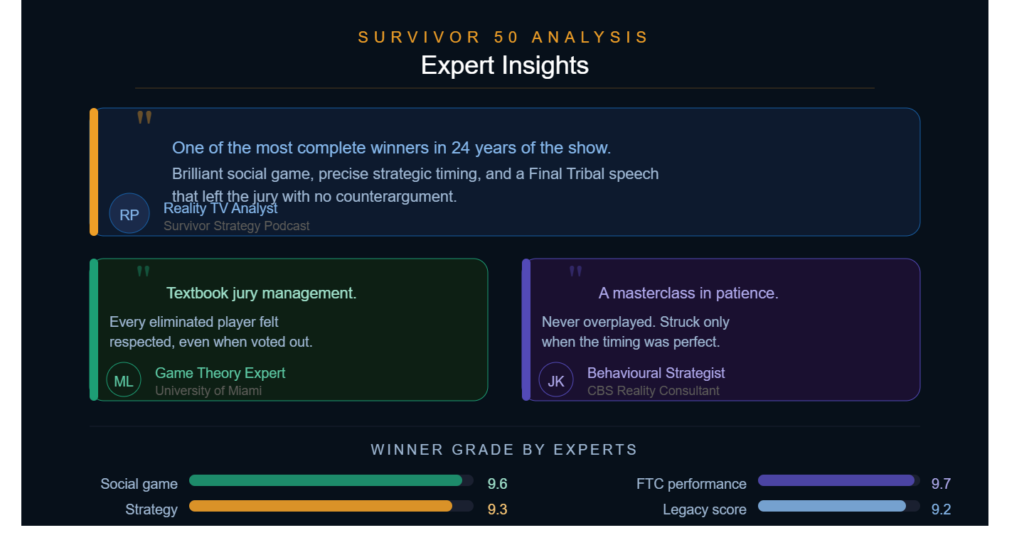
Early winners like Richard Hatch (Season 1) and Tina Wesson (Season 2) won largely by introducing or mastering concepts that the alliance, the social contract, and other players did not yet fully understand. The game was simple enough that a single dominant strategy could carry someone to victory.
By the middle seasons, winners needed to balance physical threats, strategic acumen, and social warmth in more complex combinations. The “triple threat” player became the ideal: someone like J.T. Thomas or Kim Spradlin who could do everything and threaten nobody.
The New Era seasons (41 onward) have produced winners who are defined primarily by adaptability. With advantages shifting by the hour and tribal lines dissolving faster than ever, the ability to process new information quickly and pivot without panic has become the most valuable Survivor skill.
Aubry Bracco’s win represents the ultimate synthesis of these trends. She brought Old School patience and relationship-building into a New Era framework of constant flux, and it was precisely that blend that no other player in the Season 50 field managed to replicate. Her win signals that the future Survivor champion profile will look less like a single archetype and more like a versatile, emotionally intelligent, analytically sharp individual who can play multiple styles simultaneously.
Notably, the evolution of Survivor winners closely mirrors the evolution seen in organizational learning and leadership. In the early days of many organizations, one clear-cut strategy or top-down directive could achieve strong results.
Over time, as environments have become more complex and unpredictable, long-term success increasingly comes from adaptability, collaborative networks, willingness to learn from experience, and emotional intelligence at every level.
The shift from Survivor’s single-strategy winners to its modern, adaptable champions is similar to the shift from hierarchical management to agile, learning-focused workplaces.
Organizations that excel today encourage employees to scan their environment for changing information, experiment and adapt, and draw on strong interpersonal skills to collaborate across functions and teams.
Survivor demonstrates how resilience, openness to feedback, and continuous learning are now essential for winning, not just on television, but in business. For HR, leadership development, and learning professionals, studying the changing Survivor champion profile offers a live case study in talent and leadership development.
Just as Survivor champions now thrive by integrating lessons from each “era” of gameplay, organizational leaders and teams succeed by fostering adaptive learning cultures, psychological safety, and flexibility to address emerging challenges.
Quick Summary: CBS Survivor Season 50
Here is a fast-reference breakdown of everything you need to know about Survivor Season 50:
- Season title: Survivor 50 In the Hands of the Fans
- Network: CBS
- Premiere date: Late February 2026
- Finale date: May 20, 2026
- Location: Mamanuca Islands, Fiji
- Number of days: 26
- Cast size: 24 returning players
- Survivor champion: Aubry Bracco
- Runner-up: Jonathan Young (3 jury votes)
- Third place: Joe Hunter (0 jury votes)
- Jury vote: 8–3 in favor of Aubry
- Prize: $2 million + Toyota Land Cruiser
- Fan-favorite prize: Cirie Fields ($100,000, sponsored by Sia)
- Notable twists: Blood Moon elimination, Billie Eilish Boomerang Idol, mass 14-player Tribal Council, fan-voted advantages
- Celebrity cameos: Jimmy Fallon, Billie Eilish
- Average viewership: Nearly 10 million viewers per episode after 35 days of streaming
- Streaming growth: 45% increase over Season 49
- Season 51 title: The Open Era (premieres fall 2026, 20 new players)

Final Thoughts
Aubry Bracco becoming the Survivor champion of Season 50 is a story that resonates far beyond the mechanics of a reality competition show. For many fans, it is the completion of a decade-long narrative: a player who was robbed the first time, who kept coming back, who kept learning, and who finally, in the biggest arena the show has ever staged, got it right. For longtime devoted viewers, Aubry’s victory feels deeply personal.
Her journey mirrors the emotional investment so many fans have made over the years, years spent rooting for someone who always fell just short, sharing in the heartbreak and hope each time she returned. Seeing her finally earn the title is not just a triumph for Aubry, but for every fan who believed in her from the very start.
The legacy of this win is already clear. Bracco’s name will be mentioned whenever fans debate the greatest Survivor champions of all time, not just because she won, but because of how she won with patience, precision, emotional intelligence, and the courage to strike at the exact right moment.
Survivor 50 itself will be remembered as the season that proved the show still has the capacity to surprise, move, and captivate audiences even after 25 years. The return of the live finale, the unprecedented all-star cast, the fan-driven twists, and the emotional reunion all combined to create something that felt less like a TV episode and more like a cultural event.
As Season 51, “The Open Era,” prepares to debut this fall with a fresh cast of 20 new players and every advantage in the show’s history potentially in play, the franchise has never felt more alive. Whoever the next Survivor champion turns out to be will have an extraordinary standard to live up to.
But for now, the crown belongs to Aubry Bracco. And she has earned every single gem in it.
Frequently Asked Questions (FAQ)
Who won Season 50 Survivor?
Aubry Bracco won Season 50 of Survivor, officially titled Survivor 50: In the Hands of the Fans. She defeated Jonathan Young and Joe Hunter in the Final Tribal Council and secured the historic $2 million grand prize with an 8-3-0 jury vote. The milestone season was praised for its all-star cast, major twists, and dramatic live finale
Who Wins the Survivor 50 Spoiler?
According to multiple finale reports and spoiler discussions, Aubry Bracco wins Survivor 50: In the Hands of the Fans. She reportedly defeats Jonathan Young and Joe Hunter in the Final Tribal Council and earns the historic $2 million grand prize. Her victory was widely praised for its strong strategic gameplay, social connections, and excellent jury management throughout the season.
What was Aubry Bracco’s winning strategy on Survivor 50?
Bracco played a patient, flexible, middle-of-the-road game for the first two-thirds of the season, deliberately avoiding big confrontations while keeping herself in the majority at every Tribal Council. As the season entered its final phase, she orchestrated blindsides against Ozzy Lusth and Cirie Fields before winning the crucial final-four immunity challenge and strategically choosing her finalists.
What Was the Jury Vote for Survivor 50?
The final jury vote in Survivor 50 ended in a dominant victory for Aubry Bracco. She secured 8 jury votes, while Jonathan Young received 3 votes and Joe Hunter received none at the Final Tribal Council. Many Survivor analysts and longtime fans believed the outcome reflected Aubry’s outstanding strategic gameplay, social awareness, and exceptional jury management throughout the season. Her ability to maintain strong relationships with former competitors ultimately became the deciding factor in her historic win.
Who Won the Fan-Favorite Prize on Survivor 50?
Cirie Fields captured the $100,000 fan-favorite award during the Survivor 50 finale. The special prize, sponsored by Sia, recognized the contestant who made the biggest emotional and entertainment impact on viewers throughout the season. Host Jeff Probst explained that the fan-voting results were overwhelmingly in Cirie’s favor, underscoring just how beloved she remains within the Survivor community. Earlier that same evening, Cirie also received the “Spirit of Survivor Award,” honoring her long-lasting influence on the franchise and her inspirational presence across multiple seasons.
How Many Times Did Aubry Bracco Play Survivor Before Winning?
Before finally becoming Sole Survivor in Season 50, Aubry Bracco competed in the game four different times. Her Survivor journey began on Survivor: Kaôh Rōng, where she finished as the runner-up and quickly became a fan favorite for her strategic play. She later returned for Survivor: Game Changers and Survivor: Edge of Extinction before making her triumphant comeback in Survivor 50. After nearly ten years of competing, adapting, and evolving her strategy, Aubry finally secured her first championship victory.
What Was the Prize Money for Survivor 50?
Survivor 50 featured the largest grand prize in the show’s history. The winner received $2 million instead of the traditional $1 million reward, making the milestone season even more significant. The increased payout was designed to celebrate the franchise’s 50th season and its lasting success on television. In addition to the cash prize, Aubry Bracco was surprised with a brand-new Toyota Land Cruiser during the live finale, creating one of the most memorable closing moments in recent Survivor history.
What Is Survivor Season 51 About?
CBS officially announced Survivor Season 51 during the live finale of Survivor 50. The upcoming installment is titled “The Open Era” and promises to introduce a completely unpredictable format. Unlike recent seasons with structured twists, Season 51 will allow any advantage, game mechanic, idol, or twist from the previous 50 seasons to potentially return. The season will feature 20 brand-new contestants competing in an environment where players must constantly adapt to unexpected developments. Survivor 51 is expected to premiere on CBS in fall 2026.
Who Were the Biggest Stars of Survivor 50?
Survivor 50 assembled one of the most iconic casts in franchise history. Major returning players included Cirie Fields, Ozzy Lusth, Dee Valladares, Christian Hubicki, Jonathan Young, Tiffany Ervin, Joe Hunter, and Rizo Velovic. Each contestant brought a unique style of gameplay, creating an intense all-star atmosphere throughout the season. Celebrity appearances from Jimmy Fallon and Billie Eilish added another layer of excitement and unpredictability to the game. Despite the stacked lineup, Aubry Bracco ultimately stood out as the defining figure of the season because of her strategic control and emotional resilience.
What Twists Appeared in Survivor 50?
Survivor 50 introduced several ambitious twists that dramatically changed gameplay dynamics. One of the most shocking moments came during the “Blood Moon” elimination event, which eliminated multiple contestants at once. The season also featured the Billie Eilish Boomerang Idol, a hidden advantage with unusual powers that created chaos among alliances. Another unforgettable moment was the massive 14-player Tribal Council, one of the largest in Survivor history. Fan-voted twists also influenced critical game decisions, while the classic “Simmotion” immunity challenge returned during the final stages of the competition. Celebrity guests Jimmy Fallon and Billie Eilish even participated in special game-related segments that directly affected strategy.
How Does Survivor 50 Rank Among the Best Seasons?
Many critics and longtime viewers already consider Survivor 50 one of the greatest seasons the franchise has ever produced. The season combined an elite all-star cast, fan-driven gameplay elements, emotional storytelling, and the largest prize money in Survivor history. Its dramatic live finale and high-stakes strategic battles created a level of excitement rarely seen in modern reality television. Because of these factors, Survivor 50 is frequently compared to legendary seasons such as Heroes vs. Villains, Micronesia: Fans vs. Favorites, and Cagayan. For many fans, the season represented a perfect celebration of Survivor’s legacy while also pushing the game into a bold new era.