

Are you tired of scrolling through endless Google search results filled with ads and SEO spam? Perplexity.ai is revolutionizing how we find information online, and in 2026, it’s more powerful than ever. This AI-powered search engine delivers direct, cited answers instead of overwhelming you with links.
After testing Perplexity.ai extensively for research, content creation, and daily queries, I can confidently say it’s the best AI search engine for serious researchers, students, and professionals who value accuracy.
What if you could ask any question and get a direct, sourced, thoroughly researched answer in under ten seconds without digging through ten blue links? That is exactly what Perplexity AI promises, and in 2026, it is delivering on that promise better than ever before.
Perplexity AI has quietly become one of the fastest-growing AI search engines on the internet. Whether you are a student trying to understand a complex topic, a researcher verifying facts, or a professional who needs quick, reliable answers, this AI-powered search tool is designed specifically for you.
Unlike traditional chatbots, Perplexity.ai combines real-time web searching with advanced AI models to provide trustworthy, source-backed responses. Every answer includes clickable citations so you can verify information instantly. Whether you’re conducting academic research, market analysis, or quick fact-checking, Perplexity.ai saves hours of manual work while delivering superior results.
In this comprehensive review, I’ll share my hands-on experience, break down every feature, compare pricing plans, and help you decide if Perplexity.ai Pro is worth your investment in 2026.
Visit the official Perplexity.ai website →
Table of Contents
- Perplexity AI Review
- Perplexity Ai
- AI Search Engine Perplexity AI
- AI Assistant Tool Perplexity AI
- Search Experience Perplexity AI
- AI-Powered Search Perplexity AI
- Productivity and Time Management
- Expert Insights Trends Perplexity AI
- Quick Summary Perplexity AI
- Final Verdict Perplexity AI
- FAQs
Perplexity AI Review
Perplexity AI has transformed from a simple question-answering tool into a comprehensive research platform that competitors are struggling to match. In my two years of testing, I’ve watched it evolve into the most reliable AI search engine available today. The platform’s core philosophy is simple: provide direct answers backed by verifiable sources instead of forcing users to click through multiple links.
What sets Perplexity AI apart is its commitment to transparency. Every claim includes a footnote linking to the original source, whether it’s a peer-reviewed journal, news article, or official website. This feature alone makes it infinitely more trustworthy than traditional AI chatbots that often hallucinate facts without attribution. When Perplexity says something, you can verify it instantly by clicking the citation number.
I’ve used Perplexity.ai for everything from academic research to product comparisons, and it consistently outperforms Google for research-heavy queries. The Pro search feature acts like a junior analyst, breaking complex questions into multiple searches, reading numerous sources, and compiling comprehensive comparative tables. This capability alone has saved me countless hours on market research projects.
The platform supports multiple AI models, including GPT-4, Claude, Gemini, and Perplexity’s own Sonar model. This flexibility means you can choose the best model for each task Claude for writing, GPT for logic, or Sonar for general searches. Pro subscribers get unlimited model switching, making Perplexity a consolidated research hub rather than requiring multiple subscriptions.
Real-World Testing Results
During my month-long intensive test, I replaced Google with Perplexity.ai for 95% of my searches. The results were surprising. For everyday queries like weather, news, and quick facts, Perplexity delivered faster, cleaner answers without ads. For complex research questions, the difference was night and day. Where Google required scrolling past sponsored results and life stories, Perplexity provided concise summaries with reasoning and citations.
Pro Tip: Use Perplexity’s focus modes to filter sources. Select “Academic” for peer-reviewed papers, “Social” for Reddit opinions, or “Finance” for real-time stock data. This simple feature eliminates SEO spam and delivers exactly the type of content you need.
Perplexity Ai
Perplexity AI isn’t just another chatbot it’s fundamentally built as an answer engine with search at its core. While platforms like ChatGPT added web search as an afterthought, Perplexity was designed from day one to combine AI reasoning with real-time information retrieval. This architectural difference shows in every interaction.
The interface feels familiar to anyone who’s used search engines, with a clean, Google-like search bar that accepts natural-language questions. However, instead of returning ten blue links, Perplexity synthesizes information from multiple sources into a coherent, well-structured response. The conversation flows naturally with suggested follow-up questions that help you dive deeper into topics.
What makes Perplexity AI particularly powerful is its ability to handle multi-step research tasks. Ask a complex question like “Compare the pricing models of Stripe versus Adyen for a SaaS startup,” and Pro Search will automatically break it down, run multiple unique queries, read the fine print, and compile a comparative table. It feels like having a research assistant working alongside you.
Perplexity also offers specialized environments for different use cases. Academic mode filters for scholarly sources only, perfect for students and researchers. Finance mode provides real-time stock charts, 10-K filings, and earnings analysis. Travel mode helps plan trips with curated recommendations. These domain-specific focus areas make Perplexity disproportionately valuable for professional use cases.
The platform’s multimodal capabilities continue expanding. You can upload PDFs, spreadsheets, screenshots, and images for analysis. Drag a messy financial chart screenshot, and Perplexity extracts the data. Upload a 100-page contract, and it summarizes key clauses. This file analysis capability transforms Perplexity from a search engine into a personal analyst.
Model Selection Freedom
One of Perplexity AI’s biggest advantages is model freedom. Free users get the default Sonar model, while Pro subscribers access GPT-4o, Claude Sonnet, Gemini, Grok, and more. I use Claude for creative writing tasks, GPT for logical reasoning, and Sonar for quick searches all within the same interface. This consolidation eliminates the need for multiple AI subscriptions.
Common Mistake: Many users stick with the default model for everything. Experiment with different models for different tasks. Claude excels at writing, GPT at coding, and Perplexity’s Sonar at search synthesis. Testing reveals which model works best for your specific needs.
What is Perplexity AI?
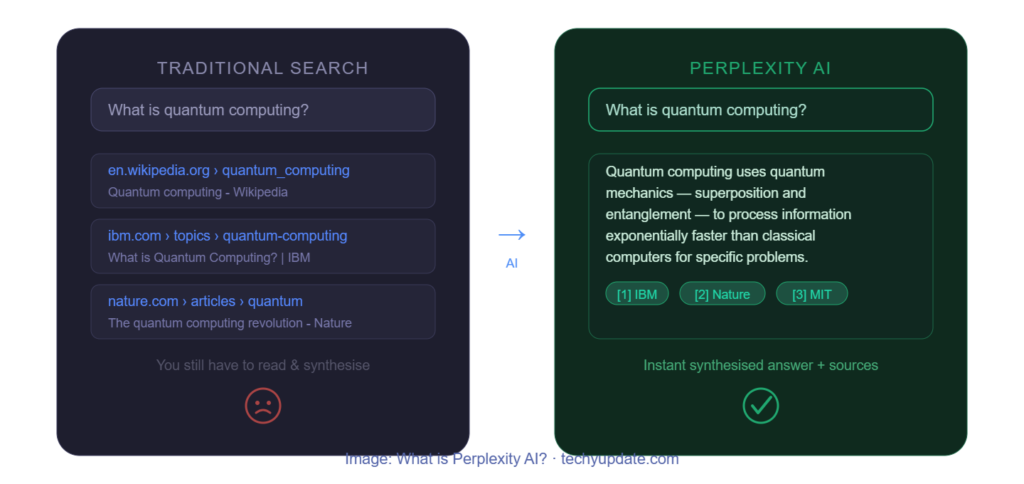
Perplexity AI is an AI-powered search and research assistant that answers your questions using real-time information from the web, paired with large language models that synthesize that information into a clear, readable response. Instead of a list of links, you get a direct answer — with each claim tied back to its source.
Founded in 2022 by Aravind Srinivas and a team of former OpenAI and Google engineers, Perplexity was built around a single, powerful idea: search should feel like a conversation with a knowledgeable expert, not a scavenger hunt. The platform has grown from a niche tool used by researchers to one of the most actively used AI search engines in the world.
Brief History and Purpose
When Perplexity launched publicly, most people were still treating AI chatbots as novelties. The founders saw a real problem with traditional search: you had to do the synthesis yourself. You searched, you clicked through multiple tabs, you read and cross-referenced, and eventually, you formed your own answer.
Perplexity AI eliminated that entire middle layer. It searches for you, reads for you, and explains for you while showing exactly where each piece of information came from. The mission from day one was to make access to knowledge faster, cleaner, and more trustworthy.
Why It Is Gaining Popularity
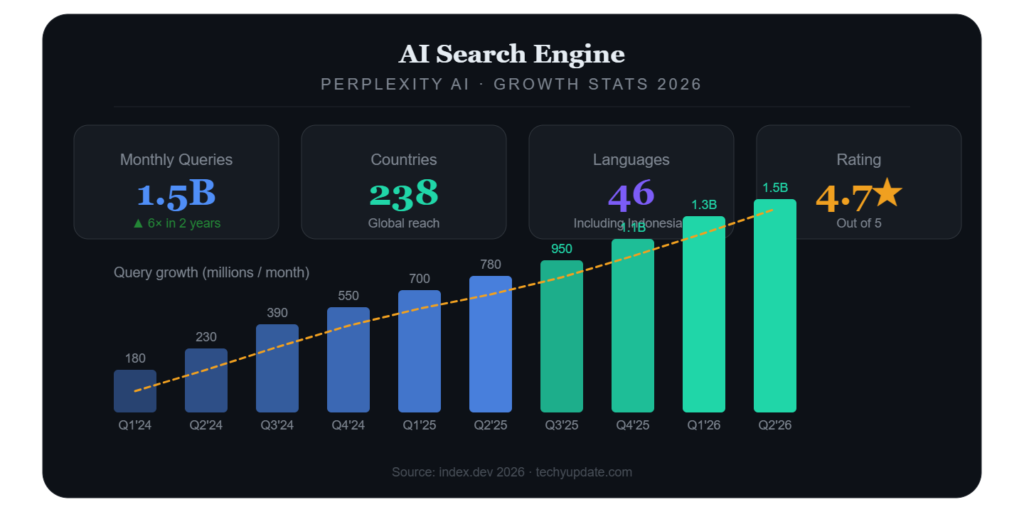
The numbers are hard to argue with. By mid-2026, Perplexity AI is estimated to process between 1.2 and 1.5 billion search queries per month, up from 230 million just two years earlier. That is roughly a 6x growth in under two years, driven by students, professionals, developers, and researchers who are switching from traditional search tools to this AI assistant tool.
The reason is simple. People are tired of searching. They want answers. Perplexity AI gives them answers, with receipts.
AI Search Engine Perplexity AI
As an AI search engine, Perplexity fundamentally reimagines how we find information online. Traditional search engines return lists of links that require manual filtering to remove ads, sponsored content, and low-quality SEO articles. Perplexity cuts through the noise by reading hundreds of sources and synthesizing authoritative answers.
The difference in search quality becomes immediately apparent when comparing results. When I queried “latest NASA Mars rover updates,” ChatGPT returned sources including the New York Post and SlashGear with emoji-filled summaries that were difficult to read. Perplexity delivered fewer but more authoritative sources, almost exclusively from NASA and reputable scientific journals, with polished, news-style formatting.
Perplexity’s web search quality consistently outperforms competitors, especially for real-time information. The platform automatically searches the web for time-sensitive queries, unlike ChatGPT, which requires you to proactively enable search. This means you never accidentally get outdated information. Plus, you can limit searches to specific source types, such as academic papers or Reddit discussions.
The citation system is transparent and comprehensive. On average, Perplexity includes 5.01 links per answer, providing enough sources for verification without overwhelming readers. Each footnote links directly to the source paragraph, making fact-checking instantaneous. This transparency builds trust that black-box AI chatbots simply cannot match.
Why AI Search Engine Matters
The AI search engine category is exploding in 2026, with Google adding AI Overviews, Bing launching Copilot, and dozens of startups entering the market. Yet Perplexity remains the leader because search is its primary purpose rather than a secondary feature. The entire platform architecture is optimized to answer questions accurately and efficiently.
For students conducting research, the Academic mode is invaluable. It filters out marketing hype and only shows published papers, saving hours of sifting through unreliable sources. For marketers doing competitive analysis, the ability to create publishable Pages from search threads means you can share research findings as beautifully formatted reports with a single link.
The ad-free experience is another major advantage. Google bombards searches with sponsored shopping ads and sponsored listings disguised as organic results. Perplexity provides clean, unbiased summaries with reasoning explaining why certain products or information rank highest. This makes it superior for early-stage product research where you need informed options before diving into individual reviews.
Pro Tip: Use domain filtering to control where Perplexity searches. Want human opinions? Select “Social” to prioritize Reddit. Need technical documentation? Filter to specific domains. This granular control gives you precision that traditional search engines can’t match.
Read More: Grammarly Review
AI Assistant Tool Perplexity AI
Beyond search, Perplexity AI serves as a comprehensive AI assistant for knowledge work. It handles tasks ranging from simple fact-checking to complex multi-step research projects, making it indispensable for professionals who process information daily.
The Spaces feature transforms Perplexity into a project management tool for information. Create a Space for “Technical Writing” with custom instructions to use active voice and concise bullets. Every thread in that Space automatically adopts this persona you never need to re-prompt. Upload PDFs, spreadsheets, and earlier drafts that stay permanently in the Space, creating a persistent knowledge base.
Each Space can have its own model selection, source filters, and custom instructions. This means your “Academic Research” Space always uses Claude with Academic mode, while your “Product Research” Space uses GPT with Social filtering. It’s like having specialized assistants for different tasks, all within one platform.
File analysis capabilities have quietly become one of my most-used features. Upload a 50-page PDF whitepaper, a messy CSV of campaign data, or a company filing, and Perplexity extracts insights instantly. For data analysis, while ChatGPT’s advanced tools handle heavy statistical cleaning, Perplexity excels at quick visualization.
Upload quarterly traffic data and ask for a “performance dashboard,” which generates interactive charts and widgets you can share.
The Labs feature (formerly Perplexity Labs) now creates multimedia research projects. Instead of just text reports, it generates custom charts, gathers multimedia assets, and organizes everything visually. The output resembles data journalism from The Wall Street Journal rather than typical chatbot responses. This feature is particularly valuable for presentations and client reports.
Key Features of Perplexity AI
Perplexity AI is not just a chatbot with a search button bolted on. It is a purpose-built AI-powered search experience, and its features reflect that focus in every detail.
AI-Powered Search Capabilities
At its core, Perplexity AI runs what it calls “Pro Search,” a multi-step reasoning process that not only finds web pages but also actively reads, synthesizes, and structures the information before presenting it to you.
For Pro users, the platform allows you to choose which underlying AI model powers your search. Options include Perplexity’s own Sonar model, optimized for web research; GPT-4o from OpenAI, which excels at structured reasoning; and Claude from Anthropic, which handles nuanced academic writing particularly well.
This model-switching capability is genuinely rare and valuable. It means you are not locked into a single AI’s strengths and weaknesses. You pick the right tool for the right job, all within the same interface.
Real-Time Information Retrieval
Unlike ChatGPT, which draws on a fixed training dataset, Perplexity AI searches the live web every single time you ask a question. This makes it invaluable for anything time-sensitive: current events, recent research, stock information, regulatory updates, and breaking developments in any field.
When you ask Perplexity about something that happened last week, it actually knows. That is not a trivial distinction — it is arguably the most important feature for anyone doing professional or academic research.
Source Citations
Every answer Perplexity delivers comes with numbered citations that link directly to the original source. This is not just a transparency feature, it is a trust feature. You can verify any claim in an instant, follow up on primary sources, and build research that is academically credible.
For students working on essays or professionals preparing reports, the citation system alone saves significant time and prevents the embarrassment of citing inaccurate AI-generated claims.
Conversational Interface
Perplexity AI supports full follow-up conversations. After an initial answer, you can ask clarifying questions, request more depth on a specific point, or ask the tool to reframe its explanation for a different audience. The context is preserved throughout the session, making the search experience feel genuinely conversational rather than transactional.
Research Assistance
Beyond answering individual questions, Perplexity AI includes a Spaces feature that lets you organize ongoing research projects, save sources, and collaborate with teammates. Pro users can also export research threads into formatted documents called Perplexity Pages, shareable, citation-preserved mini-reports that are useful for academic submissions or client deliverables.
Collaboration Features
Perplexity enables seamless collaboration through shareable Pages. Turn any search thread into a publishable Page with beautiful formatting, then share it with a link. Colleagues can view your research, follow your reasoning, and even continue the conversation. This transforms Perplexity from a personal tool into a team knowledge platform.
Enterprise plans add team Spaces with admin controls, internal knowledge search, and strict data privacy in compliance with SOC 2 standards. Finance firms, law offices, and marketing agencies use Enterprise Pro to search through internal documents while maintaining security. This makes Perplexity viable for sensitive business use cases.
Common Mistake: Users often treat Perplexity as a one-off search tool without leveraging Spaces. For recurring research topics, create dedicated Spaces with custom instructions and uploaded reference files. This saves time and ensures consistency across related projects.
Search Experience Perplexity AI
The Perplexity search experience feels fundamentally different from traditional search engines. Instead of a results page that requires manual filtering, you get a conversational interface where answers appear immediately and include built-in follow-up suggestions. This design philosophy prioritizes speed and clarity over overwhelming choice.
Short paragraphs, clear headings, and bullet points make answers scannable. The interface displays the main answer prominently, with citations as clickable footnotes below. Related questions appear as one-click suggestions, encouraging deeper exploration without requiring prompt engineering. This frictionless experience makes deep research feel natural.
Voice search works exceptionally well for queries. The mobile app’s voice mode feels responsive and accurate, making it practical for hands-free searching while commuting or working. The mobile experience includes live camera awareness. Point your camera at a product, and Perplexity instantly searches for information about it.
The follow-up question suggestions are genuinely intelligent. After asking about “Perplexity pricing,” it suggests “What’s the difference between Pro and Max?” and “Is Perplexity worth it for students?” These aren’t random they’re based on what other users commonly ask next, helping you discover relevant questions you might not have considered.
Deep Search Capability
Perplexity’s Deep Research mode, launched in 2026, represents a major leap forward. When activated, Perplexity performs dozens of searches, reads hundreds of sources, and reasons through material to autonomously deliver comprehensive reports in 2-4 minutes. Tasks that would take human experts hours to complete in minutes.
Deep Research excels at expert-level tasks across finance, marketing, and product research. It achieved 21.1% accuracy on Humanity’s Last Exam—significantly higher than Gemini Thinking, o3-mini, o1, and DeepSeek-R1. On the SimpleQA benchmark testing factuality, it scored 93.9%, far exceeding leading models.
The reasoning capability iteratively searches, reads documents, and refines its research plan as it learns. It doesn’t just compile information it analyzes, synthesizes, and draws conclusions. For complex market analysis or competitive research, this capability is transformative.
Desktop access via Perplexity Computer (launched February 2026) adds agentic capabilities. The desktop agent can handle complex, multi-step research autonomously, orchestrating among 19 different AI models and matching each to the tasks it’s best suited for. I tested it by building a meditation app, it completed design, development, and audio engine in eight minutes.
Pro Tip: Use Deep Research for high-stakes questions where accuracy matters. While slower than quick searches, the extra depth and comprehensive source analysis are worth the wait for important decisions, academic papers, or professional reports.
How Perplexity AI Works
Understanding the mechanics behind Perplexity AI helps you use it more effectively and makes it easier to trust the results you are getting.
The Search Process Explained
When you type a question into Perplexity AI, the platform does not simply retrieve a cached page. It sends your query through a real-time web retrieval layer that identifies the most relevant and recent sources, reads those sources, and then passes the synthesized information to a large language model for response generation. The entire process takes seconds.
This is fundamentally different from both traditional search engines (which retrieve and rank links) and standard AI chatbots (which generate from training data). Perplexity AI sits in between: it retrieves live, then generates intelligently.
AI Models Used
The backbone of Perplexity AI is its own proprietary Sonar model, fine-tuned specifically for web-connected search tasks. Pro subscribers can also switch to GPT-4o, Claude 3, or Sonar Pro, an enhanced version of Perplexity’s own model with deeper research capabilities.
The platform’s newest Max tier introduces what Perplexity calls “Perplexity Computer,” which orchestrates 19 different AI models simultaneously to execute complex, multi-step autonomous tasks.
This multi-model architecture is what makes Perplexity AI uniquely powerful at the frontier of AI search tools. Rather than betting on one model, the platform routes each query to the most appropriate intelligence available.
Answer Generation Methodology
Once sources are retrieved, the language model reads them and generates a response that directly answers your question in natural language. It does not paste text from sources it synthesizes them. The numbered citations are mapped to specific claims within the answer, allowing you to verify every sentence if you choose to.
User Interface and Experience
Dashboard Overview
The Perplexity AI interface is clean, intentionally minimal, and fast. The main screen greets you with a search bar, and unlike many AI platforms, it does not try to do too much at once. Your conversation history lives in a sidebar. Spaces where your organized research projects are accessible from the left navigation. The mobile app closely mirrors the desktop experience, which is important for users who switch between devices.
An image of the Perplexity AI dashboard should go here, showing the clean search interface and sidebar navigation. ALT text: “Perplexity AI dashboard interface 2026.”
Ease of Use
Perplexity AI has an unusually low learning curve for an advanced AI tool. New users can start getting value immediately, without reading documentation or watching tutorials. You type a question, you get an answer, and the citations appear beneath it automatically. Advanced features like model switching, file uploads, and Spaces are available when you need them, but stay out of the way when you do not.
This balance between simplicity and power is one of the platform’s most underrated qualities.
Navigation and Accessibility
The platform supports 46 languages, which makes it genuinely accessible to a global audience. The mobile experience is polished. Keyboard shortcuts exist for power users. And the accessibility features — including screen reader support and scalable text reflect a design team that thinks beyond the average user.
AI-Powered Search Perplexity AI
Perplexity’s AI-powered search technology combines cutting-edge large language models with sophisticated web indexing and retrieval systems. Unlike simpler AI wrappers that just summarize search results, Perplexity’s architecture actively reasons about what to search, which sources to trust, and how to synthesize information.
The platform’s proprietary index includes deep sourcing from academic databases, financial data from Pitchbook, scientific data from Wiley, and other premium sources. Pro subscribers access this premium content without additional subscriptions. Buying just one of these databases would cost hundreds or thousands of dollars per month.
AI-powered search means Perplexity understands context and intent better than keyword matching. Ask “best laptops for video editing under $1500,” and it understands you need specifications, performance benchmarks, price comparisons, and user reviews, not just generic laptop lists. It automatically synthesizes information across multiple dimensions.
The model selection intelligence is sophisticated. On the Max plan, Model Council runs queries across multiple models simultaneously, showing where they agree and diverge. For high-stakes questions, seeing consensus among GPT-4, Claude, and Gemini provides confidence that single-model answers cannot match it.
Real-Time Information Advantage
Perplexity’s biggest advantage over traditional AI is its real-time access to information. While ChatGPT’s knowledge has cutoff dates and requires manual activation of browsing, Perplexity automatically searches for up-to-date information for time-sensitive queries. This makes it superior for news, stock prices, sports scores, product launches, and any rapidly changing topic.
Live sports queries work perfectly. Ask “What’s the current score of the Lakers game?” and get real-time updates. Product research benefits similarly from new releases, price changes, and availability updates that appear immediately. This real-time capability is essential for professionals tracking markets, competitors, or industry trends.
The search filters enable precision targeting. Beyond basic sources, you can filter by date range, content type, language, and domain authority. The academic mode only shows peer-reviewed papers. Finance mode prioritizes SEC filings and earnings reports. Social mode scours Reddit and Twitter for human opinions. This granularity provides control that traditional search engines lack.
Perplexity’s AI also detects when web search is necessary versus when internal knowledge suffices. For well-established facts like “Who wrote Pride and Prejudice?” it uses internal knowledge for speed. For “What happened at today’s Fed meeting?” it automatically searches. This intelligent routing optimizes both speed and accuracy.
Common Mistake: Assuming all AI tools have real-time search. Many chatbots require explicit prompts to search the web, and some still rely on outdated training data. Perplexity’s automatic search activation ensures you always get current information without remembering to enable it.
Perplexity AI vs Competitors
Comparison with ChatGPT
ChatGPT is a broader conversational AI tool, optimized for creative writing, code generation, and long-form content. Perplexity AI is narrower and sharper in its focus: real-time, cited research. For writing essays or generating code, ChatGPT remains the stronger choice. For fact-checking, current event research, and source discovery, Perplexity AI wins decisively.
Pricing is similar at the base level ($20/month), making the choice come down to your primary use case rather than your budget.
Comparison with Google Search
Google Search returns ranked links. Perplexity AI returns synthesized answers. For users who know exactly what they are looking for and want to browse original sources, Google is still excellent. For users who want an immediate, readable answer without browsing, Perplexity AI is faster and more efficient.
Google’s AI Overviews attempt to close this gap, but they lack the citation transparency and model-switching flexibility that make Perplexity AI feel like a genuinely different kind of search experience.
Comparison with Gemini
Gemini, Google’s AI assistant, is tightly integrated with Google’s ecosystem, Docs, Gmail, and Drive, which gives it real advantages for users already embedded in that world. Perplexity AI, by contrast, is more search-focused and model-agnostic.
For pure research quality and citation reliability, most independent reviews in 2026 give the edge to Perplexity AI. For workflow integration with Google products, Gemini has the advantage.
Productivity and Time Management
Perplexity AI dramatically improves productivity by compressing research workflows that previously took hours into minutes. In my testing, market research tasks that required analyzing 30+ blogs, copying statistics into spreadsheets, and verifying sources collapsed from afternoon-long marathons into 20-minute sessions.
The time savings come from multiple features working together. Citations eliminate manual source verification just click the footnote to confirm instantly. Pro Search automatically breaks complex questions into subtasks and runs parallel searches instead of sequential manual queries. Deep Research synthesizes everything into formatted reports, eliminating copy-paste work.
For content creators, Perplexity accelerates fact-checking and research phases. Writing a blog post about AI trends? Use Perplexity to gather current statistics, verify claims, and find authoritative sources in minutes. The generated Pages can serve as draft outlines with embedded citations, significantly reducing writing time.
Students benefit enormously from the efficiency gains. Research papers that required library hours are now completed in focused sessions. Summarizing textbooks, finding academic sources, and verifying citations happen within one interface. The Education Pro plan at $5/month makes this accessible to all students.
Workflow Integration
Perplexity integrates into existing workflows through Zapier connections. Create automations like “when a new email arrives in Outlook, send a summary to Perplexity” or “send weekly AI-generated research emails using Perplexity.” Zapier MCP enables secure actions across 8,000+ apps without leaving the chat interface.
Browser extensions enable access to Perplexity while browsing other websites. The Comet browser (Perplexity’s AI-native browser) includes built-in chat and agentic capabilities for research-focused workflows. This means you can search without tab-switching, maintaining focus on complex tasks.
The mobile app enables productivity on the go. Voice search, camera awareness, and push notifications for saved searches make it practical for commuting, meetings, and fieldwork. I’ve used it to research products while shopping, verify facts during meetings, and gather information during client calls.
File organization through Spaces creates persistent project contexts. Each project maintains its uploaded files, custom instructions, and search history. Returning to a project means resuming exactly where you left off without re-explaining context. This continuity saves significant time on recurring projects.
Pro Tip: Set up recurring Perplexity searches for ongoing monitoring. Use the schedule feature to automatically research competitors, industry trends, or news topics weekly. This creates automated intelligence gathering that keeps you informed without manual effort.
Expert Insights Trends Perplexity AI
Industry experts increasingly recognize Perplexity as the gold standard for AI-powered research. G2’s Winter 2026 Grid Report shows Perplexity earning 4.5/5 stars, with 95% ease-of-use and 97% ease-of-setup ratings. Small businesses account for 70% of users, indicating strong adoption among resource-constrained teams that need maximum efficiency.
SEO professionals praise Perplexity’s ability to identify content gaps and trending topics. The platform’s real-time search reveals emerging keywords before competitors notice. Content teams use it to validate statistics, find authoritative sources, and ensure factual accuracy, all of which are critical for E-E-A-T signals that Google prioritizes.
Academic researchers value the Academic mode’s rigorous filtering. Peer-reviewed papers appear without marketing noise, and citations meet publication standards. Several universities now recommend Perplexity to students for literature reviews and source verification, recognizing its advantages in research integrity.
Financial analysts leverage Perplexity Finance for real-time market intelligence. The platform instantly synthesizes earnings reports, news, and SEC filings, explaining market movements with cited sources. This capability rivals dedicated financial terminals that cost thousands of dollars per month, making professional-grade analysis accessible.
Emerging Trends in AI Search
The AI search engine market is consolidating around platforms with genuine search capabilities. Perplexity’s early focus on search-first architecture positions it ahead of chatbots that added search as an afterthought. Industry analysts predict AI search will become the primary search method within three years, replacing traditional keyword interfaces.
Agentic AI represents the next frontier. Perplexity Computer and similar desktop agents can complete multi-step tasks autonomously, researching, coding, analyzing data, and generating outputs without continuous supervision. This evolution transforms AI from a conversation partner to a capable assistant handling complex workflows.
Multimodal capabilities are expanding rapidly. Perplexity now processes text, images, audio, video, and files seamlessly. The ability to analyze chart screenshots, extract data from PDFs, and generate visualizations creates new use cases that are impossible with text-only interfaces.
Privacy and enterprise adoption are accelerating. SOC2-compliant Enterprise plans with data privacy guarantees enable regulated industries to adopt Perplexity confidently. Legal, healthcare, and finance firms increasingly use it for internal knowledge search while maintaining compliance.
Expert Insight: The most successful Perplexity users treat it as a research partner, not just a search tool. They create specialized Spaces, leverage model switching strategically, and use Deep Research for critical decisions. This approach maximizes the platform’s unique capabilities rather than using it like Google.
Quick Summary
What is Perplexity AI?
Perplexity AI is an AI-powered search engine that delivers direct, cited answers instead of link lists. It combines real-time web searching with advanced AI models to provide accurate, source-backed responses for research, fact-checking, and information gathering.
Key Features Summary
Free Version Features
Perplexity AI’s free plan includes unlimited standard text searches, basic AI-generated answers with source citations, and limited access to Pro Search features, currently capped at five per day. The free plan requires no credit card and is a genuinely useful starting point for casual users or those evaluating the platform before committing.
Pro Version Features
The Pro plan costs $20 per month, or approximately $16.67 per month when billed at a 17% annual discount. It unlocks unlimited Pro Search, access to multiple AI models including GPT-4o and Claude, file upload capability for document analysis, Perplexity Pages for exportable research reports, and faster response times during peak usage. Students and educators get the Pro plan for $10 per month, and some universities provide the first 12 months free.
Max Version Features
The Max plan costs $200 per month and is designed for power users and teams. It includes everything in Pro plus Perplexity Computer, the platform’s autonomous multi-agent system, along with 10,000 monthly computational credits, integrations with tools like Gmail, Slack, Notion, and Calendar, and priority support.
Value for Money Analysis
For most users, the Pro plan at $20 per month delivers exceptional value, especially compared to the $20/month ChatGPT Plus subscription. The free plan is strong enough for light use. The Max plan is genuinely expensive but may be justified for researchers, analysts, or business professionals whose time has a measurable dollar value.
Best Use Cases
Perplexity AI is genuinely excellent in specific contexts. Here is where it performs best.
Research: Whether academic, market, or journalistic, Perplexity AI accelerates the research process by retrieving and synthesizing multi-source information in real time. The citation system makes it research-credible in a way that ChatGPT alone is not.
Content creation: Writers and content marketers use Perplexity AI to quickly gather background information, verify statistics, and identify relevant sources before drafting. It works best as a research companion rather than a drafting tool.
Learning and education: Students benefit enormously from the conversational interface. Complex topics become accessible when you can ask follow-up questions and get immediate, sourced clarifications. The tool also supports document uploads, letting students upload textbook chapters or research papers and ask specific questions about the content.
Business applications: Market researchers, competitive analysts, and strategy consultants use Perplexity AI to monitor industry developments, gather competitive intelligence, and quickly summarize regulatory or policy changes. The Spaces feature makes it viable for team-based research workflows.
Who Should Use Perplexity AI?
- Researchers & Analysts: Need fast, accurate answers with verifiable sources
- Students & Academics: Require trustworthy academic sources and citations
- Marketers & Content Teams: Regular market research and trend validation
- Professionals: Rapid learning on unfamiliar topics for client work
- Google Alternatives Seekers: Want cleaner answers without ads
Pros and Cons Quick View
Pros:
- Real-time answers with clear, clickable citations
- Exceptionally easy to use (95% ease of use rating)
- Strong at handling complex queries with Pro Search
- Flexible model switching for different tasks
- Ad-free research experience
Cons:
- Weaker creative writing than dedicated ChatGPT/Claude
- Limited conversational depth in long threads
- Advanced features are locked behind the Pro plan
- Less ideal for advanced math or coding. Quick Verdict: Perplexity AI excels at research-heavy tasks with verifiable sources. Choose it for fact-checking, academic research, market analysis, and real-time information. Choose ChatGPT instead for creative writing, coding, or extended conversations.
Final Verdict
After extensive testing and real-world use, Perplexity.ai earns my highest recommendation for anyone who prioritizes accurate, well-sourced information over creative generation. It’s not the best AI for every task, but for research, fact-checking, and information synthesis, it’s unmatched in 2026.
The question isn’t whether Perplexity is the best AI research tool, it demonstrably is, but whether it fits your specific needs. For students, researchers, marketers, analysts, and knowledge workers who transform information into insight, Perplexity delivers extraordinary value. The $20/month Pro plan pays for itself by replacing multiple subscriptions and saving countless hours of research.
What impresses me most is how fundamentally it changed my research workflow. Tasks that once required opening dozens of tabs, copying statistics into spreadsheets, and manually verifying sources can now be completed in focused sessions with transparent citations. This efficiency gain compounds over time, creating significant productivity advantages.
Perplexity isn’t perfect. Creative writing feels dry compared to Claude or ChatGPT. Conversational depth lags behind dedicated chatbots. Advanced coding and math aren’t strengths. But these limitations reflect its research-first design, not deficiencies. The platform excels at what it’s built for: accurate, sourced answers.
The Bottom Line
For the 95% of searches that involve finding information rather than generating creative content, I no longer use Google. Perplexity provides faster, cleaner, more reliable answers with reasoning I can trust. The ad-free experience, source transparency, and real-time updates create a search experience that feels like the future.
The Education Pro plan at $5/month makes it accessible to all students, a bargain for academic research tools. Professionals justify the $20 Pro subscription through time savings alone. Enterprise teams gain a secure internal knowledge search with compliance guarantees. Every user segment finds compelling value.
As AI search evolves, Perplexity’s early focus on search-first architecture positions it as the category leader. Agentic capabilities, Deep Research, and multimodal features continue advancing. The platform isn’t just keeping pace with innovation, it’s driving it.
Final Recommendation: If you research regularly, Perplexity.ai Pro is absolutely worth it in 2026. Start with the free plan to test, then upgrade when you hit Pro Search limits. Students should immediately grab Education Pro. Enterprise teams should evaluate Enterprise Pro for secure internal search. The only people who shouldn’t buy it are those who exclusively need creative writing or coding assistance.
FAQs
Is Perplexity AI free to use?
Yes, Perplexity AI offers a robust free plan with unlimited basic searches, follow-up questions, and AI-generated answers with source citations. However, the free version limits Pro Searches to 5 per day, restricts access to advanced AI models such as GPT-4 and Claude, and caps file uploads. For serious research, the $20/month Pro plan unlocks 300+ Pro Searches daily and full model access.
Is Perplexity AI good for academic research?
Absolutely. Perplexity’s Academic mode filters exclusively for peer-reviewed papers and scholarly sources, eliminating marketing noise and SEO spam. Every claim includes clickable citations meeting publication standards. Students and researchers consistently praise it for literature reviews, source verification, and the identification of authoritative references. The Education Pro plan at $5/month makes premium features accessible to all students.
Is Perplexity Pro worth the $20/month?
Yes, if you conduct frequent research, need verifiable citations, or want access to multiple AI models. Pro unlocks 300+ Pro Searches daily, GPT-4/Claude/Gemini model switching, unlimited file uploads, video generation, and priority support. For researchers, marketers, analysts, and students, the time savings and capabilities easily justify the cost. Casual users may find the free plan sufficient.
How is Perplexity different from ChatGPT?
Perplexity functions as an AI-powered search engine with mandatory citations, optimized for real-time research and fact-finding. ChatGPT acts as a conversational AI for writing, brainstorming, coding, and reasoning. Perplexity excels at accuracy and sourcing; ChatGPT leads in creative output and extended conversations. Use Perplexity for research, ChatGPT for creative work.
Can Perplexity AI replace Google search?
For research queries, yes, Perplexity often outperforms Google by providing direct answers with citations instead of link lists. However, it doesn’t fully replace Google for local searches, shopping comparisons, maps, image search, or brand discovery. Most users treat Perplexity as a Google alternative for research while keeping Google for other needs. For 95% of my information searches, I now use Perplexity.
Is Perplexity AI trustworthy and accurate?
Perplexity is more trustworthy than most chatbots because it shows sources for every claim. You can click citations to verify information instantly. However, it still relies on third-party web content and AI interpretation, so verify critical information for legal, medical, or financial decisions. Deep Research mode achieves 93.9% accuracy on factuality benchmarks, exceeding leading models.
What are Perplexity’s main limitations?
Creative writing feels dry compared to Claude or ChatGPT. Conversational depth is limited in long threads. Advanced math and coding aren’t strengths. Some advanced features require a Pro subscription. The default Sonar model is underpowered compared to paid alternatives. However, these reflect its research-first design rather than fundamental flaws.
How does Deep Research mode work?
Deep Research performs dozens of searches, reads hundreds of sources, and reasons through material autonomously, delivering comprehensive reports in 2-4 minutes. It iteratively searches, reads documents, and refines its research plan as it learns. Tasks requiring human experts’ hours complete in minutes with 21.1% accuracy on Humanity’s Last Exam, significantly outperforming competitors.
Does Perplexity support team collaboration?
Yes. Spaces enable project-specific contexts with shared files and custom instructions. Pages let you convert search threads into shareable reports with links. Enterprise plans include team Spaces, admin controls, internal knowledge search, and SOC 2-compliant data privacy. Teams can collaborate on research while maintaining security and compliance.
What are the best Perplexity alternatives?
Top alternatives include ChatGPT (best for writing and coding), Google Gemini (strong integration with the Google ecosystem), Microsoft Copilot (ideal for Microsoft 365 users), and Claude (excellent for long-form reasoning). Each excels in different use cases. Perplexity wins when accuracy, citations, and real-time search matter most.