

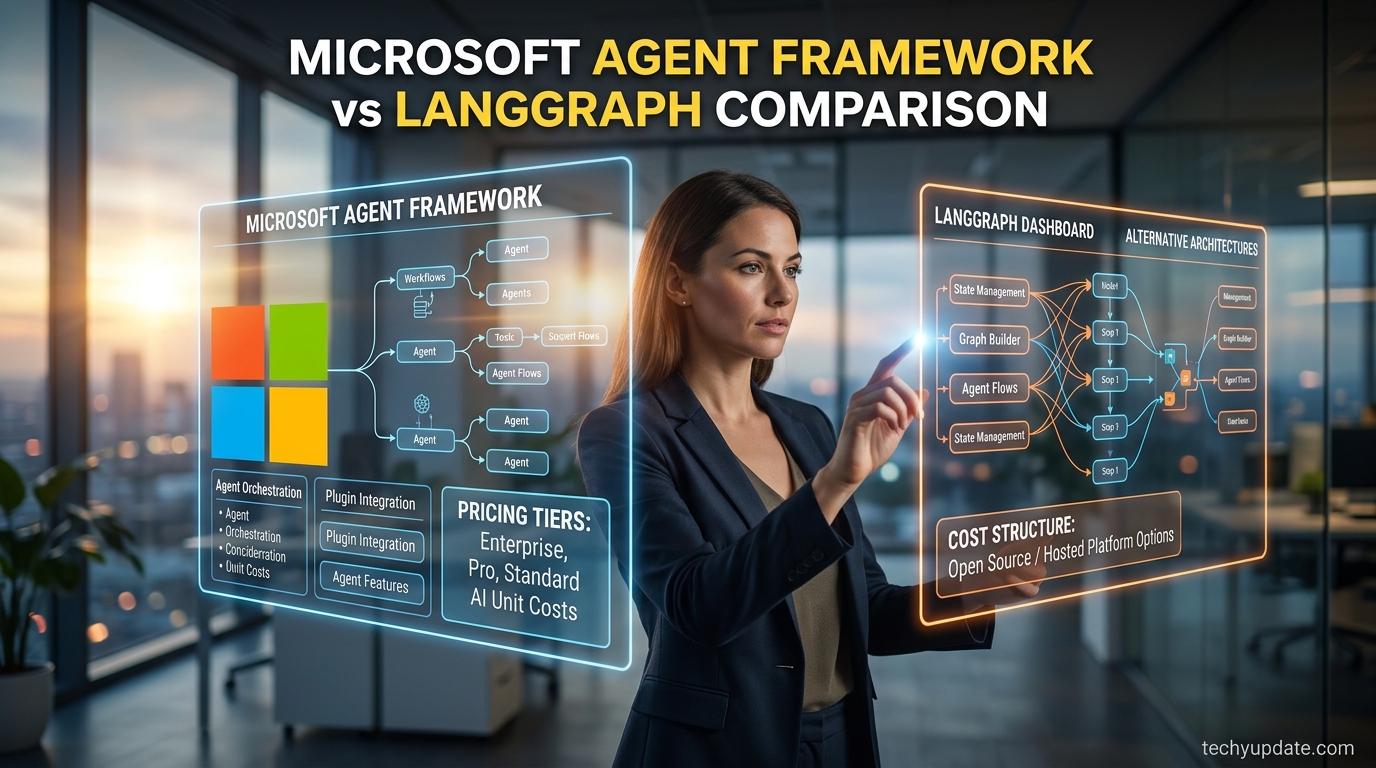
Since comparing frameworks is one of the most common next questions after a review, this section puts Microsoft Agent Framework and LangGraph side by side.
Table of Contents
Quick Comparison Table
| Category | Microsoft Agent Framework | LangGraph |
|---|---|---|
| Cost Model | Free (MIT license) + optional Azure hosting costs | Free (open source) |
| Primary Languages | .NET and Python | Python (with JS support) |
| Backing Organization | Microsoft | LangChain |
| Ecosystem Maturity | Newer, smaller ecosystem | Larger, more established community |
| Protocol Support | Built-in MCP and A2A support | Tool-calling via LangChain integrations |
| Hosted Option | Foundry Agent Service (Azure) | LangGraph Platform |
Feature-by-Feature Breakdown

Orchestration model: Microsoft Agent Framework uses graph-based workflows with built-in handoff orchestration for multi-agent systems, conceptually similar to LangGraph’s own graph-based state machine approach. Both frameworks converge on graphs as the right abstraction for coordinating multiple agents, though the specific APIs and terminology differ.
Language support: MAF’s genuine strength is treating .NET and Python as first-class, equally supported languages, while LangGraph’s primary and most mature support remains centered on Python, with JavaScript support available but generally considered secondary in terms of ecosystem depth.
Protocol standards: MAF ships with built-in support for both the Model Context Protocol (MCP) and the Agent-to-Agent (A2A) protocol, aiming explicitly at cross-framework interoperability. LangGraph integrates with MCP through the broader LangChain ecosystem’s tooling, but doesn’t center A2A-style cross-framework agent communication as directly in its core design.
Ecosystem and integrations: This is where LangGraph currently holds a clear, acknowledged edge. LangGraph has a larger ecosystem of community tools and integrations built up over a longer period, meaning more pre-built connectors, more community tutorials, and more battle-tested patterns for common use cases.
Enterprise readiness: Microsoft Agent Framework leans more heavily into enterprise-specific features out of the box, given its Semantic Kernel heritage, migration assistants, hosted enterprise agents via Foundry Agent Service, and tight Azure identity and compliance integration for organizations already in that ecosystem.
Debugging and observability: MAF’s DevUI gives a real-time, browser-based view into agent execution and orchestration decisions. LangGraph offers its own observability tooling through LangSmith, which has a longer track record and, correspondingly, greater community familiarity.

Cost Comparison
Both frameworks are free and open-source at their core, so the real cost difference lies in deployment choices rather than licensing. Microsoft Agent Framework’s hosted path through Foundry Agent Service uses Azure’s usage-based pricing with scale-to-zero billing, while LangGraph’s hosted option through LangGraph Platform has its own separate pricing structure. For self-hosted deployments on your own infrastructure, both frameworks incur no direct licensing costs; your costs are purely the compute and model inference you consume.
Ecosystem Maturity
This is arguably the single biggest differentiator between the two. LangGraph has had more time in the market to accumulate community-built integrations, tutorials, and proven production patterns. Microsoft Agent Framework is newer as a unified 1.0 product, even though it inherits the real, battle-tested lineage of both AutoGen and Semantic Kernel.
If your team values a large existing community to lean on when something breaks, that currently favors LangGraph; if your team values official, vendor-backed long-term support and a clear enterprise roadmap, that favors Microsoft Agent Framework.
Ease of Use
Developers already comfortable in the Microsoft and Azure ecosystem tend to find the Microsoft Agent Framework’s setup and identity integration notably smoother, since it plugs directly into the tooling many .NET teams use daily. Developers coming from a Python-first, framework-agnostic background often find LangGraph’s setup more familiar, given its longer history and larger volume of community-written getting-started guides.
Best-For Use-Case Split
- Choose Microsoft Agent Framework if: your team is Azure-native, you need genuine .NET support alongside Python, or you want built-in MCP/A2A interoperability with official enterprise support paths.
- Choose LangGraph if you want the largest available community ecosystem today, you’re Python-first without a .NET requirement, or you’re not specifically committed to the Azure ecosystem.
Pros and Cons of Each
| Microsoft Agent Framework Pros | Microsoft Agent Framework Cons |
|---|---|
| Genuine .NET and Python parity | Smaller community ecosystem currently |
| Built-in MCP and A2A protocol support | Self-hosted enterprise support gap outside Foundry Agent Service |
| LangGraph Pros | LangGraph Cons |
|---|---|
| Largest current community and integration ecosystem | Less first-class .NET support |
| Long production track record | Less centralized enterprise support path than Microsoft’s Azure integration |
Read more: LangGraph Review
Read more: Microsoft Agent Framework Review
Read more: Microsoft Agent Framework Pricing & Alternatives
Final Verdict
Neither framework is a universal winner. Microsoft Agent Framework is the stronger choice for Azure-native and . NET-heavy teams that value official enterprise support and built-in interoperability protocols, while LangGraph remains the safer default for Python-first teams that prioritize ecosystem size and community maturity over vendor-backed enterprise features. Many teams reasonably prototype on both before committing to one as their production standard.
Frequently Asked Questions
Is Microsoft Agent Framework better than LangGraph?
Neither is universally better. Microsoft Agent Framework offers stronger enterprise readiness and .NET support for Azure-native teams, while LangGraph currently holds a larger community ecosystem and longer production track record.
Does LangGraph support .NET, as the Microsoft Agent Framework does?
No, LangGraph’s primary and most mature support centers on Python, with secondary support for JavaScript, while Microsoft Agent Framework treats .NET and Python as equally first-class languages.
Which framework has better protocol support for cross-agent communication?
Microsoft Agent Framework ships with built-in support for the Model Context Protocol and the Agent-to-Agent protocol, specifically aimed at cross-framework interoperability, while LangGraph integrates MCP via the broader LangChain ecosystem’s tooling.
Is LangGraph more mature than Microsoft Agent Framework?
In terms of community size and integrations, yes, LangGraph has had more time in the market to build out its ecosystem, though Microsoft Agent Framework inherits mature lineage from AutoGen and Semantic Kernel individually.
Should a .NET team choose Microsoft Agent Framework over LangGraph?
Generally, yes, since Microsoft Agent Framework offers genuine first-class .NET support and tighter Azure ecosystem integration that LangGraph does not match as directly.
Conclusion
Choosing between Microsoft Agent Framework and LangGraph in 2026 comes down to ecosystem fit rather than raw capability, since both frameworks converge on similar graph-based orchestration concepts. Prioritize Microsoft Agent Framework for Azure-native, .NET-inclusive teams wanting official enterprise support, or LangGraph for Python-first teams that value the largest available community ecosystem today.