

Unlike a typical SaaS product, Microsoft Agent Framework pricing isn’t based on subscription tiers. Understanding its actual cost structure means separating the free, open-source framework itself from the optional hosted infrastructure many production teams end up paying for.
Table of Contents
Cost Structure Breakdown

Microsoft Agent Framework is open source under the MIT license, meaning the SDK itself costs nothing to download, use, or modify, whether you’re an individual developer experimenting with a personal project or an enterprise team building a production system. There’s no subscription fee, no per-seat license, and no usage cap baked into the framework code itself. Where cost enters the picture is in how and where you choose to run the agents you build with it.
Foundry Agent Service Pricing

For teams that don’t want to manage their own hosting infrastructure, Microsoft offers hosted agents through Foundry Agent Service, part of Azure AI Foundry. This service uses standard usage-based Azure pricing, meaning costs scale with actual consumption model inference calls, compute time, and storage rather than a flat subscription fee.
A key feature here is scale-to-zero billing: you pay nothing while an agent sits idle, and the service automatically scales back up the moment a new request comes in. For workloads with unpredictable or bursty traffic, this can meaningfully reduce costs compared to keeping dedicated infrastructure running around the clock.
Hidden Costs and Limitations
The framework being free doesn’t mean running agents in production is free. Real costs show up in a few places worth planning for upfront: the underlying model inference costs (which apply regardless of which agent framework you use), Azure compute and storage costs if you choose Foundry Agent Service, and, for larger organizations, the cost of enterprise support, since self-hosted enterprise support currently has no path without third-party providers.
If your organization needs guaranteed support SLAs outside of Foundry Agent Service, budget for that gap explicitly rather than assuming it’s included.
Free / Open-Source Plan Analysis
For individual developers, small teams, and organizations comfortable with self-hosting on their own infrastructure, Microsoft Agent Framework’s free, open-source nature is a genuine advantage, as you can build, test, and deploy agents without any framework-level licensing costs. The practical limitation isn’t the framework’s price; it’s that self-managed enterprise-grade support isn’t currently offered directly by Microsoft outside of the Foundry Agent Service hosted path, which does carry standard Azure costs.
Value-for-Money Verdict
For Azure-native teams already paying for Azure infrastructure, Microsoft Agent Framework represents a strong value, as it adds sophisticated agent orchestration capabilities on top of infrastructure spend you’d likely already have, without an additional framework licensing fee.
For teams outside the Azure ecosystem evaluating whether to adopt Azure specifically to use MAF, the calculation is less clear-cut, since you’d be taking on new infrastructure costs rather than extending existing spend.
Top Alternatives to Microsoft Agent Framework
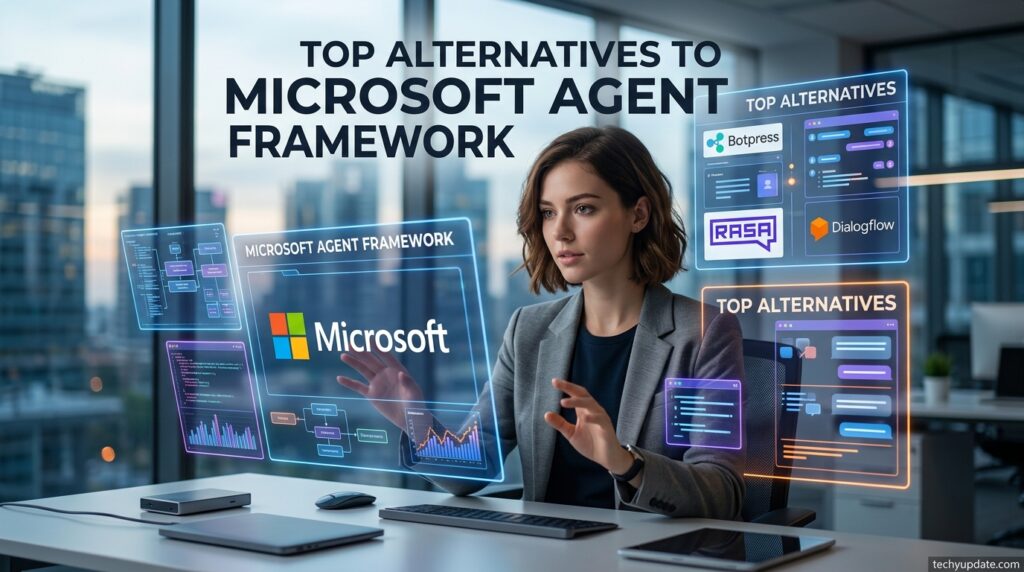
LangGraph is currently the most established alternative, built by the team behind LangChain, and it has a larger ecosystem of community tools and integrations than the Microsoft Agent Framework at this stage. For teams that value a mature, battle-tested community and extensive third-party tooling, LangGraph remains a strong first consideration, particularly for teams not already committed to Azure.
CrewAI has achieved broader adoption among Fortune 500 companies, specifically for prototyping multi-agent systems, making it a compelling option for teams that want to quickly validate an agent-based approach before committing to a longer production build. Its role-based agent design tends to feel intuitive for teams newer to multi-agent concepts.
OpenAI Agents SDK offers first-class support for tool calling, structured outputs, and multi-agent patterns, and is a natural fit for teams that primarily build on OpenAI’s models rather than a multi-provider approach.
Vercel’s eve is a newer entrant, an open-source agent framework positioned as “Next.js for agents.” You define each agent as a file in a directory, and it compiles into a production app with durable execution, sandboxes, approvals, subagents, and built-in evaluations, making it an interesting option for teams already deep in the Vercel/Next.js ecosystem.
Claude Agent SDK is worth considering for teams prioritizing Anthropic’s models specifically, with genuine architectural differences from LangGraph in how state handling and multi-agent patterns are approached. A detailed head-to-head comparison between the two is increasingly common reading for teams making this specific decision.

Alternatives Comparison Table
| Framework | Cost Model | Standout Strength |
|---|---|---|
| Microsoft Agent Framework | Free (MIT license) + Azure usage costs for hosting | Enterprise readiness, .NET/Python parity, MCP/A2A support |
| LangGraph | Free (open source) | Largest community ecosystem and integrations |
| CrewAI | Free (open source), paid enterprise tier available | Broadest Fortune 500 prototyping adoption |
| OpenAI Agents SDK | Free SDK + OpenAI API usage costs | Deep OpenAI model integration |
| Vercel eve | Free (open source) + Vercel hosting costs | Simple file-based agent definition, durable execution built in |
Read more: LangGraph Review
Read more: Microsoft Agent Framework Review
Read more: Microsoft Agent Framework vs LangGraph Comparison
Who Should Pick What
- Azure-native and . NET-heavy teams: Microsoft Agent Framework is the clear default, given its enterprise readiness and alignment with existing infrastructure.
- For teams seeking the largest community and integration ecosystem today, LangGraph remains the safer, more established choice.
- Teams that need to prototype quickly and validate an idea before a full build: CrewAI’s intuitive, role-based design accelerates the early phase.
- Teams committed primarily to OpenAI’s models: the OpenAI Agents SDK offers the tightest integration with the least framework overhead.
- Teams already building on Vercel/Next.js: eve offers a familiar developer experience while staying within that ecosystem.
Frequently Asked Questions
Is Microsoft Agent Framework really free?
Yes, the SDK itself is open source under the MIT license with no licensing cost, though hosted production agents through Foundry Agent Service carry standard Azure usage-based pricing for compute and inference.
What is scale-to-zero pricing in Foundry Agent Service?
Scale-to-zero means you pay nothing while an agent is idle, and Azure automatically scales the service back up the moment a new request arrives, reducing costs for workloads with unpredictable traffic patterns.
Is LangGraph a better alternative than Microsoft Agent Framework?
It depends on your team’s ecosystem. LangGraph currently has a larger community and integration ecosystem, while Microsoft Agent Framework offers deeper enterprise readiness for Azure and .NET-native teams specifically.
Does Microsoft Agent Framework offer enterprise support?
Enterprise support is primarily available through Foundry Agent Service; self-hosted enterprise support currently has no path without relying on third-party providers.
What is the cheapest way to run Microsoft Agent Framework in production?
Self-hosting the free, open-source framework on your own infrastructure avoids Azure usage costs entirely, though you’ll take on the operational responsibility that Foundry Agent Service would otherwise handle for you.
Conclusion
Microsoft Agent Framework’s real cost story is straightforward once separated correctly: the framework is genuinely free and open source, and cost only enters the picture through optional Azure hosting via Foundry Agent Service. For teams weighing alternatives, LangGraph and CrewAI remain legitimate, mature options depending on whether ecosystem size or prototyping speed matters more to your specific situation.