

If you’re searching for a genuine Microsoft Agent Framework review, you’re probably a developer or engineering lead trying to figure out whether this is the right foundation for building production AI agents, or whether you should stick with an existing tool like LangGraph or CrewAI instead. This review breaks down what the Microsoft Agent Framework actually is, what it does well, and where it still has real limitations.
Table of Contents
What Is Microsoft Agent Framework?
Microsoft Agent Framework (MAF) is Microsoft’s open-source SDK and runtime for building AI agents and multi-agent workflows, released as version 1.0 on April 3, 2026, in production-ready form. It represents the formal unification of two previously separate Microsoft projects, AutoGen, known for its innovative multi-agent orchestration patterns, and Semantic Kernel, known for its enterprise-ready foundations.
Rather than being a thin compatibility layer bolted onto either project, MAF was built by the same teams that created both AutoGen and Semantic Kernel, combining the best of each into a single, stable SDK with long-term support commitments.
The framework works consistently across both .NET and Python, giving teams the same conceptual model, chat clients, agent sessions, context providers, and middleware regardless of which language their stack already uses.
This cross-language consistency is a genuinely useful design decision for larger organizations that run mixed .NET and Python environments, since teams don’t need to learn two completely different mental models depending on which language a given service uses.
MAF reached General Availability after a development path that included a Release Candidate phase in February 2026, during which Microsoft locked the feature surface and invited the developer community to stress-test it before committing to stable APIs. That RC-to-GA process is worth noting because it suggests a level of real-world hardening before the 1.0 label was applied, rather than shipping a “1.0” the moment initial features were complete.
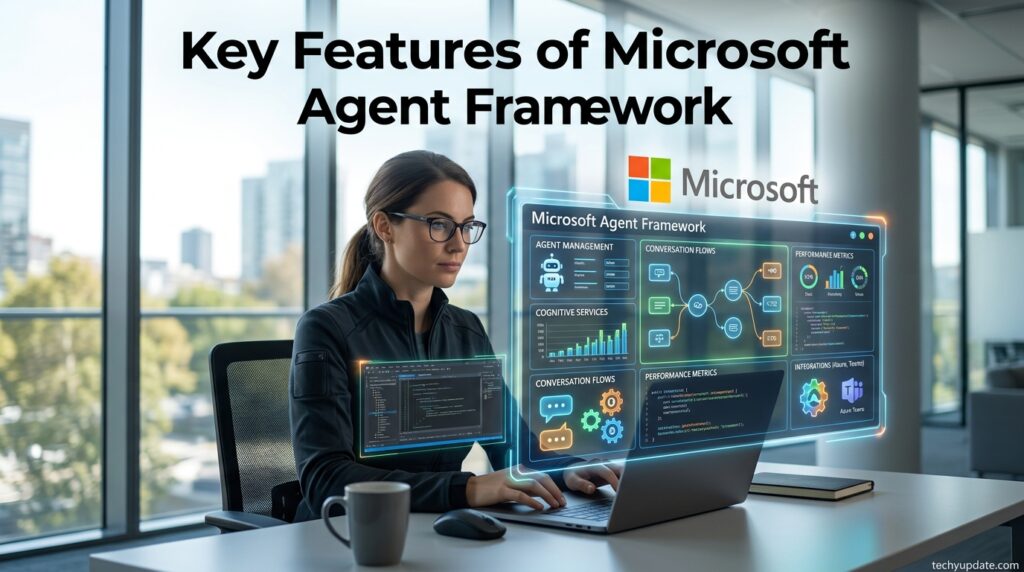
Key Features of Microsoft Agent Framework
Agent Harness
The agent harness is the execution layer where model reasoning meets real action, giving agents controlled access to the shell, file system, and messaging loops needed to actually do things rather than just talk about doing them. It bundles function invocation, history persistence, planning, and tool access into a single, consistent call, meaning a developer building a custom agent gets most of this scaffolding “for free” and only needs to supply what makes their specific agent unique: its instructions and any custom tools.
Workflows and Multi-Agent Orchestration
MAF’s workflows are graph-based orchestration engines that let developers coordinate multiple specialized agents rather than relying on a single monolithic agent to do everything. A common pattern here is handoff orchestration, where a router agent forwards a request to a specialist agent, and the framework automatically injects the handoff tools that each agent needs to transfer control, solving a problem that used to break the first time a simple router encountered a request requiring follow-up context from a peer agent.
Model Context Protocol (MCP) and Agent-to-Agent (A2A) Support
MAF ships with built-in MCP client support, enabling agents to dynamically discover and invoke external tools exposed by MCP-compliant servers, without requiring custom integration code for each tool. Alongside this, A2A protocol support enables cross-runtime agent collaboration, meaning agents built on Microsoft Agent Framework can coordinate with agents running in entirely different frameworks using structured, protocol-driven messaging, a meaningful step toward interoperability rather than vendor lock-in.
CodeAct
One of the more technically interesting additions announced at Microsoft’s BUILD 2026 conference is CodeAct, which collapses the traditional “choose a tool, wait, choose the next tool” loop into a more efficient process. Instead of that repeated back-and-forth, the model writes a single short Python program that calls the available tools directly, runs it once inside a sandbox, and returns a consolidated result.
This ships inside a package that runs the model-generated code in an isolated, lightweight virtual machine per call, meaning strong security isolation comes essentially free at the level of a single tool call.
DevUI
DevUI is a browser-based local debugger that visualizes agent execution, message flows, tool calls, and orchestration decisions in real time. For developers used to debugging traditional applications with clear breakpoints and stack traces, DevUI brings some of that same visibility to what can otherwise feel like an opaque agent decision-making process.
Migration Assistants
For teams already invested in either Semantic Kernel or AutoGen, MAF includes dedicated migration assistants that analyze existing code and generate step-by-step plans to upgrade to the new framework’s standards. This meaningfully lowers the switching cost for organizations that don’t want to rewrite everything from scratch just to adopt the newer, unified SDK.
Hosted Agents via Foundry Agent Service
Beyond the open-source SDK itself, Microsoft offers hosted agents through Foundry Agent Service, supporting long-running agents and routines without requiring a team to manage their own hosting infrastructure. At BUILD 2026, Microsoft added an agent optimizer for these hosted agents, along with expanded tracing and evaluation tool features aimed squarely at teams that want production observability without building it themselves.
Who is the Microsoft Agent Framework For?
- Azure-native and .NET-heavy teams get the clearest value, since industry coverage describes MAF as “the obvious default” for organizations already committed to the Microsoft and Azure ecosystem.
- Teams migrating from AutoGen or Semantic Kernel benefit directly from the built-in migration assistants that reduce the switching cost of moving to a supported, long-term SDK.
- Enterprise teams needing compliance and support benefit from MAF’s enterprise-readiness focus, though it’s worth noting up front that self-hosted enterprise support currently runs primarily through the Foundry Agent Service rather than through independent, self-managed deployment paths.
- Cross-platform teams that work with both .NET and Python benefit from a single conceptual model rather than maintaining two separate mental models for agent development.
Real Use Cases
The enterprise .NET team. A financial services company running a large .NET codebase adopts the Microsoft Agent Framework to build an internal agent that reviews compliance documentation and flags inconsistencies for a human reviewer.
Because the team already lives inside the Azure ecosystem, wiring MAF into their existing authentication and deployment pipeline takes days rather than weeks, and the built-in human-in-the-loop approval flow means the agent can flag issues without being trusted to take irreversible action on its own.
The team is migrating from AutoGen. A data science team that built an early multi-agent research prototype on AutoGen uses Microsoft’s migration assistant to analyze their existing code and generate a step-by-step upgrade plan.
Rather than a full rewrite, the team can move their orchestration logic in a matter of days, keeping the multi-agent patterns they’ve already validated while gaining the stability guarantees of a 1.0 release with long-term support.
The cross-language platform team. A larger organization running Python-based data pipelines alongside a .NET-based customer-facing application uses Microsoft Agent Framework on both sides, giving their platform team one shared mental model for how agents are built, tested, and deployed, regardless of which language a given service uses, reducing the onboarding time for engineers moving between the two codebases.
Pros and Cons
| Pros | Cons |
|---|---|
| Backed by the same teams that built AutoGen and Semantic Kernel, not a third-party wrapper | Self-hosted enterprise support is limited without third-party providers — Foundry Agent Service is the primary supported path |
| Consistent programming model across both .NET and Python | Smaller community ecosystem than LangGraph at this stage |
| Built-in MCP and A2A protocol support for genuine cross-framework interoperability | Newer than CrewAI in terms of Fortune 500 prototyping adoption |
| Migration assistants meaningfully lower the switching cost from AutoGen or Semantic Kernel | Some orchestration APIs remain in preview and may still evolve |
| Free and open source under the MIT license | Hosted production features (Foundry Agent Service) carry standard Azure usage-based costs |
Verdict
Microsoft Agent Framework earns its “obvious default” reputation specifically for .NET and Azure-native teams, thanks to genuine enterprise-readiness features, official long-term support, and a clear migration path from Microsoft’s earlier agent tooling.
For teams outside that ecosystem, the calculus is genuinely less clear-cut. LangGraph currently offers a larger community ecosystem, and CrewAI has broader early adoption for rapid prototyping at large enterprises. MAF is a serious, credible framework rather than a marketing exercise, but whether it’s the right choice still depends heavily on which ecosystem your team already lives in.
Read more: LangGraph Review
Read more: Microsoft Agent Framework Pricing & Alternatives
Read more: Microsoft Agent Framework vs LangGraph Comparison
Frequently Asked Questions
Is Microsoft Agent Framework free to use?
Yes, the framework itself is open source under the MIT license and free to use, though hosted production features via Azure AI Foundry’s Foundry Agent Service are subject to standard Azure usage-based pricing.
What replaced AutoGen and Semantic Kernel?
Microsoft Agent Framework 1.0 replaced both, unifying AutoGen’s multi-agent orchestration innovations with Semantic Kernel’s enterprise-ready foundations into a single, production-supported SDK released in April 2026.
Is the Microsoft Agent Framework production-ready?
Yes, it reached General Availability on April 3, 2026, following a Release Candidate phase in February 2026, offering stable APIs and a long-term support commitment for both .NET and Python.
Does Microsoft Agent Framework support both Python and .NET?
Yes, it provides the same conceptual model and consistent APIs across both languages, allowing cross-language teams to share a single mental model for building and deploying agents.
Can I migrate from AutoGen to the Microsoft Agent Framework easily?
Yes, Microsoft provides dedicated migration assistants that analyze existing AutoGen or Semantic Kernel code and generate step-by-step migration plans to reduce the switching cost.
Conclusion
Microsoft Agent Framework represents a genuinely mature consolidation of Microsoft’s previously fragmented agent-building tools, backed by real enterprise features such as MCP and A2A protocol support, migration assistants, and hosted production options via the Foundry Agent Service. It’s a strong default for Azure and .NET-native teams, though organizations outside that ecosystem should honestly weigh it against more established, community-driven alternatives before committing.