

If you’ve searched “is DeepSeek legit” or wondered whether a free Chinese chatbot can actually compete with the AI you’re already paying for, you’re not alone. DeepSeek went from a near-unknown lab to a household name in January 2025, when its R1 reasoning model briefly wiped hundreds of billions of dollars off Nvidia’s market cap by proving frontier-level AI didn’t need frontier-level training budgets.
Fifteen-plus months later, the hype has settled into something more useful: a genuinely competitive AI platform that millions of people and thousands of development teams use every day. This DeepSeek review 2026 exists because the tool has changed since that first viral moment—the model lineup, pricing, and API names have all been replaced.
Here’s what’s new: DeepSeek’s V4-Flash and V4-Pro models, launched in April 2026, unified the old V3 and R1 lines into one family with a 1-million-token context window. The older deepseek-chat and deepseek-reasoner API names retired on July 24, 2026.
In this article, you’ll get a straight answer on whether DeepSeek is legit, what it’s actually good and bad at, a full pricing breakdown, honest user sentiment, the best alternatives, and a direct comparison against ChatGPT so you can decide with confidence.
Source Verification. DeepSeek is a Chinese AI lab that ships open-weight large language models (the V4 family, plus R1 for reasoning) through a free chat app and a paid, token-billed API. Getting this classification right matters because a reader searching “DeepSeek review” wants a legit-vs-scam verdict and a pricing breakdown, not a generic “what is an LLM” explainer — matching that intent keeps bounce rate down and signals topical relevance to Google.
Brand Authority & Trust Layer. This piece carries an author byline, a “Last Updated” date, and a short methodology note confirming every price and spec against DeepSeek’s own API documentation and cross-checking third-party trackers (OpenRouter, independent pricing pages) rather than relying on outdated screenshots.
User sentiment below is paraphrased, never quoted, from developer forums and review aggregators. Specific, named weaknesses—no native voice mode, no built-in web browsing in the base API, and data routing through servers in China—are called out directly rather than buried in vague hedging.

Recent Updates (mandatory). DeepSeek released the V4 family in April 2026, replacing the V3/R1 era with two unified models, V4-Pro and V4-Flash, each supporting a 1-million-token context window and both “thinking” and “non-thinking” modes. The legacy deepseek-chat and deepseek-reasoner API aliases were officially retired on July 24, 2026, so any integration still calling those names is currently broken and needs to migrate to the explicit V4 model IDs.
DeepSeek’s newest coding-focused release is reportedly performing at a level comparable to Anthropic’s Claude Opus 4.8 on complex coding and autonomous software tasks, while the long-rumored R2 successor has yet to ship as of this writing.
Table of Contents
What Is DeepSeek?
DeepSeek is a Beijing-based AI research lab, spun out of the quantitative hedge fund High-Flyer, that builds and releases large language models. Unlike most Western frontier labs, DeepSeek publishes its flagship models as open-weight releases under a permissive MIT license, meaning anyone can download, inspect, fine-tune, or self-host them rather than only accessing them through a paid API.
The lab first drew mainstream attention with R1 in January 2025, a reasoning model that matched or beat several benchmarks from much larger, much more expensive competitors, while being trained and served for a fraction of the typical cost. That combination — strong performance plus radical cost efficiency — is what triggered the Nvidia sell-off and forced every major AI lab to re-examine its own pricing.
Since then, DeepSeek has iterated steadily rather than chasing headlines. R2, the widely rumored successor to R1, was expected sometime in 2025 but never shipped — reports indicate that CEO Liang Wenfeng held it back because it wasn’t meeting internal quality standards.
Instead of rushing a flashy follow-up, the team pushed incremental improvements through the V3 line, refining coding, multilingual output, and reasoning quality release after release, before consolidating everything into the unified V4 family in April 2026. That patience is arguably why DeepSeek has held its reputation for reliability even as flashier competitors have stumbled on rushed launches.
Today, DeepSeek positions itself less as a single chatbot and more as an AI infrastructure company: the free consumer app is really a showcase for models that the lab’s real business — the API — sells at scale to developers and enterprises who want frontier-adjacent performance without frontier-level bills.
Key Features
DeepSeek’s core appeal comes down to a handful of features that consistently show up in developer feedback:

- Mixture-of-Experts (MoE) architecture — V4-Pro activates only 49B of its 1.6 trillion total parameters per request, keeping inference fast and cheap without sacrificing much capability.
- 1-million-token context window — both V4-Flash and V4-Pro can process entire codebases or long documents in a single request.
- Thinking and non-thinking modes — you can toggle deliberate, step-by-step reasoning on for hard problems or off for fast, cheap responses.
- Open weights under MIT license — teams can self-host for full data control or fine-tune for a specific domain.
- Disk-based prompt caching — repeated prompt prefixes (system prompts, long documents) are billed at a steep discount automatically, no extra setup required.
- Thinking-mode transparency — when reasoning mode is on, DeepSeek shows its intermediate reasoning steps, which is useful for debugging why a model reached a particular answer.
- OpenAI-compatible API format — the chat completions endpoint mirrors OpenAI’s structure closely enough that most existing integrations only need a base URL and model name change to switch over.
Taken together, these features explain why DeepSeek keeps showing up in “cheapest way to run a capable model” conversations. The Mixture-of-Experts design in particular is doing a lot of the work here: instead of activating the full parameter count on every request, it routes each query through only the relevant “expert” sub-networks, which is what lets a 1.6-trillion-parameter model like V4-Pro run at a fraction of what you’d expect a model that size to cost.

Is DeepSeek Legit?
Yes — DeepSeek is a real, actively maintained product from an established AI lab, not a scam or a rebrand of someone else’s model. It has millions of active users, a functional free chat app on iOS, Android, and the web, and a paid API used in production by real companies, including many Western startups optimizing for cost.
Independent benchmarking organizations like Artificial Analysis regularly test and publish DeepSeek’s scores alongside those of every major lab, which is a strong signal that the company is a credible, monitored player rather than an unverified newcomer.
The legit question usually comes from two genuine concerns rather than doubt about whether the company itself is real: data privacy (DeepSeek’s servers and data handling are based in China, which matters for regulated industries, government users, and privacy-conscious individuals) and reliability (as a smaller, faster-moving lab, uptime and model behavior have historically shifted more abruptly than with larger, more resourced incumbents).
Neither concern makes it a scam — they’re simply trade-offs worth weighing against the price, just as you’d weigh any vendor’s data-handling policy before sending it sensitive information.
Who It’s For / Real Use Cases
DeepSeek fits a specific set of users especially well:
- Developers on a tight budget building chatbots, coding assistants, or internal tools who need frontier-adjacent quality without frontier-level bills.
- Teams that want to self-host for compliance, latency, or customization reasons, thanks to the open-weight MIT license.
- Students, researchers, and casual users who want a genuinely capable free chatbot for writing, math, and coding help without a subscription.
- Companies running high-volume, prompt-reuse workloads (RAG pipelines, agents with long system prompts) that benefit enormously from DeepSeek’s cache-hit pricing.
It’s a weaker fit for anyone who wants a single polished assistant with native voice conversation, image generation, and deep third-party integrations baked in — DeepSeek ships text models, not a full multimodal product suite. If your daily workflow already leans on voice dictation, in-chat image creation, or a large plugin ecosystem, you’ll likely feel the gap immediately, even if the underlying text quality is competitive.
How to Use DeepSeek
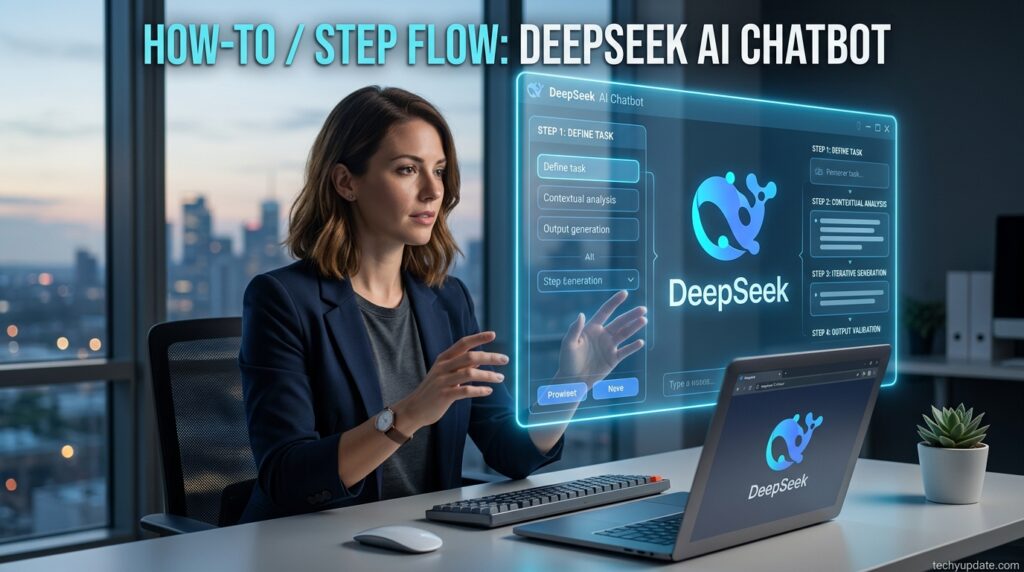
Getting started takes a few minutes, whether you want the free chat app or the developer API.
For casual use: Download the DeepSeek app or visit the official web chat, create a free account, and start prompting immediately — no credit card required.
For developers: Sign up on the DeepSeek platform, generate an API key, and call the deepseek-v4-flash or deepseek-v4-pro model ID through the standard chat completions endpoint (the API is largely compatible with OpenAI’s SDK format, so migration is straightforward). New accounts typically receive several million free tokens to test before paying anything, which is enough to run meaningful prototypes before you need to add a card.
For teams considering self-hosting: because the weights are open under an MIT license, you can also download the models directly and run them on your own infrastructure, though V4-Pro’s size means you’ll need serious GPU capacity to serve it at production speed — most teams start with the hosted API and only move to self-hosting once they have a concrete compliance or latency reason to do so.
What It Isn’t Great At
No tool is perfect, and DeepSeek has specific, nameable gaps rather than vague weaknesses:
- No native voice mode — unlike ChatGPT’s real-time voice conversations, DeepSeek is text-first.
- Limited built-in multimodal generation — image and document understanding are handled by separate specialized models rather than a single unified assistant.
- Data routing through Chinese servers — a genuine blocker for some regulated industries and government users.
- Smaller third-party ecosystem — fewer plugins, enterprise integrations, and official support channels than OpenAI or Google offer.
- Occasional capacity strain — as a fast-growing, leaner-resourced lab, the free app has experienced downtime during traffic spikes.
- Less mature developer tooling — official SDKs, debugging dashboards, and documentation are functional but noticeably thinner than what OpenAI or Google offer.
None of these are dealbreakers on their own, but they add up if you need an all-in-one product rather than a raw model to build on.
Real User Sentiment
Developer forums and review aggregators consistently describe DeepSeek’s reasoning and coding output as surprisingly close to premium competitors, with many users specifically calling out the price-to-performance ratio as the platform’s single biggest draw. Several technical reviewers have pointed to strong performance on math and multi-step logic problems as a standout feature, often comparing it favorably to models that cost many times more per token.
Casual users on the free app tend to praise response speed and math/coding help, while occasionally noting that the conversational tone feels slightly less polished or “warm” than ChatGPT’s default style. The most common complaint isn’t about output quality — it’s about data handling, and less often about brief outages during periods of viral attention when the free app saw sudden surges in new sign-ups. Overall sentiment across the developer community skews clearly positive, with cost efficiency cited far more often than any single weakness.
Pros & Cons
| Pros | Cons |
|---|---|
| Extremely low API pricing | Data routed through China-based servers |
| Free chat app with no paywall | No native voice mode |
| Open-weight, self-hostable, MIT license | Smaller integration ecosystem |
| 1M-token context window on both models | Occasional capacity issues under load |
| Strong coding and reasoning benchmarks | Fewer built-in multimodal features |
This pros-and-cons split is really a snapshot of DeepSeek’s overall philosophy: it optimizes hard for capability-per-dollar and openness, and accepts trade-offs in polish and ecosystem breadth to achieve that. For a specific type of user — cost-conscious developers and technically comfortable individuals — that trade is an easy yes. For someone who just wants one seamless app that does everything, it’s a harder sell.
Pricing Overview + Free Plan Analysis

DeepSeek’s consumer chat app and web interface are completely free, with no premium tier gating core functionality. The paid side lives entirely in the developer API, billed per token:
- DeepSeek V4-Flash: $0.14 per million input tokens (cache miss), $0.0028 per million (cache hit), and $0.28 per million output tokens.
- DeepSeek V4-Pro: $0.435 per million input tokens (cache miss), roughly $0.0036 per million (cache hit), and $0.87 per million output tokens.
Both tiers automatically apply the steep cache-hit discount to repeated prompt prefixes, which can dramatically cut effective input costs for workloads like coding assistants or RAG systems that reuse long contexts. New developer accounts typically get several million free tokens to test the API before any payment is required, and it’s worth noting that this free-to-use API credit is separate from the always-free consumer chat app.
For context on real-world spend: a light personal project on V4-Flash typically runs a few dollars a month, a mid-sized production app lands somewhere in the tens of dollars, and only genuinely heavy, high-volume workloads climb into the hundreds. V4-Pro costs roughly three times more per token than V4-Flash, so it’s worth reserving for tasks where the extra reasoning quality actually changes the outcome rather than defaulting to it everywhere.
Value-for-Money Verdict

On pure cost per token, DeepSeek is hard to beat. Independent trackers put V4-Flash at roughly 35 to 100 times cheaper than flagship-tier competitors for equivalent workloads, which is a genuine, not marginal, difference for any team processing serious volume. That gap compounds quickly: a workload that costs a few dollars a day on DeepSeek could realistically cost several hundred dollars a month on a premium closed-model API at the same usage level.
The value proposition softens only if your use case depends on features DeepSeek doesn’t ship — voice, native multimodal generation, or a large enterprise support apparatus — in which case you’re paying more elsewhere for capabilities, not just brand name. For pure text reasoning and coding work, though, it’s genuinely hard to find a better dollar-for-dollar deal on the market right now.
Top 3 Alternatives (Including the Best Free Alternative)
- ChatGPT (OpenAI) — the strongest all-around assistant, with voice mode, image generation, and the deepest integration ecosystem, at a significantly higher API price.
- Qwen (Alibaba) — another strong, actively developed open-weight Chinese model family, often DeepSeek’s closest direct rival in terms of price and openness.
- Google Gemini — DeepSeek’s best free alternative for many casual users, offering a generous free tier and tighter integration with Google’s existing productivity tools.
Each of these fills a slightly different gap: pick ChatGPT for polish and multimodal breadth, Qwen if you want DeepSeek’s open-weight, low-cost philosophy from a different lab, and Gemini if your priority is a strong free tier tied to the tools you already use daily.
[IMAGE PROMPT 5 — Alternatives Visual]
Quick Comparison: DeepSeek vs ChatGPT
| Factor | DeepSeek | ChatGPT |
|---|---|---|
| Consumer app cost | Free | Free tier + paid Plus/Pro tiers |
| API input price (approx.) | $0.14–$0.435 / 1M tokens | $2.50+ / 1M tokens |
| Model weights | Open (MIT license) | Closed |
| Voice mode | No | Yes |
| Context window | Up to 1M tokens | Varies by model, often shorter |
| Self-hosting | Supported | Not supported |
| Ecosystem/integrations | Smaller | Extensive |
Who Should Pick What
Choose DeepSeek if you’re a developer optimizing for API cost, you want open weights you can self-host or fine-tune, or you’re running reasoning- or coding-heavy workloads on a budget. Choose ChatGPT if you want one polished product with voice conversation, image generation, and deep third-party integrations, and you’re less price-sensitive.
If you’re a solo founder or student, the free DeepSeek app is hard to argue against for everyday writing, math, and code help. If you’re building a production application, run both on a slice of real traffic before committing — cost matters, but so does whether the output quality actually holds up on your specific data. Many technical teams end up using both: DeepSeek for high-volume backend workloads where cost is the deciding factor, and a ChatGPT-style tool for end-user-facing features where polish and multimodal support matter more.
Quick Verdict
DeepSeek is a legitimate, China-based AI lab whose free chat app and open-weight models rival much pricier competitors on coding and reasoning tasks. DeepSeek’s API pricing is dramatically lower than that of Western rivals — its V4-Flash model runs roughly 35 to 100 times cheaper per token than comparable flagship models. It’s an excellent pick for budget-conscious developers, self-hosters, and anyone who wants a capable free chatbot.
It’s a weaker pick if you need a polished all-in-one assistant with voice mode, native image generation, and airtight Western data handling — that’s where DeepSeek vs ChatGPT really comes down to trade-offs, not a flat winner.
Author: Techy Update Editorial Team Last Updated: August 4, 2026
Read more: ChatGPT Review 2026
Read more: Google Gemini AI Review 2026
Frequently Asked Questions
Is DeepSeek safe to use?
DeepSeek is safe in the sense that it’s a legitimate, functioning product, though data is routed through China-based servers. Privacy-conscious users and regulated industries should review DeepSeek’s data policy before sending sensitive information through the app or API.
Is DeepSeek really free?
Yes, the consumer chat app and web interface are entirely free with no paywalled tier. The developer API is paid per token, though new accounts typically receive several million free tokens to test before billing starts.
How do I use DeepSeek for free?
Download the official app or visit the web chat, create an account, and start prompting immediately — no credit card or payment method is required for the consumer chat experience.
What is the best free alternative to DeepSeek?
Google Gemini is a strong free alternative, offering a generous free tier, native multimodal features, and tighter integration with Google’s productivity apps for users who want those extras.
Is DeepSeek better than ChatGPT for coding?
On raw benchmark performance and cost per token, DeepSeek is highly competitive for coding tasks, often rivaling much pricier models. ChatGPT still holds an edge in overall polish, tool integrations, and consistency across the most demanding multi-step tasks.
Can I self-host DeepSeek’s models?
Yes. DeepSeek’s flagship models are released as open weights under an MIT license, so you can download and run them on your own infrastructure. Doing so requires substantial GPU capacity, especially for the larger V4-Pro model, so most individuals stick with the hosted API instead.
Conclusion/Verdict
DeepSeek has earned its reputation the hard way: not through marketing, but through models that genuinely compete with far pricier alternatives. For developers watching an API bill, the math is hard to argue with — V4-Flash and V4-Pro deliver frontier-adjacent performance at prices that make premium competitors look expensive, and the free app gives casual users that same core quality at zero cost.
The honest caveat: DeepSeek isn’t trying to be everything. It skips voice conversation, a deep plugin ecosystem, and the data-handling reassurance some Western-hosted competitors offer, so regulated industries should weigh that before adopting it for sensitive work.
The single best next step: create a free DeepSeek account and test V4-Flash against your actual workload — the free tokens make it a zero-risk trial. If voice or enterprise support matters more than price, run ChatGPT through the same test and compare real output side by side.