

Understanding the Ultimate AI blogging Stack layered tool hierarchy diagram is becoming essential for anyone serious about ranking on Google in 2026. SEO is no longer a manual process where writers simply insert keywords and hope for the best. Today, artificial intelligence controls how content is analyzed, ranked, and distributed across search engines.
Many bloggers struggle because they use random tools without a structured system. They might use one tool for writing, another for keywords, and another for SEO, but without integration, results stay inconsistent. This is where a structured AI blogging stack becomes powerful.
The solution is to build a layered AI system in which each tool plays a specific role. From research and writing to optimization and publishing, every layer works together like a digital ecosystem. This is what we call the Ultimate AI Blogging Stack.
In this guide, you will learn how this system works, how to build it, and how to use it to dominate search rankings in 2026 with precision and efficiency.
Read More: How to Use AI to Rank Higher on Google Today
Understanding The Ultimate AI Blogging Stack
The Ultimate AI Blogging Stack is a structured system of AI tools that automates and optimizes the entire content creation process. Instead of relying on a single tool, it combines multiple AI systems working in layers.
Each layer has a specific purpose:
- Research layer
- Content creation layer
- SEO optimization layer
- Publishing and analytics layer
This structure ensures that every blog post is not just written but fully optimized for search engines and user intent.
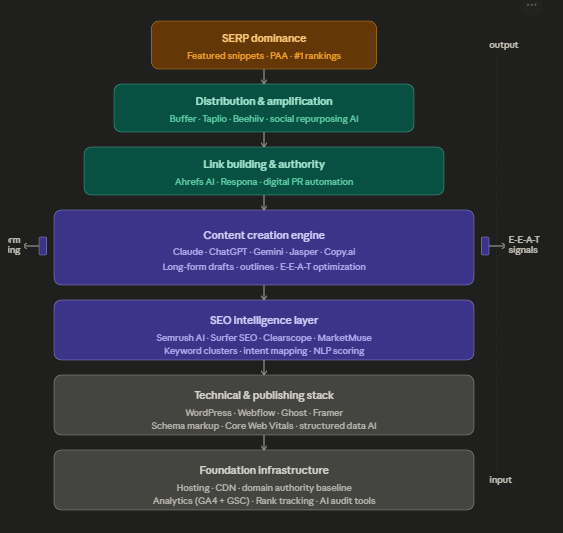
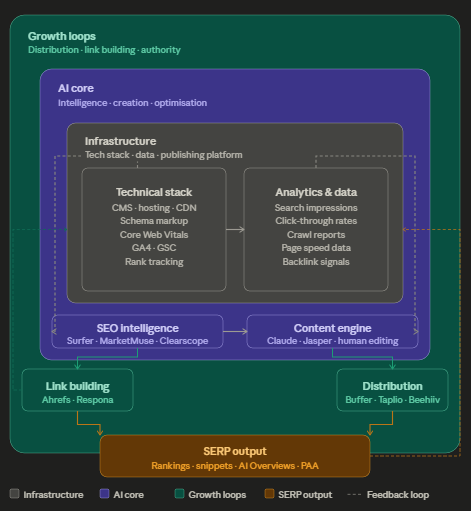
The layered tool hierarchy diagram concept helps visualize how each AI tool connects and supports the next stage of content creation.
Layered Tool Hierarchy Diagram Explained
The layered tool hierarchy is a structured model showing how AI tools work together in blogging workflows.
At the top, you have strategy and keyword research. In the middle, content creation and optimization tools. At the bottom are publishing, tracking, and analytics systems.
This hierarchy ensures:
- Better workflow organization
- Reduced manual effort
- Higher SEO efficiency
- Scalable content production
Each layer depends on the one below it, creating a fully automated content ecosystem.
How the AI Blogging Stack Works in Real SEO Systems
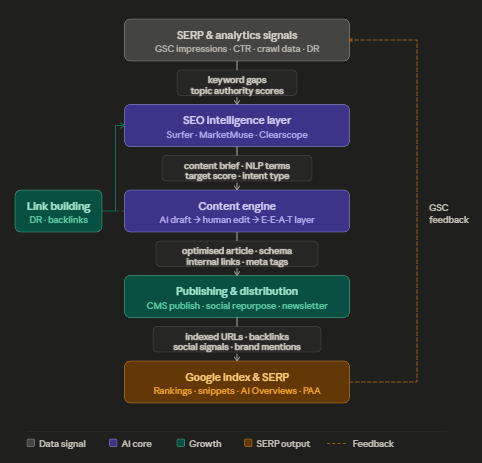
The AI blogging stack works by dividing content creation into stages.
First, AI identifies topics and keywords based on search trends. Then it generates structured outlines and full articles. After that, SEO tools optimize content to align with ranking signals.
Finally, analytics tools measure performance and suggest improvements.
This workflow ensures continuous improvement instead of one-time optimization.
Real-World Use Cases of AI Blogging Stack
Businesses and bloggers use AI blogging stacks in various industries.
Content creators use it to publish daily articles without writing them manually. Affiliate marketers use it to generate product reviews that target high-conversion keywords.
E-commerce websites use AI to create product descriptions and buying guides at scale. Digital agencies use layered AI systems to efficiently manage multiple client websites.
For example, a tech blog using an AI stack can publish:
- Daily AI news articles
- Product comparisons
- SEO-optimized guides
All without increasing manual workload significantly.
Tools and Methods in AI Blogging Stack
Each layer of the AI blogging stack includes specialized tools that perform specific tasks.
Research Tools
These tools identify trending topics, keywords, and competitor strategies. They analyze search intent and provide content opportunities.
They help with:
- Keyword discovery
- Trend analysis
- Competitor research
Content Generation Tools
These tools create full-length articles from inputs such as keywords and outlines. They generate human-like content that follows SEO structure.
They help with:
- Blog writing
- Meta content creation
- Outline generation
SEO Optimization Tools
These tools refine content for search engines. They ensure proper keyword placement, readability, and structure.
They help with:
- On-page SEO
- Semantic optimization
- Internal linking suggestions
Publishing and Analytics Tools
These tools handle scheduling, publishing, and performance tracking.
They help with:
- Content scheduling
- Traffic monitoring
- Ranking analysis
Comparison Table: Manual Blogging vs AI Blogging Stack
| Feature | AI Blogging Stack | Manual Blogging |
| Speed | Very fast | Slow |
| Scalability | High | Limited |
| SEO Optimization | Automated | Manual |
| Content Consistency | High | Varies |
| Data Analysis | AI-driven | Human-based |
| Workflow Efficiency | Optimized | Fragmented |
This comparison shows why structured AI systems outperform traditional blogging methods.
Benefits of The Ultimate AI Blogging Stack
Using a structured AI blogging system provides multiple advantages.
- Faster content production
- Improved SEO accuracy
- Reduced manual workload
- Better keyword targeting
- Scalable publishing system
It also allows bloggers to focus more on strategy rather than repetitive tasks.
Common Problems and Smart Solutions
Even with AI tools, users face challenges when building blogging stacks.
One common problem is using too many disconnected tools. This creates confusion and reduces efficiency.
Another issue is over-automation, where content becomes generic and lacks personality.
Solutions include:
- Using a structured workflow
- Combining AI with human editing
- Focusing on audience intent
A balanced approach ensures both quality and scalability.
Advanced Insights: How AI Understands Content Hierarchy
Modern AI systems do not just read content; they analyze structure, intent, and semantic depth.
They evaluate:
- Topic coverage
- Content hierarchy
- User engagement signals
This is why structured blogging stacks perform better. They align perfectly with how AI evaluates content quality.
Layered systems ensure that each stage of content creation improves the final output.
SEO Strategy Using AI Blogging Stack
A strong AI-driven SEO strategy involves more than keyword placement.
It focuses on:
- Topic clusters instead of single keywords
- Semantic keyword integration
- User-focused content creation
- Continuous optimization based on analytics
AI tools help identify gaps in content strategy and suggest improvements automatically.
Practical Example of AI Blogging Stack Workflow
Imagine building a blog post on “AI tools for marketing.”
Step 1: AI research tools identify trending keywords
Step 2: Content tools generate an outline and a draft
Step 3: SEO tools optimize structure and keywords
Step 4: Publishing tools schedule the article
Step 5: Analytics tools track performance
Each step improves efficiency and ranking potential.
Pros and Cons of AI Blogging Stack
Pros
- Highly efficient workflow
- Scalable content creation
- Strong SEO optimization
- Reduced workload
- Data-driven decisions
Cons
- Requires setup time
- Learning curve for beginners
- Risk of over-automation
- Needs human oversight
Future of AI Blogging Systems
The future of blogging will be fully AI-integrated. Blogging stacks will evolve into autonomous systems capable of:
- Predicting trending topics
- Generating optimized content automatically
- Adjusting SEO in real time
- Personalizing content for users
Layered tool hierarchy systems will become standard for all digital publishers.
Conclusion
The rise of The Ultimate AI blogging Stack, a layered tool hierarchy diagram, marks a major shift in how content is created and optimized online. Blogging is no longer just about writing articles; it is about building intelligent systems that manage the entire content lifecycle.
By using a structured AI blogging stack, you gain control over every stage of content production—from research and writing to optimization and analytics. This allows you to scale faster, improve SEO performance, and stay ahead of competitors in a rapidly evolving digital landscape.
However, success does not come from automation alone. The most effective strategy is combining AI efficiency with human creativity. AI provides speed, structure, and data insights, while humans ensure originality, emotion, and value.
To succeed in 2026, focus on:
- Building a structured AI workflow
- Using layered tools strategically
- Continuously analyzing performance
- Improving content quality over time
The future belongs to creators who understand systems, not just tools. Start building your AI blogging stack today and position your website for long-term growth, authority, and search dominance.
What is The Ultimate AI Blogging Stack?
It is a structured system of AI tools that automates blogging tasks such as writing, SEO, and publishing.
Why is a layered tool hierarchy important?
It organizes tools into structured levels for better workflow efficiency and SEO performance.
Can AI fully automate blogging?
AI can automate most tasks, but human oversight is still needed for quality control.
Is AI blogging better than manual blogging?
Yes, it is faster, more scalable, and more SEO-efficient.
What tools are used in AI blogging stacks?
Research tools, content generators, SEO tools, and analytics platforms.
How does AI improve SEO?
AI analyzes data, understands intent, and optimizes content for better rankings.
Is AI content good for Google ranking?
Yes, if it is high-quality, useful, and properly optimized.
What is the biggest advantage of AI blogging stacks?
Scalability and automation of the entire content process.
Do beginners need technical skills?
No, most AI tools are beginner-friendly.
What is the future of AI blogging?
Fully automated, intelligent, and real-time content systems.