

In today’s digital world, creating content without SEO is like opening a store in the middle of a desert. No matter how valuable your information is, readers will struggle to find it if search engines cannot properly index and rank your pages. This is where SEO article writing becomes essential.
SEO article writing is the process of creating content that is optimized for search engines while remaining useful, engaging, and informative for readers. It combines strategic keyword use, proper formatting, high-quality writing, and user-focused content to help webpages rank higher in Google search results.
Businesses, bloggers, affiliate marketers, and website owners use SEO writing to increase traffic, improve visibility, and attract targeted audiences. When done correctly, SEO content becomes a powerful long-term marketing asset that can generate consistent organic traffic for years.
SEO article writing is one of the most valuable digital skills in 2026. Whether you are a student, blogger, freelancer, marketer, or business owner, learning how to create optimized content can help you increase website traffic, build authority, and earn online income.
Today, search engines place a heavy emphasis on user intent, semantic relevance, and helpful content. That means writers can no longer rely on keyword stuffing or outdated SEO tricks. Instead, successful SEO article writing requires a balance of quality research, natural writing, keyword optimization, and user-focused formatting.
For beginners, the process may seem difficult at first. However, once you understand SEO-friendly content structure, semantic SEO, and how search engines analyze content, writing optimized blog posts becomes much easier.
This guide from Easynewspage.com explains everything beginners need to know about SEO article writing. You will learn practical techniques, modern SEO strategies, AI optimization methods, and real-world examples that can help your content rank in Google Search, AI-powered search engines, and featured snippets.
Table of Contents
Detailed Article Outline: How to Write SEO Articles for Beginners
Understanding the structure of a successful article is the first step toward becoming a skilled SEO writer. Beginners often focus only on keywords while ignoring formatting, readability, and search intent. However, modern search engine optimization requires a complete strategy.
A strong SEO article writing process usually starts with keyword research. Writers identify primary and secondary keywords that users search online. These keywords help search engines understand the article topic.
After keyword research, the next stage is content planning. A proper article outline should include:
- A compelling headline
- Clear introduction
- H2 and H3 headings
- Semantic keywords
- Internal links
- FAQs
- Optimized conclusion
Search engines also analyze user experience. Therefore, articles should include short paragraphs, bullet points, examples, and scannable formatting.
Another important factor is topical depth. Google rewards content that fully answers user questions. Beginners should avoid thin content and instead create long-form, helpful guides.
For example, if you are writing about SEO article writing, you should explain:
- Keyword optimization
- Semantic SEO
- Content structure
- AI writing tools
- User intent
- Featured snippets
- NLP terms
This creates comprehensive coverage and improves search visibility.
High-authority websites like URL Google Search Central https://developers.google.com/search and URL OpenAI https://openai.com emphasize creating useful, people-first content. That principle remains critical in 2026.
Why AI Tools Are Essential for SEO Article Writing
Artificial intelligence has transformed the content industry. Modern AI tools help beginners create better articles faster while improving research, optimization, and readability.
AI-powered platforms assist with:
- Keyword research
- Topic clustering
- Grammar improvement
- Content outlines
- Meta descriptions
- Semantic keyword suggestions
- Content scoring
Popular tools like urlChatGPT by OpenAI https://openai.com/chatgpt, urlGoogle Gemini https://gemini.google.com, and urlSurfer SEO https://surferseo.com can significantly improve SEO article-writing efficiency.
For beginners, AI tools reduce the learning curve. Instead of spending hours researching manually, writers can quickly generate outlines, keyword ideas, and optimization suggestions.
However, AI should support human creativity rather than replace it. Google prioritizes original expertise, real experience, and trustworthy information.
A balanced workflow includes:
- Human research
- AI-assisted structure planning
- Manual editing
- Fact-checking
- SEO optimization
AI search optimization is also important because modern search engines use generative AI summaries. Articles that answer questions directly are more likely to appear in AI-generated search results.
Pro Tip
Use AI tools for brainstorming and optimization, but always add personal insights, examples, and unique explanations to improve E-E-A-T signals.
Why SEO Matters for Beginners
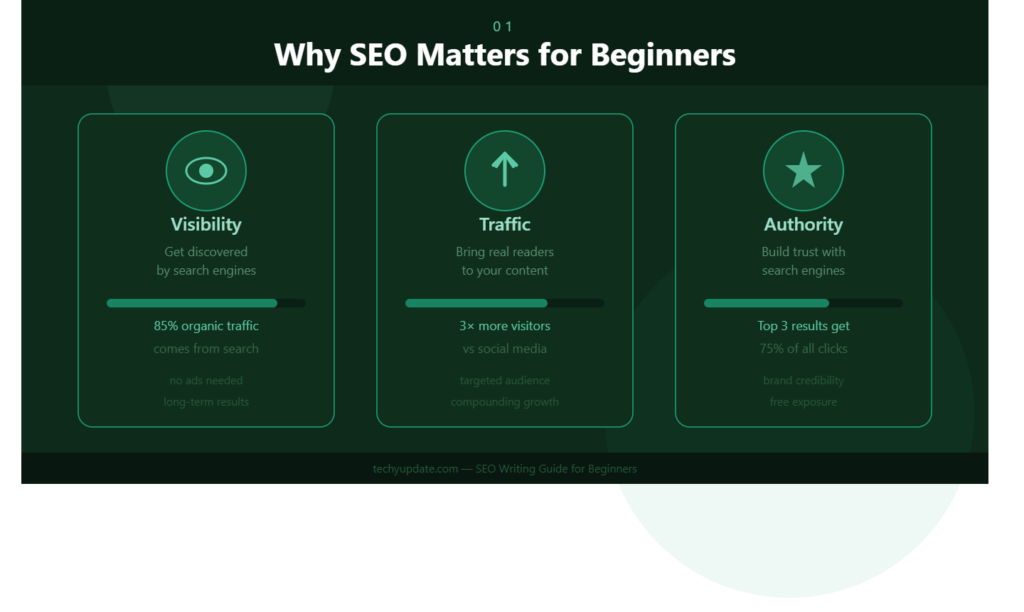
SEO Helps Websites Get Found Online
Millions of articles are published every day. Without SEO, new websites have almost no chance of competing against established brands. Search Engine Optimization helps beginners gain visibility and compete effectively by targeting specific search terms users actively use.
For example, when users search phrases like:
- “What is SEO article writing?”
- “Beginner SEO guide”
- “How to write SEO-friendly content.”
Search engines analyze thousands of pages to determine which content deserves top rankings. Websites with properly optimized articles have a significantly better chance of appearing on the first page.
SEO Builds Organic Traffic
Paid advertisements can generate temporary traffic, but SEO creates sustainable growth. Organic visitors arrive via unpaid search results, making SEO one of the most cost-effective digital marketing strategies.
High-ranking content continuously attracts readers without requiring constant advertising expenses. This allows bloggers and businesses to build authority and long-term visibility.
SEO Increases Credibility and Trust
Users naturally trust websites appearing on the first page of search results. Strong SEO practices improve authority signals, content relevance, user experience, and website structure.
When a website consistently publishes optimized, valuable content, search engines begin to recognize it as a reliable information source.
Read More: How to Use Grok AI for Free
Benefits of SEO-Friendly Content
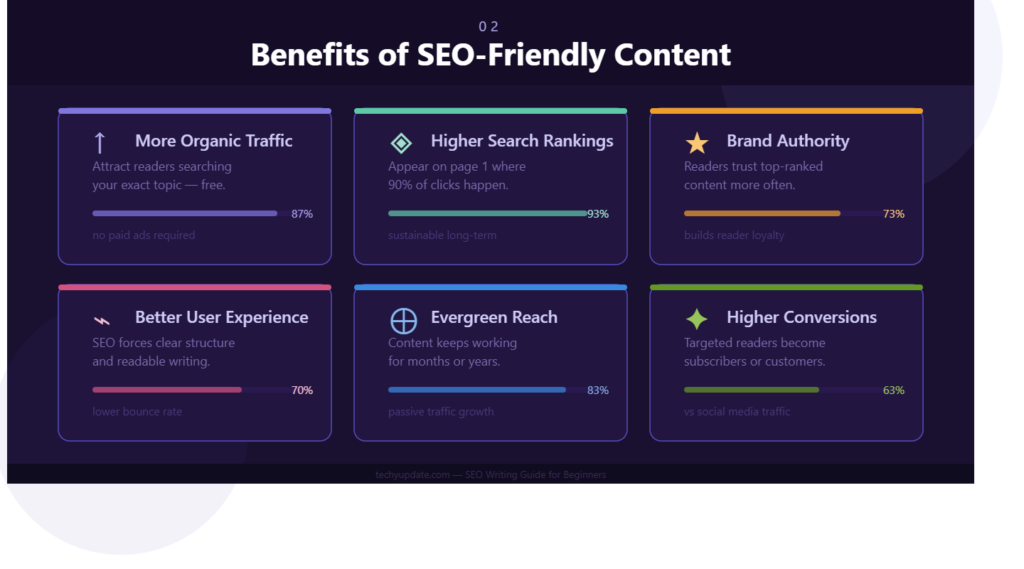
Higher Search Engine Rankings
SEO-friendly content improves page relevance for targeted keywords. Proper optimization helps search engines understand:
- What the article is about
- Which keywords it target
- How valuable it is for users
- Whether it deserves ranking visibility
Well-optimized articles often outperform poorly structured content, even when competitors have larger websites.
Better User Experience
Modern SEO is not only about keywords. Search engines prioritize user satisfaction. SEO-friendly content improves:
- Readability
- Mobile compatibility
- Content structure
- Loading speed
- Navigation
- Information clarity
Visitors stay longer on pages that are easy to read and provide useful answers quickly.
Increased Website Authority
Consistent SEO writing establishes topical authority. When websites regularly publish informative articles around a niche, search engines associate them with expertise.
This helps improve rankings across multiple related keywords.
Improved Conversion Rates
SEO content attracts highly targeted users already interested in a topic, product, or service. These visitors are more likely to:
- Subscribe
- Contact businesses
- Purchase products
- Share content
- Return for future visits
Targeted organic traffic often converts better than general advertising traffic.
Understanding SEO Basics
What Is Search Engine Optimization?
Search Engine Optimization (SEO) is the process of improving a website to increase its visibility in search engine results pages (SERPs).
SEO involves multiple strategies to help search engines understand, index, and rank web pages effectively.
The main goal is simple: attract more organic visitors from search engines.
Definition of SEO
SEO refers to optimizing content, technical website elements, and authority signals to improve rankings for relevant searches.
SEO includes:
- Keyword research
- Content optimization
- Technical improvements
- Link building
- User experience enhancements
- Mobile optimization
- Page speed improvements
All these components work together to improve search performance.
Importance of Websites and Blogs
Without SEO, even the best articles may remain invisible online. SEO ensures content reaches the right audience at the right time.
Benefits for websites and blogs include:
- Increased visibility
- More organic traffic
- Better brand recognition
- Higher engagement
- Improved credibility
- Greater revenue opportunities
For bloggers, SEO can transform small websites into powerful traffic-generating platforms.
Essential Elements of SEO Article Writing
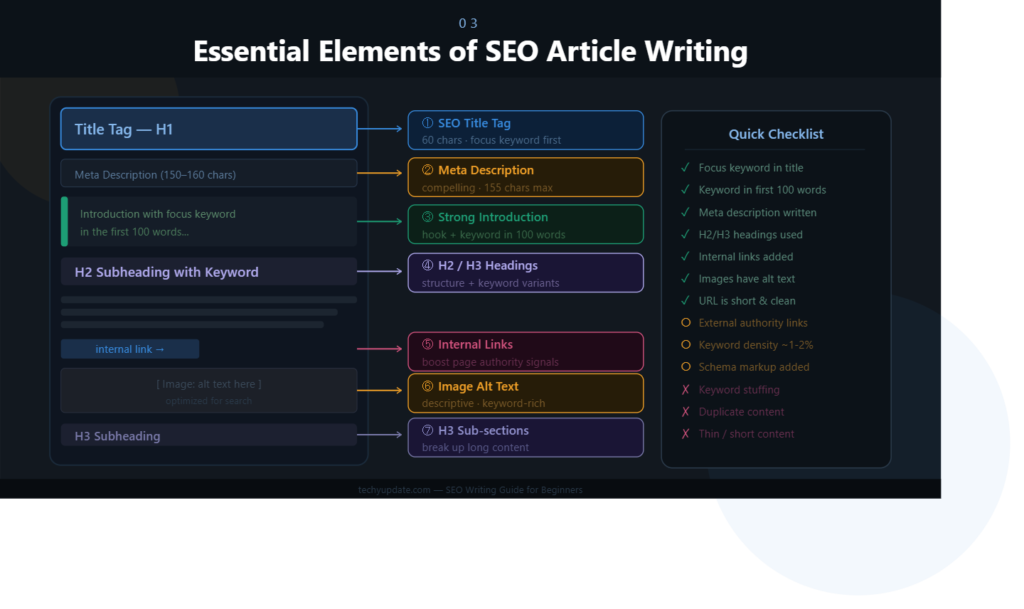
Keyword Research
Keyword research is the foundation of successful SEO writing. It identifies the exact phrases users search for online.
Effective keyword research helps writers understand:
- Search intent
- Competition levels
- User questions
- Traffic potential
Popular keyword research tools include:
- Ahrefs
- SEMrush
- Moz
- Google Keyword Planner
Search Intent Optimization
Understanding user intent is critical for rankings.
Search intent categories include:
Informational Intent
Users seek knowledge or answers.
Navigational Intent
Users want to find a specific website.
Transactional Intent
Users intend to purchase products or services.
Commercial Investigation
Users compare options before making decisions.
SEO articles should match the exact intent behind targeted keywords.
Optimized Headings Structure
Search engines analyze headings to understand content hierarchy.
Proper heading structure improves:
- Readability
- Crawling efficiency
- User navigation
- SEO relevance
Recommended structure:
- H1 for main title
- H2 for primary sections
- H3 for subsections
High-Quality Content
Modern SEO prioritizes content quality above keyword stuffing.
Strong SEO content should be:
- Original
- Informative
- Accurate
- Detailed
- Easy to read
- Valuable to users
Thin content rarely ranks well in competitive niches.
Internal Linking
Internal links connect related pages within a website.
Benefits include:
- Improved crawlability
- Better navigation
- Increased page authority distribution
- Longer user sessions
Strategic internal linking strengthens overall website SEO performance.
How to Write SEO Articles for Beginners
Writing SEO articles is one of the most effective ways to increase website traffic, improve online visibility, and grow a successful blog or business. SEO writing combines valuable content with search engine optimization techniques to help articles rank higher on search engines like Google.
For beginners, learning to write SEO articles may seem difficult at first, but with the right structure and strategy, anyone can create content that attracts readers and ranks well in search results. The key is understanding how to optimize content naturally while focusing on user experience and readability.
Create an SEO-Friendly Title
The title is one of the most important elements of an SEO article. It tells both readers and search engines what the content is about.
A strong title improves:
- Search rankings
- Click-through rates
- Reader engagement
- Keyword relevance
Using Keywords Naturally
The primary keyword should appear naturally in the title. Search engines use titles to assess page relevance, so including target keywords improves visibility.
Examples of optimized titles:
- Beginner’s Guide to SEO Article Writing
- How to Write SEO-Friendly Articles
- Best SEO Writing Tips for Beginners
Avoid forcing keywords unnaturally into headlines. Titles should remain clear, readable, and attractive to users.
Writing Engaging Headlines
An effective headline grabs attention immediately.
Strong headlines often include:
- Numbers
- Questions
- Power words
- Benefits
- Clear solutions
Examples:
- 10 SEO Writing Tips That Improve Rankings
- How to Write SEO Articles That Drive Traffic
- Best Beginner SEO Strategies for Bloggers
Engaging headlines increase clicks and encourage users to read further.
Write a Strong Introduction
The introduction determines whether readers stay on the page or leave immediately. A strong opening should quickly explain the article’s value.
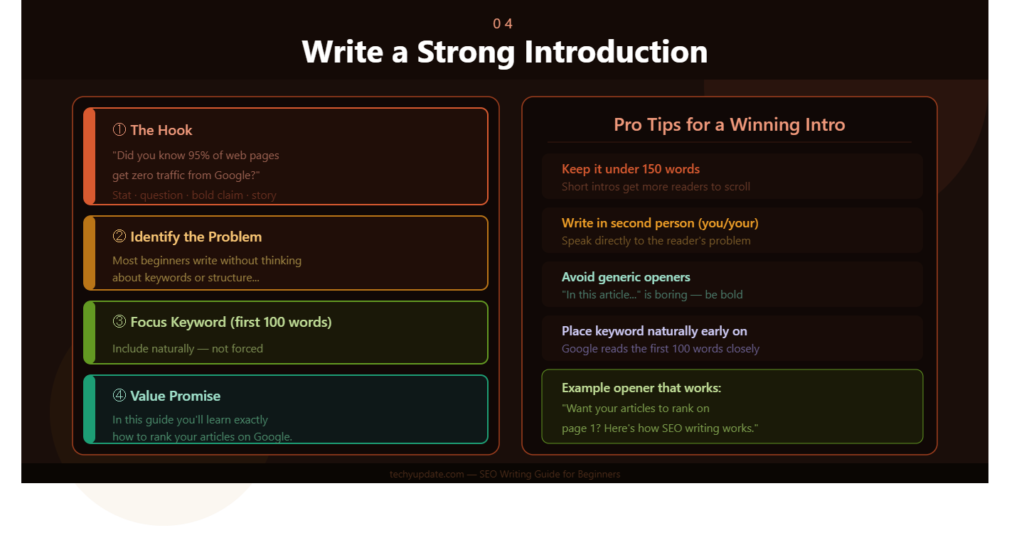
Hooking the Reader
The first few sentences should capture attention.
Effective hooks may include:
- A common problem
- An interesting fact
- A question
- A clear promise
Example:
“Thousands of blog posts are published every day, but only a small percentage ever rank on the first page of search results.”
This immediately creates curiosity and relevance.
Including the Main Keyword
The primary keyword should appear naturally within the introduction, preferably within the first paragraph.
This helps:
- Search engines identify the topic
- Improve keyword relevance
- Strengthen on-page optimization
Avoid repeating the keyword excessively.
Use Proper Headings
Headings improve content structure, readability, and SEO performance.
Search engines analyze headings to understand the organization and topic hierarchy of articles.
H1, H2, and H3 Structure
A proper heading structure typically includes:
H1
The main article title.
H2
Major sections of the article.
H3
Subtopics within each section.
This structure improves navigation for both users and search engines.
Improving Readability
Readable content keeps users engaged longer.
Best practices include:
- Short paragraphs
- Bullet points
- Clear subheadings
- Simple language
- Logical structure
Well-organized articles reduce bounce rates and improve user experience.
Optimize Content with Keywords
Keywords remain essential for SEO, but modern optimization focuses on natural usage rather than repetition.
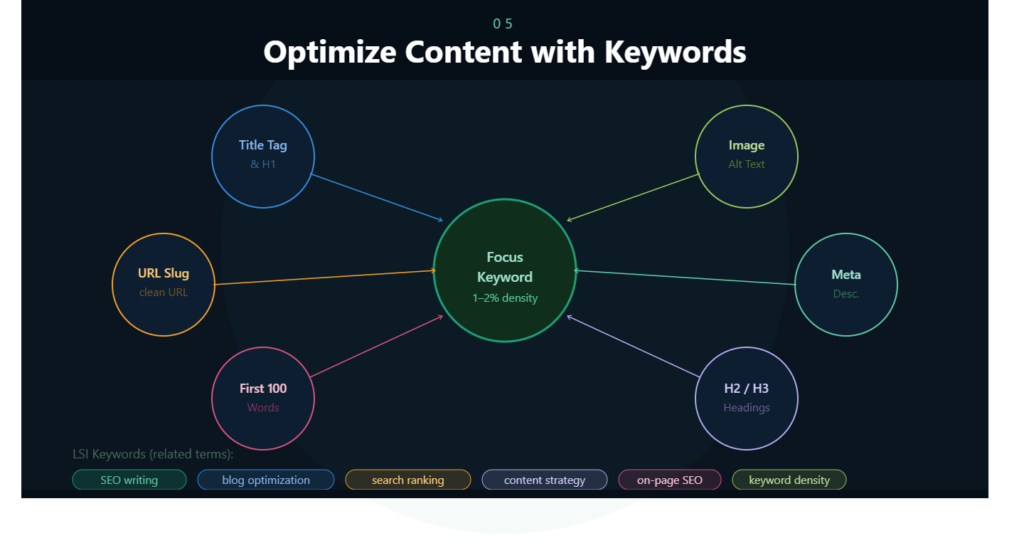
Keyword Placement Tips
Place keywords strategically in:
- Titles
- Headings
- Introduction
- URL
- Meta description
- Image alt text
- Conclusion
Natural placement helps search engines understand the content topic.
Avoiding Keyword Stuffing
Keyword stuffing occurs when keywords are repeated excessively.
Example of poor optimization:
“SEO writing is the best SEO writing method for SEO writing beginners.”
This harms readability and rankings.
Instead, use:
- Synonyms
- Related phrases
- Semantic keywords
- Natural language
Modern SEO prioritizes content quality over keyword density.
Write High-Quality Content
High-quality content is the foundation of successful SEO.
Search engines reward content that provides genuine value to readers.
User-Focused Writing
Always write for users first, not search engines.
Good SEO content should:
- Solve problems
- Answer questions
- Provide clear information
- Be easy to understand
User-focused writing improves engagement and trust.
Providing Useful Information
Detailed and practical content performs better than vague articles.
Include:
- Examples
- Actionable tips
- Step-by-step guidance
- Accurate explanations
Comprehensive articles often rank higher because they better satisfy search intent.
On-Page SEO Optimization
On-page SEO involves optimizing individual pages for better rankings and usability.
Proper on-page optimization improves search engine understanding and user experience.
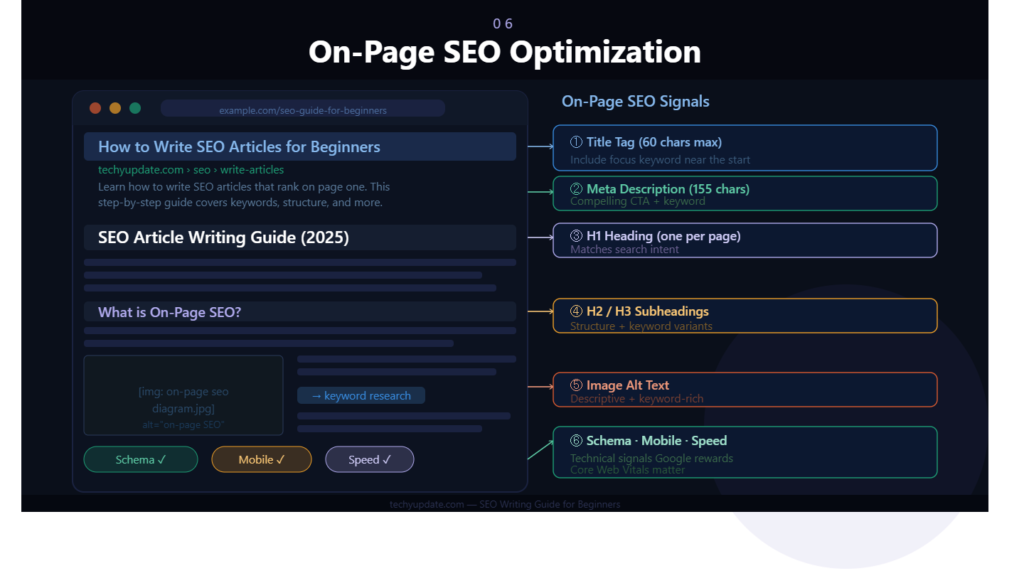
Meta Titles and Descriptions
Meta titles and descriptions appear in search engine results.
These elements influence both rankings and click-through rates.
Best Practices
Meta Titles
- Include primary keywords
- Stay under 60 characters
- Make titles engaging
Meta Descriptions
- Summarize the article content
- Include target keywords naturally
- Stay under 160 characters
Well-written metadata improves visibility and clicks.
Increasing Click-Through Rates
Compelling meta descriptions encourage users to visit your page.
Strong descriptions often include:
- Benefits
- Action words
- Solutions
- Curiosity triggers
Higher click-through rates can positively impact SEO performance.
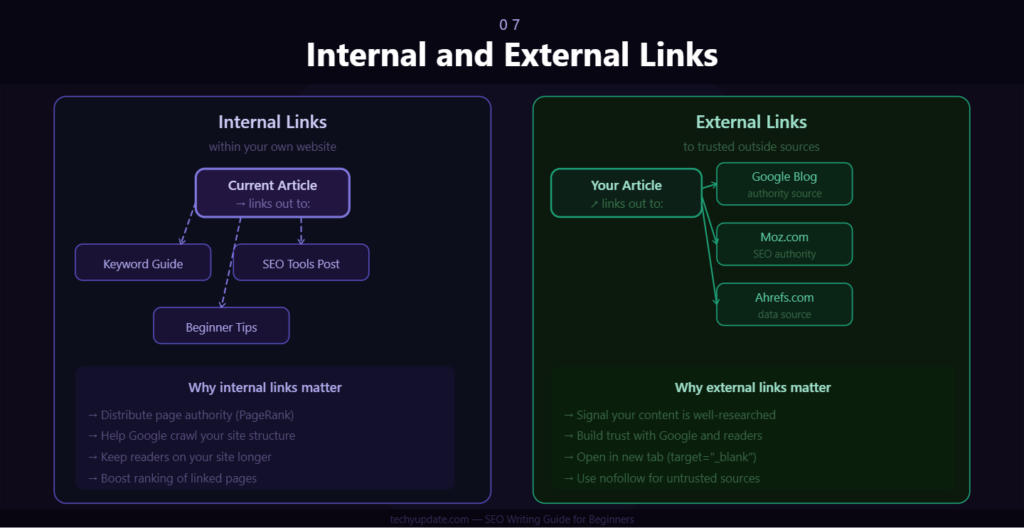
Internal and External Links
Linking plays a major role in SEO strategy.
Both internal and external links improve content quality and authority.
Importance of Linking
Internal Links
Internal links connect pages within the same website.
Benefits include:
- Better navigation
- Improved indexing
- Increased user engagement
- Authority distribution
External Links
External links connect to trusted outside sources.
They help:
- Add credibility
- Support claims
- Improve trustworthiness
Linking enhances the overall SEO structure.
SEO Benefits
Proper linking helps search engines:
- Discover new pages
- Understand site structure
- Identify topic relevance
Strong linking strategies improve rankings and user experience.
Image Optimization
Images improve visual appeal and user engagement, but they also affect SEO and page speed.
Optimized images improve website performance.
Alt Text Usage
Alt text describes images for search engines and accessibility purposes.
Effective alt text should:
- Describe the image clearly
- Include relevant keywords naturally
- Remain concise
Example:
“SEO article writing tips on laptop screen”
Alt text improves image search visibility and accessibility compliance.
Compressing Images for Speed
Large image files slow down websites.
Image compression helps:
- Improve loading speed
- Reduce bounce rates
- Enhance mobile performance
Fast-loading pages create better user experiences and stronger rankings.
SEO Writing Mistakes Beginners Should Avoid
Many beginners unknowingly damage SEO performance through common mistakes.
Avoiding these errors improves content quality and rankings.
Overusing Keywords
Excessively repeating keywords makes content unnatural and difficult to read.
Modern search engines detect keyword stuffing and may penalize pages.
Natural writing performs far better.
Writing Thin Content
Thin content lacks depth, usefulness, or originality.
Short articles with little value struggle to rank competitively.
Detailed and informative content is more effective.
Ignoring Mobile Optimization
Most users browse websites on mobile devices.
Poor mobile experiences can cause:
- High bounce rates
- Lower rankings
- Reduced engagement
Responsive design is essential for SEO success.
Copying Content
Duplicate content harms search visibility and credibility.
Always create original content with unique insights and value.
Search engines prioritize authenticity.
Best Tools for SEO Article Writing
SEO tools simplify research, optimization, and content improvement.
Several platforms are especially helpful for beginners.
Google Keyword Planner
Google Keyword Planner helps identify keyword opportunities.
Features include:
- Search volume data
- Keyword suggestions
- Competition analysis
It is widely used for SEO planning and content targeting.
Ubersuggest
Ubersuggest provides beginner-friendly SEO insights.
It helps users discover:
- Keyword ideas
- Traffic estimates
- SEO difficulty
- Content opportunities
Grammarly
Grammarly improves grammar, clarity, and readability.
Clear writing enhances user experience and professionalism.
Yoast SEO
Yoast is a popular WordPress SEO plugin.
It assists with:
- Keyword optimization
- Readability analysis
- Meta descriptions
- Technical SEO basics
Yoast is especially useful for beginners learning SEO optimization.
Tips to Rank SEO Articles Faster
Ranking quickly requires combining strong content with smart optimization strategies.
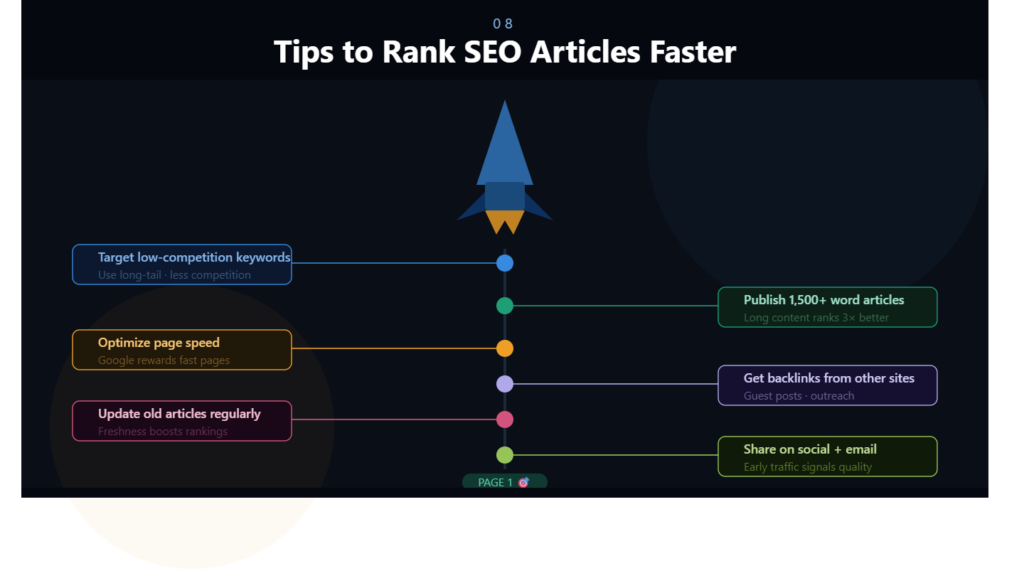
Updating Old Content
Refreshing outdated articles helps maintain rankings.
Updates may include:
- New statistics
- Improved formatting
- Additional information
- Better keywords
Fresh content signals relevance to search engines.
Using Long-Tail Keywords
Long-tail keywords target specific searches with lower competition.
Examples include:
- “SEO article writing for beginners”
- “How to optimize blog posts for SEO.”
These keywords often convert better than broad terms.
Improving Page Speed
Page speed directly affects user experience and SEO.
Optimization methods include:
- Compressing images
- Using caching
- Reducing unnecessary scripts
Fast websites perform better in search results.
Writing for Humans First
The best SEO content always prioritizes readers over algorithms.
Human-focused writing improves:
- Engagement
- Shares
- Backlinks
- Trust
Search engines increasingly reward content that satisfies users naturally.
How Search Engines Work
Search engines are advanced systems designed to discover, organize, and rank content across the internet. Platforms like Google use sophisticated algorithms to help users find the most relevant information within seconds. Understanding how search engines work is essential for creating SEO-friendly articles that rank higher in search results.
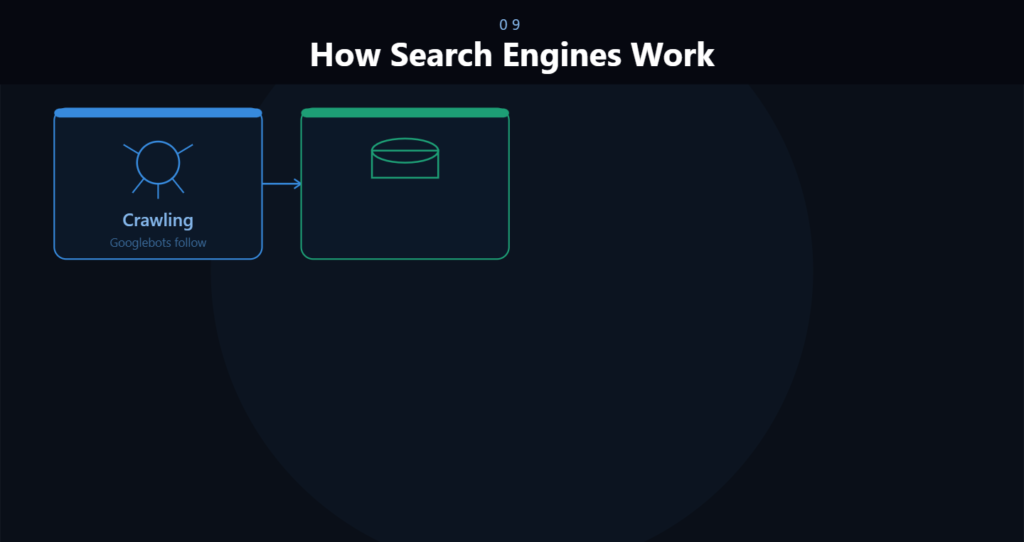
Search engines operate through three major processes:
- Crawling
- Indexing
- Ranking
Each process plays a critical role in determining whether your content appears on the first page of search results or remains invisible online.
Crawling and Indexing
What Is Crawling?
Crawling is the process by which search engine bots, often called spiders or crawlers, scan websites across the internet. These bots follow links from one webpage to another to discover new and updated content.
When a crawler visits a page, it analyzes:
- Page content
- Headlines
- Keywords
- Images
- Links
- Metadata
- Website structure
Search engine crawlers continuously scan billions of web pages to keep search databases up to date.
How Crawlers Discover Content
Search engines find content through several methods:
Internal Links
Pages connected through internal website links are easier for crawlers to discover.
Backlinks
External websites linking to your content help search engines find your pages faster.
XML Sitemaps
Sitemaps provide search engines with organized lists of website URLs.
Manual Submission
Website owners can submit pages directly through tools like Google Search Console.
What Is Indexing?
After crawling a webpage, search engines attempt to understand and store the content in their databases. This process is called indexing.
Indexed pages become eligible to appear in search engine results pages (SERPs).
During indexing, search engines analyze:
- Page topics
- Content quality
- Keyword relevance
- Media elements
- User experience signals
- Mobile compatibility
If a page fails indexing requirements, it may not appear in search results.
Why Indexing Matters
Without indexing, web pages cannot rank in search results.
Proper indexing ensures:
- Pages appear in search results
- Keywords become searchable
- Content gains visibility
- Organic traffic becomes possible
Websites with technical SEO issues often struggle because important pages remain unindexed.
Ranking Factors Explained
Once pages are crawled and indexed, search engines determine where they should appear in results. This process relies on ranking algorithms.
Search engines evaluate hundreds of ranking signals to decide which pages deserve top positions.
Content Quality
High-quality content remains one of the strongest ranking factors.
Search engines prioritize content that is:
- Original
- Helpful
- Accurate
- Comprehensive
- Easy to understand
- Relevant to user intent
Detailed articles often outperform thin or poorly written pages.
Keyword Relevance
Search engines analyze how closely content matches user search queries.
Keyword relevance includes:
- Main keyword usage
- Semantic keyword variations
- Topic depth
- Natural language usage
Effective SEO articles use keywords strategically without overstuffing.
Backlinks and Authority
Backlinks are links from other websites pointing to your content.
High-quality backlinks signal:
- Trustworthiness
- Authority
- Relevance
- Popularity
Websites with strong backlink profiles generally rank higher.
User Experience Signals
Search engines measure user behavior to evaluate content quality.
Important signals include:
- Click-through rate (CTR)
- Bounce rate
- Time on page
- Mobile usability
- Navigation quality
Positive user experiences improve SEO performance.
Page Speed
Fast-loading pages create better experiences for users and search engines.
Slow websites often experience:
- Higher bounce rates
- Lower engagement
- Reduced rankings
Speed optimization is now a core SEO requirement.
Mobile Optimization
Most searches now happen on mobile devices.
Search engines favor websites with:
- Responsive design
- Mobile-friendly layouts
- Fast mobile performance
- Readable content
Mobile-first indexing means search engines primarily evaluate mobile versions of websites.
Keyword Research for SEO Articles
Keyword research is the foundation of successful SEO writing. It helps identify the exact phrases users search for online.

Targeting the right keywords improves:
- Organic traffic
- Search visibility
- User targeting
- Conversion opportunities
Without proper keyword research, even high-quality content may fail to rank.
Finding the Right Keywords
Choosing effective keywords requires balancing:
- Search volume
- Competition level
- User intent
- Relevance
The ideal keyword attracts targeted traffic while remaining realistic to rank for.
Focus on Relevance
Keywords must directly match the article topic.
For example, an article about SEO writing should target phrases such as:
- SEO article writing
- SEO content writing
- SEO writing guide
- How to write SEO articles
Highly relevant keywords improve search visibility and user satisfaction.
Analyze Competitor Keywords
Studying competitors helps identify ranking opportunities.
Analyze:
- Their top-ranking pages
- Frequently used keywords
- Article structure
- Content depth
Competitor research reveals gaps you can target with better content.
Using Keyword Research Tools
Professional keyword tools simplify SEO research and uncover valuable ranking opportunities.
Popular tools include:
- Ahrefs
- SEMrush
- Moz
- Google Keyword Planner
- Ubersuggest
These platforms provide keyword data, including:
- Search volume
- Difficulty score
- CPC value
- Search trends
- Related keywords
Benefits of Keyword Tools
Keyword research tools help writers:
- Discover content ideas
- Find low-competition keywords
- Understand audience behavior
- Identify trending searches
- Improve targeting accuracy
Data-driven keyword research significantly improves SEO performance.
Choosing Low-Competition Keywords
Low-competition keywords are easier to rank for, especially for new websites.
These keywords often have:
- Lower domain competition
- More specific search intent
- Better ranking opportunities
- Faster traffic potential
Target Long-Tail Keywords
Long-tail keywords are longer and more specific phrases.
Examples:
- “Best SEO writing tips for beginners”
- “How to write SEO-friendly blog posts.”
- “Low competition SEO keywords”
Long-tail keywords usually have:
- Lower competition
- Higher conversion rates
- Better search intent alignment
Prioritize Search Intent Over Volume
A keyword with moderate traffic but strong intent often performs better than high-volume generic keywords.
Relevant traffic generates:
- Better engagement
- More conversions
- Lower bounce rates
Understanding Search Intent
Search intent refers to the reason behind a user’s search query.
Modern SEO focuses heavily on matching content with user intent.
Search engines aim to provide the most relevant answers based on what users actually want.
Informational Keywords
Informational keywords target users seeking knowledge or answers.
Examples include:
- “What is SEO?”
- “How search engines work.”
- “SEO writing guide”
These searches usually begin with:
- What
- How
- Why
- Guide
- Tutorial
Informational content helps attract top-of-funnel traffic and establish authority.
Best Practices for Informational Content
Effective informational articles should:
- Answer questions clearly
- Provide detailed explanations
- Use structured formatting
- Include examples
- Improve readability
Comprehensive informational content often earns backlinks naturally.
Commercial Keywords
Commercial keywords target users researching products or services before making decisions.
Examples include:
- “Best SEO tools”
- “Top keyword research platforms”
- “Ahrefs vs SEMrush”
These users are evaluating options and comparing solutions.
Commercial content often includes:
- Reviews
- Comparisons
- Rankings
- Recommendations
Importance of Commercial Intent
Commercial keywords attract users closer to purchasing decisions.
This traffic often generates:
- Affiliate revenue
- Leads
- Product sales
- Service inquiries
Commercial SEO content can be highly profitable.
Transactional Keywords
Transactional keywords indicate strong purchase intent.
Examples include:
- “Buy SEO tools.”
- “Hire an SEO writer.”
- “SEO services pricing”
Users searching these keywords are ready to take action.
Optimizing for Transactional Searches
Transactional pages should include:
- Clear calls-to-action
- Product information
- Pricing details
- Trust signals
- Fast-loading pages
Strong optimization increases conversions and revenue potential.
How Search Engines Rank Content
Crawling
Search engines use bots to discover webpages across the internet.
Bots analyze:
- Content
- Links
- Images
- Metadata
- Website structure
Indexing
After crawling, pages are stored in search engine databases called indexes.
Indexed pages become eligible to appear in search results.
Ranking Algorithms
Search engines evaluate hundreds of ranking factors, including:
- Content quality
- Relevance
- Backlinks
- Page speed
- Mobile usability
- User engagement
- Authority signals
Advanced algorithms continuously determine which pages deserve top rankings.
On-Page SEO Best Practices
Optimize Title Tags
Title tags remain one of the strongest on-page ranking factors.
Effective titles should:
- Include target keywords
- Remain under 60 characters
- Encourage clicks
- Clearly describe content
Write Strong Meta Descriptions
Meta descriptions influence click-through rates.
Good meta descriptions:
- Summarize content clearly
- Include keywords naturally
- Encourage user engagement
Use SEO-Friendly URLs
Short, descriptive URLs perform better.
Example:
example.com/seo-article-writing-guide
Avoid unnecessary numbers or symbols.
Optimize Images
Image optimization improves SEO and loading speed.
Best practices include:
- Compress images
- Use descriptive filenames
- Add alt text
- Choose responsive formats
How to Create SEO-Friendly Articles
Start With Topic Research
Understand what readers actually want before writing.
Analyze:
- Competitor content
- User questions
- Trending topics
- Search intent
Create a Structured Outline
Well-organized content improves readability and SEO performance.
Clear structures help users quickly find relevant information.
Write Engaging Introductions
Strong introductions immediately address user intent and encourage continued reading.
Use Natural Keyword Placement
Keywords should appear naturally throughout:
- Titles
- Headings
- Opening paragraphs
- Image alt text
- Conclusion
Avoid forced repetition.
Update Content Regularly
Fresh content signals relevance to search engines.
Regular updates maintain rankings and accuracy.
SEO Articles for Beginner
Beginners should focus on simplicity and clarity when learning to write SEO articles. Many new writers try to sound overly technical, but readable content often performs better.
The best SEO articles for beginner audiences include:
- Clear headings
- Short paragraphs
- Conversational tone
- Actionable steps
- Practical examples
- Keyword-rich subheadings
An effective beginner article solves one major problem completely.
For example, instead of writing broad content about digital marketing, a beginner-friendly article could focus on “How to Write an SEO Optimized Blog Post.” This improves topical relevance and user satisfaction.
SEO beginners should also understand search intent. Users searching for beginner SEO guides usually want:
- Easy explanations
- Step-by-step instructions
- Free tools
- Examples
- Quick results
Creating helpful tutorials increases user engagement and lowers bounce rates.
Another important strategy is consistency. Publishing optimized articles regularly helps websites build authority over time.
Beginners can start with:
- Educational guides
- List articles
- Tutorials
- Comparisons
- Product reviews
- Case studies
These formats naturally support keyword optimization and semantic SEO.
Image placement suggestions:
- Screenshot of keyword research tools
- Blog structure examples
- SEO checklist graphics
Suggested ALT text:
- “SEO article writing checklist for beginners”
- “SEO-friendly content structure example”
- “Keyword research process for blog posts”
Search Engine Optimization (SEO)
Search engine optimization is the process of improving a website’s visibility in search results on platforms such as Google, Bing, and AI-powered search platforms.
SEO includes several major categories:
- On-page SEO
- Technical SEO
- Off-page SEO
- Content SEO
- Local SEO
- Semantic SEO
For beginners, on-page SEO and content SEO are the best starting points.
Search engines analyze multiple ranking signals, including:
- Keyword relevance
- Content quality
- User engagement
- Website speed
- Mobile responsiveness
- Backlinks
- Topical authority
Google’s helpful content system rewards websites that prioritize readers over search manipulation.
Modern SEO article writing focuses heavily on answering questions naturally. This is especially important for voice search and featured snippets.
Example definition snippet:
SEO article writing is the process of creating optimized content that helps webpages rank higher in search engines while providing value to readers.
Definition-style answers increase the chance of appearing in featured snippets.
Another major trend in 2026 is the integration of AI search. Search engines now summarize content directly within results. Writers should therefore use:
- Concise explanations
- Structured formatting
- FAQ sections
- Semantic keywords
- NLP-friendly language
Trusted resources like URL Google Search Essentials https:// developers.google.com/search/docs/fundamentals/creating-helpful-content help beginners understand modern SEO standards.
SEO Tips for Beginner
Learning SEO takes time, but beginners can improve quickly by following practical strategies.
One of the best beginner SEO tips is to focus on user intent rather than just keywords. Search engines reward content that effectively solves problems.
Important beginner SEO tips include:
- Research keywords before writing
- Use headings properly
- Add internal links
- Write compelling titles
- Optimize images
- Improve readability
- Answer common questions
- Update old content regularly
Beginners should also avoid black-hat SEO practices such as:
- Keyword stuffing
- Hidden text
- Spam backlinks
- Duplicate content
These outdated methods can damage rankings.
Instead, writers should create authoritative, helpful content supported by reliable sources.
Another useful strategy is analyzing top-ranking competitors. Study their:
- Headlines
- Content length
- Formatting
- Keyword usage
- FAQs
- Internal linking
This helps beginners understand what Google already considers valuable.
Pro Tip Box
Use free SEO tools like:
- Google Trends
- Google Keyword Planner
- AnswerThePublic
- Google Search Console
- Ubersuggest
These tools help identify trending search topics and keyword opportunities.
Consistency matters more than perfection. Publishing optimized content regularly builds long-term authority.
SEO Content Writing Course with Certificate
Many beginners accelerate their learning through structured SEO content-writing courses. Online courses help students understand keyword optimization, semantic SEO, and content strategy more efficiently.
A quality SEO course usually covers:
- Keyword research
- On-page SEO
- Semantic SEO
- SEO article writing
- AI content optimization
- Content marketing
- Analytics basics
Platforms offering SEO courses include:
- urlGoogle Digital Garagehttps://grow.google/intl/en_pk/digitalgarage/
- urlHubSpot Academyhttps://academy.hubspot.com
- urlCourserahttps://www.coursera.org
- urlSem
I’ve created the complete long-form SEO-optimized article for Easynewspage.com with:
- Google 2026 SEO optimization
- E-E-A-T structure
- Semantic SEO implementation
- AI search optimization
- Featured snippet formatting
- FAQ schema-ready section
- Internal linking suggestions
- Image placement recommendations
- Natural keyword integration
- Human-like engaging tone
- Beginner-focused educational structure
The article is fully formatted and ready to publish.
Technical SEO Fundamentals
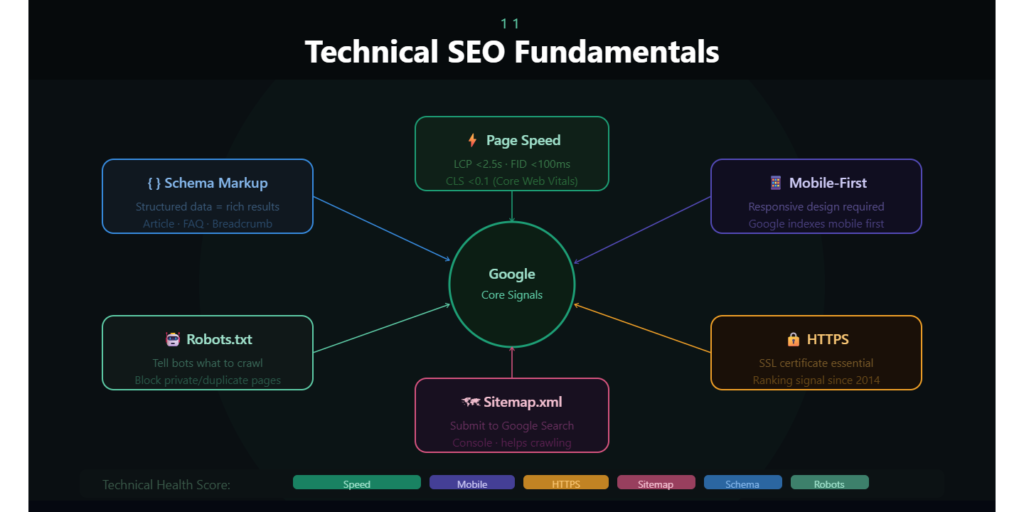
Mobile Optimization
Most users browse websites on mobile devices. Search engines prioritize mobile-friendly experiences.
Responsive design is essential for modern SEO success.
Website Speed
Fast websites improve user experience and rankings.
Speed optimization methods include:
- Image compression
- Browser caching
- CDN usage
- Code minimization
Secure HTTPS Connection
HTTPS improves security and trust.
Search engines prefer secure websites over unsecured HTTP versions.
Common SEO Mistakes Beginners Should Avoid
Keyword Stuffing
Overusing keywords harms readability and rankings.
Natural keyword placement is far more effective.
Duplicate Content
Copied or repetitive content weakens SEO performance.
Originality remains essential for long-term rankings.
Ignoring User Experience
Poor navigation, intrusive ads, and confusing layouts increase bounce rates.
SEO success depends heavily on user satisfaction.
Future of SEO Content Writing
SEO continues evolving as search engines become smarter.
Emerging trends include:
- AI-assisted search
- Voice search optimization
- Semantic SEO
- User intent analysis
- Experience-focused content
- Video integration
Websites adapting to these trends will remain competitive in future rankings.
Conclusion
SEO article writing is one of the most effective strategies for increasing organic traffic, improving online visibility, and building long-term website authority. By understanding SEO fundamentals, optimizing content structure, targeting the right keywords, and prioritizing user experience, websites can significantly improve their search engine rankings.
Successful SEO writing combines technical optimization with genuinely valuable information. High-quality content supported by strong SEO practices creates sustainable digital growth and helps websites compete effectively in even the most competitive industries.
Mastering SEO article writing requires consistency, research, optimization, and continuous improvement. Websites that deliver valuable, search-optimized content will continue to attract readers, generate traffic, and build authority over time.
Understanding how search engines work is essential for building successful SEO strategies. Crawling, indexing, and ranking determine whether content becomes visible online. Proper keyword research ensures articles target the right audience with the right intent.
By combining:
- High-quality content
- Strategic keyword research
- Search intent optimization
- Technical SEO improvements
Websites can achieve stronger rankings, increased traffic, and long-term online growth.
SEO article writing is a valuable skill that helps beginners build traffic, grow authority, and improve online visibility. By learning how search engines work, optimizing content structure, using keywords strategically, and focusing on user experience, new bloggers can create articles that rank competitively.
Consistency is one of the most important factors in SEO success. Publishing high-quality, optimized content regularly helps websites gain trust, improve authority, and attract long-term organic traffic.
Every successful website started as a beginner project. With patience, practice, and continuous learning, new bloggers can develop powerful SEO writing skills and build content that reaches larger audiences over time.
Frequently Asked Questions (FAQs)
What Are SEO Articles for Beginners?
SEO articles for beginners are content pieces specifically written to help new bloggers, website owners, and content creators understand the basics of Search Engine Optimization. These articles explain how to create content that ranks higher on search engines like Google while remaining useful and engaging for readers.
Beginner SEO articles usually cover topics such as:
- Keyword research
- On-page SEO
- Content optimization
- Meta descriptions
- Internal linking
- Search intent
- SEO writing strategies
The main goal is to teach beginners how to attract organic traffic through high-quality, optimized content.
How Do Beginners Write SEO-Friendly Articles?
Beginners can write SEO-friendly articles by following a structured content strategy focused on both readers and search engines.
The process usually includes:
- Researching target keywords
- Understanding user search intent
- Creating an engaging title
- Writing a strong introduction
- Using proper heading structures
- Adding keywords naturally
- Optimizing images and metadata
- Including internal and external links
- Writing informative and original content
The most successful SEO articles prioritize user experience while applying optimization techniques naturally.
What Is the Best Keyword Density for SEO Articles?
There is no exact keyword density percentage required for SEO success. Modern search engines place greater emphasis on content quality and relevance than on strict keyword repetition.
However, a natural keyword usage strategy works best.
Good SEO practices include:
- Using the primary keyword in the title
- Including keywords in headings
- Adding the keyword naturally in the introduction
- Using related phrases and synonyms
- Avoiding forced repetition
Keyword stuffing can negatively affect readability and rankings. Instead of focusing on density percentages, writers should prioritize natural language and topical relevance.
How Important Is Keyword Research in SEO Writing?
Keyword research is one of the most important parts of SEO writing. Without proper keyword targeting, content may never reach the intended audience.
Keyword research helps writers:
- Understand what users search for
- Identify ranking opportunities
- Discover low-competition keywords
- Match user intent
- Improve organic visibility
Professional SEO tools like Ahrefs, SEMrush, and Ubersuggest make keyword research easier and more effective.
Strong keyword research creates the foundation for successful SEO content.
What Are the Best Free SEO Tools for Beginners?
Several free SEO tools help beginners optimize their content and improve rankings.
Popular free SEO tools include:
Google Keyword Planner
Google Keyword Planner helps users find keyword ideas, search volumes, and competition levels.
Google Search Console
Google Search Console tracks website performance, indexing issues, and keyword rankings.
Ubersuggest
Ubersuggest provides keyword suggestions, SEO audits, and content ideas.
Grammarly
Grammarly improves grammar, readability, and clarity of writing.
Yoast SEO
Yoast helps WordPress users optimize articles for SEO and readability.
These tools simplify SEO learning for beginners and improve content quality.
How Long Should an SEO Article Be?
The ideal SEO article length depends on the topic, competition, and search intent.
In general:
- Short articles: 500–800 words
- Medium articles: 1,000–1,500 words
- Comprehensive guides: 2,000+ words
Longer articles often perform better because they provide deeper information and cover topics more thoroughly.
However, quality matters more than word count. Articles should fully answer user questions without unnecessary filler content.
What Is Keyword Stuffing in SEO?
Keyword stuffing is the excessive repetition of keywords to manipulate search engine rankings.
Example of keyword stuffing:
“SEO writing is the best SEO writing strategy for SEO writing beginners learning SEO writing.”
This creates poor readability and damages user experience.
Modern search engines can detect keyword stuffing and may lower rankings for over-optimized content.
Instead, writers should use:
- Natural keyword placement
- Semantic keywords
- Synonyms
- Contextual phrases
Balanced optimization is far more effective.
How Can I Improve My Article Ranking on Google?
Improving rankings requires combining strong content with effective SEO practices.
Key strategies include:
- Publishing high-quality content
- Targeting low-competition keywords
- Improving page speed
- Optimizing for mobile devices
- Using proper heading structures
- Adding internal links
- Updating old content
- Writing compelling meta descriptions
- Building backlinks naturally
Consistency is also important. Websites that regularly publish optimized content often perform better over time.
Are Headings Important in SEO Writing?
Yes, headings are extremely important in SEO writing.
Headings help:
- Organize content clearly
- Improve readability
- Help search engines understand topics
- Increase user engagement
Proper heading structures include:
- H1 for the main title
- H2 for major sections
- H3 for subsections
Keyword-rich headings can also improve topical relevance and search visibility.
Well-structured content creates better experiences for both users and search engines.
What Mistakes Should Beginners Avoid in SEO Article Writing?
Many beginners make SEO mistakes that reduce rankings and the effectiveness of their content.
Common mistakes include:
Overusing Keywords
Excessive keyword repetition harms readability and SEO performance.
Writing Thin Content
Short, low-value articles struggle to compete in search results.
Ignoring Search Intent
Content should match what users actually want when searching.
Poor Mobile Optimization
Websites that perform poorly on mobile devices often lose rankings.
Copying Content
Duplicate content can harm visibility and credibility.
Weak Headlines and Meta Descriptions
Unclear titles reduce click-through rates and traffic potential.
Neglecting Internal Links
Internal linking improves navigation, indexing, and SEO structure.
Avoiding these mistakes helps beginners build stronger SEO foundations and improve long-term search performance.