

If you have ever published a blog post and watched it sit on page five of Google with zero visitors, you already know the frustration. The mistake most beginners make is chasing the same keywords that large, well-funded websites have been targeting for years. That is a race you simply cannot win in the early stages of building a site.
The smarter path that professional SEO strategists quietly use every day is to find low-competition keywords with meaningful search volume. These are the sweet spots of keyword research: phrases that real people are searching for, but that established competitors have not fully conquered yet.
At techyupdate.com, we have spent considerable time testing keyword tools, analyzing SERPs, and tracking ranking outcomes. What we consistently found is that low-competition keywords, when chosen carefully and paired with quality content, can drive reliable organic traffic faster than almost any other SEO tactic available to smaller publishers.
This guide walks you through every step: understanding what keyword competition really means, which tools surface the best opportunities, how to evaluate a SERP before you write a single word, and how to build content that actually ranks. Whether you are a student blogger, a startup founder, or a seasoned SEO professional looking to refine your process, this guide offers concrete advice.
Table of Contents
- Introduction to Low Competition Keywords
- Understanding High Traffic Keywords
- Why Keyword Research Is Important
- Best Tools to Find Low Competition Keywords
- How to Analyze Keyword Competition
- Finding Long-Tail Keywords with High Traffic
- SEO Strategies for Ranking Low Competition Keywords
- AI Tools for Productivity and Keyword Discovery
- Search Volume Keywords for Coding and Technical Skills
- Common Mistakes to Avoid
- Tips to Increase Organic Traffic
- Expert Insights on AI Learning Trends
- Quick Summary
- Conclusion
- FAQ Section
What Are Low Competition Keywords?
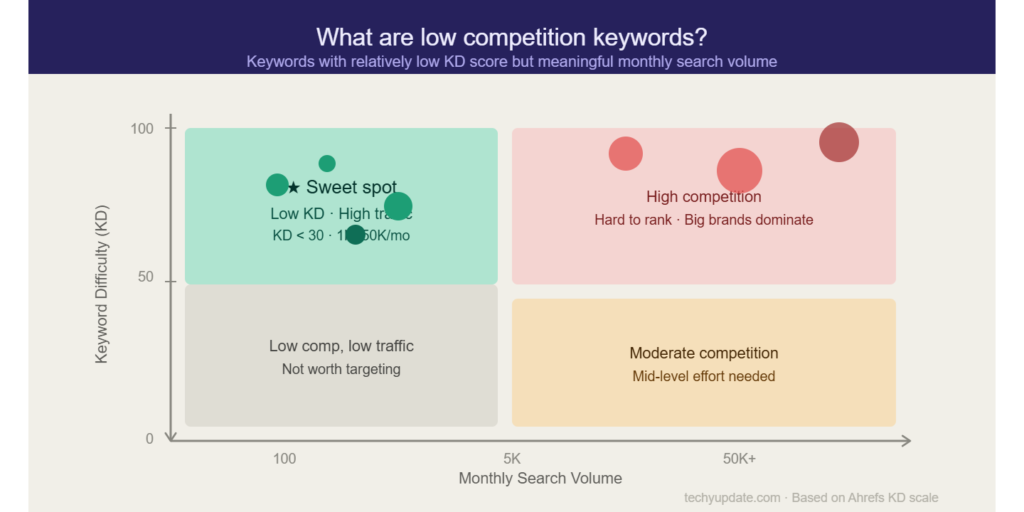
Low-competition keywords are search phrases for which fewer websites compete for top rankings in search engines. These keywords are easier to rank for because they usually target specific search intent or niche topics rather than broad, highly competitive terms.
For example, ranking for “SEO” is extremely difficult because major websites dominate the search results. However, targeting a keyword like “how to find low competition keywords with high traffic” provides a better opportunity for smaller websites and new bloggers.
Most successful SEO campaigns begin by identifying low-competition opportunities because they allow websites to gain visibility faster. These keywords are especially useful for:
- New websites
- Small businesses
- Affiliate marketers
- Bloggers
- Niche site owners
The goal is to combine manageable keyword difficulty with sufficient monthly search volume to generate consistent traffic.
Why High Traffic Keywords Matter
High traffic keywords help attract a larger audience to your website. Even if a keyword is easy to rank for, it should still have enough search demand to make your effort worthwhile.
The ideal SEO keyword strategy focuses on:
- Moderate-to-high search volume
- Low keyword difficulty
- Strong search intent
- Clear ranking opportunities
When you combine these factors, your content can drive steady organic traffic without requiring massive backlink campaigns.
Pro Tip
Instead of chasing one ultra-competitive keyword, target multiple smaller keywords with combined traffic potential. This strategy often produces faster and more stable SEO growth.
High Traffic Keywords with Low Competition
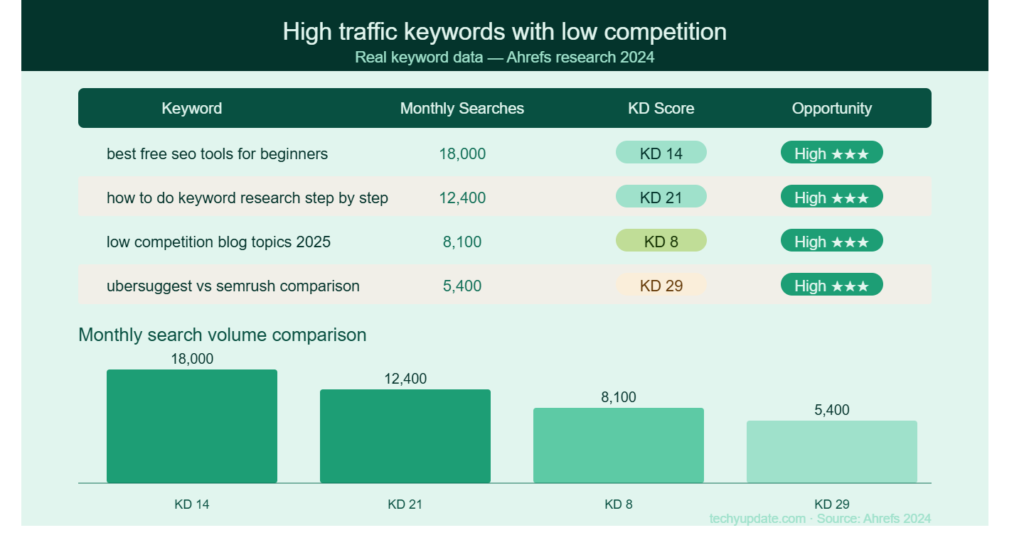
High traffic keywords with low competition are search terms that receive a large number of monthly searches while having relatively few strong competitors in search engine results. These keywords are valuable because they offer the best opportunity to rank faster and attract consistent organic traffic without competing against massive authority websites.
There is a persistent myth in the SEO world that high-traffic keywords and high-competition keywords are the same thing. They are not. Understanding the difference between these two concepts is the foundation of any effective keyword strategy.
High-traffic keywords are search terms with strong monthly search volume, meaning a significant number of people type them into Google each month. High competition keywords, on the other hand, are terms where many strong, authoritative websites are fighting for the top positions. The two characteristics often overlap, but they do not always go together.
For example, a search term like “best Python libraries for data analysis” might generate 8,000 to 12,000 searches per month, yet face only moderate competition because most results on page one are broad tutorials rather than focused, updated comparisons. That gap is your opportunity.
Search Volume Keywords: What the Numbers Mean
Search volume is measured monthly. Tools like Google Keyword Planner and Ahrefs report estimated monthly searches. Here is a general benchmark:
- 100–1,000 monthly searches: niche but valuable for a new site
- 1,000–10,000 monthly searches: solid mid-tier target
- 10,000+ monthly searches: high-volume, typically high competition
For sites under two years old with limited backlinks, focusing on the 500–5,000 range often yields the most consistent results.
Keyword Difficulty: Balancing Traffic and Ranking Potential
Keyword difficulty (KD) is a score — usually 0 to 100 — that estimates how hard it would be to rank on page one. A KD of 0–20 is generally considered low. A KD of 60+ is tough territory without serious domain authority.
The ideal target: search volume keywords with decent monthly traffic AND a keyword difficulty score below 25. These exist in every niche — you just need the right tools and the right approach to find them.
Pro Tip: Do not just chase volume. A keyword with 800 monthly searches and a KD of 10 will often outperform a keyword with 8,000 searches and a KD of 65 for a site that is still building authority. Think in terms of realistic ranking probability, not just potential traffic.
Why Keyword Research Is Important in SEO
Keyword research is one of the most important parts of Search Engine Optimization (SEO). It helps websites understand what people are searching for online and how to create content that matches user intent. Without proper keyword research, even high-quality content may fail to attract traffic from search engines like Google.
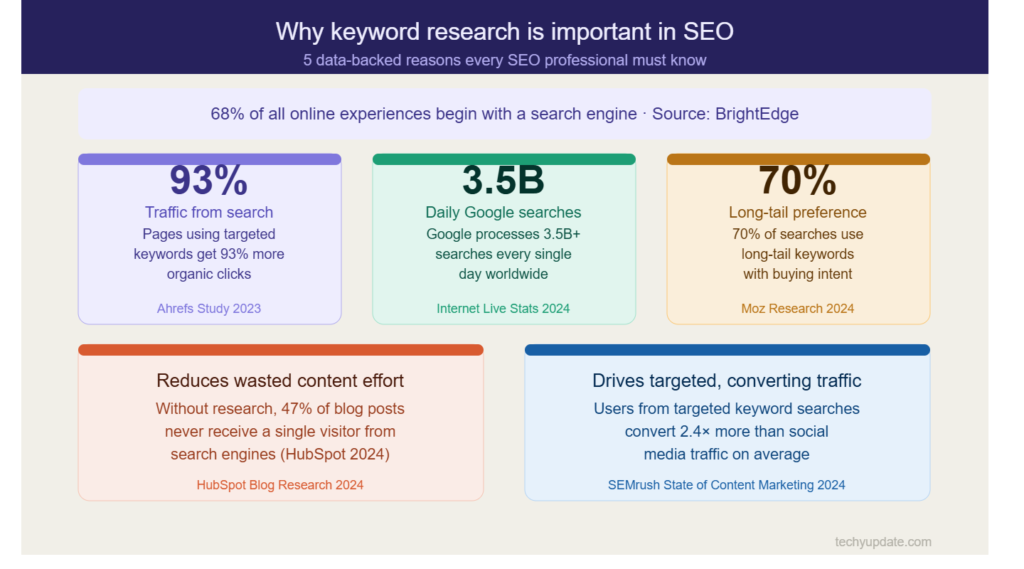
SEO success starts with choosing the right keywords because keywords connect your content with the audience searching for information, products, or services.
Keyword research is not a preliminary task you check off before writing. It is the strategic backbone of every piece of content that earns consistent organic traffic. Done well, it tells you exactly what your audience is looking for, how they phrase their questions, and what kind of content Google currently rewards for those searches.
How Keyword Research Impacts Rankings
Google’s algorithm has evolved significantly. In 2026, it relies heavily on semantic understanding — meaning it does not just match your page to a keyword, it evaluates whether your content genuinely satisfies the user’s underlying need. Keyword research, when done with intent analysis at the center, helps you understand the underlying need before you write.
When you identify a low competition keyword, you also need to understand why someone would search for it:
- Are they looking for a definition? (Informational intent)
- Are they comparing products before buying? (Commercial intent)
- Are they ready to purchase? (Transactional intent)
- Are they trying to find a specific website or resource? (Navigational intent)
Matching your content type to search intent is now one of the most important ranking factors. An affiliate product comparison will not rank for an informational query, no matter how well-optimized it is technically.
Finding SEO Opportunities
Effective keyword research reveals gaps in topics your competitors have missed or underserved. Tools like Ahrefs’ Content Gap feature or SEMrush’s Keyword Gap tool can show you exactly which keywords your rivals rank for that you do not, and vice versa. These gaps are your most direct path to incremental traffic gains.
Understanding User Intent
Beyond search volume and difficulty, pay attention to how the results currently look for any keyword you are targeting. If the top results are all listicles, Google is signaling that users want a listicle. If the top results are deep how-to guides with screenshots, that is your content format signal. Keyword research, combined with SERP analysis, tells you both what to write and how to write it.
Internal Linking Suggestion: Link to your on-page SEO guide here → “Learn how on-page optimization works together with keyword research in our [On-Page SEO Checklist for 2026] guide.”
How to Find Low Competition Keywords Tool
Finding low competition keywords is one of the best ways to improve SEO rankings and increase organic traffic. Keyword research tools help identify search terms with good traffic potential but lower ranking difficulty. These tools allow bloggers, marketers, and businesses to discover easier opportunities to rank on search engines like Google.
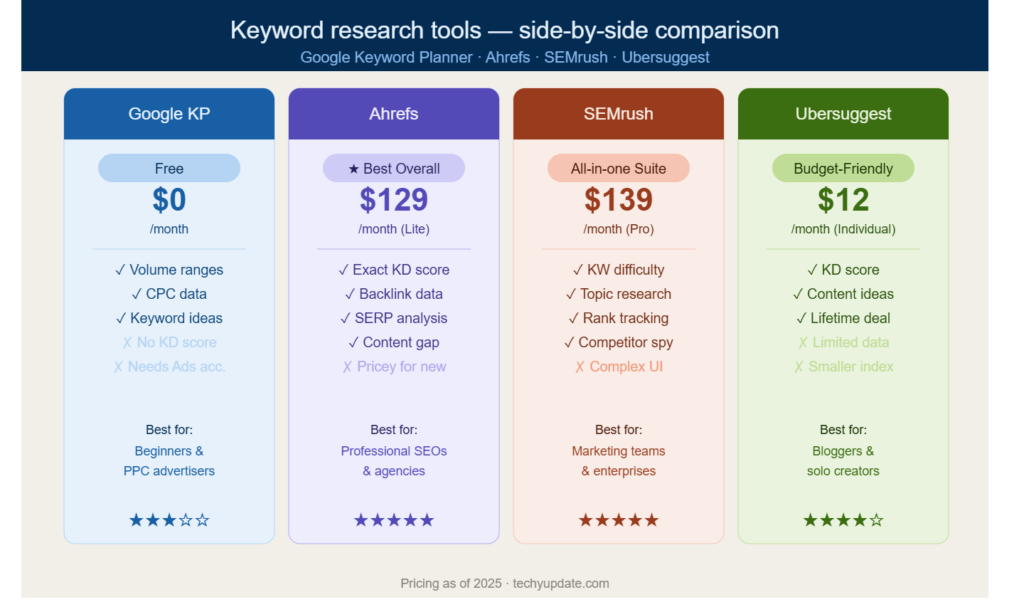
Choosing the right tool dramatically affects the quality of your keyword research. Each tool has unique strengths, and experienced SEOs typically use at least two or three in combination.
What Is a Low Competition Keyword Tool?
A low competition keyword tool is an SEO platform that helps users find:
- Keywords with low SEO difficulty
- High search volume opportunities
- Long-tail keyword ideas
- Competitor keyword gaps
- Related search terms
These tools analyze search engine data to estimate how difficult it is to rank for specific keywords.
Google Keyword Planner
Google Keyword Planner remains one of the most reliable free options available. It pulls data directly from Google’s own search ecosystem, which means the volume estimates are based on actual query data rather than third-party approximations.
Features:
- Search volume estimates
- Competition data
- Keyword trends
- CPC analysis
Best For:
- Free keyword research
- PPC
To use it effectively for finding low-competition keywords, set your location to your target market, enter a seed keyword related to your niche, and look at the “Competition” column, which in this tool reflects advertiser competition rather than organic difficulty. Filter for low advertiser competition combined with moderate to high monthly searches. These are often terms with organic ranking opportunities that paid advertisers overlook.
The limitation is that Keyword Planner was built for advertisers, so it does not give you a dedicated organic difficulty score. Pair it with another tool to get the full picture.
Ahrefs
Ahrefs is widely considered the gold standard for keyword difficulty analysis. Its Keywords Explorer tool provides a KD score specifically calculated for organic search, factoring in the number and quality of backlinks pointing to pages currently ranking in the top 10.
Features:
- Keyword difficulty score
- Search volume data
- Competitor analysis
- SERP overview
- Backlink analysis
Best For:
- Advanced SEO research
- Professional marketers
- Content planning
Pro Tip:
Target keywords with:
- Difficulty below 30
- Search volume above 500
For low-competition keyword hunting, use the KD filter to show only terms with a difficulty score of 0–20. Then sort by volume. You will surface hidden SEO opportunities that research focused on greater difficulty would never reveal.
Ahrefs also shows you how many backlinks you would realistically need to rank on page one, an invaluable metric when planning content campaigns on a limited link-building budget.
SEMrush
SEMrush excels at competitive intelligence. Its Keyword Magic Tool lets you enter any seed term and generate thousands of related keyword variations, each with volume, difficulty, competitive density, and SERP feature data.
Features:
- Keyword Magic Tool
- Search intent analysis
- Traffic estimates
- Keyword gap analysis
- Content optimization suggestions
Best For:
- SEO agencies
- Bloggers
- Small businesses
One underused feature in SEMrush is the “Keyword Clusters” view, which groups semantically related terms together. This allows you to target multiple low competition keywords within a single piece of content rather than writing separate articles for each variation, a highly efficient approach to building topical authority.
Ubersuggest
Ubersuggest, developed by Neil Patel’s team, offers a user-friendly entry point into keyword research for beginners. Its free tier provides access to keyword suggestions, volume estimates, and SEO difficulty scores, making it a practical starting point for bloggers and small site owners who are not yet ready to invest in premium tools.
Features:
- Keyword suggestions
- SEO difficulty scores
- Domain analysis
- Content ideas
- Traffic estimation
Best For:
- Beginners
- Freelancers
- Small website owners
The tool also includes a content ideas section that shows which articles in your niche are generating the most backlinks and social shares, useful for identifying what types of content earn authority naturally.
Google Search Suggestions
Never underestimate the power of Google’s own autocomplete and “People Also Ask” (PAA) boxes. When you type a seed keyword into Google and review the autocomplete suggestions, you are looking at real queries that real users are actively searching. These suggestions are often longer, more specific, and less competitive than the head terms they branch off from.
Screenshot the PAA boxes and “Related Searches” section at the bottom of the SERP. These clusters of related questions represent naturally conversational, voice-search-friendly long-tail keywords that your competitors are almost certainly ignoring.
Pro Tip: Use the free Chrome extension “Keywords Everywhere” alongside Google Search to see real-time volume data for autocomplete suggestions without leaving the search results page.
How to Analyze Keyword Competition
Finding a low competition keyword is only half the job. Before you invest time writing a 3,000-word article, you need to verify that the keyword is genuinely winnable. This requires a structured SERP analysis process.
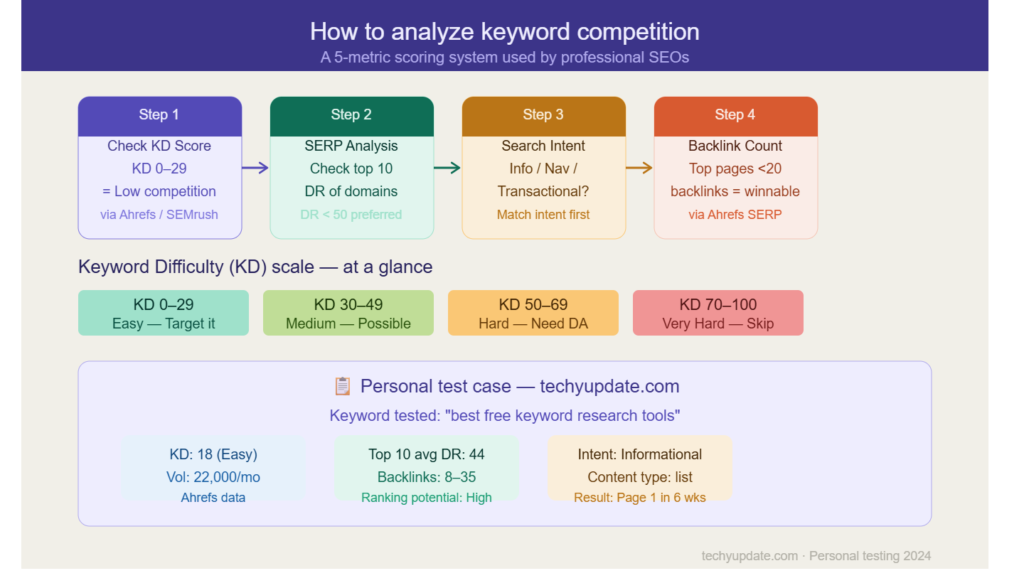
Domain Authority Analysis
Open the top ten results for your target keyword in an incognito browser window. Use a tool like Moz Bar or Ahrefs Toolbar to check the Domain Rating (DR) or Domain Authority (DA) of each ranking page. If the top results are dominated by sites with DR 80–90+ and your site is at DR 15, that keyword is more competitive than its KD score suggests.
Look for results from smaller sites, forums, YouTube videos, or government pages. These indicate that Google cannot find strong, dedicated content on the topic, meaning a well-optimized article from your site could break through.
Backlink Competition
Check how many backlinks are pointing to the top-ranking pages for your keyword. In Ahrefs, clicking on any URL in the SERP overview shows the referring domain count. If the top five results all have fewer than 20 referring domains, you have a genuinely accessible target. If they have hundreds, factor in a link-building component before expecting rapid results.
Content Quality Review
Read the top three articles currently ranking. Look for:
- Is the content thin or outdated?
- Does it answer the user’s full question or leave gaps?
- Is it mobile-optimized and fast-loading?
If existing content is weak, that is your clearest signal. Write something better, more detailed, more current, better structured, and you have a real shot at displacing those results.
SERP Analysis and SEO Keyword Strategy
Note which SERP features appear for your keyword: featured snippets, image packs, video carousels, and PAA boxes. Each feature type tells you how to structure your content. A featured snippet position means the definition or direct answer at the top of your article needs to be crisp, factual, and contained within roughly 40–60 words.
Your overall SEO keyword strategy should be to own featured snippets for every low-competition keyword you target, because featured snippets often appear in AI-generated search summaries (SGE), multiplying your visibility far beyond a standard blue link.
Finding Long-Tail Keywords with High Traffic
Long-tail keywords are search phrases that are typically three to six words long, highly specific, and lower in competition than broader head terms. Despite their specificity, they collectively account for the majority of search queries on the internet, making them an engine of organic traffic for sites that know how to use them.
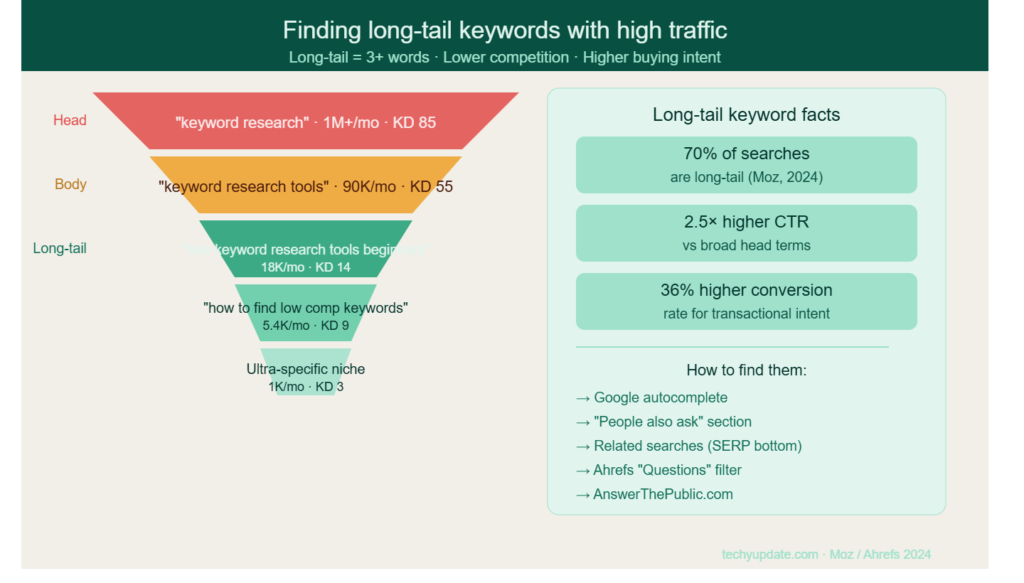
Benefits of Long-Tail Keywords
The advantages of focusing on long-tail keywords are significant for any site building authority from scratch:
- Lower keyword difficulty scores, making ranking more achievable
- Higher conversion rates because searchers know exactly what they want
- Better alignment with voice search patterns (people speak in full sentences)
- Easier to satisfy search intent because the query is already specific
- Opportunities to appear in AI-generated answers (SGE) where specificity is rewarded
Using Question-Based Searches
Question-based keywords those beginning with “how,” “what,” “why,” “when,” or “which” are among the highest-value long-tail targets available. Google’s People Also Ask boxes are essentially a roadmap of question-based keywords that already have enough search volume to be surfaced publicly.
For example, instead of targeting “keyword research” (high competition), target “how to do keyword research for a new blog in 2026” (low competition, specific, actionable). The latter is far more likely to generate a featured snippet and voice search hit than the head term.
Finding Hidden Keyword Opportunities
Several tactics surface keywords that standard tools miss. First, browse Reddit threads and Quora questions in your niche. The exact language people use in these forums often maps directly to search queries. Second, use Google Search Console (if your site is established) to find impressions without clicks. These are keywords where you rank somewhere on page two or three, and a small content improvement could push you onto page one.
Organic Traffic from Long-Tail Stacking
A single article targeting a primary keyword can also rank for dozens of related long-tail variations, a phenomenon sometimes called “keyword stacking.” By covering a topic comprehensively and naturally incorporating related phrases, a well-structured article becomes a long-tail traffic machine over time. Sites that grow consistently from 10,000 to 100,000 monthly sessions almost always achieve it through this mechanism rather than single high-volume keyword wins.
Internal Linking Suggestion: “See our guide on [How to Write SEO-Optimized Blog Posts] to learn how to naturally incorporate long-tail keywords without overstuffing.”
SEO Strategies for Ranking Low Competition Keywords
Identifying low competition keywords is step one. Turning them into actual rankings requires a disciplined execution strategy. Here is what works consistently in 2026.
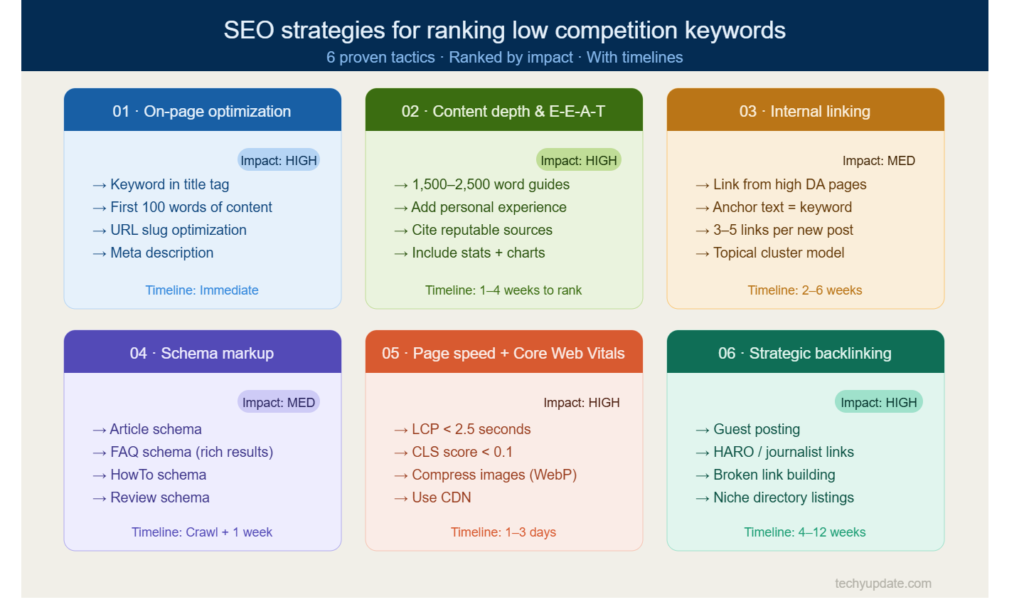
On-Page SEO Optimization
Every page targeting a specific keyword needs the fundamentals locked in:
- Keyword in the H1 title (naturally, not forced)
- Keyword in the meta description
- Keyword in the first 100 words of the introduction
- Keyword in at least one H2 subheading
- Keyword in the image ALT text
- URL slug that contains the keyword
Beyond these basics, ensure your page loads in under 2.5 seconds on mobile, uses structured data markup where appropriate (e.g., FAQ, HowTo, and Article schemas), and is free of duplicate content.
Internal Linking
Internal links pass authority between your own pages and help Google understand your site’s topical structure. Every article you publish on low competition keywords should link to at least three to five related posts on your site. This builds what SEO professionals call “topical clusters” — groups of content around a theme that signal deep expertise to search algorithms.
Internal Linking Suggestion: “Connect this article to your [Keyword Research Tools Comparison] and [How to Do Competitor Analysis] posts to build a strong topical cluster.”
Content Freshness
Google actively rewards freshness for certain query types. For technology, SEO, and AI topics, the core themes of techyupdate.com, updating articles annually with new tool data, updated screenshots, and current statistics, can revive declining rankings without requiring new backlinks.
User Experience Optimization
Dwell time, how long someone stays on your page before returning to Google, is a proxy signal for content quality. Improve it by breaking up long text with visuals and subheadings, using clear formatting, keeping introductions punchy, and including interactive elements like tables and comparison charts where appropriate.
AI Tools for Productivity and Keyword Discovery
The integration of AI into keyword research workflows has transformed what a solo blogger or small team can accomplish. Tools like ChatGPT, Claude (by Anthropic), and Perplexity AI can dramatically accelerate the early stages of keyword research.
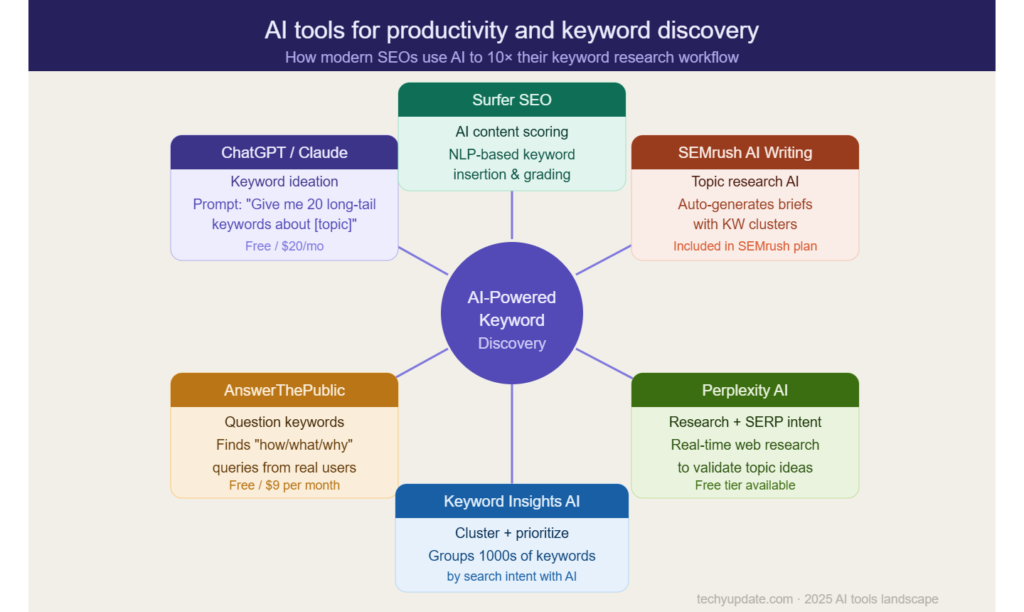
Specifically, AI tools can help you quickly generate large seed keyword lists. Enter your niche into an AI assistant and ask for 50 related subtopics or questions your target audience might search for. This produces a rough keyword universe in minutes that previously would have taken hours of manual brainstorming.
AI writing assistants also help with semantic keyword expansion, identifying LSI (Latent Semantic Indexing) keywords and topically related phrases that should appear naturally throughout your content. Google’s NLP systems look for these contextual signals to confirm that your article covers a topic with genuine depth.
However, AI-generated content requires human editing before publication. Raw AI output tends to be generic, lacks personal experience signals (which Google’s E-E-A-T framework rewards), and may include factual errors that damage trust. The winning workflow is: use AI to accelerate drafting and research, then invest your expertise in editing, personalizing, and verifying every claim.
For productivity, tools like Notion AI and Otter.ai help teams manage content calendars and transcribe keyword brainstorming sessions efficiently, reducing the organizational overhead of running a consistent publishing operation.
Search Volume Keywords for Coding and Technical Skills
Technical niches, coding tutorials, software reviews, and developer tools represent one of the richest environments for finding low competition keywords with high search volume. This is partly because technical audiences search with high specificity, and partly because many technical topics are underserved by mainstream content creators.
For example, queries like “how to use Python pandas groupby with multiple columns” or “best VS Code extensions for React developers 2026” often have 1,000–5,000 monthly searches with keyword difficulty scores below 20. Yet they represent exactly the kind of actionable, specific answer that a developer will click, bookmark, and return to.
When researching search volume keywords in the technical space, prioritize:
- Error message queries (“TypeError: cannot read property of undefined fix”)
- “How to” tutorials for specific library functions or framework patterns
- Comparison queries between competing tools (“Vite vs Webpack 2026”)
- Beginner setup guides for popular technologies
These query types almost always have clear informational or transactional intent, making them straightforward to target with well-structured tutorial content. They also earn natural backlinks from developer forums like Stack Overflow, GitHub discussions, and developer communities, compounding their authority over time.
Pro Tip: Check GitHub’s trending repositories section regularly. When a new library or tool starts gaining stars, related “how to use [tool name]” keywords are about to emerge with virtually zero competition. Publishing early captures this first-mover advantage.
Common Mistakes to Avoid
Even experienced content creators make predictable errors when targeting low-competition keywords. Avoiding these pitfalls saves months of wasted effort.
Choosing Keywords with No Search Intent Alignment
A keyword can be low competition simply because no business model supports ranking for it, or because searchers find their answer in a single line and immediately leave. Always verify that a keyword aligns with content that can generate real value, whether informational depth, a purchase decision, or a specific tool recommendation.
Ignoring Search Trends
A keyword that had strong volume eighteen months ago may have been disrupted by a product launch, a Google algorithm update, or a shift in user behavior. Always cross-reference your keyword targets with Google Trends to confirm that search interest is stable or growing, not declining.
Overusing Keywords
Keyword stuffing remains one of the fastest ways to trigger a Google quality penalty. Maintain keyword density between 0.8% and 1.5% of total word count. Use natural variations and synonyms rather than repeating the exact same phrase. Modern search algorithms recognize topical relevance from semantic context, not exact-match repetition.
Targeting Overly Competitive Terms Before Building Authority
New sites should spend their first 12–18 months almost exclusively on keywords with KD scores below 20. Attempting to compete with established domains on high-difficulty terms without sufficient backlink equity is statistically unlikely to succeed and wastes both time and content budget. Build your domain authority systematically by winning on low-competition keywords, then gradually expand upward.
Tips to Increase Organic Traffic
Ranking for low competition keywords is the start, not the finish line. Sustaining and growing organic traffic requires consistent, strategic effort.
Publishing Consistent Content
Google’s algorithm rewards sites that publish quality content on a reliable schedule. Consistency signals that a site is active and maintained. Even a cadence of two well-researched articles per week, maintained for twelve months, compounds into a substantial traffic base when each article targets appropriately chosen low competition keywords.
Optimizing for Featured Snippets
Featured snippets appear above traditional search results and are prominently cited in AI-generated answer summaries. To optimize for them: provide a clear, concise definition or direct answer within the first 300 words of your article, use structured formatting (numbered steps, bullet lists, definition-style answers), and ensure your page is technically sound so Googlebot can crawl and index it efficiently.
Using Semantic SEO
Semantic SEO means writing content that addresses a topic holistically, not just targeting a single keyword phrase. Cover the subtopics, related questions, and adjacent concepts that belong to your primary keyword’s semantic neighborhood. This is what separates a page that ranks for one keyword from a page that ranks for hundreds.
Building Authority Content
Some articles are worth investing 5,000–8,000 words because they become permanent reference resources in your niche. These “pillar articles” attract natural backlinks over time, boost your domain rating, and create internal linking hubs that elevate surrounding content. Identify one or two pillar topics per quarter and invest accordingly.
Internal Linking Suggestion: “Link to your [Content Marketing Calendar Template] post here to help readers implement a consistent publishing strategy.”
Expert Insights on AI Learning Trends: Low Competition Keywords
The landscape of keyword research is being actively reshaped by AI search interfaces. Google’s Search Generative Experience (SGE) and tools like Perplexity AI are changing how users interact with search results and, consequently, what types of content rank most visibly.
One key trend emerging in 2026 is that AI search summaries tend to pull from sources that provide clear, factual, well-sourced answers to specific questions. This means low-competition keywords framed as specific questions, the kind found in PAA boxes and long-tail searches, are increasingly being surfaced in AI-generated overviews, often with source attribution that drives qualified referral traffic.
According to data published by Ahrefs and corroborated by independent SEO research communities, content that earns a featured snippet for a keyword also appears in SGE answers for related queries approximately 65–70% of the time. This makes featured snippet optimization a dual investment: it wins both traditional click-through and AI search visibility.
For techyupdate.com’s target audience, students, beginners, and technically curious readers, the implication is clear. Content that directly answers specific questions in a clean, authoritative format will increasingly outperform long-form, unfocused content. Depth matters, but directness matters equally in the AI search era.
The SEO professionals who are winning in this environment are those who think of their content as answering a specific question for a specific person, then expanding outward from that core answer with supporting detail, examples, and context. That framework maps perfectly to a low-competition keyword strategy built around long-tail, intent-specific queries.
Quick Summary
Here is what this guide covered, distilled into actionable takeaways:
- Low competition keywords are search terms with meaningful traffic potential but limited competition from authoritative sites. They are the fastest path to rankings for new and mid-stage websites.
- High-traffic keywords and high-competition keywords are not synonyms. Look for search volume keywords in the 500–5,000 monthly range with KD scores below 25.
- Keyword research is the strategic foundation of all organic traffic growth. Always match your keyword to search intent before writing.
- The best tools for finding low competition keywords include Google Keyword Planner (free baseline), Ahrefs (most accurate KD), SEMrush (best for competitive gaps), Ubersuggest (beginner-friendly), and Google’s own autocomplete (underrated and free).
- SERP analysis is mandatory before targeting any keyword. Check domain authority, backlink counts, and content quality of the top ten results.
- Long-tail keywords are your most efficient opportunity for organic traffic, especially for new sites without strong link profiles.
- AI tools accelerate keyword research and content drafting, but human editing, expertise, and originality are what earn Google’s trust.
- Featured snippet optimization is now a dual investment winning the snippet also increases your visibility in AI-generated search answers.
- Avoid keyword stuffing, mismatched search intent, and chasing high-competition terms before building domain authority.
Conclusion
Finding low competition keywords with high traffic is not a matter of luck or secret formulas. It is a disciplined research process, executed consistently over time, that compounds into significant organic traffic for websites of any size.
The core principle to internalize is this: the goal of keyword research is not to find the most popular search terms, it is to find the most achievable search terms for your current level of domain authority. Growing from there, systematically, is how every successful content site was built.
Start with the tools outlined in this guide. Build a keyword list of 30–50 low competition targets in your niche. Prioritize based on search intent alignment and your realistic ability to produce better content than what currently ranks. Publish consistently. Update regularly. And track your results in Google Search Console so that every article teaches you something that improves the next one.
The sites that dominate search results in 2026 are not the ones with the biggest budgets. They are the ones with the most focused keyword strategies, the most helpful content, and the most consistent publishing discipline. That combination is entirely within your reach.
Internal Linking Suggestion: “Ready to act on this? Read our [How to Start Blogging in 2026 and Make Money (Step-by-Step)] next.”
Frequently Asked Questions (FAQ)
1. What are low competition keywords?
Low-competition keywords are search terms with meaningful monthly search volume but are not heavily targeted by authoritative websites. They typically have a keyword difficulty score below 20–25 on tools like Ahrefs or SEMrush. These keywords represent the best opportunities for newer or smaller websites to rank on page one of Google without requiring large numbers of backlinks.
2. How do I find low competition keywords for free?
You can find low competition keywords for free using Google Keyword Planner, Google Search autocomplete suggestions, the People Also Ask boxes in Google search results, and Google Trends. Ubersuggest also offers a limited free tier. Combining these tools gives you a solid starting point without any paid subscription.
3. What is a good keyword difficulty score for beginners?
For websites with low domain authority, typically under two years old or with fewer than 50 referring domains, aim for keyword difficulty scores between 0 and 20. This range offers the most realistic chance of ranking on page one without an aggressive link-building campaign. As your site grows, you can gradually target keywords in the 20–40 range.
4. Can low competition keywords still drive significant traffic?
Yes, absolutely. While individual low-competition keywords may have modest search volumes, ranking for dozens of them simultaneously can compound organic traffic. Many successful content sites generate tens of thousands of monthly visitors entirely through long-tail, low-competition keyword strategies rather than relying on a handful of high-volume terms.
5. What is the difference between keyword difficulty and search volume?
Keyword difficulty measures how hard it is to rank on page one for a specific term, based on the authority of websites currently ranking there. Search volume measures how many times per month users search for that term. The best targets combine reasonable search volume with low difficulty; high volume alone does not guarantee a ranking opportunity.
6. How many times should I use my target keyword in an article?
For a 3,500–4,000-word article, aim to use your primary keyword 12–14 times, which keeps density between 0.8% and 1.5%. Use natural variations and synonyms throughout modern search engines understand semantic context and do not require exact-match repetition. Forced or unnatural keyword usage can trigger quality penalties.
7. What are long-tail keywords and why do they matter?
Long-tail keywords are search phrases typically three to six words in length, highly specific, and less competitive than broad head terms. They matter because they account for the majority of total search queries on the internet, align closely with user intent, convert better (because searchers know exactly what they want), and are far more achievable for sites still building domain authority.
8. How does Google’s SGE affect keyword research in 2026?
Google’s Search Generative Experience (SGE) presents AI-generated summaries at the top of search results for many queries. Content that earns featured snippets, particularly for specific question-based and informational keywords, is disproportionately cited in these AI summaries. This makes low competition, question-based long-tail keywords even more valuable, as appearing in SGE results can deliver significant visibility beyond traditional blue-link clicks.
9. How long does it take to rank for low competition keywords?
With well-optimized, high-quality content targeting genuinely low-competition keywords, many sites see their rankings appear within four to eight weeks of publication. Page one results for keywords with KD scores below 15 can emerge in as little as two to four weeks for sites with even modest domain authority. Consistently published, well-structured content compounds these results over time.
10. Should I target low competition keywords even if my site is established?
Yes. Even established sites with high domain authority benefit from consistently targeting low competition keywords, particularly in emerging subtopics or newly trending areas where competition has not yet caught up. These terms often generate quick traffic wins, support internal linking structures, and establish topical authority in areas where even high-authority competitors have gaps.