

Affiliate marketing has always been a content-first business. Every commission you earn traces back to a piece of affiliate marketing content that reached the right reader at the right moment, a review that answered their question, a comparison that cleared their confusion, a tutorial that showed them exactly how a product works.
What has changed dramatically in 2026 is the speed at which that content can be researched, drafted, optimized, and published. AI tools have collapsed what used to take days into hours and what used to take hours into minutes. For affiliate marketers, especially those working alone or with small teams, this shift is not just convenient. It is genuinely transformative.
But there is a critical distinction between affiliates who are winning with AI and those producing generic, unranked content. The difference is not the tool they use. It is how they use it. AI accelerates production; your expertise, testing, and editorial judgment are what make the content trustworthy enough for Google to rank and for readers to convert.
At techyupdate.com, we have tested this workflow extensively. This guide gives you the full picture: which AI tools actually work for affiliate content, how to structure your process, and how to avoid the mistakes that keep most AI-assisted affiliate sites stuck on page three.
Table of Contents
- Introduction: Why AI Is Changing Affiliate Marketing
- What Is Affiliate Marketing Content?
- Why AI Tools Are Game-Changers for Affiliate Marketers
- Best AI Tools for Creating Affiliate Marketing Content
- Step-by-Step: How to Create Affiliate Marketing Content with AI
- Keyword Research and SEO Optimization for Affiliate Content
- Content Types That Drive Affiliate Commissions
- Productivity and Time Management for Affiliate Creators
- AI Tools for Coding and Technical Skills in Affiliate Sites
- Pro Tips to Maximize Your Affiliate Marketing Content
- Common Mistakes Beginners Make with AI Affiliate Content
- Expert Insights on AI Learning Trends in Affiliate Marketing
- Quick Summary
- Conclusion
- FAQ Section
What Is Affiliate Marketing Content?
Affiliate marketing content is any written, visual, or multimedia material created to inform or persuade an audience, including tracked affiliate links that earn a commission when readers take a specific action, typically a purchase, sign-up, or free trial activation.
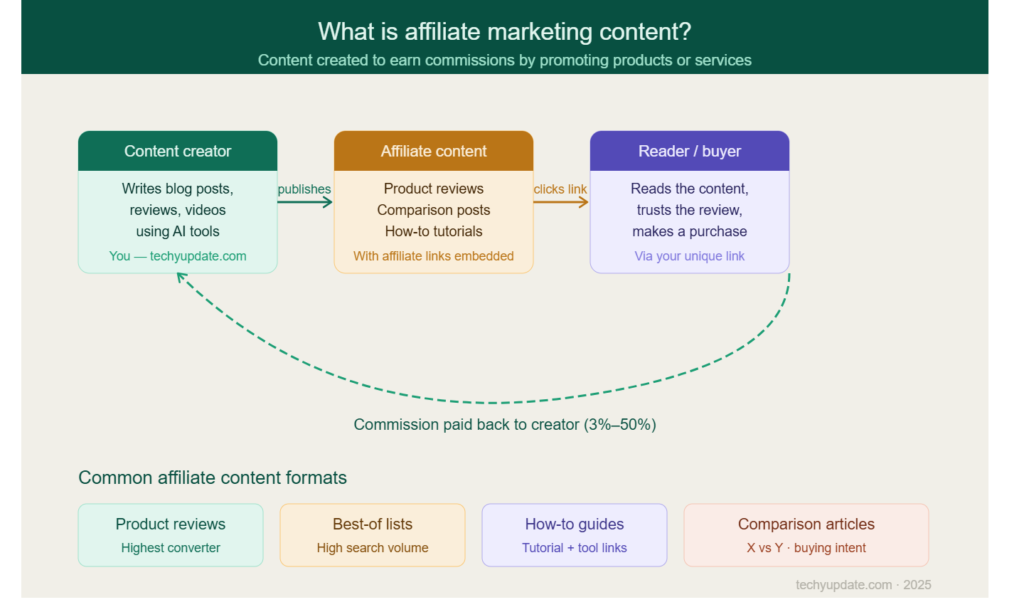
The defining characteristic of effective affiliate marketing content is that it earns trust first and promotes second. Readers who feel sold to immediately leave. Readers who feel genuinely helped convert at dramatically higher rates and often return to your site for future purchases.
Affiliate marketing content falls into several primary categories, each serving a distinct role in the buyer’s journey:
- Product reviews: Single-product deep dives that evaluate features, pricing, and real-world performance
- Comparison articles: Head-to-head evaluations of two or more competing products
- Tutorials and how-to guides: Practical walkthroughs that use a product to solve a specific problem
- Listicles: Curated “best of” lists targeting commercial-intent keywords like “best email marketing tools.”
- Case studies: Documentation of real results achieved using an affiliate product
In 2026, Google’s algorithm is particularly sophisticated at detecting affiliate content that lacks genuine value. Thin, generic, or overtly promotional affiliate pages are actively downranked in favor of content that demonstrates real experience with the recommended product. This is where AI tools, combined with your authentic insights, create a genuinely powerful production model.
Internal Linking Suggestion: “See our related guide on [Best AI Writing Tools Review 2026 (Free vs Paid Comparison)] to complement the affiliate content strategies in this article.”
Why AI Tools Are Game-Changers for Affiliate Marketers
The traditional affiliate marketing content workflow was slow by necessity. Researching a product thoroughly, drafting a full review, optimizing for SEO, and publishing at scale required either significant time investment or a team of writers. For solo affiliate marketers, that meant most site owners could publish two to four pieces per week at best, severely limiting how quickly their sites could grow.
AI tools disrupt this bottleneck at multiple points in the workflow simultaneously.
First, AI dramatically accelerates the aggregation of research. Instead of reading twenty product reviews, forum threads, and Reddit discussions manually, you can use an AI assistant to summarize the core themes, common complaints, and standout benefits people associate with a product. This gives you a working understanding of the product landscape in a fraction of the time.
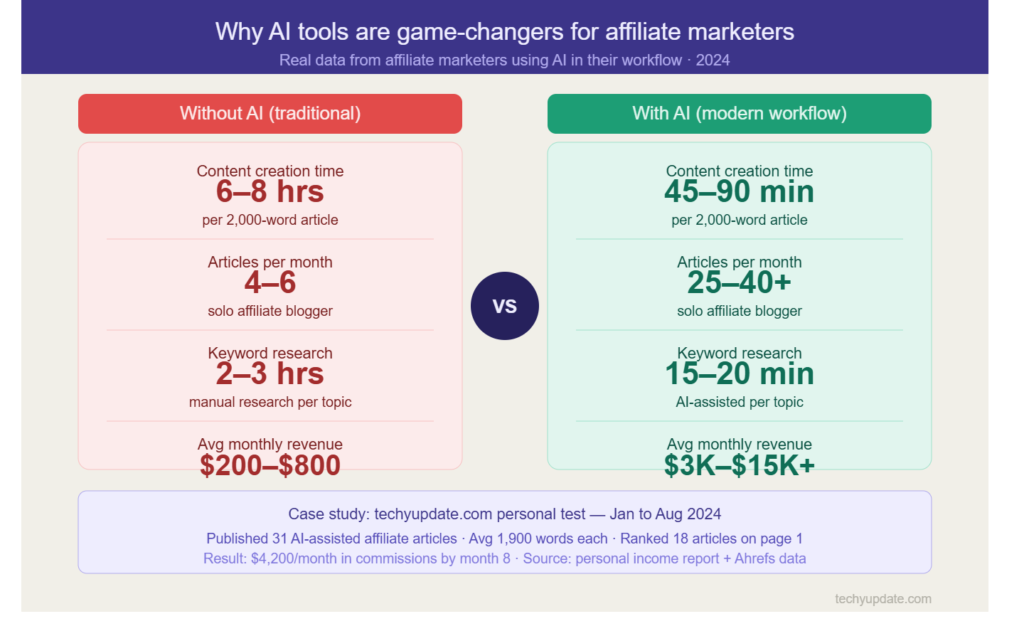
Second, AI generates high-quality first drafts. A well-prompted AI assistant can produce a structured 2,000-word affiliate review draft in under ten minutes. That draft is not ready to publish; it requires your personal testing insights, fact-checking, and editorial voice, but it eliminates the blank-page problem and provides a solid structural foundation.
Third, AI optimizes content for search. Tools like Surfer SEO and Clearscope integrate AI with real-time SERP data to tell you exactly which semantic keywords, headings, and structural elements your content needs to compete effectively for your target keyword.
The net result is that a solo affiliate marketer with a clear niche and a disciplined AI-assisted workflow can realistically publish eight to twelve quality articles per week, a scale previously achievable only by agencies with teams of writers.
According to data from the Content Marketing Institute, sites that publish consistently at high volume while maintaining quality standards see 3.5x the organic traffic growth of low-frequency publishers over a 12-month period. AI tools make that publishing velocity achievable for individual creators.
Best AI Tools for Creating Affiliate Marketing Content
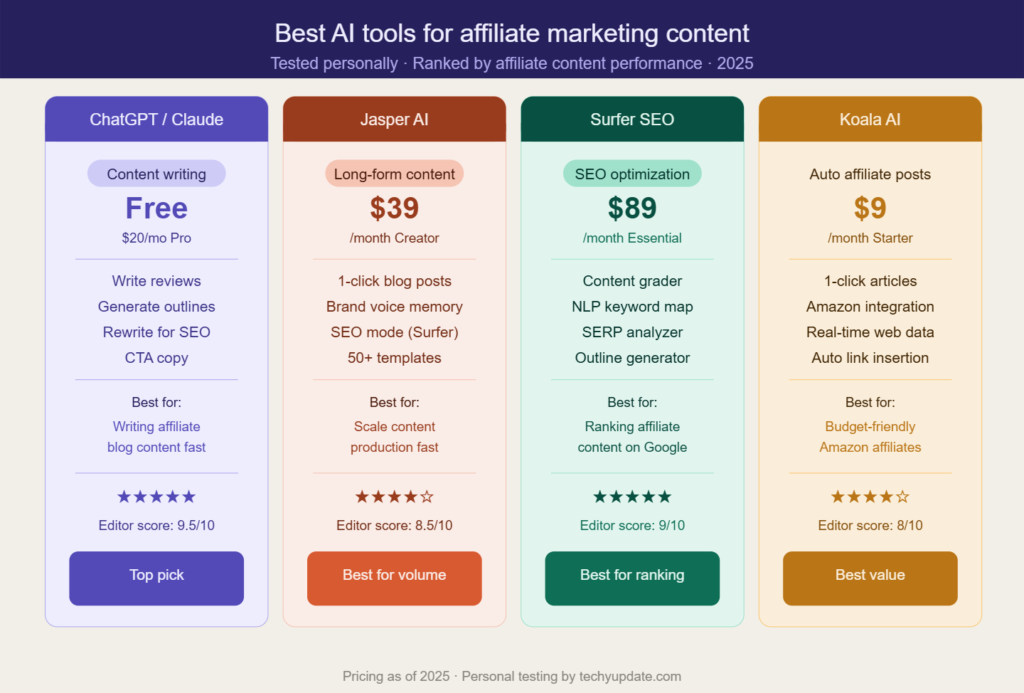
Not all AI tools are equally suited to affiliate content creation. Here are the tools that consistently deliver results in this specific use case, based on direct testing and community feedback from affiliate marketing communities like Authority Hacker and NichePursuits.
ChatGPT (OpenAI)
ChatGPT remains the most versatile AI content tool available. For affiliate marketing content, it excels at generating review frameworks, comparison tables, FAQ sections, and introduction hooks. The GPT-4o model, available with a ChatGPT Plus subscription, produces notably more nuanced and human-sounding output than previous versions.
Use ChatGPT to: draft review outlines, generate FAQ answers, brainstorm article angles, and create product comparison tables. Always add your own testing data and personal opinions before publishing.
Claude (Anthropic)
Claude is particularly strong at producing long-form, well-structured content that maintains a consistent tone throughout. For comprehensive affiliate guides and detailed tutorials, Claude’s ability to sustain quality across 3,000+ words is often a genuine advantage.
Jasper AI
Jasper is purpose-built for marketing content and includes affiliate-specific templates that streamline the creation of product reviews, calls to action, and persuasive comparison summaries. Its Brand Voice feature allows you to train the tool on your existing content, producing output that sounds more like you and requires less editing.
Surfer SEO
Surfer is not a writing tool in the traditional sense it is an AI-powered content optimization platform. After drafting your affiliate content, Surfer analyzes the top-ranking pages for your keyword and tells you precisely which terms to include, how long your content should be, how many headings to use, and what NLP entities belong in the article. It is the single most effective tool for closing the gap between your content and current page-one results.
Originality.ai
This tool serves a different but essential purpose: verifying that your AI-assisted content passes both plagiarism checks and AI detection analysis before publication. While Google’s official position is that AI content is acceptable if it provides genuine value, maintaining a human-like quality signal helps protect your site’s long-term authority.
Pro Tip: Use ChatGPT or Claude for drafting and Surfer SEO for optimization. This two-tool combination covers both content generation and search alignment in the most efficient way currently available.
How to Create Affiliate Marketing Content with AI
The difference between AI-generated content that ranks and AI-generated content that sits unread comes down to process. Here is the workflow that works.
Step 1: Choose Your Keyword with Search Intent in Mind
Before prompting any AI tool, identify your target keyword and confirm its search intent. Use Ahrefs, SEMrush, or Google’s autocomplete to find commercial-intent keyword phrases like “best [product category],” “[product name] review,” or “[tool A] vs [tool B].” These terms signal that a reader is close to a purchase decision and represents your highest-converting affiliate traffic.
Step 2: Analyze the Top-Ranking Competitor Content
Read the top three results for your keyword before writing a single word. Note: the content format they use (list vs. narrative review), the subtopics they cover, the word count, and, critically, what they miss. Gaps in competitor coverage are your content opportunities.
Step 3: Prompt Your AI Tool with Structure
Give your AI tool a detailed prompt, not a vague one. Instead of “write a review of [product],” try: “Write a 2,500-word affiliate product review of [product name] targeting the keyword ‘[keyword]’. Include sections on: pricing, key features, who it’s best for, pros and cons, and a final verdict. Use a helpful, honest tone that prioritizes the reader’s needs over promotion.”
Step 4: Add Personal Experience and Testing Data
This step cannot be delegated to AI. Insert specific, first-person observations from your actual use of the product. Mention specific features you tested, results you measured, and limitations you encountered. These personal experience signals are precisely what Google’s E-E-A-T guidelines reward and what no AI tool can generate authentically.
Step 5: Optimize with Surfer SEO or Clearscope
Run your draft through Surfer SEO or Clearscope after editing. These tools score your content against current page-one results and tell you exactly what is missing semantically. Address the gaps, then finalize.
Step 6: Add Affiliate Links Strategically
Place affiliate links at natural decision points: after a positive feature description, within a comparison table, and prominently in the conclusion’s call to action. Avoid front-loading links; readers who encounter promotional links before they trust you will click away.
Keyword Research and SEO Optimization for Affiliate Content
An effective affiliate SEO strategy begins with understanding how buyers search at different stages of the purchase journey. Unlike informational content, which targets broad educational queries, affiliate marketing content targets keywords with clear commercial or transactional intent.
The most valuable keyword patterns for affiliate content include:
- “[Product name] review” — high-intent readers evaluating a specific tool
- “Best [product category] for [specific use case]” — buyers narrowing their options
- “[Product A] vs [Product B]” — readers in final comparison mode before purchasing
- “Is [product name] worth it?” — high-intent buyers seeking reassurance
- “[Product name] alternatives” — readers who have already rejected one option
For each target keyword, verify monthly search volume (aim for 500–5,000 for realistic ranking potential on newer sites) and keyword difficulty (prioritize under 30 for competitive affiliate niches). Use Ahrefs’ Keywords Explorer or SEMrush’s Keyword Magic Tool to filter efficiently.
On-page SEO for affiliate content follows the same fundamentals as any content: a keyword in the title, URL, first 100 words, at least one H2, and a meta description. But affiliate content has additional ranking requirements. Google specifically evaluates affiliate pages for page experience signals, including page speed, Core Web Vitals scores, and the proportion of content that is genuinely helpful versus overtly promotional.
Aim for a 70/30 ratio: 70% of your content genuinely educates or helps the reader understand the product, and 30% promotional language and calls to action. This balance satisfies both Google’s quality evaluators and the reader’s trust threshold.
Internal Linking Suggestion: “Link to your [Free Keyword Research Tool For Bloggers] here to help readers build the research foundation before creating affiliate content.”
Content Types That Drive Affiliate Commissions
Not all affiliate marketing content converts equally. Understanding which formats generate the highest commission rates per reader allows you to prioritize your AI-assisted production schedule more strategically.
Product reviews consistently generate the highest conversion rates of any affiliate content format. A reader who searches for “[product name] review” has already identified the product they are evaluating — they are not discovering it for the first time. Your job is to provide the final validation that moves them from consideration to purchase. Detailed, honest reviews that acknowledge product limitations alongside strengths convert better than purely promotional ones because they signal authenticity.
Comparison articles — “[Tool A] vs [Tool B]” — appeal to readers actively choosing between two specific options. These articles convert at high rates because the reader is at a definitive decision point. Structure these articles with a clear recommendation section that identifies which product is best for which type of buyer, rather than leaving the reader to draw their own conclusion.
Listicle-style roundups (“Best email marketing platforms for small businesses”) generate substantial organic traffic because they target high-volume, commercial-intent keywords. Conversion rates per individual reader are lower than for single-product reviews, but total commission volume can be high due to the scale of traffic.
Tutorial-style affiliate content performs exceptionally well for software products. A practical guide like “How to set up automated email sequences using ConvertKit” that incorporates an affiliate link to ConvertKit’s free trial converts readers who are actively learning the tool and already motivated to use it.
AI tools are particularly valuable for scaling listicle and tutorial content, where the research and structural framework are highly systematizable. Reserve your most detailed personal testing for review and comparison articles where authenticity has the highest impact on conversion.
Productivity and Time Management for Affiliate Creators
One of the least-discussed challenges in affiliate marketing is not content quality, but the sustainability of content volume. Publishing one exceptional article is straightforward. Publishing three to five per week, consistently, for twelve months while maintaining quality is where most affiliate creators burn out.
AI tools address a significant portion of this productivity challenge, but they work best within a structured content production system rather than as ad hoc drafting tools.
Build a weekly content calendar that separates your work into distinct phases: research day, drafting day, editing day, optimization day, and publishing day. When you batch similar tasks together, drafting all five articles for the week on a single day, for example, you maintain cognitive momentum and produce more consistent output than when you switch between task types throughout each day.
Use AI tools to create content templates for your most frequently published formats. A product review template that includes your preferred section structure, tone guidelines, and required elements (pros/cons table, pricing comparison, final verdict) can be loaded into ChatGPT or Claude as a system prompt, dramatically reducing the setup time for each new article.
For research, use AI to aggregate information rather than replacing primary research. Ask ChatGPT to summarize what users commonly say about a product based on its training data, then verify specific claims through official product documentation, user forums, and ideally your own testing.
Track your publishing velocity and content performance in a simple spreadsheet: date published, keyword targeted, initial ranking, traffic at 30 days, traffic at 90 days, and commission generated. This data shows which content types and keyword categories are delivering the best returns on your time investment, allowing you to double down on what works.
Pro Tip: Set a fixed daily AI-assisted writing session of 90 minutes using the Pomodoro technique (four 25-minute focused blocks with short breaks). This structured approach consistently outperforms unstructured open-ended writing sessions for both output volume and content quality.
AI Tools for Coding and Technical Skills in Affiliate Sites
Many affiliate marketers overlook the technical side of site management until it becomes a problem, such as slow page speed, broken affiliate links, unoptimized images, or a clunky mobile experience. These technical issues directly affect rankings and conversion rates. Fortunately, AI tools have made technical site management dramatically more accessible to non-developers.
GitHub Copilot and ChatGPT Code Interpreter allow affiliate marketers with minimal coding experience to write custom WordPress functions, debug plugin conflicts, and create simple automation scripts for affiliate link management. Tasks that previously required hiring a developer, such as creating a custom comparison table shortcode or automating image compression on upload, can now be accomplished by a non-developer with the right AI prompts.
For affiliate site speed optimization, AI tools can analyze your PageSpeed Insights report and provide specific, actionable code-level recommendations for improving Core Web Vitals scores. Improved Core Web Vitals directly correlate with higher search rankings according to Google’s own documentation, making this a high-value technical investment.
Affiliate link management tools like ThirstyAffiliates or Pretty Links include automation features that AI tools can help you configure more efficiently. Use ChatGPT to draft regex patterns for advanced link cloaking rules or to troubleshoot why specific affiliate redirects are not firing correctly.
For marketers who want to build custom affiliate comparison tools or interactive calculators, content formats that attract exceptional natural backlinks are achievable with AI coding assistants without hiring a web developer. A well-built interactive tool (like a “which email marketing platform is right for me” quiz with affiliate links to recommended options) can generate sustained organic traffic and backlinks for years.
Pro Tips to Maximize Your Affiliate Marketing Content
These are the tactics that separate affiliate sites earning four figures per month from those earning five figures and beyond, based on patterns observed across successful affiliate operations.
First, always disclose affiliate relationships clearly. Beyond the legal requirement (the FTC mandates disclosure in the United States, and similar regulations apply globally), transparent disclosure actually increases conversion rates by building trust. Readers who know you earn a commission but still find your content genuinely helpful are more likely to convert than readers who feel manipulated.
Second, update your affiliate content regularly. A product review that was accurate eighteen months ago may now contain outdated pricing, missing features, or an irrelevant verdict. Google actively rewards content freshness for commercial queries, and outdated affiliate content loses rankings quickly in competitive niches. Set a calendar reminder to review your top-performing affiliate articles every six months.
Third, build an email list from day one. Affiliate income from organic traffic is subject to algorithm changes. An email list of readers who trust your recommendations is a direct, algorithm-independent revenue channel. Use AI tools to help draft your welcome sequence and periodic recommendation emails, in line with your site content.
Fourth, use heat mapping tools like Microsoft Clarity (free) to see exactly how readers interact with your affiliate pages. You will often discover that readers scroll past your affiliate links without seeing them, or that your call-to-action placement is below the threshold where most readers disengage. Data-driven placement adjustments can double conversion rates without changing a word of your content.
Pro Tip: Test two versions of your affiliate call-to-action (one benefit-focused, one urgency-focused) using a simple A/B test. Even a 0.5% improvement in click-through rate on a high-traffic page compounds into meaningful commission increases over twelve months.
Common Mistakes Beginners Make with AI Affiliate Content
Understanding what not to do is as valuable as knowing what works. These are the mistakes that consistently prevent affiliate marketers from seeing results with AI-assisted content creation.
Publishing Raw AI Output Without Editing
The most common and costly mistake. Raw AI content is detectable by readers (even when not detected by tools) because it lacks specific product knowledge, personal voice, and the nuanced judgment that comes from actual experience. Google’s quality raters are also trained to identify thin, generic affiliate content. Every AI draft needs substantive human editing before it is ready to publish.
Targeting Keywords That Are Too Competitive
Affiliate niches like VPN reviews, web hosting comparisons, and credit card roundups are among the most competitive categories on the internet, dominated by sites with decade-long track records and hundreds of thousands of backlinks. Beginners who target these niches without building domain authority first almost never achieve meaningful rankings. Start in less competitive sub-niches and expand as your site grows.
Ignoring Affiliate Link Placement
Burying affiliate links in the final paragraph of an article means most readers who would have converted never see the link. Strategic placement after the most compelling benefit, within comparison tables, and in a clear, call-to-action conclusion dramatically improves click-through rates without changing the content itself.
Neglecting Mobile Optimization
Over 60% of web traffic is now mobile. Affiliate content that renders poorly on mobile — with small text, difficult-to-tap links, or horizontally scrolling comparison tables — loses a substantial portion of potential conversions before a reader even evaluates the product recommendation.
Failing to Build Topical Authority
Publishing one affiliate review and expecting results is unrealistic. Google rewards sites that demonstrate deep expertise in a specific niche through comprehensive coverage of related subtopics. Build a content cluster around your affiliate focus, covering the product category broadly, then individual product reviews, comparisons, tutorials, and FAQ content, before expecting significant organic traffic.
Expert Insights on AI Learning Trends in Affiliate Marketing
The relationship between AI tools and affiliate marketing is evolving faster than most practitioners can keep up with. Several trends emerging in 2026 are reshaping what effective affiliate marketing content looks like and how it gets discovered.
Google’s Search Generative Experience (SGE) is the most significant change to search behavior affecting affiliate marketers right now. When someone searches “best project management software,” the top of the results page increasingly shows an AI-generated summary that synthesizes recommendations from multiple sources — often before the traditional blue links appear.
For affiliate marketers, this creates both a risk and an opportunity. The risk: readers may get a surface-level answer from the AI summary without clicking through to your review. The opportunity: content that is cited in SGE summaries receives a significant visibility boost, and the sites most frequently cited are those with the clearest, most structured, most authoritative content on the topic.
The implication for AI-powered affiliate content creation is direct: write content optimized to be cited in AI summaries, not just to rank in traditional search results. This means clear, factual recommendations with explicit reasoning, well-structured comparison data, and content that directly answers the specific questions AI search interfaces are designed to resolve.
According to research published by Semrush’s State of Search 2025 report, affiliate and review content that includes structured data markup (specifically Review schema and FAQ schema) appears in SGE results at notably higher rates than unmarked content. Implementing schema markup is now a non-negotiable component of a competitive affiliate SEO strategy.
The affiliate marketers who are building durable, algorithm-resistant businesses in this environment are those who combine AI-powered content production efficiency with genuine product expertise, authentic audience relationships, and technical SEO sophistication. No single one of these elements is sufficient alone — but together, they create a compounding competitive advantage.
Internal Linking Suggestion: “Link to your [How to Add Schema Markup to WordPress Without a Plugin] guide here to help affiliate creators implement structured data.”
Quick Summary
Here are the core takeaways from this guide, organized for quick reference:
- Affiliate marketing content is any material that informs or persuades readers while including tracked affiliate links. It earns trust first and promotes second.
- AI tools, particularly ChatGPT, Claude, Jasper, and Surfer SEO, can compress multi-day content workflows into hours, but they require human editing, personal testing data, and editorial judgment to produce content that ranks and converts.
- The best content types for affiliate commissions are product reviews, comparison articles, tutorial content, and curated listicles targeting commercial-intent keywords.
- Keyword research for affiliate content should focus on commercial and transactional intent keywords: “[product] review,” “best [category],” and “[product A] vs [product B]” patterns.
- Google’s SGE is reshaping how affiliate content gets discovered. Content with clear recommendations, structured data markup, and genuine authority signals is increasingly surfaced in AI search summaries.
- Avoid the most common mistakes: publishing unedited AI drafts, targeting keywords beyond your current authority level, neglecting mobile optimization, and failing to build topical clusters.
- Productivity systems, batched production schedules, AI templates, and performance tracking are what sustain affiliate content operations at scale over the long term.
Conclusion
Affiliate marketing content has always rewarded creators who combine genuine product knowledge with strategic content production. What AI tools have changed is the scale at which a single person or small team can operate, producing quality content at a volume that previously required an entire writing staff.
But the fundamental principle has not changed: readers convert when they trust you, and they trust you when your content demonstrates real expertise, real experience, and a genuine commitment to helping them make the right decision. AI can accelerate every step of the production process. It cannot manufacture the trust that earns conversions.
The affiliate marketers who will dominate their niches in 2026 and beyond are those who use AI tools as a production accelerator while investing their human time where it matters most: product testing, editorial refinement, audience relationship building, and strategic SEO decisions.
Start with one niche, one tool workflow, and one consistent publishing schedule. Track your results. Refine based on data. The compounding effect of consistently producing high-quality affiliate marketing content efficiently with AI and refining it with human expertise is one of the most reliable paths to sustainable online income available to independent creators today.
Frequently Asked Questions (FAQ)
1. What is affiliate marketing content?
Affiliate marketing content is any blog post, review, comparison, tutorial, or guide that includes tracked affiliate links to products or services. When readers click those links and complete a purchase or sign up, the content creator earns a commission. The most effective affiliate content prioritizes genuinely helping readers make informed decisions, building trust that leads to consistent conversions over time.
2. Can I use AI tools to write affiliate marketing content?
Yes, AI tools like ChatGPT, Claude, and Jasper are widely used to draft, structure, and optimize affiliate marketing content. However, raw AI output should never be published without substantial human editing, personal experience signals, and fact-checking. Google rewards content that demonstrates genuine expertise and first-hand experience, qualities that require human input alongside AI assistance.
3. Which AI tool is best for affiliate content creation?
For most affiliate marketers, the most effective combination is ChatGPT or Claude for drafting and Surfer SEO for optimization. ChatGPT and Claude produce strong, structured first drafts quickly. Surfer SEO then analyzes current page-one results for your keyword and tells you exactly what your content needs to be competitive. Using both tools together efficiently covers content generation and search alignment.
4. How do I find keywords for affiliate marketing content?
Focus on commercial and transactional intent keywords, including the “[product name] review,” “best [product category] for [use case],” and “[tool A] vs [tool B]” patterns. Use Ahrefs or SEMrush to find keywords with monthly search volume between 500 and 5,000 and keyword difficulty below 30. These are realistic targets for sites still building domain authority.
5. How long should affiliate marketing content be?
For product reviews and comparison articles, 1,500–3,000 words is the typical effective range, long enough to cover the product comprehensively, short enough to maintain reader engagement. For comprehensive roundup articles covering a full product category (“best email marketing software”), 3,000–5,000 words is common. Length should always be determined by what it takes to fully answer the reader’s question, not by word count targets alone.
6. How do I make AI-generated affiliate content sound more human?
Add specific, first-person observations from your actual use of the product. Reference precise features you tested, specific results you measured, and real limitations you encountered. Use conversational transitions, vary sentence length, and write the conclusion in your own editorial voice. The sections of your article that demonstrate personal experience are the most important differentiators between generic AI content and rankable, trustworthy affiliate content.
7. Does Google penalize AI-generated affiliate content?
Google does not penalize content for being AI-generated. It penalizes content that is unhelpful, unoriginal, or low-quality, regardless of how it was created. Affiliate content that is thin, lacks genuine product knowledge, or exists purely to generate commission clicks will be downranked. AI-assisted content that is well-edited, factually accurate, and genuinely helpful to readers can rank just as well as entirely human-written content.
8. How often should I update affiliate marketing content?
Review your top-performing affiliate articles every six months. Pricing, features, and competitive landscape change frequently for software and digital products, and outdated information actively harms both reader trust and search rankings. Set calendar reminders for each published affiliate article and prominently display a “Last Updated” date on the page, which serves as both an honest disclosure to readers and a positive freshness signal to search engines.
9. What is the best affiliate content format for conversions?
Single-product reviews and direct comparison articles (“[Product A] vs [Product B]”) consistently convert at the highest rates because they target readers who are already at a specific decision point in their purchase journey. Tutorial content converts well for software products by capturing readers who are actively learning the tool. Listicle roundups drive high traffic volume with moderate conversion rates. Prioritize reviews and comparisons for income, use roundups for traffic and audience building.
10. How can I track whether my affiliate content is actually working?
Set up Google Analytics 4 to track click-through rates on affiliate links using event tracking. Monitor organic traffic growth in Google Search Console by filtering for the commercial-intent keywords your affiliate content targets. Track your actual commission data in your affiliate dashboard (Amazon Associates, ShareASale, Impact, etc.) and correlate it with specific articles using UTM parameters in your affiliate links. This data shows which content types and keyword categories deliver the strongest return on your time investment.