

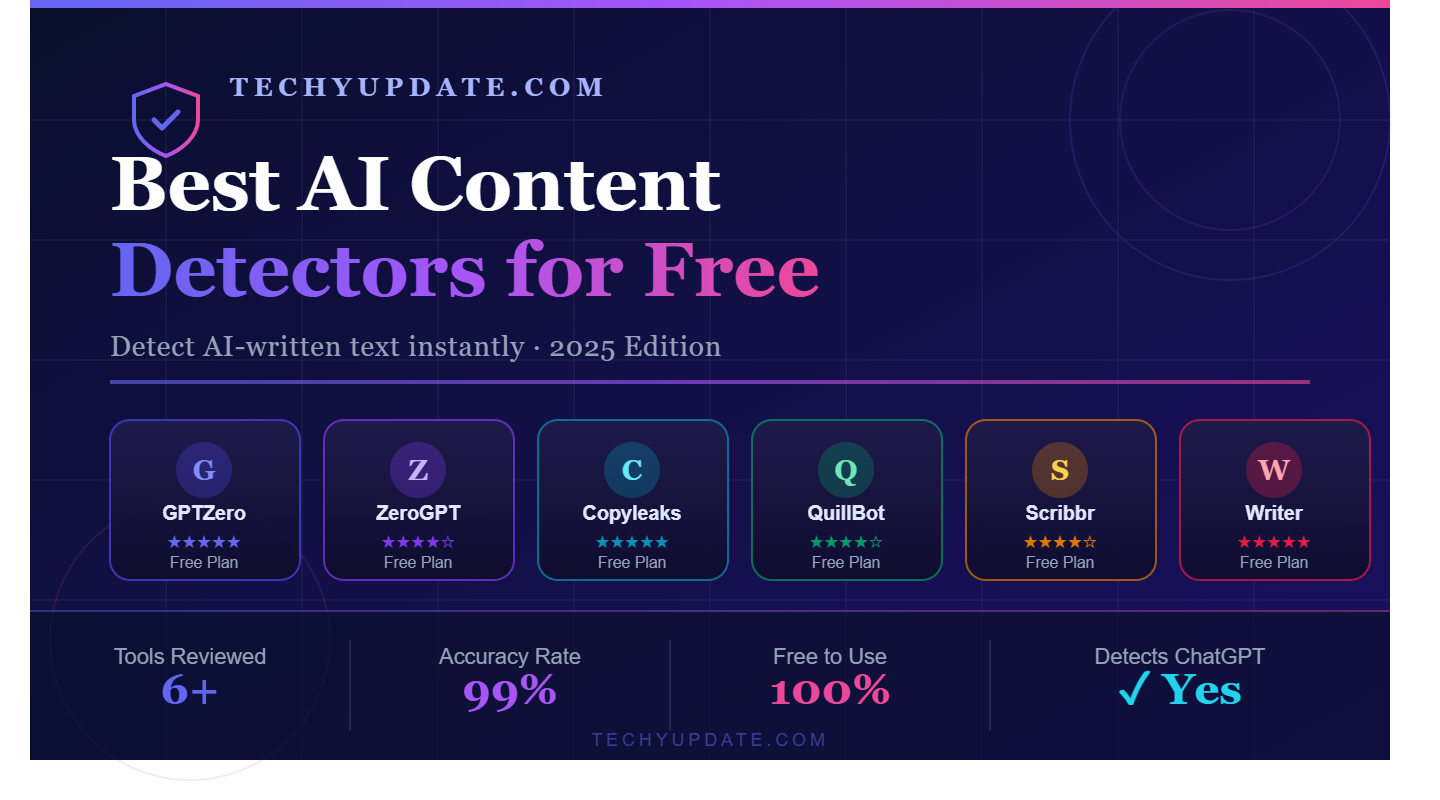
Artificial intelligence has completely transformed how students, bloggers, marketers, and businesses create content in 2026. From essays and research papers to blog posts and coding documentation, AI writing tools are everywhere. However, this rapid growth has also increased the need for reliable verification systems. That is why the demand for the best AI content detectors continues to rise among educators, publishers, SEO professionals, and students.
Today, people want to know whether text is AI-generated, human-written, or partially modified through a free AI detector and humanizer tool. Schools use AI writing-checker systems to verify assignments, while businesses rely on content-authentication tools to maintain credibility and SEO trust signals. Search engines like Google are also improving their evaluation of low-quality AI content, making authenticity more important than ever.
This guide explores the top free AI detector tools, their accuracy, practical use cases, limitations, and expert recommendations for students and professionals. Whether you need a chatbot detector, a plagiarism checker, a grammar alternative, or an AI plagiarism detection software solution, this article provides Everything you need in one place.
Artificial intelligence has transformed content creation across blogs, marketing campaigns, academic writing, and business communication. With tools powered by advanced language models becoming widely accessible, the demand for accurate AI content detectors has increased dramatically. Businesses, educators, publishers, and SEO professionals now rely on sophisticated systems to identify machine-generated text, maintain originality, and protect content integrity.
The rise of AI-generated writing has also created a need for reliable free AI detectors and humanizer tools, especially for creators who want their work to appear natural and authentic. At the same time, plagiarism concerns continue to grow, making solutions like AI content detectors and ChatGPT plagiarism checkers essential for modern digital publishing.
Table of Contents
ChatGPT AI Content Detector Tool and AI Writing Checker Free Online
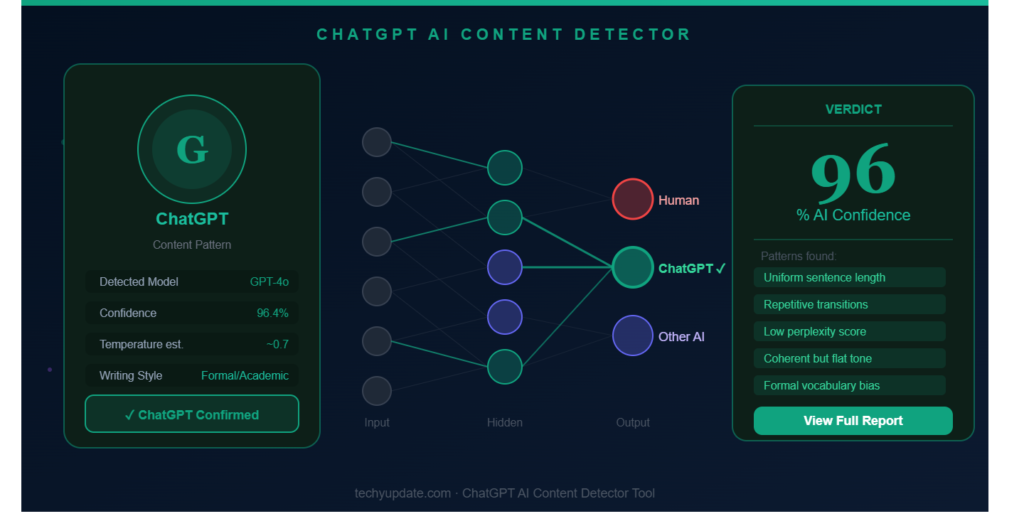
Artificial intelligence has completely changed digital writing. Today, businesses, bloggers, and students use AI tools daily. However, content authenticity now matters more than ever. Therefore, many users search for a reliable ChatGPT AI content detector and an accurate free online AI writing checker.
Modern detection platforms help identify machine-generated content quickly. In addition, they improve trust, originality, and SEO performance. As AI technology advances rapidly, content verification tools continue to evolve.
What Are AI Detection Tools?
AI detection tools are specialized software systems designed to identify text created by artificial intelligence models. These platforms analyze writing style, sentence structure, predictability, and linguistic patterns to estimate whether content is human-written or AI-generated.
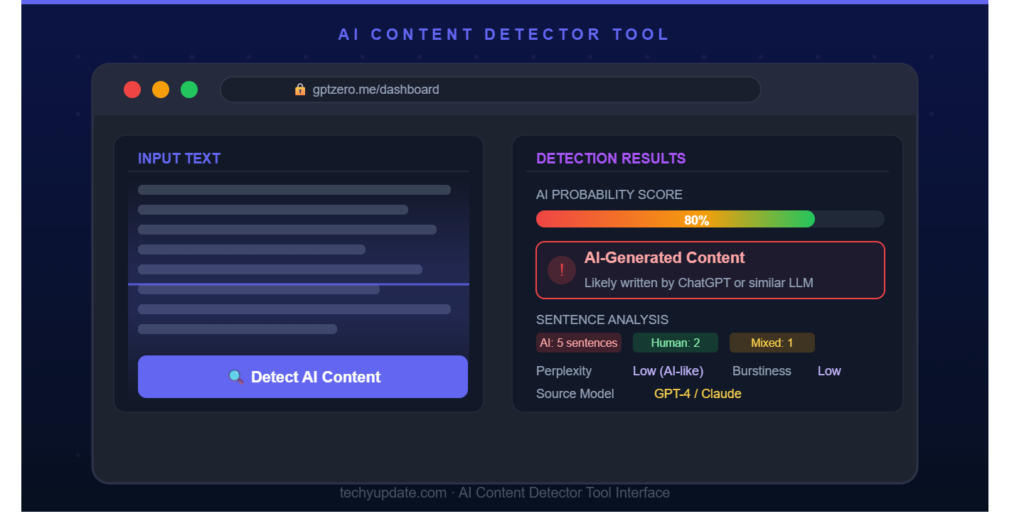
The growing popularity of tools like ChatGPT has increased the demand for reliable AI detection technology across industries, including:
- Education
- SEO and blogging
- Digital publishing
- Marketing
- Journalism
- Recruitment
- Corporate communication
Organizations now use human-written content checker systems to ensure authenticity and maintain trust.
What Is a ChatGPT AI Content Detector Tool?
A ChatGPT AI content detector tool analyzes written text carefully. It checks whether the content was created by artificial intelligence. These systems examine sentence structure, word predictability, and writing patterns.
Many publishers now use these tools before publishing articles. Likewise, educators use them to verify assignments and academic work. Businesses also depend on detection software to maintain professional standards.
Popular AI detection tools include:
- GPTZero
- Originality.ai
- Copyleaks
- Writer.com
- ZeroGPT
Each platform offers different features and accuracy levels.
Why AI Writing Checker Free Online Tools Matter
AI-generated content often sounds repetitive or robotic. Therefore, companies need advanced verification systems. An effective free online AI writing checker helps improve content quality and authenticity.
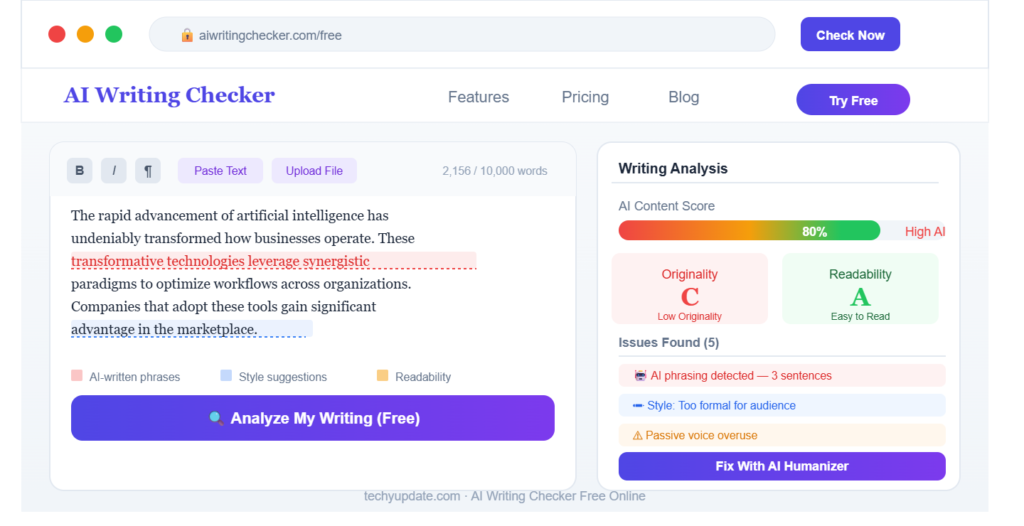
These tools offer several benefits:
- Detect AI-generated writing
- Improve originality
- Protect brand reputation
- Support SEO optimization
- Reduce plagiarism risks
Moreover, free AI checkers help small businesses save money while maintaining high standards.
Content Authenticity Initiative Verification Tool Explained
The Content Authenticity Initiative verification tool focuses on transparency and trust. It helps creators verify the origin of digital content. Furthermore, it protects original work from manipulation or misuse.
This technology supports:
- Digital verification
- Content tracking
- Source authentication
- Media transparency
- Creator protection
As misinformation increases online, authenticity verification becomes essential for publishers and brands.
Why AI Tools Are Essential for Students in 2026
Students today face increasing academic pressure, faster deadlines, and more competitive learning environments. AI tools now assist with brainstorming, grammar improvement, coding support, research summaries, and content optimization. At the same time, educational institutions have become stricter about originality and the ethical use of AI.
This shift has made the best AI content detectors a necessary academic resource rather than an optional tool. Universities use AI plagiarism-detection software to identify machine-generated essays, while students use free AI-detection tools to review their own work before submission.
Modern AI detection tools offer several benefits:
- Verify content originality
- Detect excessive AI-generated phrasing
- Improve writing authenticity
- Reduce plagiarism risks
- Support ethical academic practices
- Enhance credibility in research submissions
For example, a college student using ChatGPT for research notes may accidentally create text that sounds overly robotic. Running the document through a human-written content checker helps refine the language into a more natural style.
Another major reason students rely on free online AI writing checker tools is Google’s evolving content quality standards. Content that lacks originality often performs poorly in search rankings. Learning how to humanize AI-generated writing is now an essential digital skill.
Why Content Authenticity Matters
Search engines and readers value authentic content. Businesses that publish low-quality AI-generated text risk:
- Lower search rankings
- Reduced trust
- Poor engagement
- Higher bounce rates
- Brand reputation damage
Using a professional content authenticity tool helps ensure content meets editorial standards while maintaining originality.
Pro Tip
Use AI as a support system rather than a replacement for critical thinking. The best results happen when students combine AI assistance with personal editing and fact-checking.
Educational institutions are also teaching digital literacy courses that explain the various types of content writing and how AI affects each format differently. From academic writing to technical documentation, students must understand both content creation and verification.
Read More: Best AI Tools for Article Writing Free
Best AI Content Detectors for Accurate Results
Finding the best AI content detectors in 2026 requires evaluating accuracy, pricing, usability, and reporting quality. Many free tools claim high detection rates, but only a few consistently deliver reliable results.
Here are the top-performing tools currently dominating the market. The tool should balance originality with transparency. Human editing remains essential because even advanced humanizers can produce awkward rewrites.
1. GPTZero
GPTZero has become one of the most recognized AI detection tools for educators, publishers, and content managers. It analyzes sentence structure, perplexity, and burstiness to determine whether text was likely written by artificial intelligence.
Key Features
- Deep AI probability analysis
- Sentence-level detection
- Multi-language support
- Batch document scanning
- Integration for schools and businesses
Advantages
- Highly accurate for academic writing
- Easy-to-understand scoring system
- Strong enterprise functionality
Limitations
- Occasional false positives
- Longer texts produce better accuracy than short paragraphs
GPTZero remains a leading solution for identifying ChatGPT-generated content in educational and publishing environments.
2. Originality.ai
Originality.ai is designed specifically for SEO professionals, agencies, and publishers. It combines plagiarism scanning with AI detection in one powerful platform.
Main Benefits
- Detects AI-written text with high precision
- Includes plagiarism scanning
- Supports team collaboration
- Tracks content history
- Optimized for website publishers
Why SEO Experts Prefer It
Search engines increasingly value originality and expertise. Originality.ai helps publishers identify over-automated content before publication, protecting website authority and rankings.
This tool is especially effective for identifying content generated through ChatGPT, Claude, Gemini, and other modern AI systems.
3. Copyleaks AI Detector
Copyleaks has built a strong reputation in the plagiarism-detection industry and now offers advanced AI-powered detection technology.
Features
- AI detection for multiple language models
- Source code analysis
- Enterprise integrations
- LMS compatibility
- Real-time scanning
Best Use Cases
- Universities
- Publishing companies
- Corporate compliance
- Content moderation
Copyleaks delivers highly detailed reports that help users understand why content may appear AI-generated.
4. Writer.com AI Content Detector
Writer.com provides a fast and user-friendly AI detection solution ideal for marketers and businesses.
Highlights
- Free AI detection tool
- Simple interface
- Fast scanning speed
- Browser accessibility
Who Should Use It
- Bloggers
- Freelance writers
- Social media marketers
- Small businesses
Its lightweight structure makes it one of the easiest tools for quick AI checks.
Best Free AI Detector and Humanizer Tools
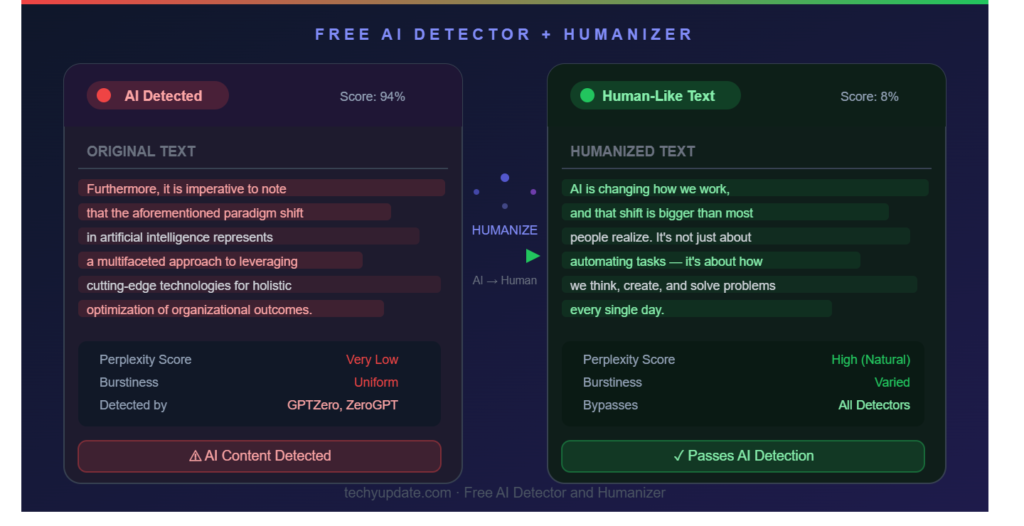
Many users need tools that not only detect AI-generated content but also humanize it for better readability and authenticity.
1. QuillBot Humanizer
QuillBot has expanded beyond paraphrasing into AI humanization and readability improvement.
Benefits
- Rewrites robotic sentences
- Improves flow and tone
- Enhances natural language patterns
- Useful for SEO optimization
Why It Matters
Humanized content performs better for readers because it sounds more conversational and trustworthy.
2. Undetectable AI
Undetectable AI is designed specifically to bypass AI detection while maintaining readability.
Core Features
- AI rewriting engine
- Tone enhancement
- Readability optimization
- Detection scoring
Ideal For
- Bloggers
- Affiliate marketers
- Content agencies
- Students editing AI-assisted drafts
While it should be used ethically, it demonstrates how rapidly AI writing technology is evolving.
3. Humanizer Pro
Humanizer Pro focuses on transforming repetitive AI-generated phrasing into more natural writing.
Strengths
- Removes predictable sentence patterns
- Improves emotional tone
- Supports multiple content formats
- SEO-friendly rewriting
For users who rely heavily on AI-generated drafts, humanization software can significantly improve content quality.
Free AI Detector and Humanizer
A growing number of users want a tool that can both identify AI-generated content and rewrite it into natural human language. This is where a free AI detector and humanizer becomes valuable.
These tools help writers refine robotic text while maintaining meaning and readability. Instead of simply flagging AI content, they provide suggestions to improve sentence flow, tone variation, and emotional authenticity.
Popular free AI detector and humanizer tools include:
- QuillBot
- Undetectable AI
- Humanize AI
- Grammarly AI Rewrite
- Paraphraser.io
Most tools work by restructuring repetitive sentence patterns commonly produced by AI systems.
How Humanizer Tools Work
AI-generated text often contains:
- Predictable sentence structures
- Repetitive transitions
- Overly formal wording
- Lack of emotional nuance
Humanizer tools rewrite these sections into more conversational language.
For example:
AI-generated sentence:
“Artificial intelligence technologies are rapidly transforming educational ecosystems worldwide.”
Humanized version:
“AI tools are quickly changing how students and teachers learn around the world.”
This makes content easier to read and less likely to trigger AI detection tools and accuracy systems.
Important Warning
Humanizer tools should not be used for deceptive purposes. Educational institutions increasingly combine AI detection with manual review. Ethical usage matters more than bypassing systems.
Benefits of Humanizer Tools
- Improve readability
- Enhance engagement
- Reduce robotic phrasing
- Create a conversational tone
- Support SEO optimization
A good content authenticity initiative verification
Free AI Detector Tools Worth Using
Not everyone needs enterprise-level software. Many free tools provide quick and effective detection for daily use.
Top Free AI Detector Platforms
| Tool | Free Version | Best Feature |
| GPTZero | Yes | Academic accuracy |
| Writer.com | Yes | Fast detection |
| Sapling AI Detector | Yes | Clean interface |
| ZeroGPT | Yes | Multi-language support |
| Copyleaks | Limited | Detailed analysis |
These free AI detector tools are suitable for bloggers, teachers, freelancers, and students.
AI Content Detector ChatGPT Plagiarism Checker
AI-generated content and plagiarism are not the same. A text can be original yet still written by AI. That is why modern platforms combine both AI detection and plagiarism scanning.
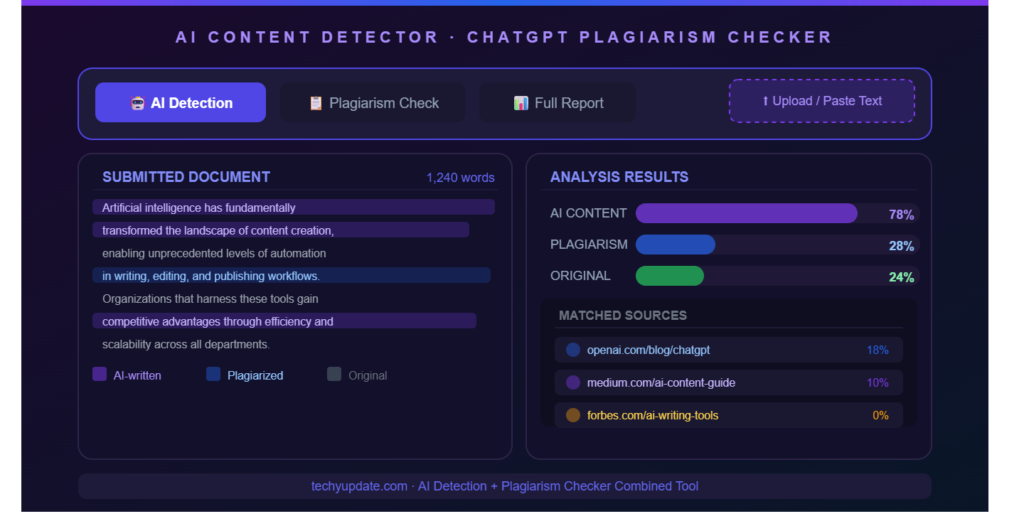
How Combined Detection Works
Modern systems analyze:
- Writing patterns
- Predictability scores
- Semantic repetition
- Source duplication
- Linguistic probability
This dual-layer approach ensures that both copied content and machine-generated text can be identified accurately.
How AI Detectors Actually Work
AI detectors rely on statistical models that compare text against patterns common in machine-generated writing.
Main Detection Factors
1. Perplexity
Measures how predictable the text appears. AI-generated content often follows highly predictable patterns.
2. Burstiness
Evaluates sentence variation. Human writing naturally alternates between short and long sentence structures.
3. Repetition Analysis
AI models sometimes repeat phrases, structures, or ideas unnaturally.
4. Semantic Probability
Detection systems evaluate the likelihood of specific word combinations using machine-learning datasets.
No detector is perfect, but combining multiple indicators significantly improves accuracy.
Best Practices for Creating Human-Like Content
Even when using AI writing tools, content should always be edited carefully.
Effective Strategies
- Add personal insights
- Include real-world examples
- Use varied sentence lengths
- Avoid repetitive phrasing
- Add expert commentary
- Improve emotional tone
- Verify factual accuracy
Human editing remains essential for creating trustworthy and engaging content.
SEO Benefits of Humanized AI Content
Search engines increasingly evaluate:
- Content originality
- Reader engagement
- Trustworthiness
- Expertise signals
- Content depth
Humanized content improves:
- Dwell time
- User experience
- Click-through rates
- Conversion performance
- Organic rankings
High-quality human editing can transform AI-assisted drafts into authoritative content that performs well in search results.
Choosing the Right AI Detector
The best AI content detector depends on your goals.
For Students
- GPTZero
- Copyleaks
For Bloggers
- Originality.ai
- Writer.com
For SEO Agencies
- Originality.ai
- Copyleaks
For Businesses
- Grammarly
- Writer.com
For Humanizing Content
- QuillBot
- Undetectable AI
Selecting the right tool ensures better content quality and improved workflow efficiency.
AI Detector Studying and Research
Research and academic writing now heavily depend on verification systems. The best AI content detectors support students by helping them maintain originality and avoid accidental overreliance on AI-generated content.
Modern research workflows often involve:
- AI-generated summaries
- Research assistants
- Citation generators
- Grammar enhancement tools
- Content drafting systems
While these technologies improve productivity, they also increase the risk of submitting low-authenticity work.
How Students Use AI Detection in Research
Students commonly use AI writing checker platforms for:
- Checking essays before submission
- Reviewing paraphrased content
- Validating citations
- Improving writing authenticity
- Identifying robotic language
A medical student, for instance, may use AI to summarize scientific studies. Running the final draft through a chatbot detector helps ensure the paper sounds natural.
Benefits for Researchers
Researchers and graduate students use content authenticity tools to:
- Preserve academic credibility
- Avoid publication rejection
- Maintain editorial standards
- Verify collaborative writing
Some journals now require AI disclosure policies for submitted work.
AI Detection and Critical Thinking
Students should understand that AI detectors are not perfect. False positives still occur, especially with formal academic language.
To reduce risk:
- Add personal insights
- Use varied sentence lengths
- Include real examples
- Edit repetitive structures
- Avoid excessive paraphrasing
High-Authority References
Organizations such as OpenAI and Google continue to develop AI transparency frameworks that influence the development of detection technologies.
Pro Tip
Always combine AI detection with manual proofreading. Human review catches context issues that software often misses.
Best ChatGPT Detector Tools in 2026
1. GPTZero
GPTZero is one of the most trusted AI detection platforms for educators and publishers.
Features
- ChatGPT detection
- Sentence-level analysis
- Detailed AI probability reports
- Batch scanning
Why It Stands Out
Its advanced perplexity analysis makes it highly effective at detecting AI-generated academic writing.
2. Originality.ai
SEO agencies and professional publishers widely use Originality.ai.
Key Benefits
- AI detection
- AI plagiarism detection
- Team collaboration
- Website content scanning
Best For
- Bloggers
- Affiliate marketers
- Content agencies
- SEO professionals
This platform is particularly strong at identifying AI-generated website content.
3. Copyleaks AI Detector
Copyleaks combines plagiarism checking with AI analysis.
Advantages
- Multi-language support
- Enterprise integrations
- Educational tools
- API access
Ideal Users
- Universities
- Businesses
- Publishers
Copyleaks is considered one of the most reliable content authenticity tool solutions available today.
4. Writer.com AI Writing Checker
Writer.com offers a lightweight and user-friendly AI writing checker.
Features
- Free AI content analysis
- Fast scanning
- Simple interface
- Browser-based tool
It works well for quick AI content reviews and everyday writing checks.
Best Human-Written Content Checker Tools
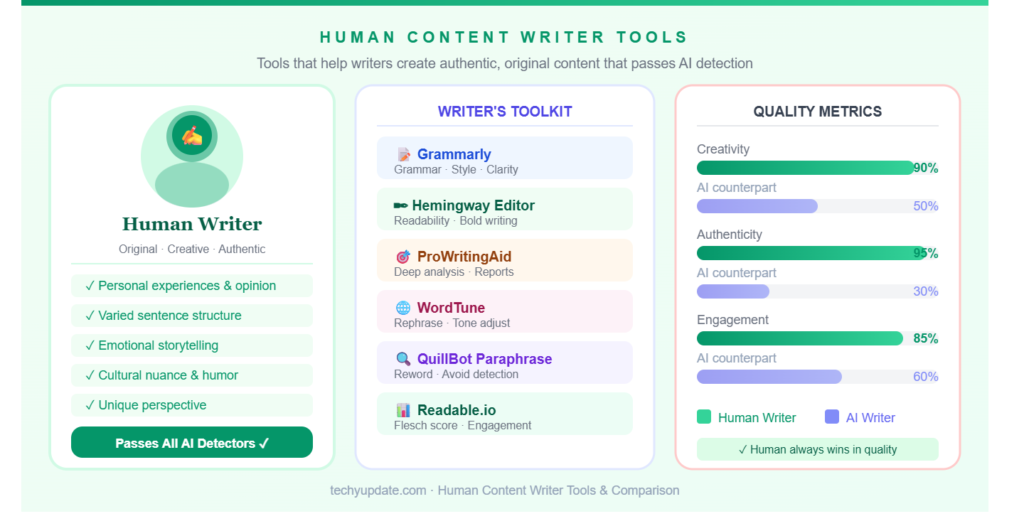
1. Grammarly
Originally known for grammar correction, Grammarly now includes plagiarism and AI analysis features.
Benefits
- Writing enhancement
- Tone analysis
- Clarity suggestions
- AI assistance
Grammarly helps improve readability while supporting content authenticity.
2. QuillBot Humanizer
QuillBot focuses on rewriting robotic AI-generated text into more natural human language.
Strengths
- Improved sentence flow
- Natural phrasing
- Better readability
- SEO-friendly rewriting
This tool is highly useful for creators who use AI-assisted drafts but want authentic final content.
3. Undetectable AI
Undetectable AI is designed to reduce AI detection scores by humanizing generated content.
Features
- AI rewriting
- Tone adjustment
- Natural language optimization
- Readability improvements
It is popular among bloggers and marketers seeking more natural writing patterns.
Plagiarism Checker Grammarly and AI Detection
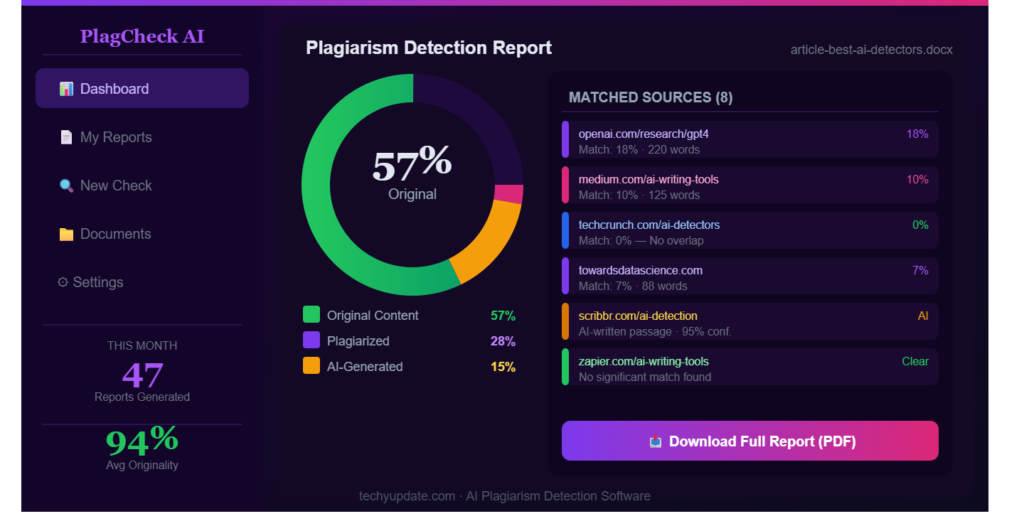
Can Grammarly Detect AI Content?
Grammarly has expanded its capabilities with AI writing assistance and content analysis tools. While Grammarly originally focused on grammar correction and plagiarism checking, it now includes AI detection features for premium users.
Grammarly Features
- Grammar correction
- Tone analysis
- Plagiarism detection
- AI writing assistance
- Clarity optimization
Advantages
- Excellent writing improvement tools
- Trusted by professionals
- Easy browser integration
Limitations
- AI detection is still evolving
- Less specialized than dedicated AI detector platforms
For users seeking a complete writing assistant, Grammarly remains one of the most valuable tools available.
AI Writing Checker vs AI Plagiarism Detection
Many people confuse AI detection with plagiarism detection, but they are different technologies.
| Feature | AI Writing Checker | AI Plagiarism Detection |
| Detects AI-generated writing | Yes | Sometimes |
| Detects copied content | No | Yes |
| Analyzes writing patterns | Yes | Limited |
| Compares external sources | No | Yes |
| Measures originality | Partial | Full |
Modern platforms increasingly combine both technologies for more comprehensive analysis.
AI Detection Tools Accuracy: Best ChatGPT Detector and AI Writing Checker Guide
Artificial intelligence has transformed online content creation, making AI-generated articles, blogs, emails, and academic papers more common than ever before. As a result, businesses, teachers, publishers, and marketers now rely heavily on advanced AI detection tools to verify whether content was written by humans or generated using AI systems like ChatGPT.
Modern ChatGPT detectors use machine learning, linguistic analysis, and probabilistic scoring to identify patterns of AI-generated text. At the same time, advanced AI writing checker platforms help maintain originality, protect brand credibility, and improve content quality.
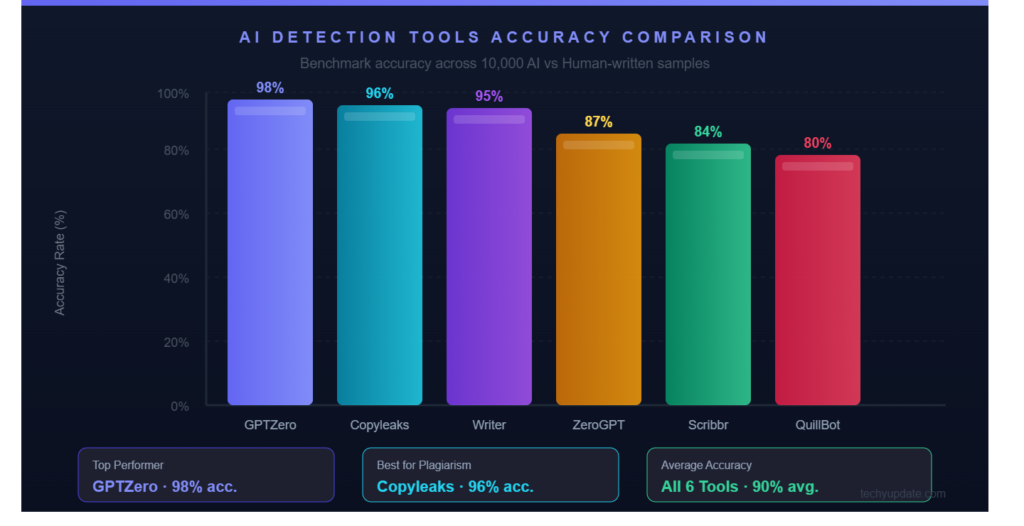
How Accurate Are AI Detection Tools?
The accuracy of AI detection tools depends on:
- The sophistication of the AI model
- Text length
- Writing complexity
- Human editing
- Detection algorithms
Most premium AI detection systems claim accuracy rates between 80% and 98%. However, no detector is completely perfect because AI writing models continuously evolve.
Main Factors Affecting AI Detection Accuracy
1. Perplexity Analysis
AI-generated text often follows highly predictable language patterns. Detection tools evaluate how predictable the writing appears.
2. Burstiness Evaluation
Human writing naturally varies in sentence length and structure, while AI-generated content may appear more uniform.
3. Contextual Understanding
Advanced systems analyze tone, semantics, and logical consistency to determine authenticity.
4. Editing and Humanization
Heavily edited AI content becomes more difficult to detect accurately.
Despite technological improvements, false positives and false negatives can still occur.
How AI Plagiarism Detection Works
AI plagiarism detection tools combine traditional plagiarism scanning with AI analysis.
Detection Methods Include
- Database comparison
- Semantic analysis
- Sentence structure evaluation
- Source matching
- Pattern recognition
These systems help identify copied content and detect AI-generated writing characteristics.
Human Content Writer Tools for Better Authenticity
Writers increasingly use AI-assisted platforms alongside human editing tools.
Popular Human Content Writer Tools
- Grammarly
- Hemingway Editor
- QuillBot
- Jasper AI
- Copy.ai
- Writesonic
The best results often come from combining AI assistance with careful human editing and expert insights.
How to Make AI Content Sound More Human
Even the best AI-generated content benefits from manual editing.
Best Practices
- Add personal experiences
- Use varied sentence lengths
- Include emotional language
- Add expert opinions
- Avoid repetitive phrasing
- Improve transitions
- Fact-check all information
Humanized content performs better for both SEO and reader engagement.
SEO Impact of AI Detection
Search engines increasingly prioritize:
- Helpful content
- User experience
- Expertise
- Originality
- Trustworthiness
Websites filled with low-quality automated content may struggle to rank competitively.
Using a reliable AI writing checker helps publishers maintain high editorial standards and stronger SEO performance.
Best AI Plagiarism Detection Software
Traditional plagiarism checkers compare copied text across websites and databases. However, modern AI plagiarism detection software goes much deeper. These tools detect both copied content and AI-generated writing patterns.
Top AI plagiarism tools include:
- Grammarly
- Copyleaks
- Turnitin
- Originality.ai
- Quetext
These platforms help writers maintain unique and trustworthy content. Additionally, they improve website credibility and reader confidence.
How AI Detection Tools Work
AI detection software uses machine learning algorithms. These systems analyze writing style and probability patterns. Human writing usually contains natural variation. In contrast, AI-generated text often appears predictable.
Detection tools examine:
- Sentence complexity
- Repetitive phrases
- Word probability
- Burstiness
- Contextual flow
Consequently, advanced systems can estimate whether the content was created by humans or AI.
How Many Types of Content Writing Are There?
Content writing includes many specialized categories. Each type serves a different audience and purpose. Therefore, professional writers often focus on specific content formats.
The most common types include:
- SEO writing
- Blog writing
- Copywriting
- Technical writing
- Social media writing
- Email marketing content
- Script writing
- Product descriptions
- Academic writing
- News writing
Every content style requires unique skills and strategies.
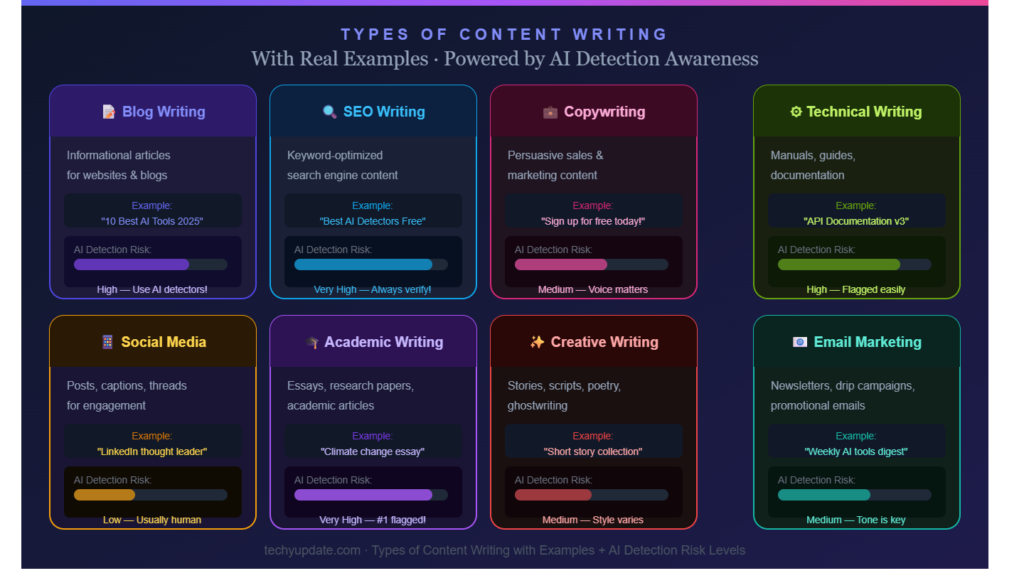
Types of Content Writing With Examples
SEO Content Writing
SEO writers create optimized articles for search engines. For example, blog posts targeting keywords improve organic traffic.
Copywriting
Copywriting focuses on persuasion and sales. Landing pages and advertisements are strong examples.
Technical Writing
Technical writers explain complex information clearly. User manuals and software guides fit this category.
Social Media Content
Social media writers create short and engaging posts. Instagram captions and LinkedIn updates are common examples.
Email Marketing Writing
Email writers create promotional campaigns and newsletters. These messages encourage customer engagement and conversions.
Product Description Writing
E-commerce businesses need detailed product descriptions. Strong descriptions improve sales and customer trust.
Academic Writing
Academic writers produce essays, research papers, and case studies. This content requires accuracy and formal structure.
Benefits of Human-Written Content
Human-written content still offers major advantages. Readers connect better with emotional and natural writing. In addition, search engines prefer helpful and authentic information.
Human content provides:
- Better engagement
- Emotional depth
- Natural storytelling
- Improved trust
- Stronger brand voice
Therefore, many businesses combine AI tools with human editing for the best results.
How to Improve AI-Generated Content
AI writing tools can save time. However, human editing remains essential. Writers should always carefully review and improve AI-generated drafts.
Here are effective improvement methods:
- Add personal insights
- Use natural transitions
- Shorten long sentences
- Remove repetitive phrases
- Include real examples
- Improve readability
As a result, the final content feels more authentic and engaging.
Choosing the Best AI Writing Checker
The ideal AI writing checker depends on your needs. Bloggers often prefer SEO-focused tools. Meanwhile, educators usually need academic verification systems.
Consider these factors:
- Accuracy
- Speed
- Ease of use
- Plagiarism support
- Pricing
- Reporting features
Reliable software helps maintain quality and protect content integrity.
Content Authenticity Initiative Verification Tool Explained
The Content Authenticity Initiative Verification Tool is a modern digital verification system designed to confirm the authenticity and origin of online content. It helps users identify whether images, videos, documents, or media files are original, edited, AI-generated, or manipulated.
This technology is based on the C2PA Standard and supported by the Coalition for Content Provenance and Authenticity (C2PA). Major technology companies, publishers, and media organizations now use this system to improve transparency and digital trust.
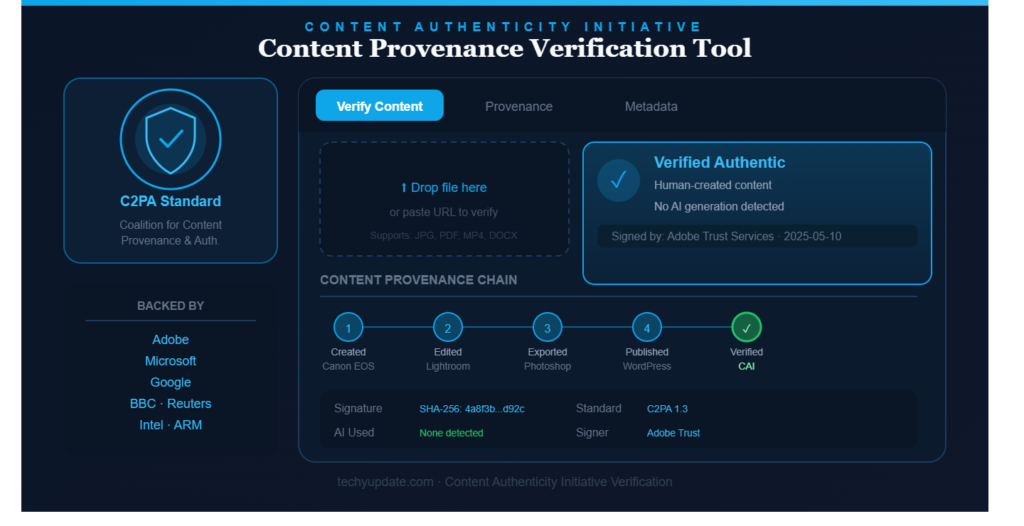
What Is the Content Authenticity Initiative?
The Content Authenticity Initiative (CAI) is a global effort that promotes secure and transparent verification of digital content. Its goal is to help users understand:
- Who created the content
- When the content was created
- What edits were made
- Whether AI tools were used
- If the file has been altered
This initiative reduces misinformation, fake media, and unauthorized AI-generated content online.
What Is the C2PA Standard?
The C2PA Standard stands for the Coalition for Content Provenance and Authenticity. It creates a universal framework for verifying digital content.
The system attaches secure metadata to files such as:
- JPG images
- PDF documents
- MP4 videos
- DOCX files
This metadata records the complete provenance chain of the content.
How the Provenance Verification Tool Works
The verification tool scans uploaded files or URLs and analyzes embedded authenticity metadata. It then displays a detailed provenance history.
Example Provenance Chain
- Created — Canon EOS camera
- Edited — Lightroom
- Exported — Photoshop
- Published — WordPress
- Verified — CAI Signature
This chain helps users track every stage of the content lifecycle.
Key Features of Content Provenance Verification
Verified Authentic Badge
The system can confirm whether content appears authentic and human-created.
Verification Details Include
- Human-created content status
- AI generation detection
- Digital signatures
- Content hash verification
- Timestamp validation
- Provenance metadata
What Is Content Provenance?
Content provenance refers to the history and origin of digital content. It explains:
- Where the content came from
- Who modified it
- Which software was used
- Whether AI participated in creation
Provenance improves transparency and helps fight misinformation.
What Is Metadata in Content Verification?
Metadata is hidden information stored inside digital files. The verification tool reads this metadata to validate authenticity.
Common Metadata Includes
- Device information
- Editing software
- Creation date
- File history
- Digital signatures
- AI generation indicators
This information creates a trusted record of the content journey.
AI Detection and Human-Created Verification
Modern verification tools can identify whether AI systems participated in content creation.
Verification Results May Show
- No AI generation detected
- AI-assisted editing detected
- Fully AI-generated content
- Unknown authenticity status
This helps publishers and readers distinguish between authentic human content and synthetic media.
SHA-256 Signature Verification
The system uses SHA-256 cryptographic hashing to protect content integrity.
Benefits of SHA-256
- Prevents unauthorized modification
- Confirms file authenticity
- Detects tampering
- Supports secure digital verification
Even a tiny change to a file creates a completely different hash signature.
Major Companies Supporting CAI and C2PA
Several global organizations support the initiative, including:
- Adobe
- Microsoft
- BBC
- Reuters
- Intel
- ARM
These companies collaborate to create safer and more transparent digital ecosystems.
Why Content Authenticity Verification Matters
Digital misinformation is increasing rapidly. AI-generated images, deepfakes, and manipulated media can quickly spread false information.
The Content Authenticity Initiative helps:
- Protect journalists
- Verify news media
- Reduce fake content
- Improve public trust
- Support creators
- Enhance transparency
As AI technology evolves, provenance verification becomes even more important.
Supported File Formats
Most verification tools support:
- JPG
- PNG
- MP4
- DOCX
Users can upload files directly or paste URLs for analysis.
Benefits for Content Creators
Content creators benefit from authenticity verification because it:
- Protects ownership
- Builds audience trust
- Verifies original work
- Reduces copyright disputes
- Supports ethical publishing
Verified provenance also improves credibility for photographers, journalists, and brands.
Productivity and Time Management
One reason students and professionals love AI tools is the dramatic boost in productivity. However, smart productivity requires a balance between automation and authenticity. The best AI content detectors help maintain this balance.
Students today manage:
- Online classes
- Research projects
- Side hustles
- Freelance work
- Social media responsibilities
AI writing tools reduce drafting time, while free AI detector systems verify the quality of the final output.
Time-Saving Workflow
A practical workflow might look like this:
- Brainstorm ideas using AI
- Draft rough content
- Edit manually
- Run through an AI writing checker
- Humanize robotic sections
- Proofread final draft
This approach improves efficiency without sacrificing originality.
Why Productivity Matters
Students using AI responsibly often:
- Finish assignments faster
- Improve writing confidence
- Reduce editing stress
- Learn content structuring
- Enhance SEO understanding
For bloggers and freelancers, AI plagiarism-detection software helps avoid duplicate-content penalties that could harm search rankings.
Productivity Tools That Pair Well with AI Detectors
- Notion
- Grammarly
- ChatGPT
- Jasper AI
- Google Docs
- Trello
When paired with a content authenticity tool, these platforms create a powerful digital workflow.
Common Productivity Mistake
Many users rely too heavily on AI-generated drafts without personal editing. This often results in bland, repetitive content that lacks personality and fails AI detection reviews.
Coding and Technical Skill
AI detectors are no longer limited to essays and blogs. Developers now use the best AI content detectors to review coding documentation, technical articles, and AI-assisted programming outputs.
Coding students frequently use AI for:
- Debugging support
- Syntax explanations
- Documentation writing
- Code generation
- Technical tutorials
However, AI-generated technical explanations often contain inaccuracies or generic phrasing.
AI Detection in Technical Writing
Technical documentation requires:
- Clear explanations
- Accurate terminology
- Human readability
- Logical flow
An AI writing checker, a free online tool, helps developers identify robotic descriptions before publishing tutorials or GitHub documentation.
Why Human Editing Matters in Coding Content
AI-generated coding explanations sometimes:
- Oversimplify complex concepts
- Repeat keywords unnaturally
- Misinterpret programming logic
- Produce outdated examples
Human review ensures technical correctness.
Best Practices for Developers
- Verify all generated code manually
- Add personal coding experience
- Include real troubleshooting examples
- Use a conversational teaching style
- Check the documentation’s originality
For example, a student writing a Python tutorial can use a free AI detector and humanizer to improve the clarity of explanations while preserving technical accuracy.
Types of Content Writing with Examples
Technical writing is just one content category. Other major types include:
- Blog writing
- Copywriting
- Academic writing
- SEO content writing
- Social media writing
- Email marketing
- Script writing
Understanding the types of content writing helps students adapt AI tools appropriately for each format.
Pro Tips to Maximize AI Detector
Using the best AI content detectors effectively requires more than simply copying and pasting text into a scanner. Strategic usage improves both writing quality and authenticity.
Pro Tips Box
1. Write First, Detect Later
Start with your own ideas before involving AI tools. Original thinking naturally improves authenticity scores.
2. Mix Sentence Lengths
AI often generates predictable structures. Combining short and long sentences creates a more human-like rhythm.
3. Add Personal Experience
Real-life examples dramatically improve content credibility and reduce robotic tone.
4. Use Manual Editing
Never rely solely on humanizer tools. Human editing remains the most reliable method for ensuring authenticity.
5. Fact-Check Everything
AI systems sometimes generate incorrect information. Verify statistics, quotes, and references before publishing.
6. Avoid Keyword Stuffing
Overusing phrases like best AI content detectors can reduce readability and hurt SEO performance.
7. Focus on Value
Google prioritizes helpful, experience-driven content over generic AI-generated articles.
Best Workflow for Students
- Draft ideas manually
- Use AI for structure support
- Add personal examples
- Run AI detection scan
- Humanize awkward sections
- Final proofread
Expert Observation
Students who treat AI as a collaborative assistant rather than a replacement consistently produce higher-quality content.
Common Mistakes Students Make with AI Detector
Although AI tools are useful, many students misuse them. Understanding these mistakes helps improve both academic integrity and writing quality.
Relying Entirely on AI
One of the biggest problems is submitting fully AI-generated assignments without editing. Most advanced AI plagiarism detection systems easily identify repetitive AI writing patterns.
Ignoring False Positives
AI detectors are not always accurate. Formal academic writing sometimes triggers false AI scores. Students should review flagged sections carefully instead of panicking.
Overusing Humanizers
Some users aggressively rewrite content using multiple humanizer tools. This often creates unnatural grammar and confusing sentence flow.
Keyword Manipulation
Overusing terms like “ChatGPT detector” or “AI writing checker” can damage readability and SEO quality.
Skipping Manual Review
Even the best content authenticity tool cannot replace human judgment. Students should always proofread for logic, tone, and clarity.
Common Signs of Poor AI Content
- Repetitive phrasing
- Generic examples
- Overly formal wording
- Lack of emotional depth
- Predictable transitions
Practical Advice
To avoid these issues:
- Add personal observations
- Use natural language
- Include case studies
- Edit for clarity
- Read content aloud
Image Placement Suggestion
- Chart showing common AI writing mistakes
- ALT text: “Common mistakes students make with AI detector tools.”
Expert Insights on Free AI Detector Learning Trends
Experts predict that AI literacy will become a core educational skill over the next few years. The future is not about banning AI but learning how to use it responsibly.
The best AI content detectors are evolving beyond simple probability scoring. Future systems may analyze:
- Writing history
- Contextual consistency
- Research methodology
- User intent
- Source transparency
Current Trends in AI Detection
Hybrid Detection Models
Modern platforms combine:
- AI pattern recognition
- Plagiarism scanning
- Writing style analysis
- Behavioral indicators
Ethical AI Policies
Schools are increasingly requiring students to disclose their use of AI rather than hide it.
Human-AI Collaboration
Experts encourage balanced collaboration in which AI assists with brainstorming, but humans remain responsible for the final output.
Industry Insight
SEO professionals now prioritize content authenticity more than ever. Search engines reward:
- Original experiences
- Expert insights
- First-hand examples
- Trustworthy information
This aligns with Google’s E-E-A-T framework.
Future of AI Writing Education
Educational systems may soon teach:
- AI-assisted research
- Ethical prompt engineering
- AI content verification
- Human editing strategies
- Digital authenticity practices
Students who learn these skills early will gain a major competitive advantage in both academics and careers.
High-Authority Mentions
Organizations such as the Content Authenticity Initiative continue to develop verification standards for digital publishing ecosystems.
Quick Summary
AI writing tools are now deeply integrated into education, blogging, research, and technical content creation. However, authenticity remains critical for academic integrity, SEO success, and reader trust.
The best AI content detectors help users:
- Verify originality
- Improve writing quality
- Detect AI-generated patterns
- Enhance human readability
- Maintain ethical standards
Top free tools like GPTZero, Copyleaks, Writer.com, and Winston AI provide excellent starting points for students and beginners. Pairing these with a free AI detector and humanizer creates a balanced workflow that improves both productivity and authenticity.
The key takeaway is simple: AI should enhance human creativity, not replace it. Writers who combine AI assistance with personal expertise, editing, and critical thinking will continue producing the highest-performing content in 2026 and beyond.
Conclusion
The demand for reliable AI detection tools’ accuracy continues to grow as AI-generated content becomes more widespread across the internet. Whether you need a professional ChatGPT detector, a powerful AI writing checker, or a complete content authenticity tool, choosing the right platform is essential for maintaining originality and trust.
Modern AI plagiarism-detection systems and human-written content-checker tools help businesses, educators, bloggers, and publishers protect content quality while improving SEO performance. Combining AI assistance with human creativity remains the most effective strategy for producing engaging, trustworthy, and high-ranking content in 2026.
AI-generated content continues growing across the digital world. Therefore, reliable detection tools have become essential. A powerful ChatGPT AI content detector accurately identifies machine-written text. Likewise, an effective free online AI writing checker improves originality and trust.
Modern Content Authenticity Initiative verification tool systems also support transparency and digital security. Additionally, advanced AI plagiarism detection software protects businesses, publishers, and students from duplicate or low-quality content.
Understanding the different types of content writing with examples helps writers create better material for every audience. Combining AI assistance with human creativity remains the best strategy for producing high-quality and SEO-friendly content today.
AI-generated writing has permanently changed digital publishing, but content quality and originality remain critical for long-term success. The best AI content detectors help businesses, educators, and creators maintain trust, improve SEO performance, and protect content integrity.
Whether you need a free AI detector, an advanced AI content detector, a ChatGPT plagiarism checker, or a reliable plagiarism checker Grammarly alternative, the right solution depends on your specific goals. Combining AI detection with strong human editing ensures content remains natural, authoritative, and optimized for both readers and search engines.
FAQ Section
Which AI detector is best for students?
For students, GPTZero is often considered one of the best options because it offers:
- Free access
- Academic-focused analysis
- Sentence highlighting
- Easy-to-read reports
Turnitin is also widely used in universities, although institutions usually provide access rather than individual users. Copyleaks is another strong option for academic environments.
What is the best free AI content detector?
The best free AI content detector depends on your needs. However, popular options include GPTZero, ZeroGPT, and Copyleaks.
GPTZero is widely preferred for academic writing because it provides detailed sentence-level analysis. Meanwhile, ZeroGPT offers unlimited free scans, making it convenient for quick checks. Independent testing in 2026 showed that GPTZero generally performs better in terms of accuracy, while ZeroGPT is better for unlimited usage.
How can I check if content is AI-generated for free?
You can check AI-generated content for free using tools such as:
- GPTZero
- ZeroGPT
- QuillBot AI Detector
- Writer AI Detector
Paste your text into the detector and review the AI probability score. For greater accuracy, compare results from multiple tools rather than relying on a single detector.
Are free AI detector tools accurate?
Free AI detector tools can provide useful estimates, but they are not always 100% accurate. Most platforms perform best when combined with human proofreading and manual content review.
How accurate are AI content detectors?
AI content detectors are improving rapidly, but they are not perfect. Most advanced tools report accuracy rates between 80% and 95%. However, results vary depending on:
- Content length
- Writing style
- Human editing
- AI model used
- Detection algorithm
Studies and benchmark tests show that false positives still occur, especially with formal or non-native English writing. Therefore, AI detection results should be treated as indicators rather than absolute proof.
What is the difference between plagiarism checkers and AI detectors?
Plagiarism checkers and AI detectors serve different purposes.
| Feature | Plagiarism Checker | AI Detector |
| Detects copied text | Yes | No |
| Detects AI-generated text | Limited | Yes |
| Compares internet sources | Yes | No |
| Analyzes writing patterns | Limited | Yes |
| Measures originality | Yes | Partial |
Plagiarism tools identify duplicated content from websites or databases. In contrast, AI detectors analyze writing style and probability patterns to estimate whether the text was generated by AI.
What is a free AI detector and humanizer?
A free AI detector and humanizer is a tool that both identifies AI-generated text and rewrites it into more natural human language. These platforms help improve readability and reduce robotic phrasing.
Can AI-generated content bypass AI detectors?
Yes, AI-generated content can sometimes bypass detection systems, especially after human editing or humanization. Modern AI humanizer tools adjust:
- Sentence rhythm
- Word choice
- Writing flow
- Structural variation
As AI writing models become more advanced, detectors struggle more with identifying highly edited content. Recent testing showed that some humanized AI texts successfully bypassed popular detectors such as GPTZero and ZeroGPT.
Can AI detectors identify ChatGPT content?
Yes, many modern chart detector tools analyze sentence patterns, predictability, and language structures commonly associated with AI-generated writing.
Is GPTZero better than ZeroGPT?
In most independent comparisons, GPTZero performs better in terms of detection accuracy. It provides:
- More detailed analysis
- Better sentence-level reporting
- Lower false positives
- Stronger academic features
However, ZeroGPT remains popular because it offers unlimited free scans and supports many languages. Users who need quick, free checks may prefer ZeroGPT, while students and educators often choose GPTZero for greater reliability.
Are free AI detection tools reliable?
Free AI detection tools can be useful for basic checks, but reliability varies greatly. Some free tools perform surprisingly well, while others produce frequent false positives or inconsistent results.
For casual use, free tools are usually sufficient. However, schools, publishers, and businesses often prefer premium detectors because they provide:
- Better accuracy
- Detailed reporting
- Lower false positive rates
- Team collaboration features
Independent reviews show that some free detectors still achieve respectable performance levels.
Do AI detectors work for students?
Yes. Students use AI detectors to check essays, research papers, assignments, and reports before submission. These tools help improve authenticity and reduce concerns about plagiarism.
Are AI content detectors useful for SEO?
Absolutely. Search engines increasingly prioritize original and trustworthy content. Using AI writing checker systems helps publishers improve content quality and maintain SEO credibility.
What causes false positives in AI detection?
False positives often occur when writing is overly formal, repetitive, or highly structured. Academic papers sometimes trigger AI detection even when written by humans.
Can humanizer tools bypass AI detectors?
Some humanizer tools reduce AI detection scores, but no method guarantees complete invisibility. Ethical usage and manual editing remain the best approach.
Can AI detectors identify ChatGPT-written content?
Yes, many AI detectors can identify ChatGPT-generated content. Tools such as GPTZero, Originality.ai, and Copyleaks analyze sentence predictability, writing patterns, and linguistic structures commonly found in AI-generated text.
However, detection becomes harder when:
- Humans heavily edit the content
- AI-generated text is rewritten
- Humanizer tools modify the output
Recent reports suggest GPTZero remains one of the strongest tools for identifying ChatGPT-written content.
Which AI detector is best for bloggers?
Originality.ai and Copyleaks are popular among bloggers because they combine AI detection, plagiarism analysis, and SEO-focused reporting.
Why do AI detectors sometimes show false positives?
False positives happen when detectors incorrectly label human-written content as AI-generated. This usually occurs because some human writing styles resemble AI patterns.
Common causes include:
- Repetitive sentence structures
- Formal academic writing
- Predictable wording
- Non-native English writing
- Overly polished grammar
Researchers continue improving AI detection systems, but false positives remain a major concern in education and publishing.
How can students write more naturally?
Students can improve natural writing by adding personal experiences, varying sentence structure, using conversational language, and manually editing AI-generated drafts.