

Artificial intelligence will have fundamentally transformed article writing and content creation. Bloggers, marketers, students, agencies, and businesses now utilize AI tools to increase efficiency, enhance quality, and reduce hiring costs. Contemporary AI platforms can rapidly generate blog posts, SEO articles, emails, social media captions, product descriptions, and long-form research content.
Recent industry reports indicate that AI writing software has reached unprecedented popularity within the content sector. Millions of users rely on free AI tools daily for brainstorming, editing, outlining, and drafting. Platforms such as ChatGPT, Claude, Gemini, and Rytr have become essential for digital productivity and time efficiency.
The primary advantage of these tools is their accessibility. Historically, only large companies or agencies could afford professional writing support. Currently, many leading AI writing tools offer free plans, enabling a broad range of users to produce high-quality content at minimal cost. This guide reviews the best free AI article-writing tools available in 2026, their features, and their impact on digital publishing.
The Rise of AI Article Writing
Artificial intelligence now drives digital publishing. In the past, content creation required large editorial teams, costly freelancers, and significant time for research and editing. AI writing platforms can now draft articles, enhance headlines, improve readability, and generate SEO-friendly content within minutes. This increased efficiency has transformed online publishing.
With rising content demands, more businesses are adopting AI writing systems. Websites require regular blog updates, online stores need product descriptions, and agencies manage extensive content calendars. AI tools address these needs efficiently and cost-effectively. Experts identify ChatGPT, Claude, and Gemini as the most popular free AI writing tools due to their flexibility and content quality.
Free AI tools have democratized content creation. Small businesses and independent bloggers can now compete with larger organizations by producing professional articles using free platforms. Students organize essays, marketers generate advertisements rapidly, and entrepreneurs build websites without advanced writing skills. These advancements lower barriers to entry and accelerate skill development. AI supports, rather than replaces, human creativity: writers contribute ideas, strategy, tone, and originality, while AI assists with drafting and editing. Analogous to musicians utilizing software to streamline music production, writers leverage AI to enhance efficiency while retaining creative control.
READ MORE: Best Free AI Tools for Students
What Makes a Great AI Writing Tool?
AI writing tools vary significantly in quality. Some generate rigid, robotic text, while others produce natural, well-organized content. The leading AI writing platforms in 2026 are characterized by speed, user-friendliness, SEO support, and contextual awareness. The optimal tool depends on specific writing goals, content requirements, and workflow preferences.
Speed is a critical factor in selecting an AI writing tool. Writers prefer platforms that rapidly generate outlines, introductions, product descriptions, and long-form articles. Slow tools disrupt workflow and reduce productivity. Leading AI tools such as ChatGPT and Claude provide fast performance and conversational editing, enabling incremental improvements rather than relying on rigid templates.
SEO optimization is essential. Many AI writing tools enhance readability, keyword usage, headings, and engagement. Effective SEO now prioritizes readability, relevance, and user experience rather than keyword density alone. AI platforms that balance these elements offer bloggers and marketers a significant advantage in search rankings.
Usability is equally important as the feature set. Complex interfaces can hinder productivity and discourage new users. The most effective free AI writing platforms provide intuitive dashboards, straightforward editing, and flexible options. Many integrate directly with Google Docs, Microsoft Word, browsers, and content management systems, ensuring seamless workflow integration.
Accessibility further distinguishes leading AI tools. Free plans that permit daily use are preferable to limited trials. Users seek reliable, unrestricted tools rather than temporary demonstrations with significant limitations.
Best Free AI Writing Tools
ChatGPT Free
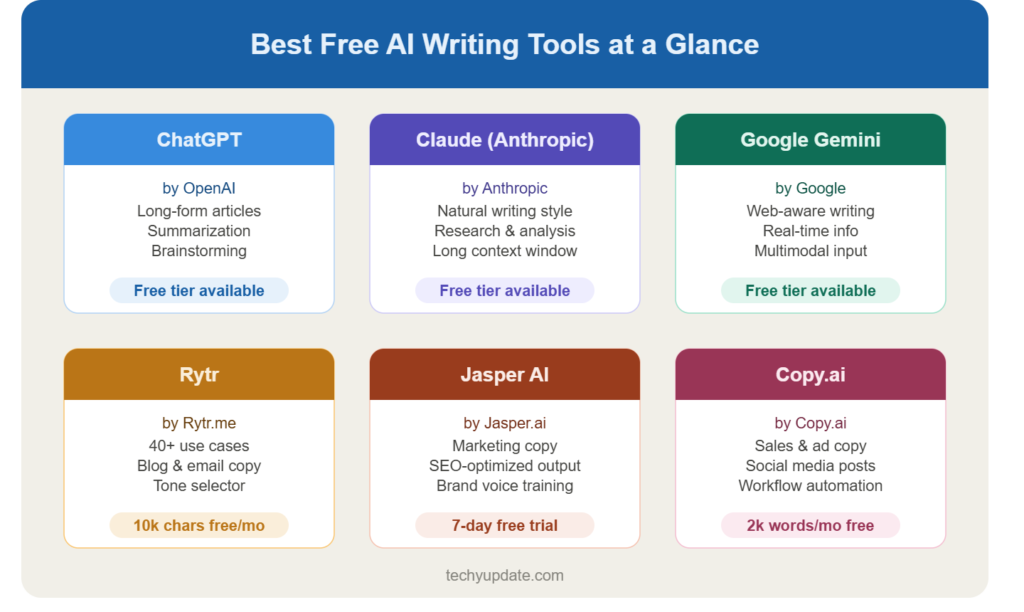
ChatGPT remains the most popular free AI writing tool in 2026 due to its versatility and conversational interface. Free users now access GPT-4o, including browsing, file uploads, and content editing support. Writers can generate blog posts, rewrite paragraphs, brainstorm ideas, summarize research, and optimize SEO content through simple prompts.
One major advantage of ChatGPT is its flexibility. It works well for long-form blogging, marketing copy, social media captions, creative storytelling, and technical writing. Unlike rigid template-based systems, ChatGPT enables dynamic conversation-style editing, allowing users to refine outputs step by step. This creates a more collaborative writing experience that feels closer to working with a real editor.
The free version includes usage limits during peak traffic periods, but remains one of the strongest free AI writing options available.
Claude Free
Claude has become especially popular among long-form writers because of its nuanced writing style and ability to maintain context across extended conversations. Many bloggers and researchers prefer Claude for article writing because the content often sounds smoother and more natural.
Claude performs particularly well for:
- Research summaries
- Educational content
- Analytical articles
- Detailed explanations
- Conversational blog posts
The platform excels at maintaining logical structure throughout long documents, making it ideal for comprehensive guides and informational articles.
Google Gemini
Google Gemini has evolved rapidly thanks to deep integration with Google Workspace. Writers using Gmail, Google Docs, and Google Search benefit from seamless connectivity between tools. Gemini also handles summarization and brainstorming tasks efficiently.
Its biggest strength lies in ecosystem integration. Users already working within Google’s productivity suite can generate and edit content without constantly switching platforms.
Rytr
Rytr remains one of the best lightweight AI writing tools for short-form content. It specializes in:
- Social media posts
- Product descriptions
- Email copy
- Ad headlines
- Quick blog intros
Recent testing found Rytr strong for concise, punchy writing compared with some larger AI systems. The free plan includes monthly character allowances suitable for casual creators and small businesses.
Copy.ai
Copy.ai continues focusing heavily on marketing and business writing. It offers templates for sales copy, landing pages, email campaigns, and branded content. Although some premium features remain locked behind subscriptions, the free plan still provides valuable tools for startups and marketers.
Best AI Tools for Content Generation
Several AI platforms dominate the content generation industry today.
| AI Tool | Best Use Case | Key Features |
| ChatGPT | Long-form article writing | NLP writing, SEO support, brainstorming |
| Claude | Research and detailed content | Human-like readability, long context |
| Google Gemini | Google ecosystem workflows | Workspace integration, AI drafting |
| Jasper AI | Marketing and SEO writing | Templates, tone control, campaigns |
| Copy.ai | Sales and ad copy | Automated workflows, templates |
Each platform offers unique strengths depending on workflow needs, content goals, and publishing strategies.
How AI Writing Tools Improve SEO
SEO writing has changed dramatically because of AI. In the past, content creators spent hours researching keywords, organizing outlines, and optimizing readability. AI writing tools now automate much of this process while improving publishing speed. The result is like using GPS navigation instead of paper maps. The destination remains the same, but the journey is faster and more efficient.
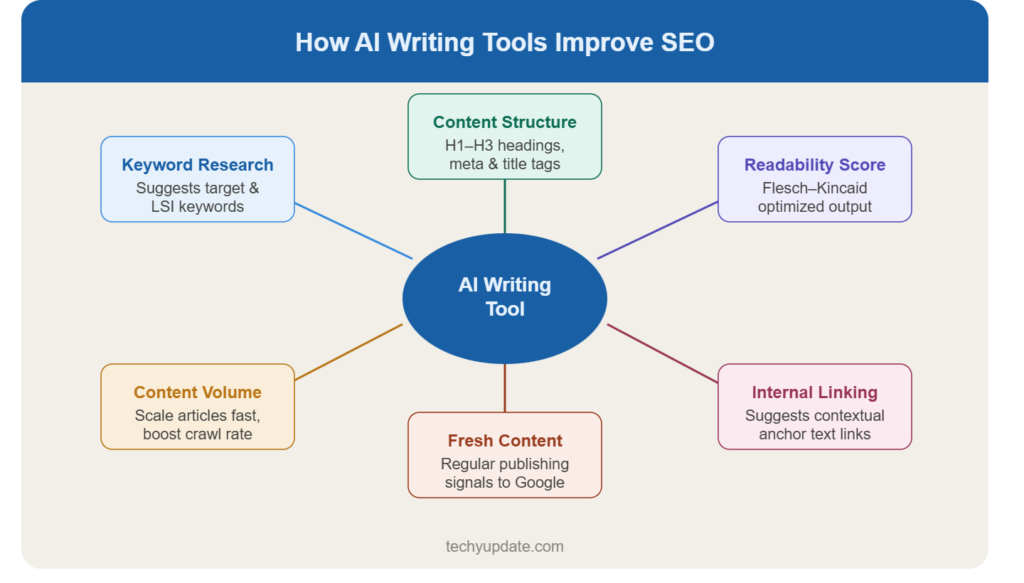
AI tools help writers create SEO-friendly content through:
- Better keyword distribution
- Improved heading structure
- Enhanced readability
- Faster topic research
- Optimized introductions
- Stronger meta descriptions
Search engines increasingly prioritize user experience rather than keyword density alone. AI writing systems help optimize content flow, sentence clarity, and reader engagement naturally. Articles become easier to scan, understand, and navigate. These improvements directly affect metrics such as bounce rate and time on page.
Another major advantage is scalability. A solo blogger can now publish content at speeds previously possible only for large editorial teams. AI dramatically reduces drafting time, allowing creators to focus more on strategy, originality, and audience connection. Businesses that once struggled to maintain weekly publishing schedules can now produce multiple optimized articles daily using AI-assisted workflows.
Advantages of Using Free AI Writers
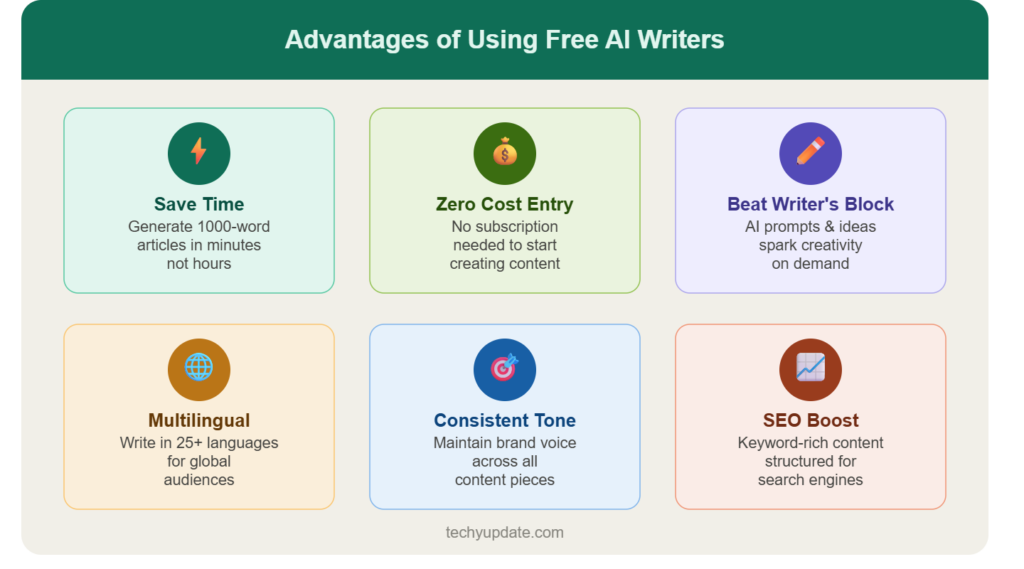
The biggest advantage of free AI writing tools is cost efficiency. Professional writers and agencies can be expensive, especially for startups and small businesses. Free AI platforms enable creators to produce large volumes of content without significant financial investment. This accessibility has opened content marketing opportunities to millions worldwide.
AI writing tools also save significant time. Drafting articles manually often requires hours of outlining, research, and editing. AI systems compress this process. Writers can generate initial drafts in minutes and spend more energy refining tone, adding expertise, and improving originality.
Creativity enhancement is another benefit. Many writers experience creative blocks during brainstorming. AI tools serve as idea generators, sparking inspiration and offering fresh angles for articles, headlines, and storytelling structures. Instead of replacing creativity, AI often accelerates it.
Productivity improvements are especially noticeable for:
- Bloggers
- Students
- Marketing agencies
- Freelancers
- eCommerce businesses
- Social media managers
Writers handling multiple projects simultaneously gain the greatest advantage because AI substantially reduces repetitive drafting.
Limitations of Free AI Writing Tools
Despite their strengths, free AI writing tools have important limitations. Most free plans include usage restrictions, daily message caps, or reduced access during high traffic. Some platforms lock advanced SEO optimization, plagiarism detection, or premium AI models behind paid subscriptions.
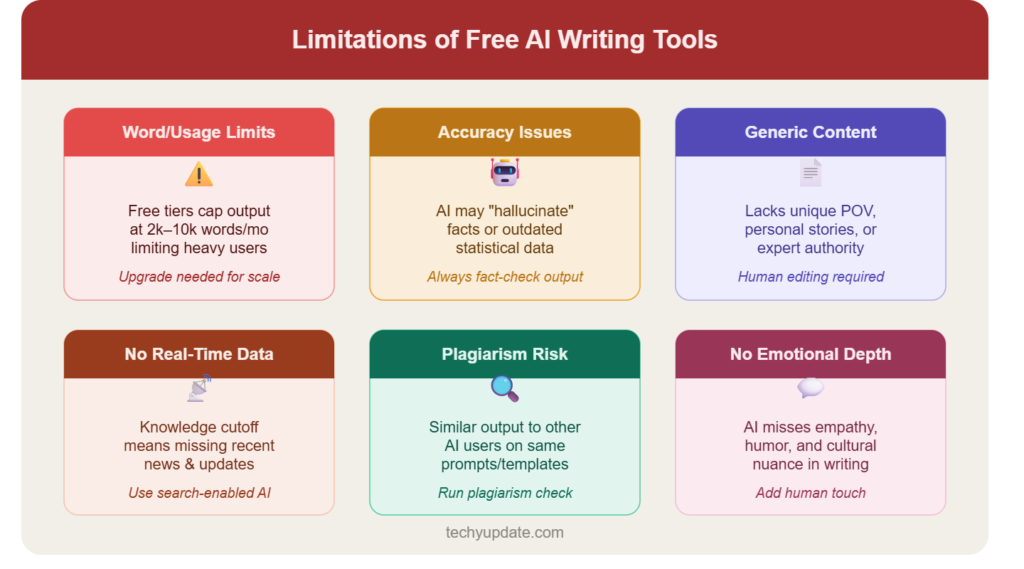
Fact-checking remains a critical issue. AI tools can generate incorrect statistics, outdated information, or fabricated details. Human review is essential before publishing AI-assisted content. Writers should treat AI as a drafting assistant, not an unquestionable authority.
Another challenge involves originality and AI detection. Search engines and educational institutions increasingly evaluate AI-generated content differently. Robotic writing patterns can reduce reader trust and affect SEO performance. That is why human editing remains crucial even when using advanced AI systems.
Writers who rely entirely on AI without adding personal insights, expertise, or storytelling often produce generic content. The best results occur when human creativity and AI efficiency work together.
AI Content Generation: The Future of Long Form Content Creation and Blog Writing Automation
The digital publishing landscape has evolved dramatically in recent years, and artificial intelligence now sits at the center of modern content creation. Businesses, marketers, bloggers, agencies, and entrepreneurs increasingly depend on AI content generation platforms to create faster, smarter, and more optimized content at scale. What once required entire editorial teams can now be accomplished with intelligent writing systems that produce detailed articles, optimize for semantic SEO, correct grammar, and customize tone within minutes.
Modern AI writing technology is no longer limited to generating basic paragraphs. Today’s advanced systems use natural language processing, machine learning, and semantic analysis to understand context, audience intent, readability, keyword relationships, and content structure. These tools help writers create highly engaging long-form articles while maintaining consistency, clarity, and SEO performance across all content.
As competition in search rankings intensifies, content quality has become more important than ever. Search engines reward comprehensive, well-structured, readable, and relevant articles. AI-powered writing systems help content creators meet these standards efficiently while dramatically reducing production time. From NLP keyword optimization to plagiarism checking, AI now powers nearly every stage of modern digital publishing.
What Is AI Content Generation?
AI content generation refers to the use of artificial intelligence systems to automatically or semi-automatically create written content. These systems analyze prompts, understand context, process language patterns, and generate human-like text using advanced natural language processing technology.
Modern AI writing platforms can create:
- Blog posts
- SEO articles
- Product descriptions
- Email campaigns
- Social media captions
- Website copy
- Landing pages
- Video scripts
- Academic summaries
- Marketing content
Unlike older automation systems that relied heavily on templates, modern AI platforms generate dynamic content based on meaning, intent, and conversational flow. This creates more natural and engaging writing that closely resembles human-created content.
The rapid growth of AI-generated content reflects increasing demand for scalable publishing solutions. Businesses now require constant content production to remain visible online. AI enables teams to publish more consistently without sacrificing quality or hiring large editorial departments.
How AI Improves Long Form Content Creation
Faster Content Production
Long-form article writing traditionally required hours of research, outlining, drafting, editing, and proofreading. AI writing tools dramatically accelerate this process by generating structured drafts within seconds.
Writers can now create comprehensive article frameworks instantly and focus their energy on refinement, personalization, and strategic improvements. This productivity boost allows bloggers and marketers to scale publishing operations efficiently.
For businesses managing multiple websites or clients, AI-assisted writing creates a major competitive advantage. Content teams can publish more frequently while maintaining consistency across all channels.
Smarter AI Article Structuring
One of the strongest advantages of modern AI writing systems is intelligent AI article structuring. AI platforms analyze search intent, semantic relevance, and readability patterns to organize content effectively.
These tools automatically generate:
- SEO-friendly headings
- Logical subheadings
- Topic clusters
- Structured paragraphs
- Keyword-rich outlines
- Reader-friendly formatting
Well-structured content improves both user engagement and search engine crawling efficiency. Readers can scan information more easily, while search engines better understand the relevance and hierarchy of articles.
Improved Research and Topic Expansion
AI systems also assist with topic expansion and research organization. Writers can generate content ideas, supporting arguments, FAQs, and semantic topic variations instantly.
This capability helps eliminate writer’s block while improving the depth and comprehensiveness of articles. Instead of struggling to expand a topic manually, writers can use AI suggestions to generate more authoritative, informative content.
Grammar Correction and Readability Improvements
Advanced Grammar Correction
Modern AI writing systems include sophisticated grammar correction engines that go far beyond traditional spell checkers. These tools analyze sentence structure, punctuation, context, and readability simultaneously.
AI grammar systems can detect:
- Subject-verb agreement issues
- Punctuation mistakes
- Contextual spelling errors
- Sentence fragments
- Passive voice overuse
- Redundant phrasing
- Awkward sentence flow
Real-time corrections improve writing quality instantly and significantly reduce manual proofreading time.
Readability Improvements for Better Engagement
Search engines are increasingly prioritizing readable, user-friendly content. AI writing tools enhance readability by simplifying overly complex sentences, reducing repetition, and improving paragraph flow.
High readability offers several advantages:
- Increased time on page
- Lower bounce rates
- Better audience retention
- Improved comprehension
- Higher engagement levels
Modern readers consume content quickly, especially on mobile devices. AI readability optimization ensures content remains accessible and engaging across all platforms.
NLP Keyword Optimization and Semantic SEO
Understanding NLP Keyword Optimization
Search engines no longer rank pages based solely on exact keyword matching. Modern algorithms use natural language processing to understand topic relationships, search intent, and semantic relevance. This makes NLP keyword optimization essential for SEO success.
AI writing tools analyze:
- Semantic keyword relationships
- Search intent patterns
- Contextual relevance
- Related topic entities
- Reader behavior signals
Instead of repeating keywords unnaturally, AI systems help writers create contextually rich content that aligns with modern SEO standards.
Semantic Content Suggestions
One of the most powerful AI capabilities involves generating semantic content suggestions. These suggestions expand topical coverage naturally by identifying related concepts and supporting subtopics.
For example, an article about AI writing tools may also include semantic concepts such as:
- SEO automation
- Content scaling
- Readability optimization
- AI editing
- Blogging workflows
- Search intent analysis
This broader topical relevance strengthens search visibility while improving content comprehensiveness.
Tone Customization in AI Writing
Why Tone Matters
Writing tone significantly affects audience engagement and brand identity. A formal corporate article requires a tone different from that of a casual lifestyle blog or a persuasive sales page.
AI-powered tone customization allows writers to adapt content for specific audiences instantly.
Popular tone options include:
- Professional
- Conversational
- Persuasive
- Informative
- Friendly
- Academic
- Humorous
- Confident
This flexibility helps businesses maintain consistent brand communication across multiple channels.
AI-Powered Audience Adaptation
Modern AI systems can also adjust sentence complexity, vocabulary, and structure depending on target audiences. Content aimed at beginners may become simpler and more explanatory, while expert-level content can include advanced terminology and deeper analysis.
This adaptability improves communication effectiveness while enhancing user satisfaction.
Plagiarism Checking and Content Originality
The Importance of Original Content
Originality remains one of the most critical factors in digital publishing. Duplicate or heavily copied content damages SEO performance and reduces credibility.
Modern AI writing systems often include built-in plagiarism checking capabilities that compare text against billions of web pages and databases.
These tools help writers:
- Detect accidental duplication
- Verify originality
- Avoid copyright issues
- Improve academic integrity
- Maintain SEO compliance
Human Editing Still Matters
Although AI plagiarism tools are highly advanced, human oversight remains essential. Writers should always review AI-generated content carefully to ensure originality, factual accuracy, and natural flow.
The best-performing content combines AI efficiency with human creativity and expertise.
Blog Writing Automation for Content Scaling
Automating Repetitive Content Tasks
Blog writing automation has become one of the most valuable applications of AI technology. Businesses managing high-volume publishing schedules can automate several repetitive tasks, including:
- Outline generation
- Meta description creation
- Title suggestions
- Intro paragraph drafting
- Content summarization
- SEO formatting
- Social media snippets
This automation dramatically improves productivity while reducing operational costs.
Scaling Content Marketing Efficiently
Content marketing success often depends on consistency. Websites that regularly publish high-quality articles tend to perform better in search rankings over time.
AI automation enables businesses to:
- Publish more frequently
- Maintain quality consistency
- Reduce production bottlenecks
- Accelerate SEO growth
- Support multi-channel marketing
Small businesses and solo bloggers can now compete with larger companies thanks to AI, which lowers the barriers to large-scale content creation.
AI Content Generation: The Future of Long Form Content Creation and Blog Writing Automation
The digital publishing landscape has evolved dramatically in recent years, and artificial intelligence now sits at the center of modern content creation. Businesses, marketers, bloggers, agencies, and entrepreneurs increasingly depend on AI content generation platforms to create faster, smarter, and more optimized content at scale. What once required entire editorial teams can now be accomplished with intelligent writing systems that produce detailed articles, optimize for semantic SEO, correct grammar, and customize tone within minutes.
Modern AI writing technology is no longer limited to generating basic paragraphs. Today’s advanced systems use natural language processing, machine learning, and semantic analysis to understand context, audience intent, readability, keyword relationships, and content structure. These tools help writers create highly engaging long-form articles while maintaining consistency, clarity, and SEO performance across all content.
As competition in search rankings intensifies, content quality has become more important than ever. Search engines reward comprehensive, well-structured, readable, and relevant articles. AI-powered writing systems help content creators meet these standards efficiently while dramatically reducing production time. From NLP keyword optimization to plagiarism checking, AI now powers nearly every stage of modern digital publishing.
What Is AI Content Generation?
AI content generation refers to the use of artificial intelligence systems to automatically or semi-automatically create written content. These systems analyze prompts, understand context, process language patterns, and generate human-like text using advanced natural language processing technology.
Modern AI writing platforms can create:
- Blog posts
- SEO articles
- Product descriptions
- Email campaigns
- Social media captions
- Website copy
- Landing pages
- Video scripts
- Academic summaries
- Marketing content
Unlike older automation systems that relied heavily on templates, modern AI platforms generate dynamic content based on meaning, intent, and conversational flow. This creates more natural and engaging writing that closely resembles human-created content.
The rapid growth of AI-generated content reflects increasing demand for scalable publishing solutions. Businesses now require constant content production to remain visible online. AI enables teams to publish more consistently without sacrificing quality or hiring large editorial departments.
How AI Improves Long Form Content Creation
Faster Content Production
Long-form article writing traditionally required hours of research, outlining, drafting, editing, and proofreading. AI writing tools dramatically accelerate this process by generating structured drafts within seconds.
Writers can now create comprehensive article frameworks instantly and focus their energy on refinement, personalization, and strategic improvements. This productivity boost allows bloggers and marketers to scale publishing operations efficiently.
For businesses managing multiple websites or clients, AI-assisted writing creates a major competitive advantage. Content teams can publish more frequently while maintaining consistency across all channels.
Smarter AI Article Structuring
One of the strongest advantages of modern AI writing systems is intelligent AI article structuring. AI platforms analyze search intent, semantic relevance, and readability patterns to organize content effectively.
These tools automatically generate:
- SEO-friendly headings
- Logical subheadings
- Topic clusters
- Structured paragraphs
- Keyword-rich outlines
- Reader-friendly formatting
Well-structured content improves both user engagement and search engine crawling efficiency. Readers can scan information more easily, while search engines better understand the relevance and hierarchy of articles.
Improved Research and Topic Expansion
AI systems also assist with topic expansion and research organization. Writers can generate content ideas, supporting arguments, FAQs, and semantic topic variations instantly.
This capability helps eliminate writer’s block while improving the depth and comprehensiveness of articles. Instead of struggling to expand a topic manually, writers can use AI suggestions to naturally produce more authoritative and informative content.
Grammar Correction and Readability Improvements
Advanced Grammar Correction
Modern AI writing systems include sophisticated grammar correction engines that go far beyond traditional spell checkers. These tools analyze sentence structure, punctuation, context, and readability simultaneously.
AI grammar systems can detect:
- Subject-verb agreement issues
- Punctuation mistakes
- Contextual spelling errors
- Sentence fragments
- Passive voice overuse
- Redundant phrasing
- Awkward sentence flow
Real-time corrections improve writing quality instantly and significantly reduce manual proofreading time.
Readability Improvements for Better Engagement
Search engines are increasingly prioritizing readable, user-friendly content. AI writing tools enhance readability by simplifying overly complex sentences, reducing repetition, and improving paragraph flow.
High readability offers several advantages:
- Increased time on page
- Lower bounce rates
- Better audience retention
- Improved comprehension
- Higher engagement levels
Modern readers consume content quickly, especially on mobile devices. AI readability optimization ensures content remains accessible and engaging across all platforms.
NLP Keyword Optimization and Semantic SEO
Understanding NLP Keyword Optimization
Search engines no longer rank pages based solely on exact keyword matching. Modern algorithms use natural language processing to understand topic relationships, search intent, and semantic relevance. This makes NLP keyword optimization essential for SEO success.
AI writing tools analyze:
- Semantic keyword relationships
- Search intent patterns
- Contextual relevance
- Related topic entities
- Reader behavior signals
Instead of repeating keywords unnaturally, AI systems help writers create contextually rich content that aligns with modern SEO standards.
Semantic Content Suggestions
One of the most powerful AI capabilities involves generating semantic content suggestions. These suggestions expand topical coverage naturally by identifying related concepts and supporting subtopics.
For example, an article about AI writing tools may also include semantic concepts such as:
- SEO automation
- Content scaling
- Readability optimization
- AI editing
- Blogging workflows
- Search intent analysis
This broader topical relevance strengthens search visibility while improving content comprehensiveness.
Tone Customization in AI Writing
Why Tone Matters
Writing tone significantly affects audience engagement and brand identity. A formal corporate article requires a completely different tone than a casual lifestyle blog or a persuasive sales page.
AI-powered tone customization allows writers to adapt content for specific audiences instantly.
Popular tone options include:
- Professional
- Conversational
- Persuasive
- Informative
- Friendly
- Academic
- Humorous
- Confident
This flexibility helps businesses maintain consistent brand communication across multiple channels.
AI-Powered Audience Adaptation
Modern AI systems can also adjust sentence complexity, vocabulary, and structure depending on target audiences. Content aimed at beginners may become simpler and more explanatory, while expert-level content can include advanced terminology and deeper analysis.
This adaptability improves communication effectiveness while enhancing user satisfaction.
Plagiarism Checking and Content Originality
The Importance of Original Content
Originality remains one of the most critical factors in digital publishing. Duplicate or heavily copied content damages SEO performance and reduces credibility.
Modern AI writing systems often include built-in plagiarism checking capabilities that compare text against billions of web pages and databases.
These tools help writers:
- Detect accidental duplication
- Verify originality
- Avoid copyright issues
- Improve academic integrity
- Maintain SEO compliance
Human Editing Still Matters
Although AI plagiarism tools are highly advanced, human oversight remains essential. Writers should always review AI-generated content carefully to ensure originality, factual accuracy, and natural flow.
The best-performing content combines AI efficiency with human creativity and expertise.
Blog Writing Automation for Content Scaling
Automating Repetitive Content Tasks
Blog writing automation has become one of the most valuable applications of AI technology. Businesses managing high-volume publishing schedules can automate several repetitive tasks, including:
- Outline generation
- Meta description creation
- Title suggestions
- Intro paragraph drafting
- Content summarization
- SEO formatting
- Social media snippets
This automation dramatically improves productivity while reducing operational costs.
Scaling Content Marketing Efficiently
Content marketing success often depends on consistency. Websites that regularly publish high-quality articles tend to improve their search rankings over time.
AI automation enables businesses to:
- Publish more frequently
- Maintain quality consistency
- Reduce production bottlenecks
- Accelerate SEO growth
- Support multi-channel marketing
Small businesses and solo bloggers can now compete with larger companies thanks to AI, which lowers the barriers to large-scale content creation.
Best AI Tools for Content Generation
Several AI platforms dominate the content generation industry today.
| AI Tool | Best Use Case | Key Features |
| ChatGPT | Long-form article writing | NLP writing, SEO support, brainstorming |
| Claude | Research and detailed content | Human-like readability, long context |
| Google Gemini | Google ecosystem workflows | Workspace integration, AI drafting |
| Jasper AI | Marketing and SEO writing | Templates, tone control, campaigns |
| Copy.ai | Sales and ad copy | Automated workflows, templates |
Each platform offers unique strengths depending on workflow needs, content goals, and publishing strategies.
Challenges of AI Content Generation
Fact Accuracy and Hallucinations
AI-generated content can occasionally include incorrect facts or fabricated information. Writers must carefully verify statistics, sources, and technical claims before publication.
AI should support research and drafting, not replace fact-checking entirely.
Over-Reliance on Automation
Heavy reliance on AI without human editing often results in generic or repetitive content. Search engines increasingly value originality, expertise, and authentic perspectives.
Human creativity remains critical for storytelling, strategic insights, emotional connection, and brand identity.
Balancing SEO and Human Readability
Some AI-generated content becomes overly keyword-optimized, reducing natural readability. The best content balances SEO optimization with conversational flow and reader engagement.
Successful writers use AI as a productivity partner rather than a complete replacement for human creativity.
AI Writing Tools Changing the Content Industry
Modern AI writing tools no longer produce robotic text like early AI generators. In 2026, they will use:
- Natural Language Processing (NLP)
- Semantic understanding
- Search intent analysis
- Human-like language patterns
- Context-aware writing
- Predictive content optimization
These systems help creators write:
- Blog posts
- Product descriptions
- Affiliate reviews
- News articles
- Technical documentation
- Long form content
- Landing pages
- Social media captions
- Email campaigns
The rise of AI content generator technology has also made content production affordable for small businesses and solo creators.
Best AI Tools Comparison Table 2026
| Tool | Best For | Free Plan | Long Form Content | Grammar Check | NLP Optimization |
| Grammarly | Grammar & clarity | Yes | Limited | Excellent | Moderate |
| ChatGPT | Article writing | Yes | Excellent | Strong | Excellent |
| Copy.ai | Marketing copy | Yes | Good | Good | Moderate |
| Writesonic | Blog content | Yes | Excellent | Good | Excellent |
| Rytr | Budget writing | Yes | Moderate | Good | Moderate |
| Jasper AI | Professional marketers | Trial | Excellent | Excellent | Excellent |
| QuillBot | Rewriting | Yes | Limited | Good | Moderate |
| Notion AI | Productivity writing | Yes | Good | Moderate | Moderate |
Best AI Tools for Article Writing
ChatGPT
OpenAI created one of the most powerful AI writing assistants available today.
Why ChatGPT Stands Out
- Generates human-like articles
- Supports long-form content
- Excellent idea generation
- Creates outlines instantly
- Improves readability
- Helps with storytelling
- Strong semantic understanding
- Excellent for informational articles
Best Use Cases
- Blog writing
- Affiliate marketing
- Content planning
- AI content generator tasks
- Educational articles
- Technical writing
Pros
- Fast output
- High-quality writing
- Natural language flow
- Excellent topic understanding
- Flexible writing styles
Cons
- Requires editing for originality
- Can sound repetitive
- Fact-checking still necessary
Expert Opinion
ChatGPT is one of the best free AI tools for creators who want scalable article writing with strong readability and semantic optimization.
Grammarly
Grammarly remains the top grammar-focused AI writing assistant.
Core Features
- Grammar correction
- Punctuation fixing
- Clarity suggestions
- Tone improvements
- Sentence restructuring
- Plagiarism checker
Perfect For
- Students
- Bloggers
- Professional writers
- Business communication
- Editing AI-generated content
Pros
- Excellent grammar detection
- Real-time writing assistance
- Beginner-friendly
- Browser integrations
Cons
- Limited content generation
- Premium features expensive
Best Strategy
Use Grammarly after generating content with another AI article writer.
Writesonic
Writesonic is one of the strongest competitors in AI blog writing software.
Key Advantages
- Long-form article generator
- NLP keyword integration
- AI blog writer
- Landing page creator
- Product description generator
Strong Features
- Fast article production
- SEO-friendly structure
- Easy-to-use dashboard
- Multiple writing templates
Pros
- Great for marketers
- High-speed workflow
- Semantic optimization
- Excellent for blog writing
Cons
- Free credits limited
- Occasional repetitive phrasing
Copy.ai
Copy.ai specializes in marketing-focused content creation.
Ideal For
- Ad copy
- Product descriptions
- Email writing
- Social media content
- Short-form articles
Pros
- Fast interface
- Creative outputs
- Strong marketing templates
Cons
- Less powerful for deep, long-form content
Rytr
Rytr is popular among beginners because of its affordability and simplicity.
Features
- AI article writer
- Tone selection
- Blog outline creator
- AI paragraph generator
Pros
- Easy learning curve
- Budget-friendly
- Lightweight interface
Cons
- Limited advanced optimization
Free AI Tools Worth Using Daily
Best Combination Workflow
Professional writers rarely use only one tool.
Smart Content Workflow
Research Phase
Use:
- ChatGPT
- Perplexity AI
- Google Trends
Writing Phase
Use:
- Writesonic
- Jasper AI
- Rytr
Editing Phase
Use:
- Grammarly
- QuillBot
- Hemingway Editor
Publishing Phase
Use:
- Surfer SEO
- RankMath
- WordPress optimization
Content Writing Strategies Using AI
Human + AI Hybrid Writing Wins
Google’s 2026 algorithms prioritize:
- Experience
- Expertise
- Authority
- Trustworthiness
Pure AI-generated articles often fail because they lack real insights and storytelling.
Winning Strategy
Use AI for:
- Research
- Outlines
- Drafts
- Semantic keyword suggestions
- Grammar cleanup
Add human value through:
- Personal experience
- Expert insights
- Original opinions
- Real examples
- Data interpretation
Long Form Content Optimization
Long articles still dominate search rankings in competitive industries.
Why Long Form Content Performs Better
Advantages
- Covers user intent fully
- Increases topical authority
- Better keyword coverage
- Higher engagement time
- More internal linking opportunities
Ideal Long Form Structure
| Section | Purpose |
| Introduction | User intent alignment |
| Problem explanation | Build relevance |
| Tool comparison | Decision-making |
| Tutorials | Practical value |
| FAQs | Semantic coverage |
| Conclusion | Conversion & CTA |
AI Content Generator Features That Matter
Most Important Features
NLP Optimization
Good AI tools understand:
- Search intent
- Semantic relationships
- Keyword variations
- Contextual meaning
Readability Enhancement
Strong tools improve:
- Sentence clarity
- Paragraph flow
- Engagement
- Simplicity
Grammar Accuracy
AI writing software should fix:
- Spelling mistakes
- Punctuation errors
- Tone inconsistencies
- Passive voice issues
Content Uniqueness
High-quality tools reduce:
- Duplicate phrasing
- Generic wording
- Robotic patterns
AI Writing Tools for Bloggers
Bloggers Need Different Features
Bloggers benefit from:
- Long-form content support
- Outline generation
- Keyword clustering
- Topic suggestions
- Meta descriptions
- AI introductions
- FAQ generation
Best Choice for Bloggers
| Tool | Best Advantage |
| ChatGPT | Best overall flexibility |
| Writesonic | Best article automation |
| Grammarly | Best editing |
| Jasper AI | Best marketing writing |
AI Article Writing Real-World Examples
Example 1: Affiliate Blog
A beginner affiliate marketer used:
- ChatGPT for outlines
- Writesonic for article drafts
- Grammarly for editing
Result:
- Published 50 articles in 3 months
- Increased organic traffic
- Reduced content costs
Example 2: Small Business Website
A local business owner used:
- Copy.ai for service pages
- QuillBot for rewriting
- Grammarly for polishing
Result:
- Faster website launch
- Better readability
- Improved conversions
Comparison: AI Writing vs Human Writing
| Feature | AI Writing | Human Writing |
| Speed | Excellent | Moderate |
| Creativity | Good | Excellent |
| Research | Fast | Deep |
| Cost | Low | High |
| Emotional storytelling | Moderate | Excellent |
| Grammar accuracy | Strong | Variable |
| Scalability | Excellent | Limited |
Common Mistakes Using AI Writing Tools
Overusing AI Outputs
Publishing raw AI content without editing can hurt rankings.
Better Approach
- Edit manually
- Add examples
- Include original insights
- Improve readability
- Add trustworthy sources
Ignoring Search Intent
Many creators focus only on keywords.
Google now prioritizes:
- User satisfaction
- Helpful information
- Content depth
- Real expertise
Weak Content Structure
AI-generated content often lacks organization.
Improve Structure With
- H2 headings
- Bullet points
- Comparison tables
- FAQs
- Summary sections
Free AI Tools for Students
Students benefit heavily from AI writing assistance.
Useful Student Features
- Grammar correction
- Essay structuring
- Citation formatting
- Paraphrasing
- Research assistance
Best Student Tools
| Tool | Best Student Feature |
| Grammarly | Grammar correction |
| ChatGPT | Research help |
| QuillBot | Rewriting |
| Notion AI | Organization |
Grammar, Readability, and Content Quality
Why Grammar Still Matters
Even the best ideas fail when grammar is poor.
High-Quality Content Needs
- Short sentences
- Clear wording
- Strong transitions
- Active voice
- Natural tone
Readability Tips
- Use simple English
- Keep paragraphs short
- Avoid jargon
- Add bullet points
- Use subheadings
Semantic Content Optimization
Google understands context better than ever.
Semantic SEO Matters in 2026
Modern content should naturally include related terms.
Important Semantic Terms
- AI content generator
- AI article writer
- Blog writing software
- Content optimization
- NLP writing assistant
- AI copywriting tool
- Free content creator
- Writing automation
These terms help search engines understand the relevance of a topic.
AI Writing Tool Reviews
Jasper AI
Jasper targets professional marketers and agencies.
Best Features
- Brand voice customization
- Long form workflows
- Marketing optimization
- Team collaboration
Drawback
- Expensive compared to free AI tools
QuillBot
QuillBot focuses on rewriting and paraphrasing.
Strong Advantages
- Sentence rewriting
- Clarity improvements
- Grammar correction
Best For
- Students
- Editors
- Academic writing
Troubleshooting AI Writing Problems
Content Sounds Robotic
Fixes
- Add personal stories
- Use a conversational tone
- Edit repetitive sentences
- Include examples
Poor Article Rankings
Possible Causes
- Thin content
- Weak topical authority
- No semantic optimization
- Poor readability
- Missing user intent
Duplicate Content Issues
Solutions
- Rewrite manually
- Add expert commentary
- Use plagiarism checkers
- Include original research
Future of AI Content Writing
AI writing will continue evolving rapidly.
Expected 2026 Trends
Hyper-Personalized Content
AI will adapt content based on:
- User behavior
- Search patterns
- Audience demographics
Better Semantic Understanding
Future AI tools will better understand:
- Search intent
- Emotional context
- Topical authority
Multimedia Content Integration
AI systems will combine:
- Text
- Images
- Videos
- Voice content
Pro Tips for Better AI Content
Best Practices
Always Edit AI Content
Never publish raw output.
Add Human Experience
Real expertise increases trust.
Focus on User Intent
Answer user questions directly.
Improve Formatting
Use:
- Bullet points
- Tables
- Subheadings
- Short paragraphs
Update Content Frequently
Freshness improves rankings.
Best AI Tools Pros and Cons Summary
| Tool | Pros | Cons |
| ChatGPT | Flexible, powerful | Needs fact-checking |
| Grammarly | Excellent editing | Limited generation |
| Writesonic | Great blog writing | Limited free usage |
| Copy.ai | Strong marketing copy | Weak long-form depth |
| Rytr | Beginner-friendly | Fewer advanced tools |
| Jasper AI | Professional workflows | Expensive |
Real-World Content Writing Examples
Example 1: Affiliate Blogger
A beginner blogger used:
- ChatGPT for outlines
- Writesonic for article generation
- Grammarly for editing
Results
- Faster publishing schedule
- Better readability
- Increased organic traffic
Example 2: Small Business Website
A local business owner used AI writing software for:
- Service pages
- Product descriptions
- Blog posts
Benefits
- Reduced content costs
- Faster website launch
- Better user engagement
Expert Tips for Better Content Writing
Creating powerful AI-assisted content requires strategy.
Always Edit AI Outputs
Human editing improves:
- Accuracy
- Trustworthiness
- Originality
Focus on Reader Experience
Google rewards content that:
- Solves problems
- Loads quickly
- Reads naturally
Use Semantic Keywords Naturally
Avoid keyword stuffing.
Instead, include related phrases naturally throughout the article.
Improve Content Structure
Use:
- H2 headings
- H3 subheadings
- Bullet points
- Tables
- FAQs
Update Content Frequently
Fresh content performs better in competitive industries.
The Future of AI Content Writing
AI writing technology continues evolving rapidly. Future systems will likely become more context-aware, emotionally intelligent, and personalized.
Emerging AI trends include:
- Predictive content performance analysis
- Real-time SEO optimization
- Voice-based content generation
- Personalized writing assistants
- Multi-language semantic adaptation
- AI-powered audience targeting
The future of content creation will revolve around collaboration between human expertise and AI efficiency. Writers who understand how to combine the two effectively will dominate the digital publishing landscape in the coming years.
AI writing technology is evolving at an incredible speed. Future platforms will likely become even more personalized, context-aware, and collaborative. Emerging systems already support memory functions, hierarchical outlining, multimodal inputs, and workflow automation. Research projects like TreeWriter demonstrate how AI-assisted long-form writing may soon become more structured and contextually intelligent.
The future of AI content writing will probably involve deeper integration with SEO tools, analytics platforms, publishing systems, and audience behavior tracking. AI may eventually predict content performance before publication and automatically recommend structural changes.
Human writers, however, will remain essential. Creativity, emotional storytelling, brand voice, lived experience, and strategic thinking cannot be fully automated. AI excels at acceleration and assistance, but authentic communication still depends heavily on human perspective and originality.
The creators who succeed most in the future will not necessarily be those who avoid AI. Instead, they will be the writers who learn how to combine AI efficiency with genuine human expertise.
AI writing technology continues evolving rapidly. Future systems will likely become more personalized, context-aware, and integrated with SEO analytics, publishing platforms, and audience behavior tracking.
Emerging innovations include:
- Predictive SEO optimization
- AI-driven audience targeting
- Automated content updating
- Multi-language semantic adaptation
- Voice-based content generation
- Personalized writing assistants
The future belongs to creators who understand how to effectively combine human creativity with AI-powered productivity.
Conclusion
The world of content creation has changed permanently in 2026. Free AI writing tools now empower bloggers, students, businesses, marketers, and entrepreneurs to create professional-quality articles at speeds that were unimaginable just a few years ago. Platforms like ChatGPT, Claude, Gemini, Rytr, and Copy.ai have transformed article writing from a slow, resource-heavy process into a highly scalable digital workflow.
Each AI writing tool offers different strengths depending on user needs. Some excel at long-form blogging, others focus on marketing copy or research assistance. The best results usually come from combining AI-generated drafts with human creativity, editing, and strategic insight.
Free AI article writing tools are no longer experimental novelties. They are now essential productivity systems shaping the future of SEO, blogging, marketing, and online publishing. Writers who adapt early gain a major competitive advantage in content speed, scalability, and efficiency.
AI has permanently transformed content creation, SEO writing, and digital publishing. From AI-generated content and grammar correction to semantic content suggestions and blog-writing automation, intelligent writing systems now power nearly every stage of modern online communication.
Businesses, bloggers, marketers, and agencies increasingly rely on AI tools to create scalable, optimized, and engaging content faster than ever before. Features such as NLP keyword optimization, tone customization, plagiarism checking, and readability improvements help writers produce professional-quality articles while significantly reducing manual workload.
The most successful content creators are not replacing human creativity with AI. Instead, they are combining AI efficiency with authentic storytelling, expertise, and strategic thinking. This partnership between human intelligence and artificial intelligence represents the future of long-form content creation and SEO-driven publishing.
Artificial intelligence has completely transformed modern content creation. From faster article creation and better grammar accuracy to semantic keyword suggestions and easy blog publishing workflows, AI writing systems now play a central role in SEO-driven publishing strategies.
Modern AI tools help writers create scalable, optimized, and engaging content while significantly reducing the manual workload. Features such as NLP keyword optimization, AI-powered outlines, improved content uniqueness, and higher readability scores enable businesses and creators to publish smarter and more efficiently than ever before.
As digital competition continues to increase, AI-assisted writing will become even more essential for bloggers, marketers, agencies, and businesses aiming to maintain visibility and authority online. The most successful creators will not replace human creativity with AI; they will amplify it through intelligent automation and strategic collaboration.
FAQs
What is the best free AI tool for article writing in 2026?
ChatGPT Free is widely considered the best overall free AI writing tool for its versatility, access to GPT-4, and conversational editing capabilities.
Are free AI writing tools good for SEO content?
Yes. Many free AI writing tools help optimize readability, headings, keyword usage, and structure for SEO-focused articles.
Can AI writing tools replace human writers?
No. AI tools assist with drafting and productivity, but human creativity, expertise, storytelling, and originality remain essential.
Which AI writing tool is best for long-form articles?
Claude is highly rated for long-form content for its smooth readability and its ability to maintain context throughout lengthy documents.
Do free AI article writers have limitations?
Yes. Most free tools include daily usage caps, feature restrictions, and limited access to premium AI models or advanced SEO tools.
What are the best free AI tools for article writing?
The best free AI tools include ChatGPT, Grammarly, Writesonic, Rytr, and Copy.ai.
Can AI writing tools create long-form content?
Yes. Modern AI article-writing platforms support long-form blog posts and guides.
Are AI-generated articles good for SEO?
Yes, if they provide value, originality, semantic relevance, and satisfy user intent.
Which AI tool is best for beginners?
Rytr and ChatGPT are beginner-friendly because they are simple and easy to use.
Can AI improve grammar and readability?
Yes. Grammarly and other AI writing assistants significantly improve grammar, clarity, and readability.
Do bloggers use AI content generators?
Yes. Many bloggers use AI content generators for outlines, drafts, optimization, and research.
Is AI content detectable?
Some AI-generated text may be detectable, but heavy editing and human insights improve originality.