

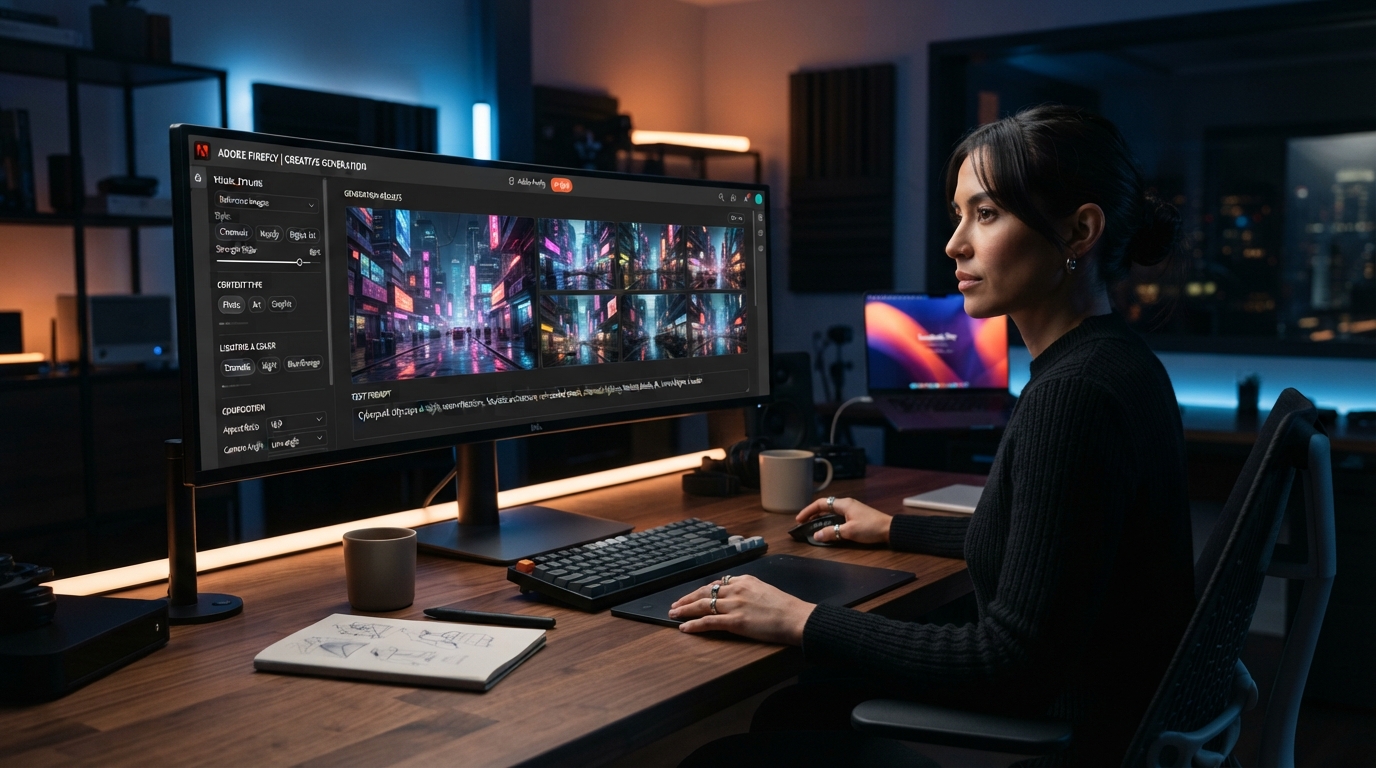
Adobe Firefly prompts are the instructions you give Firefly to describe the image you want. Better prompts generally provide more useful visual direction, including the subject, setting, appearance, lighting, composition and artistic style. Adobe recommends using clear, direct and descriptive language rather than vague instructions.
The good news is that you do not need complicated prompt-engineering syntax to get useful results from Firefly. A straightforward description can work well when it clearly explains what should appear in the image and how it should look.
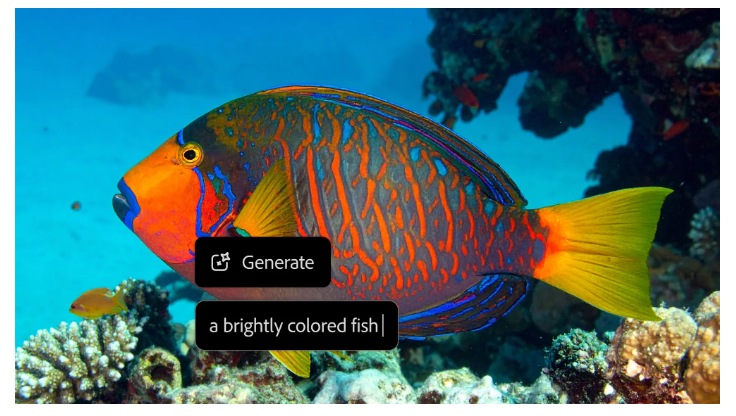
For example, instead of writing “modern laptop”, you could write:
A premium silver laptop on a minimalist wooden desk, modern home office, soft morning window light, realistic product photography, clean background, subtle shadows, wide composition.
The second prompt gives Firefly considerably more visual information to work with.
Firefly also gives you controls beyond the text prompt. Depending on the model and workflow, you can use content type, style references, composition references, effects, color and tone, lighting, camera angle and aspect ratio to refine the result.
This guide explains how to structure Adobe Firefly prompts, which details matter most, how to write prompts for different image types, how reference images can improve consistency, and what to do when your first generation is not what you expected.
Table of Contents
What Makes a Good Adobe Firefly Prompt?
A good Firefly prompt clearly communicates the visual idea without unnecessary complexity.
Adobe recommends being specific and descriptive and using simple, direct language. Adobe’s current guidance also recommends using at least three words and avoiding unnecessary command words such as “generate” or “create.”
A useful prompt can contain several elements:
Subject + Environment + Composition + Lighting + Style + Details
For example:
Professional photographer working in a modern studio, large camera on a desk, soft window lighting, three-quarter composition, realistic editorial photography, muted neutral colors, shallow depth of field.
You do not have to include every element in every prompt. Add the details that actually matter for the image.
Read more: What Is Adobe Firefly? AI Image Features, Styles, and Use Cases
Start With the Main Subject
The subject is the most important part of your prompt.
Clearly identify what should appear in the image.
Weak:
A beautiful technology image.
Better:
A modern silver laptop beside a smartphone on a clean office desk.
More specific:
A premium silver laptop beside a black smartphone on a dark walnut desk, both positioned beside a small desk lamp.
The more important an object is to the image, the more clearly you should describe it.
Useful Subject Details
Depending on the image, you can describe:
- Object type
- Color
- Material
- Size
- Shape
- Clothing
- Age or appearance of a person
- Position
- Number of objects
- Important accessories
For example:
A matte-black wireless keyboard with low-profile keys on a dark wooden desk.
This gives Firefly a much clearer starting point than simply saying:
A keyboard.
Describe the Environment
After defining the subject, explain where it is.
Compare:
A laptop.
with:
A silver laptop on a minimalist desk inside a bright modern home office.
The second prompt establishes a setting that can influence the overall composition.
Useful environment descriptions include:
- Modern office
- Minimalist bedroom
- Professional photography studio
- Mountain landscape
- Urban street
- Futuristic laboratory
- Cozy coffee shop
- Luxury hotel
- Outdoor garden
- Dark technology workspace
You can also describe the background:
Clean white studio background with subtle shadows.
or:
Busy futuristic city in the background with soft neon lights.
Specify the Composition
Composition tells Firefly how the subject should be arranged within the image.
This becomes particularly important when the image will be used on a website, advertisement or social-media graphic.
Useful composition descriptions include:
- Close-up
- Wide shot
- Medium shot
- Three-quarter view
- Top-down view
- Centered composition
- Subject on the left
- Subject on the right
- Symmetrical composition
- Negative space
- Foreground and background separation
For example:
Premium smartphone positioned on the right side of a minimalist desk, large clean negative space on the left for website headline text.
This is much more useful for a website hero image than:
Premium smartphone advertisement.
Use Lighting to Control the Mood
Lighting can significantly change the appearance of an AI-generated image.
Instead of simply saying:
Realistic photo.
Try:
Realistic product photography with soft studio lighting and subtle shadows.
Or:
Cinematic evening lighting with warm highlights and deep atmospheric shadows.
Other useful lighting descriptions include:
- Soft natural light
- Morning sunlight
- Golden-hour lighting
- Studio lighting
- Diffused light
- Dramatic side lighting
- Neon lighting
- Backlighting
- Low-key lighting
- High-key lighting
Adobe’s Firefly interface also provides lighting controls in supported image-generation workflows, allowing you to combine interface settings with your text prompt.
Add a Visual Style
Style determines how the final image should look.
For example:
realistic product photography
creates a very different direction from:
detailed digital illustration
You can describe styles such as:
- Photorealistic
- Editorial photography
- Cinematic
- Digital illustration
- Watercolor
- Pencil sketch
- 3D render
- Minimalist
- Vintage photography
- Futuristic concept art
- Luxury advertising
- Documentary photography
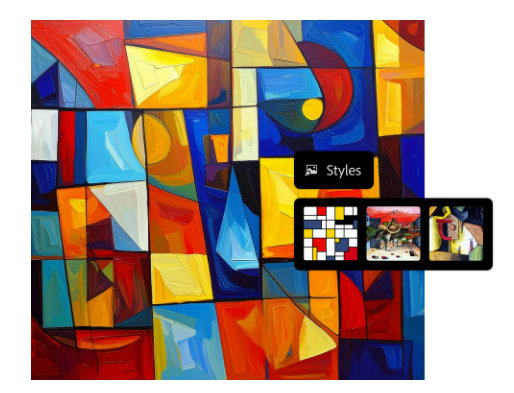
Firefly also provides style-reference functionality, allowing a reference image to guide the visual style and aesthetic of generated variations.
Control the Camera Angle
Camera perspective can make the same subject look completely different.
Compare:
A modern smartphone on a desk.
with:
Close-up three-quarter view of a modern smartphone on a desk, camera positioned slightly above the product.
You can use descriptions such as:
- Close-up
- Wide-angle view
- Eye-level view
- Low-angle shot
- High-angle shot
- Overhead view
- Three-quarter view
- Macro photography
- Front-facing view
For product images, camera perspective can be especially important because it determines how much of the product is visible.
Describe Color and Tone
Color can help establish a consistent visual identity.
For example:
Dark charcoal background with subtle blue lighting and warm orange highlights.
This can work particularly well for technology-themed graphics.
You can also describe:
- Neutral tones
- Pastel colors
- Monochromatic palette
- High contrast
- Muted colors
- Warm tones
- Cool tones
- Vibrant colors
- Desaturated colors
Firefly also provides color and tone controls in supported generation workflows, so you do not always need to describe every color preference only through text.
Add Important Details, but Avoid Contradictions
Specificity helps, but adding too many unrelated instructions can make a prompt harder to follow.
For example, this is unnecessarily complicated:
A minimalist, extremely detailed, futuristic, vintage, colorful, monochrome, realistic, cartoon-style luxury office…
Several of these descriptions conflict with one another.
A better prompt is:
A futuristic minimalist office with premium furniture, realistic materials, soft blue ambient lighting and subtle orange accent lights.
The goal is not to make the prompt as long as possible. The goal is to make the creative direction clear.
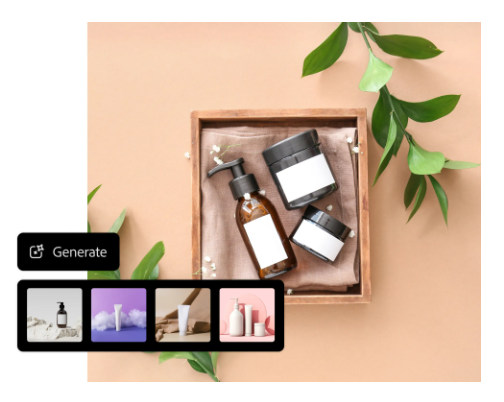
A Simple Adobe Firefly Prompt Formula
A practical formula for many image-generation tasks is:
[Subject] + [Environment] + [Appearance] + [Composition] + [Lighting] + [Style]
For example:
A modern AI workstation in a premium home office, dual monitors showing software dashboards, centered composition, soft blue ambient lighting with warm desk illumination, realistic technology editorial photography.
You can then add specific details when necessary.
Prompt Example
Basic prompt:
AI workstation.
Improved prompt:
Modern AI workstation with dual monitors in a minimalist home office, dark desk, blue ambient lighting, realistic technology photography.
More controlled prompt:
Modern AI workstation with dual monitors displaying abstract software dashboards, positioned on a dark walnut desk in a minimalist home office, three-quarter camera angle, soft blue ambient lighting with warm desk light, realistic premium technology editorial photography, clean background with subtle depth of field.
The final prompt gives Firefly considerably more visual direction without relying on complicated syntax.
Adobe Firefly Prompt Examples
Realistic Product Photography
Premium wireless headphones on a dark walnut desk, minimalist technology workspace, soft studio lighting, three-quarter product view, realistic commercial photography, subtle reflections, clean background, high-end advertising aesthetic.
Website Hero Image
Modern AI technology workspace with multiple monitors displaying abstract software interfaces, subject positioned toward the right, clean negative space on the left for headline text, dark background, blue and orange accent lighting, realistic premium technology editorial photography, wide composition.
Digital Illustration
Detailed digital illustration of a futuristic city powered by artificial intelligence, tall glass buildings, autonomous vehicles, glowing data streams, atmospheric depth, sophisticated blue and violet palette, cinematic concept-art style.
Blog Image
Professional technology blogger working at a modern desk with a laptop displaying an AI interface, soft natural window light, clean workspace, realistic editorial photography, approachable and professional atmosphere.
Social Media Graphic
Modern AI robot assistant surrounded by floating productivity icons, dark futuristic background, vibrant blue and purple lighting, centered composition, polished 3D illustration, clean space around the subject.
Food Photography
Fresh Italian pasta on a ceramic plate, rustic wooden table, soft natural window light, overhead food photography, realistic textures, warm neutral colors, shallow depth of field.
Portrait
Professional business portrait of a confident adult wearing a dark navy blazer, modern office background, soft window lighting, natural skin texture, eye-level camera, realistic editorial photography, subtle background blur.
How to Write Prompts for Realistic Images
If realism is important, include photographic details that describe the intended visual result.
A useful structure is:
Subject + setting + camera perspective + lighting + photographic style + realistic details
Example:
Realistic portrait of a professional designer in a modern studio, eye-level camera, soft window lighting, natural skin texture, subtle background blur, editorial photography, neutral color grading.
However, avoid stuffing every possible photography term into one prompt.
The objective is a coherent photographic description rather than a list of random camera keywords.
How to Write Prompts for Product Images
Product prompts benefit from precise descriptions of the product and its presentation.
Include:
- Product appearance
- Material
- Position
- Background
- Lighting
- Camera angle
- Advertising style
Example:
Matte-black wireless earbuds in an open charging case on a clean white studio surface, front three-quarter view, soft commercial lighting, subtle natural shadow, premium product photography, minimal luxury advertising aesthetic.
If the image is for a website, also describe where you want empty space.
Product positioned on the right side with clean negative space on the left for promotional text.
How to Write Prompts for Technology Images
Technology imagery often benefits from a clear visual hierarchy.
Example:
Premium AI research workstation with three monitors displaying abstract data analysis dashboards, modern dark desk, subtle blue ambient lighting, warm orange accent lights, three-quarter camera angle, realistic technology editorial photography, clean background, sophisticated professional atmosphere.
This type of prompt gives Firefly a subject, environment, composition, lighting and style.
Use Reference Images When Text Is Not Enough
Sometimes you know exactly what visual style you want but cannot describe it easily with words.
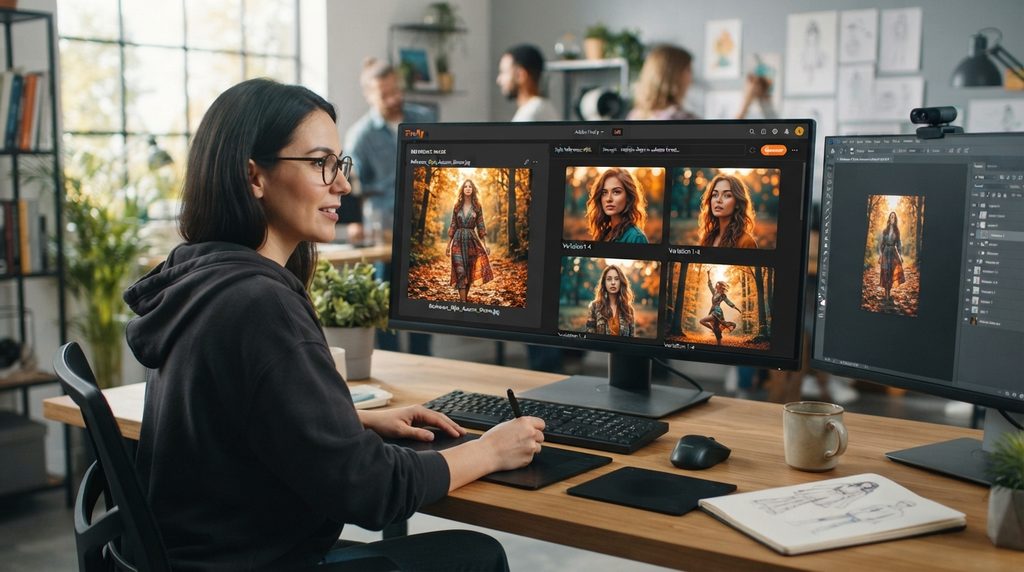
Firefly’s Reference feature lets you upload an image to guide the visual style and aesthetic of generated variations. Adobe also provides controls for adjusting how closely generated images follow the reference.
A useful workflow is:
- Write your main prompt.
- Add a suitable reference image.
- Generate several variations.
- Compare the visual direction.
- Adjust the prompt or reference strength.
- Generate again.
Reference images can be particularly useful when creating a consistent visual series.
For example, if you are producing several illustrations for the same website, a reference can help establish a consistent visual direction.
Use Composition References for Better Structure
A reference image does not always need to define the style.
Depending on the model and workflow, Firefly can also use images to provide compositional guidance. Adobe’s current mobile documentation describes composition references that help Firefly match the outline and depth of a reference image.
This can be useful when you know where objects should appear but want Firefly to change their appearance.
For example:
Use the reference composition but replace the objects with modern AI technology devices.
This separates the structure of the image from its visual styling.
Use Firefly’s Prompt Enhancement When Available
For Firefly Image 4 and Firefly Image 4 Ultra, Adobe provides a Prompt enhancement option that automatically makes an English prompt more detailed and descriptive.
This can be useful when your initial idea is short.
For example:
Futuristic AI office with a robot.
Firefly’s enhancement feature can expand the underlying description to provide more visual direction.
However, prompt enhancement should not replace your own creative decisions. If you have specific requirements for composition, branding or subject placement, write those details yourself.
How to Improve a Bad Firefly Result
A weak result does not necessarily mean the tool failed. Often, the prompt simply needs refinement.
If the Subject Is Wrong
Make the subject more specific.
Instead of:
A phone.
Try:
A slim black smartphone with a large edge-to-edge display and matte metal frame.
If the Background Is Wrong
Describe the environment directly.
Place the product on a clean white studio background with a subtle soft shadow.
If the Image Looks Too Artificial
Specify the intended visual style.
Realistic commercial product photography with natural materials, physically believable shadows and soft studio lighting.
If the Composition Is Wrong
Tell Firefly where the subject should appear.
Place the main product on the right third of the frame and leave clean negative space on the left.
If the Colors Are Wrong
Specify a controlled palette.
Dark charcoal background, cool blue ambient lighting and subtle warm orange highlights.
Do Not Rewrite Everything Every Time
One of the most useful prompting habits is to change only the part that is wrong.
Suppose your first result has the correct subject and composition but incorrect lighting.
Instead of creating an entirely new prompt, keep the existing description and modify the lighting:
Keep the composition and subject, but change the lighting to soft morning sunlight through a large window.
This makes iteration more deliberate.
The same approach works for:
- Background
- Color
- Camera angle
- Style
- Subject position
- Lighting
- Mood
Use Firefly Settings Alongside Prompts
Your text prompt is only one part of the generation process.
Depending on the selected model, Firefly can provide controls for:
- Content type
- Style
- Reference image
- Composition
- Effects
- Color and tone
- Lighting
- Camera angle
- Aspect ratio
Adobe’s current documentation shows these controls as part of Firefly’s image-generation workflow.
This means you do not necessarily need to describe every visual characteristic in the prompt.
For example, if a lighting control already gives you the direction you want, the prompt can focus more heavily on the subject and scene.
Choose Photo or Art for the Right Goal
Firefly can automatically select an appropriate content type, but supported workflows also allow users to choose Photo or Art. Photo is intended for more realistic photographic results, while Art can produce more illustrative variations.
For a product advertisement:
Premium smartwatch on a studio surface, realistic commercial product photography.
Photo may be a logical starting point.
For a fantasy illustration:
Ancient floating city above a mist-covered ocean, elaborate architecture, atmospheric fantasy illustration.
Art may be more appropriate.
Generate Variations Instead of Chasing One Perfect Prompt
AI image generation is naturally iterative.
A practical workflow is:
Prompt → Generate → Compare → Identify problem → Refine → Generate again
If four results are generated, you may find that one has the best composition while another has better lighting.
Use those observations to refine the next prompt.
Adobe’s current Firefly workflows also provide actions for continuing to modify generated images rather than always starting from scratch.
Common Firefly Prompt Mistakes
Being Too Vague
Nice office.
There is not enough information about what “nice” means.
Using Contradictory Styles
Photorealistic cartoon watercolor 3D pencil photograph.
Choose a coherent visual direction.
Describing Everything Except the Subject
Do not spend 50 words describing lighting while barely explaining what should appear in the image.
Ignoring Layout Requirements
If the image is for a website banner, mention the intended composition and negative space.
Changing Too Many Variables
If only the lighting is wrong, do not completely rewrite the subject, setting and style.
Using Reference Images Without Permission
Only upload reference material that you have the right to use. Adobe specifically notes that users should have the necessary rights for reference images.
A Practical Prompt Template
You can use this template for many Adobe Firefly projects:
[Main subject], [appearance/details], [environment], [composition/camera angle], [lighting], [color/tone], [visual style], [important additional detail].
Example
Modern silver laptop with a thin black display bezel, positioned on a dark wooden desk in a minimalist home office, three-quarter camera angle, soft natural window lighting, cool neutral color palette, realistic premium technology editorial photography, clean negative space on the left.
You can remove any section that is not relevant.
Adobe Firefly Prompt Templates by Use Case
Blog Hero Image
[Main technology subject] in [environment], positioned on the right side of the frame, clean negative space on the left for headline text, [lighting], [color palette], realistic technology editorial photography, wide composition.
Product Advertisement
[Product] with [key physical details], placed on [surface/background], [camera angle], [lighting], premium commercial product photography, clean composition, realistic materials and subtle shadows.
Social Media Image
[Subject] surrounded by [supporting elements], bold centered composition, [color palette], [lighting], polished modern 3D illustration, visually clear at small screen sizes.
AI Technology Illustration
[AI concept] inside a futuristic [environment], [important visual elements], cinematic composition, [lighting], sophisticated [color palette], detailed digital concept art.
Professional Portrait
[Person description] wearing [clothing], [environment], [camera perspective], soft [lighting], natural skin texture, realistic editorial portrait photography, subtle background separation.
The Best Way to Think About Firefly Prompts
Do not think of a Firefly prompt as a list of keywords.
Think of it as a short creative brief.
Instead of:
AI, office, laptop, blue, realistic, modern
write:
Modern AI workspace with a premium laptop and dual monitors displaying abstract software dashboards, minimalist dark desk, blue ambient lighting with subtle warm highlights, realistic technology editorial photography.
The second version communicates an actual visual concept.
That is the main principle behind better Adobe Firefly prompts: describe the image you want to see, not just the keywords associated with it.
Pros & Cons Table
| Pros | Cons |
|---|---|
| Simple natural-language prompting | Results can vary between generations |
| Detailed prompts provide strong creative direction | Very long prompts are not automatically better |
| Reference images can improve visual consistency | Reference images must be used appropriately |
| Photo and Art controls simplify style selection | Available controls can vary by model |
| Prompt enhancement can help expand short English prompts | Prompt enhancement is not available for every model/workflow |
| Additional visual controls reduce the need to describe everything in text | Final results may still require manual editing |
Comparison Table — only if relevant
| Prompting Approach | Best For | Main Advantage | Main Limitation |
|---|---|---|---|
| Short descriptive prompt | Quick ideas | Fast to write | Less visual control |
| Detailed creative prompt | Specific compositions | More direction | Takes more planning |
| Prompt + reference image | Consistent visual style | Stronger visual guidance | Requires a suitable reference |
| Prompt + Firefly settings | Controlled generation | Text and visual controls work together | Options vary by model |
| Prompt enhancement | Short English prompts | Adds descriptive detail automatically | Does not replace precise creative instructions |
Alternatives — only if relevant
Midjourney
What it is: An AI image-generation platform focused heavily on visual creation.
Main strength: Strong emphasis on artistic image generation.
Main limitation: It does not provide the same Adobe Creative Cloud workflow.
Best for: Users primarily interested in artistic image exploration.
ChatGPT Image Generation
What it is: A conversational image-generation workflow.
Main strength: Natural-language iteration and broader conversational assistance.
Main limitation: It is not designed as a replacement for Adobe’s full professional creative ecosystem.
Best for: Users who want to develop image ideas conversationally.
Google Gemini
What it is: Google’s multimodal AI ecosystem with image-generation capabilities.
Main strength: Integration with Google’s wider AI services.
Main limitation: It does not provide the same Adobe-specific design workflow.
Best for: Users already working heavily with Google’s AI tools.
Read more: How to Use Adobe Firefly for AI Image Generation and Editing
FAQs
What is the best way to write an Adobe Firefly prompt?
Answer: Describe the main subject clearly and add useful details about the environment, composition, lighting, color and visual style. Adobe recommends specific, descriptive and direct prompts rather than vague instructions.
How long should an Adobe Firefly prompt be?
Answer: There is no fixed ideal length. A prompt should contain enough information to communicate the desired image clearly without adding unnecessary or contradictory details.
Do longer Firefly prompts create better images?
Answer: Not necessarily. Useful visual details matter more than simply increasing the number of words. A concise prompt with clear subject, composition and style information can be more effective than a long, confusing description.
Can I use a reference image with Adobe Firefly?
Answer: Yes. Firefly supports reference images for guiding visual style and aesthetics in supported image-generation workflows.
Can Adobe Firefly improve my prompt automatically?
Answer: Firefly Image 4 and Firefly Image 4 Ultra support Prompt enhancement for English prompts. The feature expands the original description with additional detail to help guide image generation.
How do I make Firefly images more realistic?
Answer: Clearly describe the subject, environment, lighting and photographic style. Selecting Photo content type can also help when a realistic appearance is the goal.
Why does Adobe Firefly generate the wrong composition?
Answer: The prompt may not provide enough information about object placement or camera perspective. Describe the position of important subjects, the viewpoint and any required negative space, then generate another variation.
Can I use Firefly prompts for commercial images?
Answer: Adobe’s current FAQ says Firefly-generated outputs from features without a beta label can be used in commercial projects, while beta features may also be commercially usable unless Adobe explicitly states otherwise. Check the applicable product terms for the specific workflow you use.
Quick Take
Main point: Better Firefly images usually come from clearer visual instructions, not simply longer prompts.
Best use case: Creating realistic product images, website graphics, illustrations, marketing visuals and editorial artwork.
Main advantage: Text prompts can be combined with Firefly’s visual controls and reference images for greater creative direction.
Main limitation: Prompt quality does not guarantee a perfect result; generation remains iterative and settings vary by model.
Best approach: Start with the subject and scene, add only the important visual details, generate variations, identify what is wrong and refine one element at a time.
Conclusion
Adobe Firefly prompts work best when they function like concise creative briefs.
Start with the subject, explain the environment, then add important information about composition, lighting, color and visual style. Use Firefly’s reference-image and visual controls when text alone cannot provide enough direction.
You also do not need to create a completely new prompt every time an image is imperfect. If the subject is correct but the lighting is wrong, change the lighting. If the composition is wrong, adjust the composition. This makes the process faster and more predictable.
For beginners, the most useful habit is to replace vague descriptions with specific visual instructions. For experienced users, combining prompts with reference images and Firefly’s generation controls provides additional control.
The key takeaway: a good Firefly prompt does not need to be complicated. It needs to clearly describe the image you want.
Author Bio
TechyUpdate Editorial Team covers practical technology, AI tools, apps, software and digital productivity, with a focus on clear, useful and independently researched guides.