

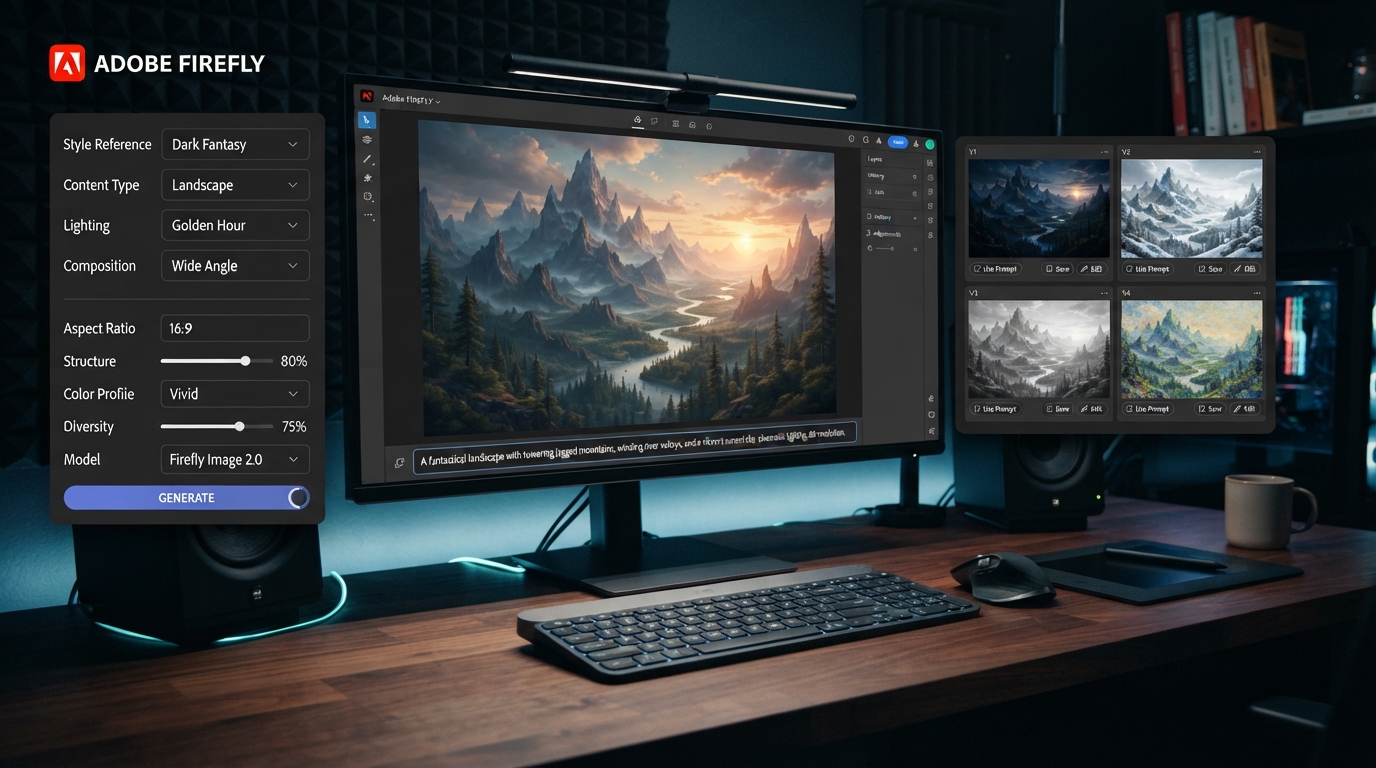
Adobe Firefly is Adobe’s generative AI platform for creating and editing creative content, including images, video, audio and vector artwork. For images, Firefly can turn text descriptions into visuals, transform existing images, apply visual styles, generate variations, and help users refine compositions. It is available as a standalone web experience and also powers generative AI features across Adobe’s creative applications.
What makes Adobe Firefly particularly useful is its connection to the wider Adobe ecosystem. Instead of treating AI image generation as a separate tool, Adobe positions Firefly as part of a workflow that can move from an initial idea to editing and production in applications such as Photoshop, Illustrator and Adobe Express.
For creators, that means Firefly can be used for much more than generating an attractive picture from a prompt. You can use it to explore concepts, create marketing visuals, develop characters, produce product imagery, change an image’s style, extend a composition and create visual variations.
This guide explains what Adobe Firefly is, how its AI image features work, which styles you can create, where it is most useful, its limitations, pricing considerations and what type of user can benefit from it.
Read more: Canva vs Adobe Express: 2026 Comparison
Table of Contents
What Is Adobe Firefly?
Adobe Firefly is a family of generative AI models and creative tools developed by Adobe. It works both as a standalone web-based creative environment and as technology integrated into Adobe applications.
At its simplest, Firefly lets you describe what you want to create and generates visual content from that instruction. However, its current capabilities extend into image editing, image-to-image transformations, style matching, video, audio, vector creation and AI-assisted creative workflows.
Adobe also offers access to partner models alongside its own Firefly models. Adobe’s current documentation lists Firefly Image 3, Firefly Image 4, Firefly Image 4 Ultra and Firefly Image 5 among its image-generation models, while Firefly can also provide access to selected partner models.
How Does Adobe Firefly Work?
The basic process is straightforward:
- Describe the image or modification you want.
- Select an available AI model and relevant generation settings.
- Choose an aspect ratio and visual/content settings where available.
- Generate image variations.
- Refine the result using additional prompts and controls.
- Continue editing or move the result into compatible Adobe applications.
For example, a prompt such as:
“Create a realistic product photograph of a modern wireless keyboard on a minimalist desk, soft studio lighting, premium technology advertisement.”
can be used as the starting point for a product-visualization workflow.
The exact controls and capabilities vary according to the model and feature being used.
Adobe Firefly AI Image Features
Firefly’s image capabilities cover both image generation and image transformation.
Text-to-Image Generation
Text-to-image is the most recognizable Firefly feature. You describe a scene, object, person, product or artistic concept and Firefly generates image variations based on the prompt.
Adobe supports different content approaches, including Photo and Art, along with automatic content-type selection. Aspect ratio can also be configured for generated images.
This makes text-to-image useful for:
- Blog illustrations
- Marketing concepts
- Product visuals
- Social media graphics
- Character concepts
- Advertising ideas
- Presentation artwork
- Concept development
- Creative experimentation
The quality of the result still depends heavily on the prompt, selected model and required visual details.
Image-to-Image Generation
Firefly can also start with an existing image rather than a blank canvas.
Image-to-image workflows allow creators to transform an image by changing elements such as style, lighting, mood or composition.
This is useful when you already have a rough concept but want to explore alternative visual directions.
For example, an existing photograph could become:
- A stylized illustration
- A different lighting setup
- A cinematic composition
- A more artistic interpretation
- A variation suitable for another campaign
Generative Match
Generative Match is one of Firefly’s useful style-oriented features. It lets you provide a reference image and use its visual characteristics to influence newly generated images.
Adobe describes reference options covering styles such as watercolor, pencil, 3D, neon, landscapes and textures. You can also upload your own reference image when you have the necessary rights to use it.
This is particularly useful when visual consistency matters.
For example, a designer developing a series of illustrations can use a reference style to help keep the appearance of different generated images closer to the same creative direction.
Generative Fill and Image Editing
Firefly’s technology is also used in Adobe applications for generative editing.
Rather than generating a complete image from scratch, generative editing can help modify selected portions of an existing image. Adobe integrates these capabilities into applications such as Photoshop, while Firefly can also send generated images into Creative Cloud workflows for additional editing.
This makes Firefly more relevant to professional workflows where AI generation is only one stage of the process.
Generative Expand
Generative Expand is designed to extend an image beyond its original boundaries.
This is useful when an image needs to be adapted to a different aspect ratio or layout. Adobe also highlights Generative Expand as part of workflows for creating social-media assets and adapting existing creative material to different formats.
For example, a horizontal image could potentially be expanded to provide additional visual space for a different layout.
What Styles Can You Create in Adobe Firefly?

One of Firefly’s strengths is the range of visual directions available through prompts, reference images and model controls.
Common styles include:
| Style | Typical use |
|---|---|
| Photorealistic | Product photography, advertising and editorial concepts |
| Digital illustration | Blogs, campaigns and creative projects |
| Watercolor | Artistic illustrations and editorial visuals |
| Pencil/sketch | Concept development and early design ideas |
| 3D | Product visualization and design concepts |
| Neon | Gaming, technology and futuristic visuals |
| Cinematic | Storytelling, campaigns and concept art |
| Abstract | Creative experimentation and backgrounds |
| Minimalist | Branding, presentations and modern marketing |
| Character art | Games, stories, campaigns and concept development |
The result depends on the prompt and selected model rather than simply choosing a style label. Reference images can provide additional visual direction, particularly when consistency is important.
Adobe Firefly Use Cases

1. Marketing and Advertising
Marketing teams can use Firefly to develop campaign concepts, advertising imagery, product scenes and social-media assets.
Instead of organizing a full photo shoot for every early concept, a team can quickly explore different creative directions and determine which ideas are worth developing further.
2. Product Visualization
Firefly can help visualize products in different environments before final photography or production.
For example, a brand could explore how a product might look:
- On a studio background
- In a home environment
- In a lifestyle scene
- In a seasonal campaign
- In different advertising compositions
Adobe specifically highlights AI-generated product photography and product visualization among Firefly image-generation use cases.
3. Social Media Content
Social-media creators and marketing teams frequently need multiple visual formats.
Firefly can help generate visual concepts and, through Adobe’s broader creative tools, adapt assets for different platforms and aspect ratios. Adobe’s Firefly AI Assistant also includes workflows designed to generate social-media assets and smart crops.
4. Blog and Editorial Images
Publishers can use Firefly to create original visual concepts for articles instead of relying entirely on generic stock photography.
For a technology website, for example, Firefly could help create a conceptual illustration of:
- An AI assistant
- Cloud computing
- Cybersecurity
- Software development
- Digital productivity
- AI image generation
The generated visual should still accurately represent the article’s subject rather than simply being decorative.
5. Character and Concept Development
Firefly can generate people and characters from text prompts or reference images.
Adobe’s AI human generator supports changing characteristics such as clothing, pose, lighting, expression and scene.
This can help with early-stage character development for advertising, storytelling, games and other creative projects.
6. Brand and Creative Exploration
Design teams can use Firefly to explore different visual directions before committing to a final design.
This can reduce the time spent producing dozens of early concepts manually.
For brands, consistency is particularly important. Adobe’s newer custom-model capabilities are designed to allow users to train models using their own images for particular styles, characters and photographic looks.
Is Adobe Firefly Commercially Safe?
Adobe has positioned its own Firefly models around a commercially safer approach to generative AI. Adobe says its Firefly models are trained on licensed Adobe content and public-domain content.
However, commercially safe does not mean that every possible AI workflow is automatically risk-free.
There is an important distinction between Adobe’s own Firefly models and third-party models that can be available within the Firefly environment. Businesses should understand which model they are using and review the applicable terms for their particular project.
Users should also have the necessary rights to images they upload as references. Adobe explicitly notes this requirement for Generative Match.
Content Credentials in Adobe Firefly
Adobe also uses Content Credentials to provide information about how certain content was created or edited.
Adobe says Content Credentials are tamper-evident metadata designed to provide context about an asset’s creation and editing history. For assets where 100% of the pixels are generated using Adobe Firefly, Adobe automatically applies Content Credentials.
This is useful in an environment where distinguishing AI-generated content from traditionally created content is increasingly important.
Adobe Firefly Pricing
Firefly has a free option with limited daily generations, while paid plans provide additional generative credits and capabilities. Adobe’s current UK pricing lists Firefly Standard at £9.98 per month with 2,000 generative credits and Firefly Pro at £19.99 per month with 4,000 credits. Adobe also lists higher Firefly Pro Plus and Premium tiers.
Adobe also offers generative-credit add-ons. The amount of credits consumed depends on the type of generation, output and model being used.
Because Firefly pricing, promotions, included credits and model availability can change, users should check Adobe’s current pricing page before subscribing.
Read more: Adobe Firefly Pricing and Free Credits: Plans, Limits, and Commercial Use
Who Should Use Adobe Firefly?
Adobe Firefly is particularly useful for:
- Graphic designers
- Digital marketers
- Content creators
- Photographers
- Social-media teams
- Small businesses
- Advertising teams
- Illustrators
- Adobe Creative Cloud users
- People exploring AI-assisted creative workflows
It becomes especially compelling for people already using Photoshop, Illustrator, Adobe Express or other Creative Cloud applications, because Firefly can fit into existing workflows rather than requiring an entirely separate creative environment.
Who Might Not Need Adobe Firefly?
Firefly may be less attractive if you only need a very basic text-to-image generator and do not use Adobe’s wider creative ecosystem.
It may also not be the best choice for someone who requires:
- A completely free unlimited image generator
- One specific third-party AI model only
- No credit-based limitations
- Highly specialized artistic workflows outside Adobe’s ecosystem
The right choice depends on the type of images you create and how much you value integration with professional design software.
Limitations to Consider
Adobe Firefly is powerful, but it is not a replacement for every part of a professional creative workflow.
Potential limitations include:
Generative credits: Many AI operations consume credits, and the amount can vary by feature, output and model.
Prompt dependence: Poorly specified prompts can produce results that do not match the intended composition.
AI imperfections: Generated images can still contain visual inconsistencies or details that require manual correction.
Model differences: Firefly can provide access to multiple models, so results and available controls can vary depending on the selected model.
Human editing remains important: Professional projects may still require Photoshop, Illustrator or other tools for precise typography, layout, retouching and brand control.
Adobe Firefly vs a Traditional Image Workflow
The biggest difference is speed and iteration.
A traditional workflow may involve finding references, creating a sketch, arranging assets, photographing a product or manually producing several concepts.
Firefly can compress the early ideation stage into a conversational process:
Idea → Prompt → Variations → Refinement → Editing → Final creative workflow
This does not eliminate the need for human design decisions. Instead, it can make experimentation faster.
Adobe Firefly vs Other AI Image Generators
Firefly’s biggest differentiator is not simply text-to-image generation.
Its broader value comes from combining:
- AI image generation
- Image editing
- Style references
- Multiple AI models
- Adobe Creative Cloud integration
- Generative credits
- Content Credentials
- Professional creative workflows
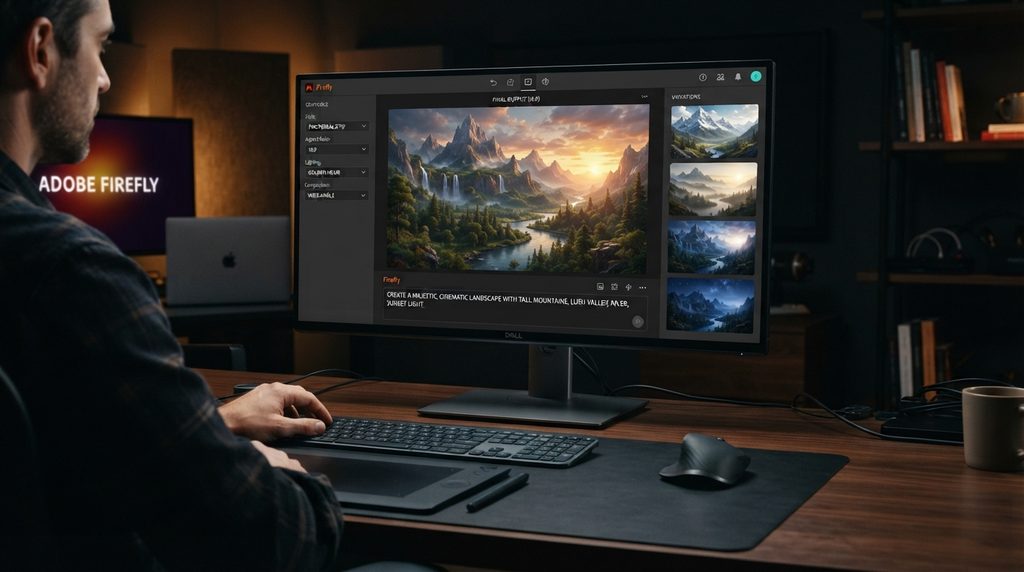
Adobe’s current Firefly environment includes both Adobe and partner models, giving users additional model choices within the same creative environment.
That makes Firefly particularly relevant to people who want AI generation connected to established design and editing tools.
Read more: Adobe Firefly Prompts: How to Create Better AI Images
Pros & Cons Table
| Pros | Cons |
|---|---|
| Strong integration with Adobe Creative Cloud | Many advanced generations use credits |
| Supports text-to-image and image transformation | Results can still require manual editing |
| Multiple visual styles and reference-image workflows | Model capabilities can vary |
| Adobe and partner AI models are available | Pricing and available features can change |
| Useful for professional creative workflows | May be more than casual users need |
| Content Credentials support AI-content transparency | Commercial considerations still depend on the specific workflow and model |
Comparison Table — only if relevant
| Factor | Adobe Firefly | General AI Image Generator |
|---|---|---|
| Text-to-image | Yes | Usually |
| Image editing | Yes | Varies |
| Style references | Yes | Varies |
| Adobe integration | Strong | Usually limited |
| Partner models | Available in Firefly | Depends on service |
| Professional design workflow | Strong | Varies |
| Content Credentials | Supported for qualifying Firefly-generated assets | Depends on provider |
| Best use case | AI-assisted professional creative work | General image generation |
Alternatives — only if relevant
ChatGPT Image Generation
Useful for people who want image generation integrated into a broader conversational AI workflow.
Main strength: Natural-language creative interaction.
Main limitation: It is not a replacement for Adobe’s full professional design ecosystem.
Best for: General creative ideation and conversational workflows.
Google Gemini
Google’s AI ecosystem provides image-generation capabilities alongside its broader multimodal AI tools.
Main strength: Integration with Google’s AI ecosystem.
Main limitation: It does not provide the same Adobe Creative Cloud workflow.
Best for: Users already working heavily within Google’s AI ecosystem.
Midjourney
Midjourney is well known for artistic and visually distinctive AI-generated imagery.
Main strength: Creative image exploration and distinctive visual aesthetics.
Main limitation: It is not designed as a direct replacement for Photoshop or Illustrator.
Best for: Artists and creators focused heavily on visual ideation.
The best alternative depends on whether the priority is image quality, artistic exploration, conversational generation or professional editing.
FAQs
What is Adobe Firefly?
Answer: Adobe Firefly is Adobe’s generative AI platform for creating and editing images, video, audio and other creative content. It is available as a standalone web experience and also powers AI features across Adobe applications.
Is Adobe Firefly an AI image generator?
Answer: Yes. Firefly can generate images from text descriptions and also supports image-to-image transformations and other AI-assisted image workflows.
Can Adobe Firefly create different image styles?
Answer: Yes. Users can guide visual style through prompts, model controls and reference images. Firefly’s Generative Match feature can use a reference image to influence the style of a generated image.
Can Adobe Firefly edit existing images?
Answer: Yes. Firefly supports image transformation and editing workflows, while Adobe also integrates Firefly-powered generative features into applications such as Photoshop and Illustrator.
Is Adobe Firefly free?
Answer: Adobe offers a free Firefly option with limited daily generations. Paid plans provide additional generative credits and capabilities.
Is Adobe Firefly commercially safe?
Answer: Adobe says its own Firefly models are trained on licensed Adobe content and public-domain content and are designed around a commercially safer approach. However, users should consider the specific model, assets and terms involved in their workflow.
Can Firefly work with Photoshop?
Answer: Yes. Firefly-powered generative capabilities are integrated into Adobe applications, including Photoshop, and Firefly-generated content can be taken into Creative Cloud applications for further editing.
Who is Adobe Firefly best for?
Answer: Firefly is particularly useful for designers, marketers, photographers, content creators and businesses that want AI generation and editing connected to Adobe’s professional creative ecosystem.
Quick Take
Main point: Adobe Firefly is more than a text-to-image generator; it is Adobe’s broader generative AI environment for creative work.
Best use case: Creating, transforming and refining visual content while keeping it connected to Adobe’s creative applications.
Main advantage: Strong combination of AI generation, image editing, style control, multiple models and Creative Cloud integration.
Main limitation: Credit consumption, changing model availability and the need for human editing can make it less attractive for some users.
Best alternative: The best alternative depends on the workflow; Midjourney is worth considering for artistic image exploration, while ChatGPT and Gemini can be better suited to broader conversational AI workflows.
Conclusion
Adobe Firefly has evolved from a simple AI image generator into a broader creative AI platform. Its image-generation capabilities are useful for creating concepts, illustrations, product visuals, marketing assets and other visual content, while features such as Generative Match and image-to-image workflows provide more control over the creative direction.
Its biggest advantage is the connection between generative AI and Adobe’s existing creative ecosystem. For someone already using Photoshop, Illustrator or other Creative Cloud applications, Firefly can become part of an established production workflow rather than another disconnected AI tool.
It is less compelling for users who only want occasional image generation and do not need Adobe’s professional creative tools.
The most important takeaway is that Firefly is best understood as a creative AI workspace, not simply an AI art generator. Its value comes from combining generation, editing, style control, model choice and Adobe workflow integration.
Author Bio
TechyUpdate Editorial Team covers practical technology, AI tools, apps, software and digital productivity, with a focus on clear, useful and independently researched guides.
1 Comment
Pingback: How to Use Adobe Firefly for AI Image Generation