

Which is better, ChatGPT or Gemini? That question makes “ChatGPT vs Gemini” the single most-searched AI comparison query on the internet right now and for good reason. These are the two most widely distributed AI chatbot platforms in the world: ChatGPT holds an estimated 64–68% of the AI assistant market, while Gemini has grown from single digits to over 20% in roughly eighteen months, largely riding Google’s built-in distribution through Search, Android, Gmail, and YouTube.

This part compares them directly across the factors that actually change a buying decision for a writer, professional, or business: features, pricing, real-world performance, ease of use, and who each tool is genuinely built for. If you’ve read Parts 1 and 2, you already know what ChatGPT offers on its own. Here’s how that holds up against its biggest rival.
Table of Contents
Quick Comparison Table
| ChatGPT | Google Gemini | |
|---|---|---|
| Developer | OpenAI | |
| Current model | GPT-5.5 | Gemini 3.1 Pro |
| Context window | Up to 1M tokens (Pro) | Up to 1M+ tokens |
| Starting paid price | $8/month (Go) | ~$20/month (AI Pro) |
| Strongest at | Breadth, writing/editing via Canvas, coding agents | Google Workspace integration, real-time search grounding, multimodal |
| Free tier | Yes, with ads (US) | Yes, generally more generous |
Feature-by-Feature Breakdown

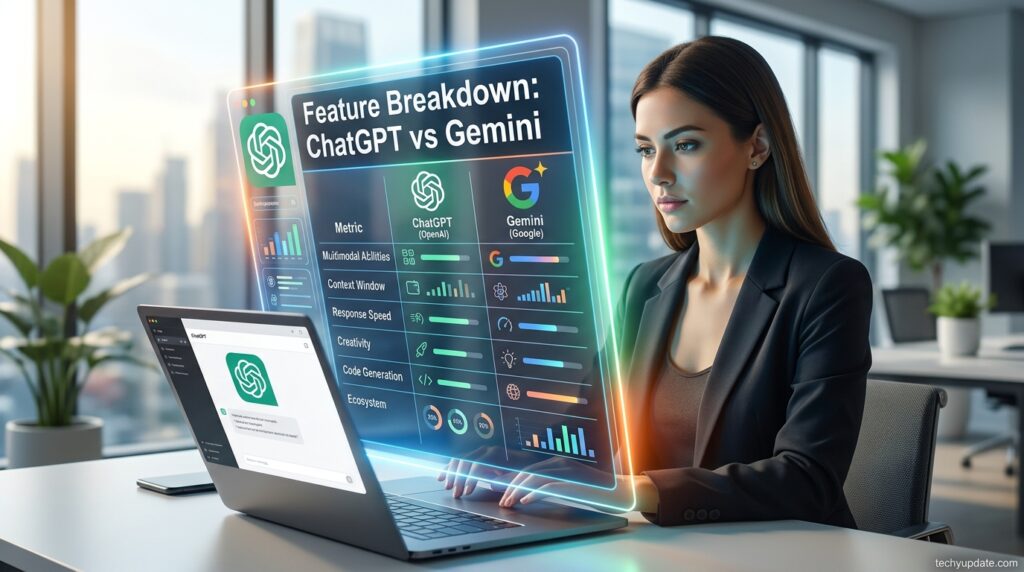
1. Writing quality. Which AI writes better, ChatGPT or Gemini? Independent testing throughout 2026 generally places Claude first on pure prose quality, with ChatGPT a strong second thanks to Canvas’s iterative editing workflow, while Gemini’s output is frequently described as accurate but more functional than polished — better as a fast drafting assistant than a finished-piece writer.
2. Coding. GPT-5.5 posts strong scores on agentic coding benchmarks like Terminal-Bench 2.0 via Codex, while Gemini has narrowed the gap on multi-file refactoring and test generation, though it still trails on complex debugging accuracy in most independent tests.
3. Multimodal understanding. Gemini has a clear edge here — native image, video, and audio understanding, plus deep integration with Google Lens, Photos, and YouTube, makes it the stronger choice for anyone working across media types.
4. Real-time information. Does Gemini have access to real-time information that ChatGPT doesn’t? Largely, yes Gemini’s native Google Search grounding means it pulls current web results as a built-in part of how it processes a query, while ChatGPT’s web browsing is a tool it invokes rather than a default part of every response.
5. Ecosystem integration. Gemini wins decisively for anyone inside Google Workspace drafting in Docs, summarizing Gmail threads, and building formulas in Sheets natively. ChatGPT’s strength lies in its standalone ecosystem (Codex, Canvas, Custom GPTs, 60+ third-party connectors) rather than in any single productivity suite.
6. Context window. Both now offer approximately 1M-token windows at their top tiers, a rough parity that didn’t exist a year ago, though real-world reliability at the very top of that range still varies by task for both tools.
Pricing Comparison
Is Gemini cheaper than ChatGPT? Both tools converge around $20/month for their mainstream paid tier — ChatGPT Plus vs Google AI Pro — making pricing alone a weak differentiator at the top. ChatGPT’s Go tier ($8/month) offers a lower entry point than Gemini’s paid tier, but Gemini’s free tier is often described as more generous out of the box, particularly for multimodal and search-grounded tasks.
Performance Comparison
In blind, label-removed testing conducted by independent reviewers in 2026, ChatGPT’s strongest showing came in structured, business-style reasoning tasks — like competitive-response strategy prompts — while Gemini performed consistently as a strong all-rounder without dominating any single category outright, rarely the best but also rarely the worst.
Which one is faster to respond? ChatGPT’s Instant model and Gemini’s default responses are both near-instantaneous for typical queries; the meaningful speed difference only shows up when either tool’s “thinking” or reasoning mode kicks in for a harder problem, where both platforms trade off speed for accuracy in similar ways.
Which one handles longer conversations better? With both now supporting roughly 1M-token context windows on their top tiers, long-conversation reliability has become much closer than it was even a year ago — the practical gap that remains shows up less in raw capacity and more in how consistently each model stays on-topic and remembers earlier instructions across a very long session.
Ease of Use
Is ChatGPT or Gemini easier to use for beginners? Both platforms are approachable. ChatGPT’s interface centers on a single chat, plus Projects and Custom GPTs; Gemini is arguably easier for existing Google users, since it appears directly within apps they already use daily, reducing the learning curve to near zero for that audience.
Best-For Use-Case Split
- Choose ChatGPT if you want the broadest single writing and productivity tool, strong agentic coding via Codex, and the industry’s most active release cadence.
- Choose Gemini if you live inside Google Workspace, need native real-time search grounding, or work heavily with images/video/audio alongside text.
Which Should Students, Developers, and Businesses Choose?

Which AI is better for students, ChatGPT or Gemini? For most students, ChatGPT’s free tier plus its strong homework-explanation and essay-drafting capability makes it the more familiar default, though Gemini’s tighter Google Docs integration is worth considering for anyone already writing assignments there.
Which AI is better for developers? ChatGPT, primarily because of Codex — its agentic coding workflow (reading a codebase, writing and testing code, submitting a pull request) is more mature than Gemini’s current coding tooling, even though Gemini has narrowed the gap on straightforward refactoring tasks.
Which AI is better for a growing business? It depends on the existing stack. A Google Workspace shop gets more immediate value from Gemini simply because it’s already embedded in the tools employees open every day. A business without a strong Google dependency, or one that wants the broadest possible feature set in one subscription, is generally better served by ChatGPT Business.
Security & Data Privacy Comparison

Is ChatGPT or Gemini more secure for business use? Both offer enterprise-grade options — ChatGPT Enterprise includes SOC 2 compliance, SSO, audit logs, and configurable data retention, while Gemini’s business tier (through Google Workspace) inherits Google Cloud’s broader compliance certifications and data-residency options. For most SMBs, the practical difference is smaller than the marketing suggests; the decision usually comes down to which vendor your IT team already trusts and audits, rather than a meaningful gap in the underlying protections.
Customer Support Comparison
Which has better customer support, ChatGPT or Gemini? Neither offers strong support at the free or entry-paid tier — both rely primarily on help-center documentation and community forums for individual subscribers. The gap opens at the business level: Google’s enterprise support infrastructure (built over two decades of Workspace and Cloud customers) is generally viewed as more mature than OpenAI’s comparatively newer enterprise support organization, though OpenAI has been investing heavily in this area through 2025 and 2026.
Pros & Cons of Each
| ChatGPT | Gemini | |
|---|---|---|
| Pros | Broadest features, Canvas editing, fastest updates, strong coding agent | Best multimodal, native Google integration, generous free tier |
| Cons | Ads on Free/Go, model routing confusion | Weaker outside the Google ecosystem, writing feels more functional than polished |
Final Verdict for Part 3
So which one should you actually choose? Neither tool is a universal winner the honest answer depends entirely on your existing workflow. If you’re Google-native, Gemini’s integration advantage is hard to beat for day-to-day writing. If you want the single most capable, broadest standalone AI writing and productivity platform on the market, ChatGPT remains the stronger overall pick in 2026.
FEATURED
Definition: ChatGPT is an AI chatbot and writing assistant developed by OpenAI that uses the GPT-5.5 large language model to generate and edit human-like text, code, images, and voice responses from natural language prompts.
List — ChatGPT Pricing Tiers: Free, Go ($8/mo), Plus ($20/mo), Pro ($100 or $200/mo), Business ($20–25/user/mo), Enterprise (custom).
Table — Quick Comparison: See Part 3 comparison table above.
How-To — Choosing a ChatGPT Plan: Start on Free to test the platform → move to Plus at $20/month once you hit daily limits → consider Pro only if you’re a heavy Codex or Deep Research user → move to Business/Enterprise for team-wide deployment.
Read more: ChatGPT Pricing 2026
Read More: ChatGPT Review 2026
FREQUENTLY ASKED QUESTIONS
Is ChatGPT good for writing blog posts and articles?
Yes — Canvas allows section-by-section editing rather than full regeneration, and Deep Research can gather sourced background before drafting, making it a strong tool for long-form content.
Is ChatGPT better than Google Gemini?
It depends on your workflow — ChatGPT offers broader standalone features and stronger writing/editing tools, while Gemini wins for users embedded in Google Workspace and real-time search grounding.
How much does ChatGPT Business cost?
ChatGPT Business costs roughly $20 per user per month billed annually, or $25 per user per month billed monthly, with a minimum of two users.
Can I use ChatGPT without creating an account?
No, an account is required for all tiers, including Free, though sign-up itself is free and takes under a minute.
What is Deep Research in ChatGPT?
Deep Research is a multi-step research mode that autonomously browses the web, synthesizes multiple sources, and produces a cited report, with limited runs on Plus and higher run counts on Pro and above.
Does ChatGPT have ads now?
Yes, since February 9, 2026, ChatGPT’s Free and Go tiers display labeled “Sponsored” content to US users beneath some responses.
CONCLUSION
ChatGPT in 2026 is less a single chatbot than a full AI ecosystem, GPT-5.5’s reasoning power, Canvas’s editing workflow, Codex’s coding agent, and Deep Research’s autonomous browsing all sitting under one subscription.
On pricing, Plus at $20/month remains genuinely good value even as the tier structure above it has grown more complex, and the Free tier ads and all are still one of the most capable no-cost AI writing tools available.
Against its biggest rival, Gemini, the honest verdict isn’t a knockout win either way: ChatGPT is the stronger all-around writing and productivity platform for most people, while Gemini pulls ahead specifically for Google Workspace-native workflows. For a reader deciding today, that’s the real question to answer — not which tool is objectively “best,” but which one fits the ecosystem you already write in.
Conclusion – ChatGPT vs Gemini (2026) (~250 words)
Choosing between ChatGPT and Gemini in 2026 ultimately depends on how and where you use AI rather than determining a single overall winner. Both platforms have evolved into highly capable AI assistants, but they are designed with different priorities and ecosystems in mind. Understanding these differences is more valuable than focusing solely on benchmark scores or marketing claims.
ChatGPT excels as a comprehensive productivity platform. Its strengths include creative writing, long-form content creation, coding assistance, deep research, data analysis, brainstorming, and support for a wide variety of professional workflows. The addition of advanced tools like Canvas, Codex, and Deep Research further expands its capabilities, making it suitable for students, developers, marketers, businesses, and content creators alike.
Gemini, meanwhile, performs exceptionally well within Google’s ecosystem. Users who spend most of their time in Gmail, Google Docs, Sheets, Drive, and other Workspace applications benefit from tighter integration and smoother collaboration. Its ability to integrate seamlessly with Google’s productivity suite makes it especially attractive to organizations already invested in Google services.
Instead of asking which AI assistant is objectively better, users should consider which platform aligns with their daily workflow. If your work revolves around content creation, coding, research, and versatile AI-powered productivity, ChatGPT remains the stronger all-around choice. If your productivity depends heavily on Google Workspace and seamless integration with Google’s cloud services, Gemini may be the better fit.
In the end, both AI assistants represent the future of intelligent productivity, but for most users seeking flexibility, broader capabilities, and a mature AI ecosystem, ChatGPT continues to hold the overall advantage in 2026.