

Building a free website hosting solution with a free domain website is now a streamlined, high-performance process that anyone can execute without technical barriers. We can create a free website, deploy it on free hosting platforms, and launch a fully responsive, SEO-optimized digital presence in under an hour.
With modern no-cost website builders, AI-assisted design, and cloud infrastructure, we achieve professional-grade results without investment. This guide delivers a complete, actionable system for building a website with free hosting, configuring a free website domain, and optimizing for visibility, speed, and growth.
In today’s digital world, building an online presence has never been easier thanks to free website hosting solutions. Whether you are a beginner, freelancer, or small business owner, you can now create a free website without technical skills, coding knowledge, or upfront investment. With modern, no-cost website builders, users can launch fully functional websites in minutes and start sharing content, services, or portfolios with the world.
This guide explores everything you need to know, from understanding free domain and hosting, choosing the best platforms to create a free website, and following a step-by-step setup process, to evaluating the advantages and disadvantages of free hosting.
We also cover practical tips to improve your website performance and SEO, along with clear guidance on when to upgrade to paid hosting for long-term growth and professionalism.
Free Website Hosting
Free website hosting allows us to publish a website online without paying for server space or infrastructure. It is one of the easiest ways to create a free website, especially for beginners, students, and small projects. Most platforms offer a free subdomain, basic design tools, and limited storage, so users can launch websites quickly without coding.
This solution is ideal for learning, testing ideas, and building an initial online presence before upgrading to paid hosting for more advanced features, branding, and scalability.
What Is Free Website Hosting and a Domain?
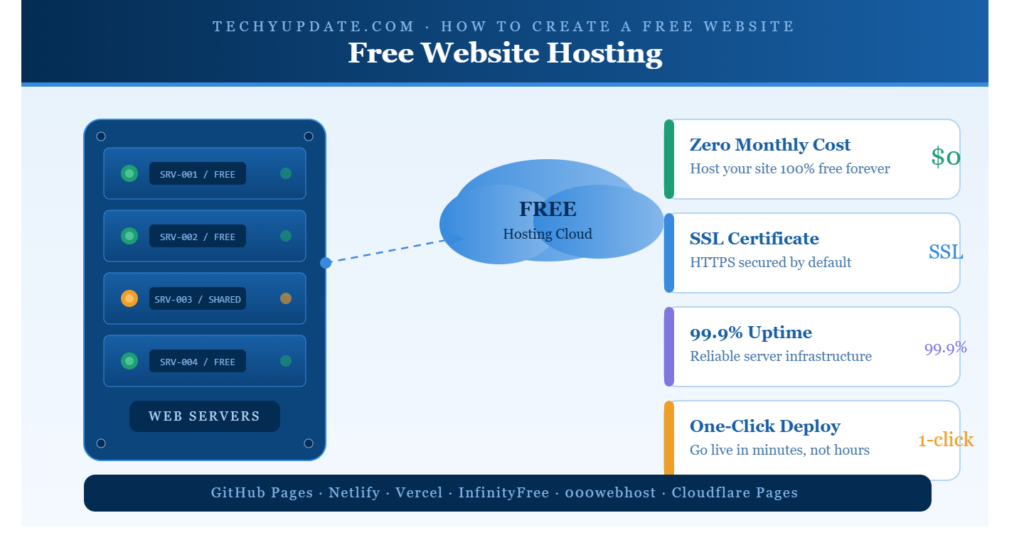
Free website hosting refers to a service that allows us to publish a website on the internet without paying for server space or infrastructure. Hosting providers allocate a portion of their servers to host our files, images, and content, making them accessible online. When combined with a free website domain, we gain a complete online presence without upfront investment.
A domain is the web address users type into a browser to access a website. In free setups, this usually comes in two forms:
- Free subdomain site (e.g., yourname.platform.com)
- Free domain extensions provided by certain services (.tk, .ml, etc.)
Together, free website hosting and a domain enable us to create a functional, accessible, and customizable website.
Core Components of a Free Website Setup
- Hosting server: Stores website data and content
- Domain or subdomain: Provides an address for user access
- Website builder: Allows design and structure without coding
- Content management system (CMS): Organizes pages and media
This ecosystem allows us to build a website without coding, manage content efficiently, and launch quickly.
Why Do People Choose Free Website Solutions?
The demand for free hosting platforms continues to grow as they eliminate financial barriers and provide essential tools for online success.
Key Reasons for Choosing Free Website Hosting
- Zero Cost Entry
- No upfront investment required
- Ideal for beginners, students, and startups
- Beginner-Friendly Setup
- Simple interfaces and guided workflows
- No technical knowledge needed
- Rapid Deployment
- Launch a website within minutes
- Pre-designed templates accelerate setup
- Learning and Experimentation
- Safe environment to test ideas
- Practice website design and SEO skills
- Accessibility for Global Users
- Enables individuals worldwide to establish a digital presence
- Supports personal branding and small business growth
- No Coding Requirement
- Drag-and-drop builders simplify design
- AI-assisted tools automate structure and content
These advantages make free website hosting a powerful entry point for anyone aiming to establish an online identity.
Overview of Free vs Paid Websites
Understanding the distinction between free website hosting and paid solutions allows us to make informed decisions based on goals and scalability.
Free Website Hosting – Key Characteristics
- Cost: Completely free
- Domain: Subdomain or limited free domain options
- Customization: Basic design flexibility
- Storage & Bandwidth: Limited resources
- Ads: Platform branding or ads may appear
- Scalability: Suitable for small or starter projects
Paid Website Hosting – Key Characteristics
- Cost: Monthly or annual subscription
- Domain: Custom domain (professional branding)
- Customization: Full control over design and features
- Performance: Higher speed, reliability, and uptime
- Security: Advanced protection and backups
- Scalability: Supports business growth and high traffic
Free vs Paid Website Comparison (Quick Snapshot)
- Free Website Hosting
- Best for beginners, testing, and personal projects
- Limited control and branding
- Fast setup with minimal resources
- Paid Hosting
- Ideal for businesses and professionals
- Full ownership and customization
- High performance and scalability
Strategic Insight
We start with a free website hosting solution to validate ideas, build initial content, and understand audience behavior. As traffic and goals expand, transitioning to a paid environment ensures long-term growth, authority, and monetization potential.
Understanding Free Domain and Hosting
Free domain and hosting are two essential components that allow us to build and publish a website online without paying any upfront cost. A free website hosting service provides the server space where website files, images, and content are stored, while a free domain provides the web address that users type to access the website.
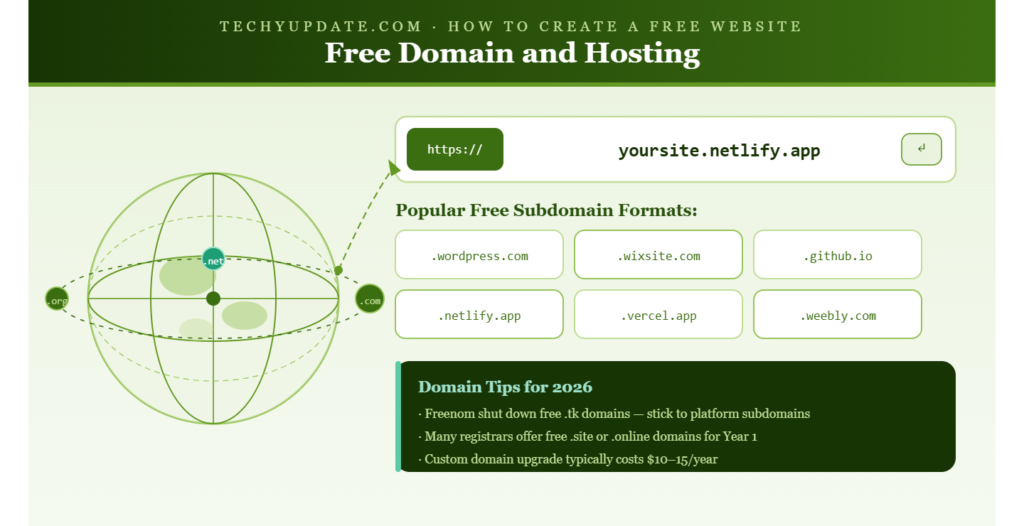
In most cases, a free setup includes a subdomain, such as yourname.platform.com, instead of a fully custom domain like yourname.com. This makes it possible to create a free website quickly and easily, especially for beginners, students, and small projects.
Free hosting platforms usually offer basic features such as drag-and-drop builders, limited storage, and standard security. While they are perfect for learning and testing ideas, they often come with restrictions such as platform branding, limited customization, and lower performance than paid solutions.
Difference Between Free Domain and Custom Domain
A free domain website typically operates on either a subdomain provided by a hosting platform or a free domain extension, subject to limited conditions. In contrast, a custom domain is a fully owned, unique web address that the user purchases and controls.
Free Domain – Key Characteristics
- Provided by free hosting platforms
- Often appears as a subdomain site (e.g., yoursite.platform.com)
- Limited branding flexibility
- May include platform name in URL
- Suitable for beginner website setup and testing
Custom Domain – Key Characteristics
- Fully owned domain (e.g., yourbrand.com)
- Strong branding and credibility
- Better SEO perception and trust signals
- Full control over DNS and configurations
- Ideal for business, monetization, and scaling
Strategic Comparison
- Free domain website
- Quick setup
- No cost
- Limited authority
- Custom domain
- Professional identity
- Long-term scalability
- Higher ranking potential
A free website domain is effective for launching quickly, while a custom domain strengthens authority and trust as the website grows.
What Is a Subdomain?
A subdomain is a secondary domain that exists under a primary domain owned by a hosting provider. It allows users to create a free website without purchasing a standalone domain.
Structure of a Subdomain
- Format: yoursite.platform.com
- “platform.com” is the main domain
- “yoursite” is the unique identifier assigned to your website
Key Features of a Subdomain
- Instantly available during free website hosting setup
- No registration required
- Integrated with the hosting platform
- Ideal for building a website without coding workflows
Common Use Cases
- Personal blogs
- Testing environments
- Student projects
- Prototype websites
Advantages
- Fast deployment
- Zero cost
- Easy management
Limitations
- Reduced branding control
- Lower perceived authority
- Less flexibility for advanced configurations
A free subdomain site provides a practical entry point, especially when speed and simplicity are priorities.
Limitations of Free Hosting Services
While free website hosting enables rapid, cost-free website creation, it comes with constraints that affect scalability, performance, and branding.
Key Limitations
- Restricted Storage and Bandwidth
- Limited space for files and media
- Traffic caps may affect performance
- Platform Branding and Ads
- Hosting provider ads may appear
- Reduced professional appearance
- Limited Customization
- Restricted access to advanced features
- Fewer design and plugin options
- Performance Constraints
- Slower loading speeds compared to premium hosting
- Shared resources across multiple users
- Domain Restrictions
- Use of a free subdomain site instead of a custom domain
- Limited domain control
- Security Limitations
- Basic security features
- Limited backup and recovery options
- Scalability Challenges
- Not suitable for high-traffic websites
- Upgrade required for growth
Practical Insight for Optimization
To maximize the value of free hosting platforms, we apply a focused strategy:
- Use lightweight designs to improve speed
- Limit heavy media files
- Optimize content for SEO
- Maintain consistent updates
- Transition to premium solutions when growth demands
Best Platforms to Create a Free Website
Choosing the right free website hosting platform is the first step to successfully creating a free website without coding or investment. Platforms like Wix and WordPress.com, InfinityFree, GoogieHost, and AwardSpace offer different features, including templates, storage, and customization options.
Each platform is designed to help beginners and small projects launch a website quickly using a free subdomain site and basic hosting tools, making it easy to build an online presence in minutes.
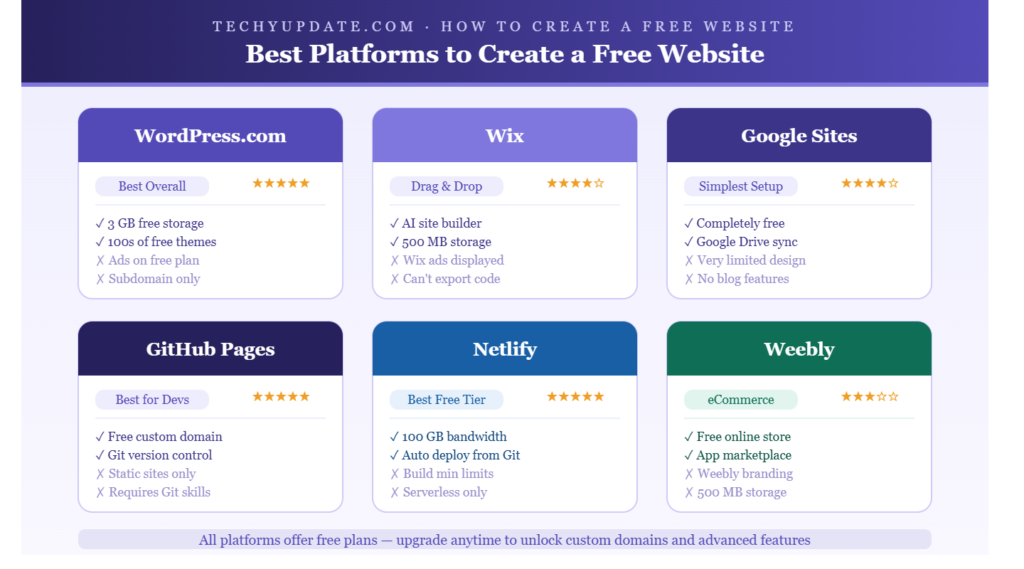
Creating a free website has never been more accessible, scalable, and powerful. Whether we are launching a personal portfolio, startup landing page, blog, or documentation hub, choosing the right platform determines performance, flexibility, and long-term growth.
This comprehensive guide explores the best free website builders: GitHub Pages, Google Sites, Weebly, and Netlify, with in-depth comparisons, use cases, and strategic advantages.
Overview of Popular Free Website Hosting Platforms
Choosing the right free website hosting platform directly impacts performance, scalability, and ease of use. Modern platforms combine no-cost website builder tools, hosting infrastructure, and free subdomain site integration, making it possible to create a free website quickly and efficiently.
Below are the most reliable and widely used free hosting platforms in 2026:
Wix – Visual Website Builder with Free Hosting
Wix is a leading free website hosting platform known for its drag-and-drop builder and design flexibility.
Key Features:
- 2500+ customizable templates
- Built-in SEO tools and AI design assistant
- Free hosting with SSL security
- Mobile-responsive layouts
Strengths:
- Extremely beginner-friendly
- High design flexibility
- Fast website creation without coding
Limitations:
- Limited storage and bandwidth (around 500MB)
- Displays Wix ads on the free plan
- Uses a subdomain (e.g., yoursite.wixsite.com)
Best For:
- Portfolios
- Small business sites
- Personal branding
WordPress.com – Content-Focused Free Hosting
WordPress.com offers a powerful content management system (CMS) with integrated free website hosting.
Key Features:
- Block-based editor for easy content creation
- 3GB storage for media and pages
- Built-in blogging and publishing tools
- Free SSL and secure hosting
Strengths:
- Ideal for blogging and content-driven websites
- Strong SEO foundation
- Large theme library
Limitations:
- Limited customization on the free plan
- Platform ads displayed
- Subdomain usage (yoursite.wordpress.com)
Best For:
- Bloggers
- Writers
- Educational websites
InfinityFree – Unlimited Resource Free Hosting
InfinityFree stands out for offering free website hosting with high resource limits.
Key Features:
- 5GB storage and unlimited bandwidth
- Free SSL certificate
- PHP and MySQL support
- Free subdomain options
Strengths:
- No forced ads on websites
- Supports custom domains
- Suitable for dynamic websites
Limitations:
- Limited support services
- Performance may vary under high traffic
Best For:
- Developers
- Small projects
- Practice websites
GoogieHost – Advanced Free Hosting Features
GoogieHost offers feature-rich free hosting with tools typically found in paid plans.
Key Features:
- 1GB storage and 100GB bandwidth
- Free SSL and malware protection
- Drag-and-drop builder
- Free subdomains
Strengths:
- No ads on hosted websites
- Advanced tools for customization
- Strong security features
Limitations:
- Interface includes external ads
- Occasional reliability concerns
Best For:
- Small business starter sites
- Experimentation with advanced features
AwardSpace – Beginner-Friendly Hosting Platform
AwardSpace is a simple and clean platform designed for beginners.
Key Features:
- One-click CMS installation (WordPress, Joomla)
- Free domain and subdomains
- Ad-free hosting
Strengths:
- Easy control panel
- Supports multiple websites
- Reliable for small projects
Limitations:
- Limited bandwidth (around 5GB/month)
- Restricted scalability
Best For:
- Beginners
- Small static websites
Freehostia – Lightweight Hosting for Small Sites
Freehostia provides basic free hosting with reliable support.
Key Features:
- 250MB storage and 6GB bandwidth
- Email accounts included
- Ticket-based support
Strengths:
- Stable hosting for small websites
- Easy setup process
Limitations:
- Very limited storage
- Not suitable for large projects
Best For:
- Test websites
- Micro projects
Features Comparison of Free Hosting Platforms
| Platform | Ease of Use | Storage | Customization | Best Use Case |
| Wix | Very Easy | 500MB | High (visual editor) | Design-focused websites |
| WordPress.com | Easy | 3GB | Medium | Blogging & content |
| InfinityFree | Moderate | 5GB | High (developer-friendly) | Dynamic websites |
| GoogieHost | Moderate | 1GB | Medium-High | Small business sites |
| AwardSpace | Easy | Limited | Medium | Beginner projects |
| Freehostia | Easy | 250MB | Low | Small test sites |
GitHub Pages: Best for Developers and Static Websites
Key Features
- Free hosting directly from repositories
- Custom domain support
- HTTPS by default
- Jekyll integration for static site generation
- Version control built-in
Advantages
GitHub Pages offers unmatched control for developers. We can build highly optimized static websites with clean code, resulting in:
- Lightning-fast loading speeds
- Superior SEO performance
- Full customization without platform limitations
Limitations
- Requires basic knowledge of Git
- No built-in drag-and-drop builder
- Limited dynamic functionality without external integrations
Best Use Cases
- Developer portfolios
- Technical blogs
- Documentation websites
- Open-source project pages
Google Sites: Best for Simplicity and Collaboration
Key Features
- Drag-and-drop interface
- Seamless integration with Google Workspace
- Real-time collaboration
- Free hosting with Google infrastructure
Advantages
Google Sites is ideal when we need to launch quickly without technical skills. Its simplicity ensures:
- Instant publishing
- Zero maintenance
- Easy team collaboration
Limitations
- Limited design flexibility
- Basic SEO controls
- Minimal customization options
Best Use Cases
- Internal company sites
- Educational projects
- Simple landing pages
Weebly: Best for Beginners and Small Businesses
Key Features
- Intuitive drag-and-drop builder
- Pre-designed templates
- E-commerce functionality
- App center for added features
Advantages
Weebly balances simplicity and functionality, allowing us to create professional websites without coding:
- Built-in SEO tools
- Mobile-responsive themes
- Easy content management
Limitations
- Weebly branding on free plan
- Limited advanced customization
- Less flexibility compared to modern builders
Best Use Cases
- Small business websites
- Personal blogs
- Basic online stores
Netlify: Best for Modern Web Development and Performance
Key Features
- Continuous deployment from Git
- Serverless functions
- Global CDN
- Custom domains with HTTPS
Advantages
Netlify is built for performance and scalability. We can deploy modern websites effortlessly:
- Instant global distribution
- Automated builds and deployments
- Advanced developer workflows
Limitations
- Requires familiarity with Git and build tools
- Not beginner-friendly
- Static-first approach
Best Use Cases
- Jamstack websites
- High-performance landing pages
- SaaS frontends
- Developer portfolios
Feature Comparison Table
| Feature | GitHub Pages | Google Sites | Weebly | Netlify |
|---|---|---|---|---|
| Ease of Use | Medium | Very Easy | Easy | Medium |
| Customization | High | Low | Medium | High |
| SEO Optimization | High | Basic | Good | High |
| Performance | Excellent | Good | Good | Excellent |
| E-commerce | No | No | Yes | Via integrations |
| Developer Friendly | High | Low | Low | High |
How to Choose the Best Free Website Platform
Choose GitHub Pages if:
- We want full control over code
- Performance and SEO are top priorities
- We are comfortable with Git workflows
Choose Google Sites if:
- We need a quick and simple website
- Collaboration is essential
- Design flexibility is not critical
Choose Weebly if:
- We want an easy drag-and-drop builder
- We are launching a small business site
- Basic e-commerce is needed
Choose Netlify if:
- We build modern web apps or static sites
- Speed and scalability matter
- We use frameworks like React, Vue, or Next.js
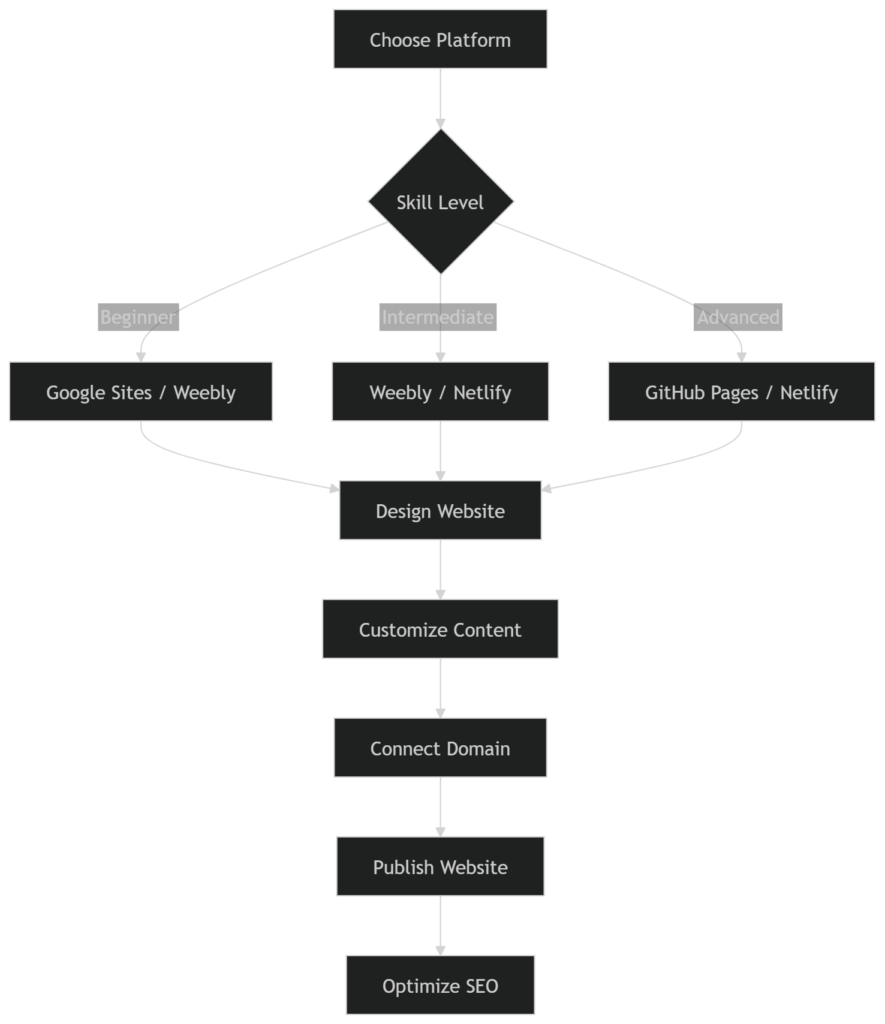
Website Creation Workflow Diagram
SEO Tips for Free Websites That Actually Rank
- Use keyword-rich titles and headings
- Optimize images with alt text
- Maintain fast loading speeds
- Use clean URL structures
- Add meta descriptions manually where possible
- Build backlinks through content and sharing
Final Verdict: Which Platform Wins?
Each platform dominates in its own category:
- Best for developers: GitHub Pages
- Best for beginners: Google Sites
- Best all-rounder: Weebly
- Best for performance: Netlify
The smartest approach is choosing based on our goals, technical skill level, and long-term scalability needs.
Key Insights for Choosing the Best Platform
For Beginners
- Wix and WordPress.com offer the simplest setup
- No coding required
- Fast deployment
For Flexibility and Customization
- InfinityFree provides more control
- Supports databases and scripts
For Lightweight Projects
- Freehostia and AwardSpace are efficient
- Minimal resource requirements
For Visual Design
- Wix dominates with templates and UI tools
Strategic Recommendation
We select a platform based on goal alignment:
- Create a free website quickly: Wix
- Content-driven growth: WordPress.com
- Technical flexibility: InfinityFree
- Balanced beginner setup: AwardSpace
By choosing the right free website hosting platform, we build a scalable, optimized, and high-performing website, ensuring a strong foundation for SEO, performance, and long-term growth.
Step-by-Step Guide to Create a Free Website
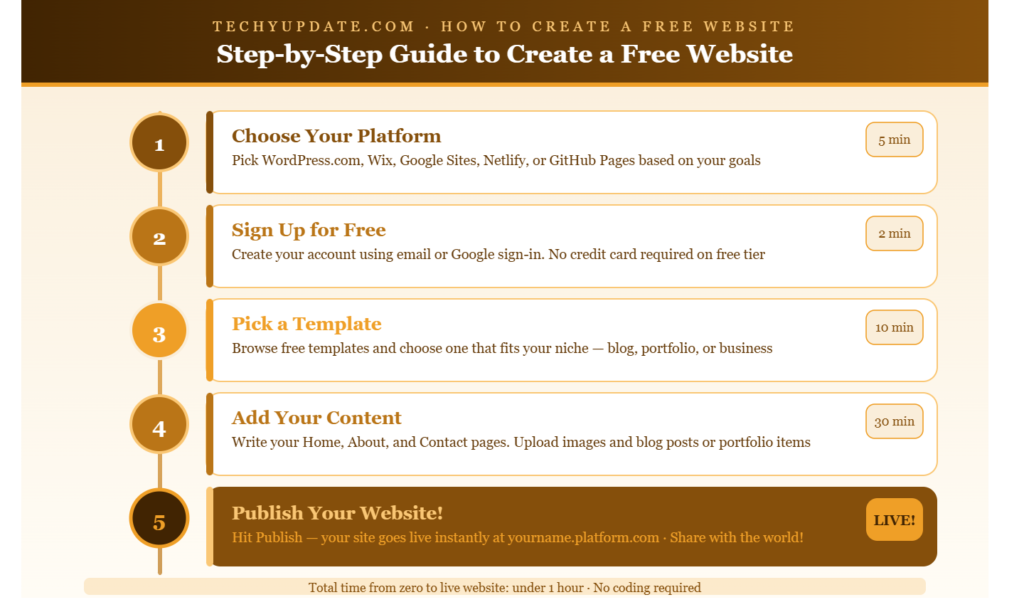
Creating a free website is now faster and more accessible than ever. With modern platforms offering ready-made templates, drag-and-drop builders, and seamless hosting, we can launch a professional-looking site without any upfront cost or advanced technical skills.
In this guide, we walk through a clear, step-by-step process to help us choose the right platform, design our website, add content, and publish it online, ensuring a smooth start and a strong digital presence from day one.
Choose a Free Website Builder
Selecting the right no-cost website builder is the foundation of a successful free website hosting setup. The platform determines how easily we can create a free website, customize the design, and manage content.
Selecting the Right Platform for Beginners
We prioritize platforms that offer:
- Simple user interface with drag-and-drop functionality
- Pre-built templates for quick setup
- Integrated free hosting platforms
- No coding requirement for faster development
Best Beginner-Friendly Characteristics
- Visual editor for real-time design
- Guided onboarding process
- Built-in SEO tools
- Automatic mobile optimization
Key Features to Look For
- Free subdomain site support
- Storage and bandwidth allocation
- SSL security (HTTPS)
- Customization flexibility
- Media management tools
- Performance optimization features
A strong builder ensures we can build a website without coding while maintaining performance and scalability.
Sign Up and Create an Account
After selecting a platform, we proceed with account creation to activate free website hosting.
Registration Process
- Visit the platform’s official website
- Enter email address or use social login
- Verify account through email confirmation
- Access dashboard and setup wizard
Choosing the Free Plan
- Select the free website hosting plan
- Confirm limitations (storage, ads, bandwidth)
- Activate the free subdomain site option
Setup Optimization
- Choose region/server if available
- Enable basic security settings
- Connect analytics if supported
This step establishes the infrastructure required to create a free website efficiently.
Select a Website Template
The template defines the visual structure and user experience of the website.
Importance of Design and Layout
- Impacts first impressions and engagement
- Determines readability and navigation flow
- Influences SEO through user behavior metrics
Choosing a Responsive Template
We ensure the template is:
- Mobile-friendly (responsive design)
- Fast-loading and lightweight
- Compatible with different screen sizes
- Optimized for accessibility
Template Selection Strategy
- Match template with niche (blog, business, portfolio)
- Choose a clean layout with clear navigation
- Avoid overly complex designs
A well-selected template accelerates the setup of a beginner’s website while ensuring a professional appearance.
Customize Your Website
Customization transforms a template into a unique free domain website aligned with branding and purpose.
Editing Content (Text, Images, Videos)
We optimize all content elements:
- Replace placeholder text with keyword-rich content
- Upload high-quality, compressed images
- Embed videos for engagement
- Maintain consistent tone and style
Creating Essential Pages
Every website with free hosting must include:
- Home Page
- Clear value proposition
- Call-to-action (CTA)
- About Page
- Brand story
- Credibility and trust signals
- Contact Page
- Email, form, or social links
- Location (if applicable)
- Optional Pages
- Blog
- Services
- Portfolio
Branding Your Website
Strong branding improves recognition and trust.
- Use a consistent color scheme
- Add logo and favicon
- Maintain uniform typography
- Align visuals with niche identity
Customization ensures the free website domain stands out and engages users effectively.
READ MORE: How to Increase Website Traffic Without SEO
Get a Free Domain
A domain connects users to the website and defines its identity.
How Subdomains Work
A free subdomain site is automatically assigned by the hosting platform.
Structure:
- yourname.platform.com
- “platform.com” = main domain
- “yourname” = unique identifier
Examples of Free Domain Structures
- yourbrand.wixsite.com
- yoursite.wordpress.com
- myproject.infinityfreeapp.com
Optimization Tips
- Keep the domain short and memorable
- Include the primary keyword naturally
- Avoid numbers and special characters
A free website domain enables instant publishing at no additional cost.
Publish Your Website
Publishing makes the website publicly accessible.
Making Your Website Live
- Click the Publish or Launch button
- Activate free hosting platforms
- Confirm domain connection
Testing Functionality
Before promoting, we verify performance:
- Check navigation links
- Test forms and contact features
- Ensure mobile responsiveness
- Verify loading speed
- Confirm SSL (HTTPS enabled)
Final Optimization Checklist
- Fix broken links
- Optimize images for speed
- Review content for clarity
- Test across browsers
Publishing completes the process of creating a fully functional website with free hosting, ready for traffic, SEO, and growth.
Advantages of Free Website Hosting
Free website hosting offers an accessible entry point for individuals and businesses looking to establish an online presence without financial commitment. However, while it provides clear benefits, it also has limitations that can affect growth and performance.
Cost-Effective Solution
A major advantage of free website hosting is the ability to launch a website without any financial investment. This allows us to test ideas, build an online presence, and experiment with content strategies without risk.
Key Benefits:
- Zero upfront cost for hosting and domain
- Ideal for students, beginners, and startups
- Enables rapid idea validation
- Eliminates financial barriers to entry
This makes it possible to create a free website and start building traffic immediately.
No Coding Required
Modern no-cost website builders are designed for simplicity, allowing us to build a website without coding.
Core Advantages:
- Drag-and-drop interface
- Pre-designed templates
- Visual editing tools
- AI-assisted layout generation
Practical Impact:
- Faster website creation
- No technical expertise needed
- Easy updates and maintenance
This approach significantly reduces complexity, making it accessible to beginners to set up a website.
Quick and Easy Setup
Speed is a defining benefit of free hosting platforms.
Setup Highlights:
- Account creation in minutes
- Instant access to templates
- One-click publishing
Efficiency Benefits:
- Launch a free subdomain site quickly
- Immediate online presence
- Rapid iteration and updates
We can go from concept to live website in less than an hour using optimized workflows.
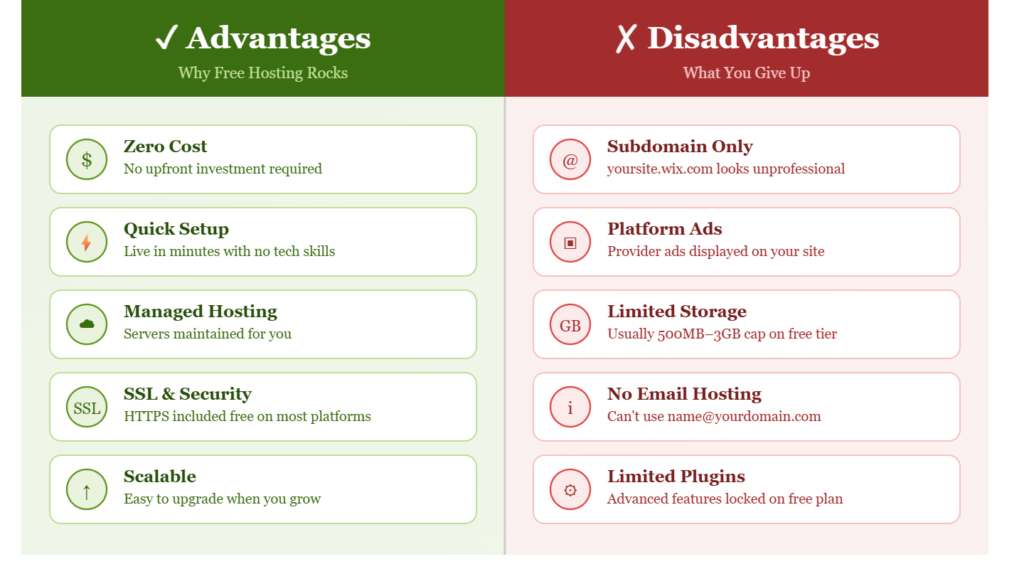
Disadvantages of Free Hosting and Domain
Platform Ads
Many free website hosting services display ads on websites to sustain their business model.
Impact:
- Reduces professional appearance
- Can distract visitors
- Limits branding control
Example:
- Banner ads or branded footers are added automatically
Limited Features and Storage
Free plans come with resource limitations that affect scalability.
Common Restrictions:
- Limited storage space
- Bandwidth caps
- Restricted access to advanced tools
Performance Impact:
- Slower loading times
- Limited ability to upload media
- Reduced flexibility for growth
These constraints make free hosting best suited for small or starter websites.
Lack of Full Control and Customization
Free platforms often restrict access to advanced customization options.
Limitations Include:
- Limited design flexibility
- Restricted plugin or extension access
- No full control over backend settings
Result:
- Difficulty scaling website features
- Reduced ability to implement advanced SEO or integrations
This affects the long-term growth potential of a free website domain.
Tips to Improve Your Free Website
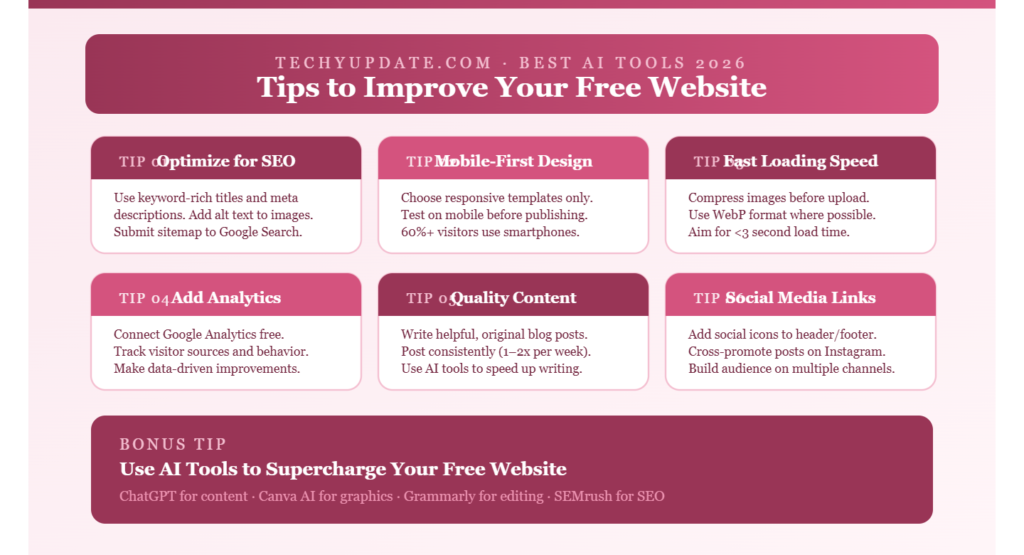
Even with the limitations of free hosting, we can significantly enhance our website’s quality, performance, and visibility by applying the right strategies. A well-optimized free website can still look professional and rank effectively in search engines.
Basic SEO Optimization
Even with free website hosting, we can implement strong SEO practices.
Essential SEO Actions:
- Use keyword-rich headings (H1, H2, H3)
- Optimize meta titles and descriptions
- Add alt text to images
- Maintain a clean URL structure
Content Strategy:
- Focus on user intent-driven content
- Use long-tail keywords
- Update content regularly
These steps improve visibility and potential for ranking.
Mobile Responsiveness
A mobile-friendly website is critical for user experience and search performance.
Optimization Techniques:
- Use responsive templates
- Test layout on multiple devices
- Ensure fast loading on mobile networks
Benefits:
- Better engagement
- Lower bounce rates
- Improved SEO rankings
Mobile optimization ensures accessibility across all devices.
User-Friendly Design Practices
Design directly influences how users interact with a website with free hosting.
Best Practices:
- Use clean and simple layouts
- Maintain consistent color schemes
- Ensure readable fonts and spacing
- Create intuitive navigation
Engagement Enhancers:
- Clear call-to-action buttons
- Organized content structure
- Fast-loading pages
A user-friendly design increases retention and conversion.
When to Upgrade to Paid Hosting
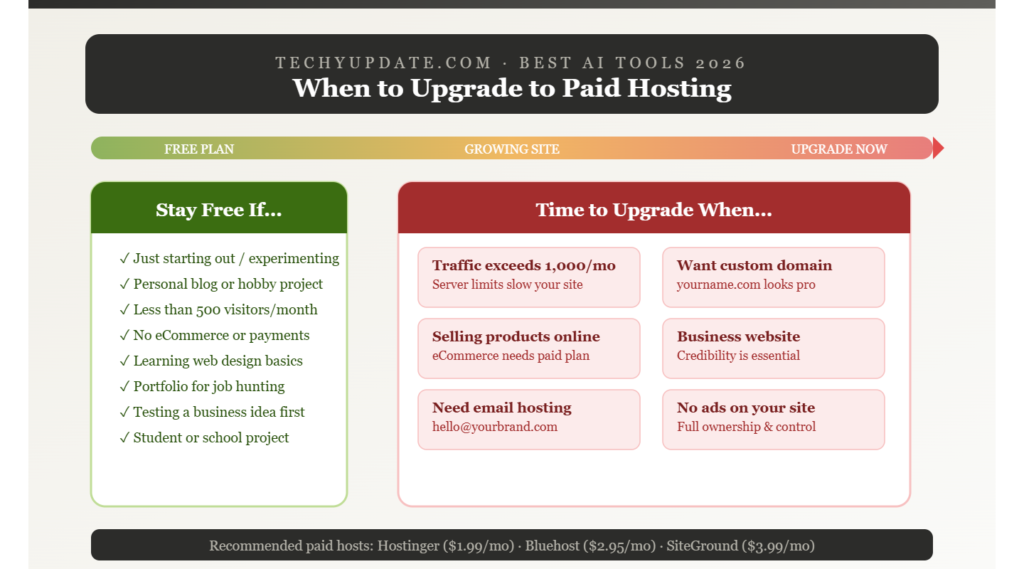
Free hosting is a great starting point, but it has limits that can slow down growth. As our website begins to attract more visitors, requires better performance, or needs to represent the brand professionally, upgrading to paid hosting becomes a smart move. In this section, we highlight the key signs that indicate it’s time to switch so we can ensure faster speeds, greater control, improved security, and a more credible online presence.
Signs You Need a Custom Domain
A free website hosting setup is ideal for starting, testing, and learning. However, as the website grows, certain clear indicators show that it is time to upgrade to a custom domain and paid hosting.
Key Signs It’s Time to Upgrade
- Traffic is increasing consistently
- Your site receives regular visitors beyond basic limits
- Branding is becoming important
- You need a professional identity beyond a subdomain site
- Monetization is planned or already active
- Ads, affiliate marketing, or product sales require credibility
- Free platform ads are affecting user experience
- Visitors see unwanted branding or advertisements
- Storage and bandwidth limits are being reached
- Media-heavy content slows performance or causes restrictions
- You need advanced features
- Plugins, databases, integrations, or custom code are required
When these conditions appear, it signals that your free website domain has reached its functional limit.
Benefits of Upgrading to Paid Hosting
Moving from free website hosting to paid solutions provides a significant upgrade in performance, control, and scalability.
1. Full Ownership and Branding
- Custom domain (e.g., yourbrand.com)
- Professional identity and credibility
- No platform branding or subdomains
This strengthens trust and improves brand recognition.
2. Improved Performance and Speed
- Dedicated resources instead of shared limits
- Faster loading times
- Better handling of high traffic volumes
This directly improves user experience and SEO rankings.
3. Advanced Customization
- Full control over website design
- Access to plugins, themes, and integrations
- Ability to modify backend functionality
This allows us to build a fully customized digital platform.
4. Enhanced SEO Potential
- Better indexing and ranking signals
- Improved domain authority over time
- Clean, keyword-optimized URLs
Search engines prioritize custom domain websites over free subdomain sites.
5. Stronger Security and Reliability
- Advanced SSL configurations
- Automated backups
- Malware protection and firewalls
This ensures data safety and business continuity.
6. Scalability for Growth
- Ability to handle increasing traffic
- Expand content, features, and functionality
- Support for e-commerce or business systems
Paid hosting supports long-term digital growth strategies.
Conclusion
Summary of Steps
Creating a successful online presence begins with understanding how to effectively use free website hosting and gradually scale toward professional solutions.
Step-by-Step Summary
- Choose a free website hosting platform
- Register and create an account
- Select a no-cost website builder template
- Customize design and content
- Add essential pages (Home, About, Contact)
- Set up a free subdomain site or free website domain
- Publish and test the website
- Optimize for SEO and mobile performance
- Monitor growth and user engagement
- Upgrade to paid hosting when needed
Final Insight
A free website with free hosting and a domain is the perfect starting point for beginners, learners, and small projects. It provides a risk-free environment for building skills, testing ideas, and establishing an online presence. However, as goals evolve toward branding, monetization, and scalability, upgrading to paid hosting becomes a strategic necessity for long-term success.
Understanding the structure of a free website domain, the role of subdomains, and the limitations of free hosting services enables us to build strategically. By leveraging free website hosting effectively, we create a strong foundation while preparing for future scalability and performance enhancements.
By leveraging the advantages of free website hosting, addressing its limitations strategically, and applying optimization techniques, we transform a simple free subdomain site into a high-performing, user-focused digital platform capable of growth and visibility.
What is free website hosting?
Free website hosting is a service that allows us to publish a website online without paying for server space. Hosting providers store website files and make them accessible on the internet using a free subdomain or a limited-domain option.
Key points:
- No upfront cost
- Limited storage and bandwidth
- Basic features included
- Ideal for beginners and testing projects
Can I get a free domain and hosting together?
Yes, many platforms offer free website hosting with a free domain.
Common setups include:
- Free subdomain (yourname.platform.com)
- Free domain extensions (.tk, .ml, etc.)
- Bundled hosting + builder packages
However, these are usually limited in branding and control compared to paid domains.
What is the difference between a domain and hosting?
A domain is the website address, while hosting is the storage system that keeps the website online.
Simple breakdown:
- Domain: www.yourwebsite.com (address)
- Hosting: Server where files are stored
Both are required for a fully functional website.
Are free website hosting services safe to use?
Yes, most free hosting platforms are generally safe if they are well-known and reputable.
Safety features often include:
- Basic SSL encryption (HTTPS)
- Account login protection
- Limited server access for security
However:
- Advanced security features may be limited
- Data backups may not always be guaranteed
Can I create a website without coding skills?
Yes, modern no-cost website builders allow us to build a website without coding.
Features that make this possible:
- Drag-and-drop editors
- Pre-designed templates
- AI-assisted website creation
- Visual customization tools
This makes setting up a beginner website simple and fast.
What are the limitations of a free domain website?
A free website domain comes with several restrictions.
Main limitations:
- Limited branding control
- Platform-based subdomain (e.g., yoursite.platform.com)
- Storage and bandwidth limits
- Display of ads on some platforms
- Less professional appearance
These factors affect long-term scalability and authority.
How long does it take to create a free website?
Creating a free website with free hosting can take anywhere from:
- 15 minutes to 1 hour for basic setup
- A few hours for customization and content creation
With templates and builders, the process is extremely fast.
Can I switch from free hosting to paid hosting later?
Yes, most platforms allow smooth migration from free website hosting to paid hosting.
Upgrade benefits include:
- Custom domain connection
- Better performance and speed
- Advanced customization options
- Full ownership and control
This is a common growth path for websites.
Which platform is best for creating a free website?
The best platform depends on your needs:
- Wix: Best for design and beginners
- WordPress.com: Best for blogging and content
- InfinityFree: Best for flexibility and developers
- GoogieHost: Balanced features for small projects
Each supports free website hosting with different strengths.
Is a free website good for professional use?
Free website hosting is suitable for learning, testing, and personal projects, but it has limitations for professional use.
Good for:
- Portfolios (basic level)
- Practice projects
- Small personal blogs
Not ideal for:
- Established businesses
- E-commerce platforms
- High-traffic professional websites
For professional branding, upgrading to a custom domain and paid hosting is recommended.