


Pricing clarity matters more for Leonardo AI than for most tools in this category, because Leonardo has recently renamed its plans, and much of what’s indexed on Google still refers to the old names. If you’ve searched around and seen “Apprentice,” “Artisan,” and “Maestro” in one article and “Essential,” “Premium,” and “Ultimate” in another, you’re not imagining things.
Both sets of names have been used by Leonardo at different points, and the two maps roughly overlap the same price points, which is exactly the kind of inconsistency that leaves shoppers second-guessing whether they’re looking at current information.
That confusion is precisely why this section exists. Rather than repeating whichever plan names were live when a particular article was written, we’ve cross-referenced multiple sources checked in mid-2026 to lock down the pricing structure as it stands today, while explicitly flagging the legacy names so you can map old information onto current reality.

We’ve also broken down what each tier is actually good for, where the hidden costs live in a token-based system like Leonardo’s, and — because “free alternative” is one of the highest-intent searches around any paid creative tool — a full alternatives section covering the best free and paid competitors worth considering before you subscribe.
Token-based pricing, in particular, is one of the more misunderstood billing models in this space. Unlike a flat “20 images per month” cap, Leonardo charges variable token amounts per generation depending on the model, resolution, and quality settings you choose, which means two people on the identical plan can get wildly different amounts of usable output.
Understanding that mechanic — not just the sticker price — is the difference between picking a plan that fits your workflow and one that leaves you either overpaying or constantly running dry.
Table of Contents
Understanding the Token Economy

Before diving into individual tiers, it’s worth spending a moment on how Leonardo actually charges for usage, because this is the part that trips up more new subscribers than the sticker price ever does. Every single generation — an image, an edit, an upscale, a video clip — costs a variable number of tokens rather than a single flat “credit.”
A basic image at default settings on a lightweight model might cost a handful of tokens, while the same prompt run through a premium-quality preset like Alchemy or a heavier third-party model can cost several times as much for a single output.
This matters because two people on the exact same plan can have wildly different real-world experiences. Someone who sticks to fast, default-quality generations on Phoenix might comfortably produce hundreds of images a month on a mid-tier plan.
Someone who leans heavily on quality-boosting presets, high resolutions, or third-party video models can burn through the same monthly allowance in a fraction of the time. If you’re trying to estimate whether a given tier will actually be enough for you, the honest answer is: it depends far more on how you generate than on the raw token number printed on the pricing page.
The upside of this system, once you understand it, is genuine flexibility — you’re not boxed into a fixed “20 images per month” cap that ignores resolution or complexity. The downside is that the pricing page alone doesn’t reveal your actual capacity; you have to use the tool for a week or two to calibrate your burn rate before committing to an annual plan.
Full Pricing Tier Breakdown
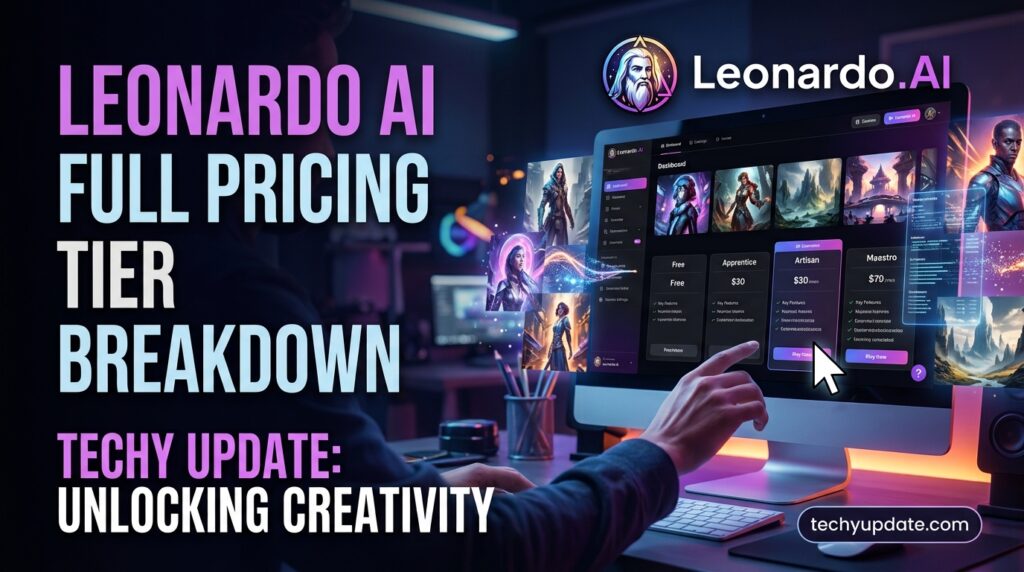
Free. The free plan gives new users a daily allowance of Fast Tokens (typically around 150/day) that can be used across Leonardo’s core models, including access to Phoenix and select community and third-party models at basic quality settings. Generations on the free plan are public, meaning other users can see them, and Leonardo — not the user — holds broader rights over that public content.
It’s genuinely enough to properly evaluate the platform’s model variety and canvas tools, but it’s not suitable for confidential client work, and heavier features like Alchemy-style quality boosts burn through the daily allowance quickly. Honest caveat: because token cost varies by model and setting, the “150 tokens a day” figure can translate to anywhere from a dozen to several dozen usable images depending on what you’re generating.
Essential (legacy name: Apprentice). Priced at roughly $12/month billed monthly, or around $10/month billed annually, this is the first paid volume tier. It substantially increases the monthly token pool (commonly cited as 8,000–8,500) and unlocks private generations, meaning your work is no longer visible in the public feed. It fits freelancers, indie creators, and hobbyists who’ve outgrown the free plan’s public-only limitation but don’t yet need team features or heavy API usage.
Honest caveat: at this tier, model training and API access are typically still limited or unavailable, so power users doing custom brand-model training will hit ceilings quickly.
Premium (legacy name: Artisan). Priced at roughly $30/month billed monthly, or around $24/month billed annually, this tier roughly triples the token allowance again (commonly cited around 25,000/month) and typically adds unlimited relaxed generation on select first-party models, meaning you can keep generating at a slower, queued pace even after burning through your fast tokens.
This is the tier most reviewers cite as the best all-around value for regular creators and small-business users. Honest caveat: “unlimited” relaxed generation generally applies only to Leonardo’s own first-party models, not to third-party or premium video pipelines, which still draw from your token pool.
Ultimate (legacy name: Maestro). Priced at roughly $60/month billed monthly, or around $48/month billed annually, this is the top consumer tier, with the largest token allowance (commonly cited around 60,000/month), priority generation speed, and the fullest feature access among solo plans, including deeper access to model training and higher-tier quality presets.
It’s built for professionals and small studios generating at a real production volume. Honest caveat: even at this tier, heavy video generation and third-party model usage can still exhaust your monthly allowance, pushing you toward Token Top-up purchases.
Team plans. Leonardo also offers Team tiers (commonly cited starting around $72/month for a starter team seat structure, scaling up for larger teams) that add shared token pools, collaboration features, and centralized billing — relevant for agencies and in-house creative teams that need multiple seats under one account.
Flag: exact current token allowances, plan names, and price points can and do shift on Leonardo’s live pricing page; the figures above are cross-referenced from multiple sources checked in mid-2026 and should be verified at checkout before you commit.
Feature-per-Tier Table
| Feature | Free | Essential | Premium | Ultimate |
|---|---|---|---|---|
| Monthly price (billed annually) | $0 | ~$10 | ~$24 | ~$48 |
| Daily/monthly tokens | ~150/day | ~8,500/mo | ~25,000/mo | ~60,000/mo |
| Private generations | No | Yes | Yes | Yes |
| Unlimited relaxed generation (select models) | No | No | Yes | Yes |
| Model training | No | Limited | Yes | Expanded |
| API access | No | Limited/No | Add-on | Add-on |
| Token rollover | No | Yes | Yes | Yes |
| Priority generation speed | No | No | Partial | Yes |
Hidden Costs
- Token top-ups. Once you exhaust your monthly allowance, continuing to use premium models or video features often requires purchasing separate top-up token packs, which are priced outside the base subscription.
- Model-dependent token burn. Higher-fidelity presets and premium or third-party models consume tokens far faster than default settings, meaning your effective “cost per image” varies widely depending on what you generate.
- Rollover limits. While unused tokens can roll over on paid plans, rollover is typically capped, so tokens don’t accumulate indefinitely — heavy users who don’t spend their full allowance still lose the excess eventually.
- Cancellation forfeits banked tokens. If you cancel a paid plan, unused rollover tokens generally don’t transfer back to a free account, so timing your cancellation to actually use banked tokens first matters.
- Video and third-party model costs. Video generation and access to third-party models typically draw from the same token pool at a steeper rate than standard image generation, which can surprise users who budgeted based on image-only usage.
Free Plan Analysis
The free plan is genuinely one of the more generous entry points in the category, especially compared to competitors like Midjourney, which offers no free tier. It’s sufficient to seriously evaluate model variety, test the AI Canvas, and get a feel for prompt adherence before spending anything. The real limitation isn’t the daily token count in isolation — it’s that free-tier work is public by default, and that heavier features burn through the allowance so quickly that daily “power users” will hit the ceiling within their first week or two of real use.
API / Developer Pricing
Leonardo offers API access for developers and businesses wanting to integrate generation directly into their own products or pipelines, generally gated to higher solo tiers or offered as a separate add-on, alongside pay-as-you-go credit options for lighter integration needs. Teams building production pipelines should budget separately for API usage rather than assuming it’s bundled into a standard consumer subscription, since access and limits vary by plan.
Annual vs Monthly Billing
Across every paid solo tier, annual billing consistently saves roughly 17–20% compared to paying monthly — for example, the Essential tier’s monthly-billed price of around $12 drops to an effective ~$10/month when paid annually. There’s no evidence of deeper promotional discounts beyond this standard annual rate; unlike some competitors, Leonardo doesn’t appear to run frequent seasonal sales, so the annual commitment is the primary lever for saving money if you’re confident you’ll stay subscribed.

Value-for-Money Verdict
For a regular creator generating multiple times a week, the Premium/Artisan tier at roughly $24–$30/month represents the strongest value point in the lineup: it adds private generations, meaningfully more tokens, and unlimited relaxed generation on core models without jumping to the Ultimate tier’s price.
Casual users are genuinely well served by staying on the free plan far longer than they might expect, given how generous the daily allowance is relative to competitors with no free option at all. The Ultimate tier only earns its price for users at real production volume — daily professional output, client work, or team-adjacent solo use.
Top 5 Alternatives (Including Best Free Alternatives)

1. Midjourney. The category’s most artistically distinctive default output, with strong photorealism and consistently praised aesthetic quality, straight out of the prompt box. Honest weakness: no free tier at all as of 2026, and it operates through a more constrained, prompt-only workflow without an equivalent to Leonardo’s Canvas. Price: plans typically range from $10 to $120/month, depending on the tier.
2. Adobe Firefly. Deep integration with Photoshop and the broader Adobe ecosystem makes it the natural pick for teams already living inside Adobe tools, with commercially safe training data as a selling point. Honest weakness: the default artistic range feels narrower and more “corporate” than Leonardo’s or Midjourney’s for stylized or experimental work. Price: bundled into Creative Cloud plans or available as a standalone subscription.
3. Ideogram. Best-in-class at generating clean, accurate text within images, a persistent weak spot for most competitors. Honest weakness: general artistic and photorealistic output isn’t as consistently strong as Leonardo or Midjourney outside of text-heavy use cases. Price: offers a usable free tier with paid tiers priced competitively against Leonardo.
4. Stable Diffusion (self-hosted or via a host like RunPod/Civitai-linked services). The most flexible and cheapest-at-scale option for technically capable users willing to manage their own model setup, with total control over fine-tuning. Honest weakness: real technical overhead — no polished all-in-one interface, and hosting costs or local hardware requirements replace a simple subscription fee. Price: free if self-hosted with your own hardware; variable if using a hosted service.
5. Free/best-free-alternative pick — Bing Image Creator (Microsoft Designer) / Google’s free-tier image tools. For users specifically hunting for “free alternative to Leonardo,” Microsoft’s and Google’s consumer-facing free image generators are the most accessible zero-cost entry points, requiring only an existing account. Honest weakness: far less model variety, no comparable canvas/editing toolset, and noticeably less control over style and consistency than Leonardo’s free tier. Price: free, with usage limits.
Switching Plans and Canceling: What Actually Happens
A detail that rarely makes it into pricing pages but matters a lot in practice: Leonardo’s upgrade and downgrade mechanics are asymmetric. Upgrading to a higher tier applies immediately, so you get the expanded token pool and any newly unlocked features right away, prorated for the remainder of your billing cycle.
Downgrading works differently — the change is scheduled to take effect at the end of your current billing cycle, not instantly, so you keep your current tier’s full feature set (and token allowance) until that cycle ends, rather than losing access the moment you click “downgrade.”
Cancellation has its own wrinkle worth knowing about before you commit tokens to a big project: any unused tokens sitting in your Rollover Bank do not carry over to a free account once a paid subscription is canceled.
If you’re planning to cancel, the financially sensible move is to burn down your banked tokens on real work first, since there’s no mechanism to reclaim or convert them after the fact. This is a fairly standard practice across subscription-based creative tools, but it’s easy to forget when a banked token balance feels like “saved” value rather than a use-it-or-lose-it allowance.
Alternatives Comparison Table
| Tool | Free Tier | Entry Paid Price | Standout Strength | Notable Weakness |
|---|---|---|---|---|
| Leonardo.Ai | Yes (generous) | ~$10–12/mo | Model variety + AI Canvas | Confusing token system |
| Midjourney | No | ~$10/mo | Default artistic quality | No free tier, prompt-only |
| Adobe Firefly | Limited | Creative Cloud pricing | Adobe ecosystem integration | Narrower stylistic range |
| Ideogram | Yes | Competitive with Leonardo | In-image text accuracy | Weaker general photorealism |
| Stable Diffusion (self-hosted) | Yes (if self-hosted) | Hardware/hosting cost | Full control, cheapest at scale | Real technical overhead |
Real Budget Scenarios
The weekend hobbyist. Generates a handful of images a couple of times a month, mostly for personal projects or gift ideas. The free plan comfortably covers this pattern indefinitely, and there’s little reason to ever upgrade unless the privacy of generations becomes a concern.
The active hobbyist / part-time creator. Generates several times a week, experiments with multiple models, and occasionally wants privacy for a personal project. This is the classic Essential-tier user — the roughly $10–12/month price point provides enough headroom to stop daily token rationing while keeping costs low.
The freelancer or small-business owner. Produces client-facing or brand assets weekly, needs private generations by default, and occasionally uses higher-quality presets for final deliverables. Premium is the natural fit here, and most reviewers (including this one) consider it the best value tier in the lineup precisely because of the unlimited relaxed generation on first-party models.
The studio or high-volume professional. Generates daily, across multiple projects, sometimes including video, and needs priority speed so client deadlines aren’t held hostage by a queue. Ultimate is built for this pattern, though even Ultimate subscribers doing heavy video work should budget for occasional token top-ups.
The agency or in-house creative team. Multiple people need access to a single account with shared billing and centralized token pools. Team plans solve a real coordination problem that solo tiers can’t, even if the per-seat math looks steeper on paper.
Who Should Pick What
Choose Leonardo.Ai if you want model variety, real editing control via the Canvas, and a genuinely usable free tier while you decide. Choose Midjourney if your highest priority is default artistic quality and you’re comfortable paying from day one, with no free trial.
Choose Adobe Firefly if your team already lives inside Creative Cloud and commercially safe training data matters to your organization. Choose Ideogram if your core use case revolves around legible in-image text. Choose self-hosted Stable Diffusion only if you have the technical comfort to manage your own infrastructure and want the lowest long-run cost at scale.
Read more: Leonardo AI Review 2026
Read more: Leonardo AI vs Midjourney 2026: Full Comparison
FAQ
Is Leonardo AI cheaper than Midjourney? At the entry tier, pricing is close — both sit around $10–12/month — but Leonardo also offers a genuinely usable free plan, which Midjourney does not, making Leonardo the cheaper option for anyone not ready to commit to a paid plan immediately.
Does Leonardo AI offer a free trial of paid plans? Leonardo’s core offering is a standing free plan rather than a time-limited trial of paid tiers; users typically upgrade directly to a paid plan when the free allowance no longer meets their needs.
What’s the best free alternative to Leonardo AI? For a genuinely no-cost option, free consumer tools like Microsoft’s or Google’s image generators are the most accessible, though they offer far less model variety and editing control than Leonardo’s own free tier.
Can I switch Leonardo AI plans later? Yes, upgrades take effect immediately, while downgrades typically take effect at the end of your current billing cycle, so you keep access to your existing tier’s features until that cycle ends.
Conclusion
Leonardo.Ai’s pricing holds up well against the competition, particularly because of how usable its free tier is and how competitively priced its entry paid tier is compared to Midjourney’s equivalent. The token-based system takes a little time to understand, and shoppers should be careful to check current plan names against Leonardo’s live pricing page, given recent renaming, but the underlying value — especially at the Premium/Artisan tier — is genuinely strong for regular creators.
For most people, the right move is to start free, watch how fast tokens actually deplete under real use, and upgrade only once that ceiling is clearly felt. Part 3 puts that value proposition to the real test: a direct, feature-by-feature comparison against Midjourney.