

The way we search for information online has changed more in the last two years than in the previous decade. Traditional search engines like Google Search once relied heavily on keywords and backlinks to deliver results. But in 2026, artificial intelligence has completely reshaped how search works. At the center of this transformation is Google AI Review, often referred to as Google AI Overview, powered by advanced generative AI systems like Gemini.
Instead of showing only a list of links, Google now provides AI-generated summaries, insights, comparisons, and direct answers at the top of search results. This means users get faster answers without needing to open multiple websites. For businesses, marketers, and content creators, this shift is both an opportunity and a challenge.
Google AI Review is not just a feature it represents a new era of AI-driven search intelligence, where machine learning understands intent, context, and user behavior more deeply than ever before. It combines knowledge graphs, natural language processing, and real-time data to create a conversational search experience.
In this detailed guide, we will explore everything about Google AI Review 2026—how it works, its features, benefits, limitations, SEO impact, and future potential. Whether you are a beginner or a digital professional, this article will help you understand how to adapt to the AI-first search era.
Visit the official Google AI website →
Table of Contents
What is Google AI Review?
Google AI Review is an AI-powered search enhancement that generates instant summaries and answers based on multiple trusted sources across the web. Instead of showing only blue links, it provides a concise AI-written overview at the top of search results.
It is powered by Gemini AI models, which are designed to understand natural-language queries, user intent, and context.
In simple terms:
Google AI Review = Search + AI Summary + Context Understanding
Google AI Overview & Generative Search Ecosystem
Google AI Overview Review
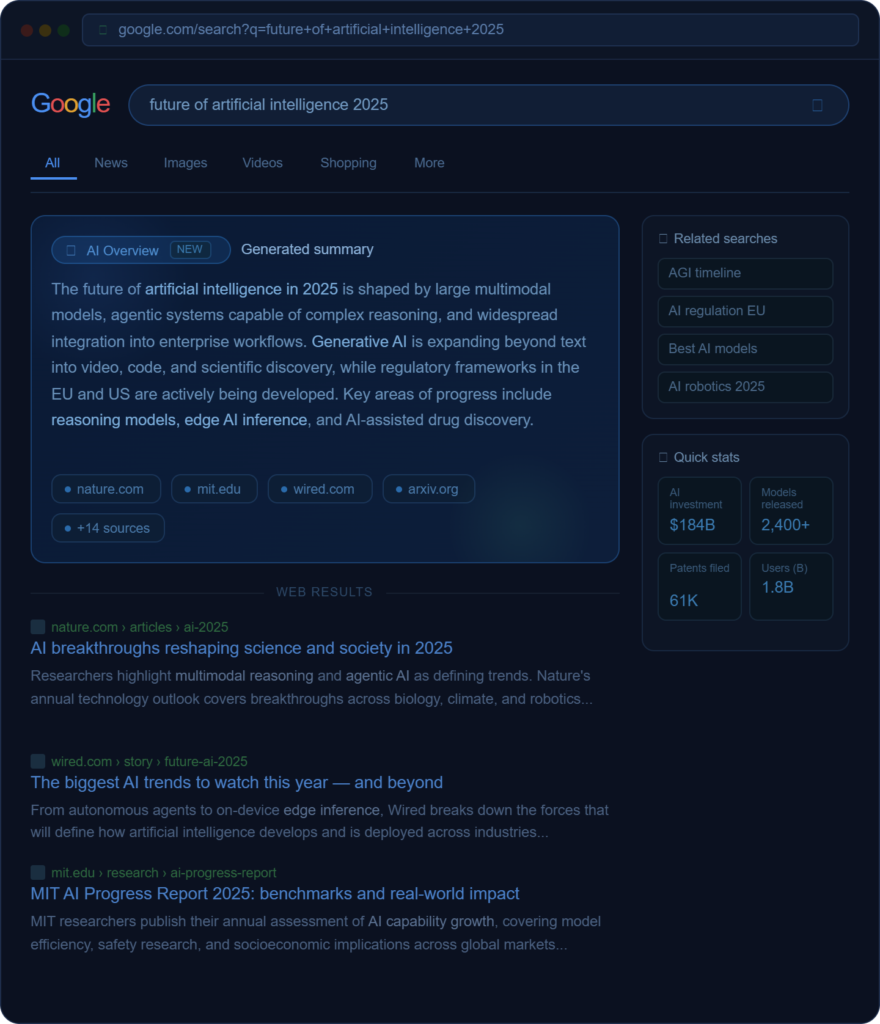
The Google AI Overview is one of the most important advancements in modern search technology. It transforms traditional search results into AI-generated summaries that appear at the top of Google Search.
Instead of showing only links, Google now uses generative AI to analyze multiple sources and provide a direct, conversational answer.
Key Highlights:
- AI-generated summaries above search results
- Multi-source information synthesis
- Context-aware answers based on user intent
- Powered by Google’s Gemini AI models
- Reduces the need to click multiple websites
In 2026, the AI Overview has become the default search experience for millions of users worldwide, reshaping SEO strategies and content creation.
Google AI Features
Google’s AI features in 2026 are designed to make search faster, smarter, and more personalized.
Major Features:
AI Instant Answers
Google provides direct responses rather than only links, saving users time.
Multimodal Search
Users can search using:
- Text
- Voice
- Images
- Video
Context Memory
Search remembers previous queries for better follow-up answers.
Personalized AI Results
Search results adapt based on:
- Location
- Search history
- Interests
Real-Time AI Updates
Google continuously updates answers using live web data.
These features make Google not just a search engine, but a fully intelligent AI assistant ecosystem.
Key Features of Google AI Overview
AI-Powered Summaries
Google automatically generates easy-to-read summaries.
Multi-Source Understanding
It combines multiple websites into one answer.
Conversational Search
Users can ask follow-up questions naturally.
Context Awareness
Remembers previous queries for better responses.
Real-Time Data Integration
Updates answers with live information.
Benefits of Google AI Search
For Users:
- Faster answers
- Less browsing time
- Simplified explanations
- Better decision-making
For Businesses:
- Higher visibility in AI results
- More organic exposure
- Stronger authority signals
For Developers:
- Improved API integration opportunities
- AI-driven search insights
Limitations and Challenges
Despite its power, Google AI Review has limitations:
- Occasional misinformation risk
- Reduced website traffic
- Dependency on training data
- Limited deep-source citations
- SEO unpredictability
Impact on SEO and Websites
Google AI Review is changing SEO forever.
Old SEO Model:
Keywords → Backlinks → Rankings → Clicks
New AI SEO Model:
Intent → Authority → Context → AI Summary Inclusion
Key SEO Changes:
- Click-through rates may decrease
- Content must be more authoritative
- Semantic SEO is essential
- Structured data is more important
Google AI Search Engine
The Google AI Search Engine is a next-generation evolution of traditional search powered by deep learning and generative AI.
Unlike keyword-based systems, it understands:
- User intent
- Semantic meaning
- Contextual relationships
- Entity-based knowledge
How it works:
- User enters query
- AI interprets intent
- Knowledge graph retrieves relevant entities
- Gemini AI generates the final response
This system creates a human-like search experience where answers feel conversational rather than mechanical.
Google Generative AI Review
Google’s generative AI technology is the backbone of its modern search system.

It is powered by advanced models like Gemini, which are capable of:
- Writing summaries
- Explaining complex topics
- Comparing products
- Generating insights from multiple sources
Strengths:
- High-speed information synthesis
- Context-aware reasoning
- Multi-language support
- Deep integration with Google services
Weakness:
- Occasional hallucination risk
- Dependency on source quality
Overall, Google’s generative AI is reshaping how users interact with information globally.
Google Gemini AI Review
The Gemini AI system is Google’s most advanced AI model ecosystem.
It powers:
- Google Search AI Overview
- Google Assistant upgrades
- AI writing and summarization tools
Key Capabilities:
- Multimodal intelligence (text, image, video understanding)
- Deep reasoning across large datasets
- Real-time search integration
- Enterprise-level AI applications
Gemini is positioned as a direct competitor to other AI systems like ChatGPT and other generative platforms.
AI Search Optimization Tools
AI search optimization tools help websites adapt to AI-driven ranking systems.
Top Optimization Strategies:
- Semantic keyword clustering
- Structured data implementation
- Entity-based SEO
- Content depth improvement
- AI readability formatting
Why they matter:
AI search engines no longer rely only on backlinks—they prioritize:
- Context
- Authority
- Relevance
- Content structure
Businesses that adopt AI SEO tools early gain a strong competitive advantage.
Artificial Intelligence Search Engine
An artificial intelligence search engine uses machine learning models to understand queries as humans do.
Core functions:
- Natural language understanding
- Intent prediction
- Knowledge graph mapping
- Predictive search suggestions
Unlike traditional engines, AI search engines focus on meaning rather than keywords.
Generative AI Search Results
Generative AI search results are AI-created responses that combine information from multiple sources into one structured answer.
Example:
Instead of showing 10 links about “best smartphones,” AI gives:
- Summary comparison
- Pros and cons
- Recommendations
- Pricing insights
Benefits:
- Faster decision-making
- Less browsing effort
- More accurate summaries
This shift is redefining the entire SEO ecosystem.
AI-Powered SERP
An AI-powered SERP (Search Engine Results Page) is a search page enhanced with artificial intelligence features.
Key Elements:
- AI Overview box
- Featured snippets
- Knowledge panels
- Conversational follow-ups
Transformation:
Traditional SERP → Link-based
AI SERP → Answer-based
This is one of the biggest revolutions in search history.
Read More: OpenAI Review
Machine Learning Search Ranking
Machine learning search ranking uses algorithms that continuously learn from user behavior.
Ranking Signals include:
- Click behavior
- Dwell time
- Content relevance
- User satisfaction
Unlike static algorithms, machine learning ranking systems improve automatically over time.
Impact:
- More accurate search results
- Reduced spam content visibility
- Better personalization
Conversational Search Experience
The conversational search experience allows users to interact with search engines as if they were human assistants.
Features:
- Follow-up questions
- Natural language queries
- Context retention
- Dialogue-based search flow
Example:
User: “Best laptops for students.”
AI: Provides a list
User: “Which one is cheapest?”
AI continues contextually
This creates a chat-like search environment inside Google.
Knowledge Graph AI
The knowledge graph AI is a massive database that connects real-world entities and relationships.
It understands:
- People
- Places
- Companies
- Concepts
Example:
Google knows:
- Apple = company + products + CEO + ecosystem
Benefits:
- Accurate entity recognition
- Better contextual answers
- Strong semantic search capability
It is the foundation of modern AI search intelligence.
Semantic Search Optimization
Semantic search optimization focuses on meaning rather than keywords.
Key Techniques:
- Topic clustering
- Natural language writing
- Entity-based SEO
- Context-rich content
Why it matters:
Google no longer matches keywords—it matches intent and meaning.
AI Content Summarization
AI content summarization is the process of converting long content into short, meaningful insights.
Used in:
- Google AI Overview
- News summaries
- Research answers
Advantages:
- Saves time
- Improves readability
- Enhances user experience
This is a core feature of modern AI search systems.
Google Gemini Ecosystem
The Google Gemini ecosystem is a connected AI infrastructure that powers:
- Search
- Workspace tools
- Mobile assistants
- Cloud AI services
Ecosystem Benefits:
- Unified AI experience
- Cross-platform intelligence
- Seamless data integration
It represents Google’s vision of an AI-first digital world.
AI-Driven Search Engine Results Page
The AI-driven SERP is the future of search interfaces.
Key Features:
- AI-generated answers at the top
- Interactive follow-ups
- Personalized content blocks
- Visual AI summaries
Evolution:
Old SERP → Blue links
New SERP → AI conversations + summaries
This shift is driving traditional SEO toward AI SEO and semantic authority building.
How Google AI Review Works
Google AI Review works using multiple layers of AI processing:
1. Query Understanding
The system first analyzes user intent using natural language processing.
2. Data Collection
It scans billions of indexed pages from Google Search.
3. Ranking with AI Signals
Instead of only backlinks, AI considers:
- relevance
- authority
- freshness
- user behavior
4. AI Summary Generation
Using Gemini, it generates a human-like answer.
5. Source Attribution
It links to supporting websites below the AI overview.
Google AI vs Traditional Search
| Feature | Traditional Search | Google AI Review |
|---|---|---|
| Results | Links | AI summaries |
| Speed | Medium | Fast |
| Interaction | Static | Conversational |
| Understanding | Keyword-based | Intent-based |
| Personalization | Low | High |
Google AI vs ChatGPT vs Bing AI
ChatGPT
- Best for conversations
- Strong content generation
- No real-time indexing (depends on version)
Bing AI
- Integrated with the Microsoft ecosystem
- Real-time web browsing
- Strong search + chat hybrid
Google AI Review
- Best for search dominance
- Deep web indexing
- Strong authority ranking system
Use Cases of Google AI Review
1. Research
Students get instant topic summaries.
2. Business Analysis
Companies analyze competitors quickly.
3. Content Creation
Bloggers generate ideas faster.
4. Product Comparison
Users compare products instantly.
5. Technical Queries
Developers get quick explanations.
How Businesses Can Adapt
To succeed in the AI search era:
1. Focus on Semantic SEO
Use topic clusters instead of keywords.
2. Build Authority Content
Google prioritizes expert-level content.
3. Improve Content Structure
Use headings, lists, and schema.
4. Optimize for AI Overviews
Write clear, concise answers.
5. Strengthen Brand Presence
Brand authority matters more than ever.
Expert Insights (2026 Trends)
Experts predict:
- 60% of searches will include AI summaries
- Organic clicks will decrease by 20–40%
- AI SEO will become a primary marketing skill
- Content depth will matter more than volume
Pros and Cons
Pros
- Faster search experience
- Better understanding of queries
- AI-generated summaries
- Improved productivity
Cons
- Reduced website traffic
- Risk of AI errors
- Less content visibility
- SEO volatility
Comparison Table (SEO Impact)
| Factor | Before AI | After Google AI Review |
|---|---|---|
| Traffic Source | Direct clicks | AI summaries |
| Ranking System | Backlinks | Authority + context |
| Content Type | Keyword-heavy | Semantic-rich |
| User Behavior | Multi-page browsing | Single-answer search |
FAQs
1. What is Google AI Review?
It is an AI-powered search feature that summarizes web content.
2. Is Google AI Review replacing search?
No, it is enhancing search, not replacing it.
3. How does it affect SEO?
It shifts focus from keywords to intent and authority.
4. Is it reliable?
Mostly yes, but there are occasional inaccuracies.
5. Does it reduce website traffic?
Yes, in some cases due to direct answers.
6. What powers Google AI Review?
Google Gemini AI models.
7. Can businesses appear in AI results?
Yes, through high-quality SEO-optimized content.
8. Is it better than ChatGPT?
It depends. Google AI is better for search, ChatGPT for conversation.
Final Verdict
Google AI Review represents the biggest transformation in search since the invention of Google itself. It combines artificial intelligence, semantic understanding, and real-time data to deliver a faster, smarter search experience.
While it offers incredible convenience for users, it also forces businesses and creators to rethink SEO strategies completely. The future belongs to content that is authoritative, structured, and AI-friendly.
Conclusion
The rise of Google AI Review marks the beginning of a new digital era where search engines are no longer just information retrievers but intelligent assistants. For users, it means faster answers. For businesses, it means adaptation is no longer optional.
To stay competitive in 2026 and beyond, embracing AI SEO strategies is essential. Those who adapt early will dominate the future of organic visibility.