


Once you’re convinced Leonardo AI is legitimate and its pricing is fair, there’s still one decision left, and it’s the one most people actually search for: Leonardo or Midjourney? These two tools are constantly compared because they occupy overlapping ground: both are subscription-based, both generate high-quality AI images, and both have passionate communities defending them. But they’re built around genuinely different philosophies, and that difference matters more than either company’s marketing admits.
Midjourney has spent years optimizing for one thing: making the default output look as good as possible with minimal prompt engineering, delivered through a tightly controlled, largely prompt-only interface. Leonardo has taken the opposite bet, spreading its energy across model variety, an actual editing canvas, and increasingly, video and API access — prioritizing control and flexibility over a single, opinionated house style.

Neither approach is objectively “better.” They’re built for different kinds of users, and the right choice depends heavily on whether you want a tool that makes decisions for you or one that gets out of your way.
This part walks through the comparison the way you’d actually want to decide — quick side-by-side numbers first, then a deeper feature-by-feature breakdown, pricing, performance, ease of use, and finally, direct verdicts for the personas most likely to be choosing between these two tools right now: students, working professionals, and small businesses.
Table of Contents
Where the Two Tools Actually Diverge
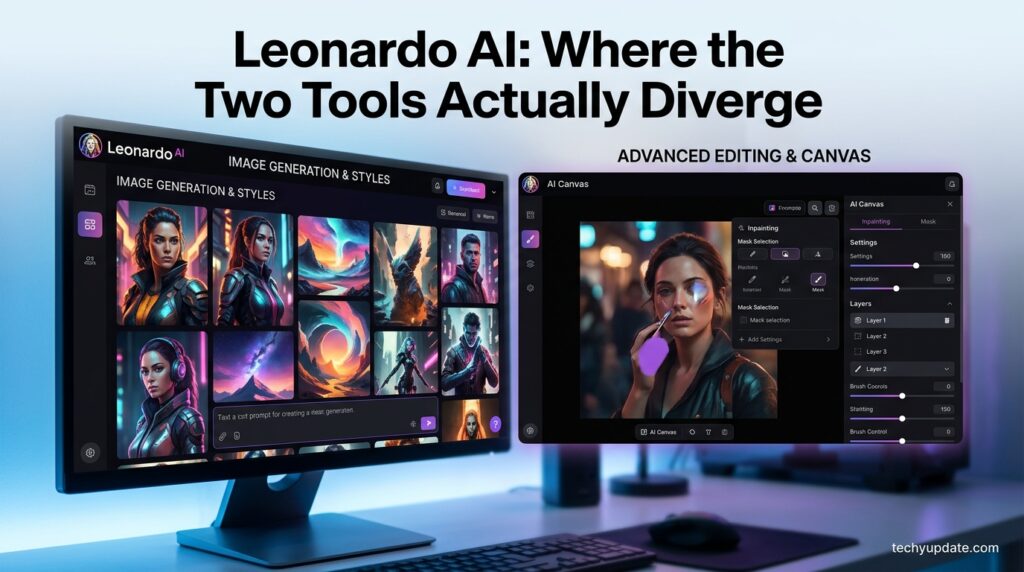
It’s worth being specific about why these two tools keep getting compared, because on the surface, they can look almost interchangeable — both are subscription-based, prompt-driven, browser-accessible AI art generators with large communities. Dig one layer deeper, and the divergence is philosophical, not just cosmetic.
Midjourney has always treated the model itself as the product. Each new version (V6, V7, now the V8 line) is a single, tightly curated aesthetic that the whole userbase shares, and the company’s energy goes into making that one aesthetic as good as possible rather than multiplying options. This is why Midjourney images tend to have a recognizable “house look” — painterly lighting, strong composition instincts, a certain default polish — even from users who barely tweak their prompts.
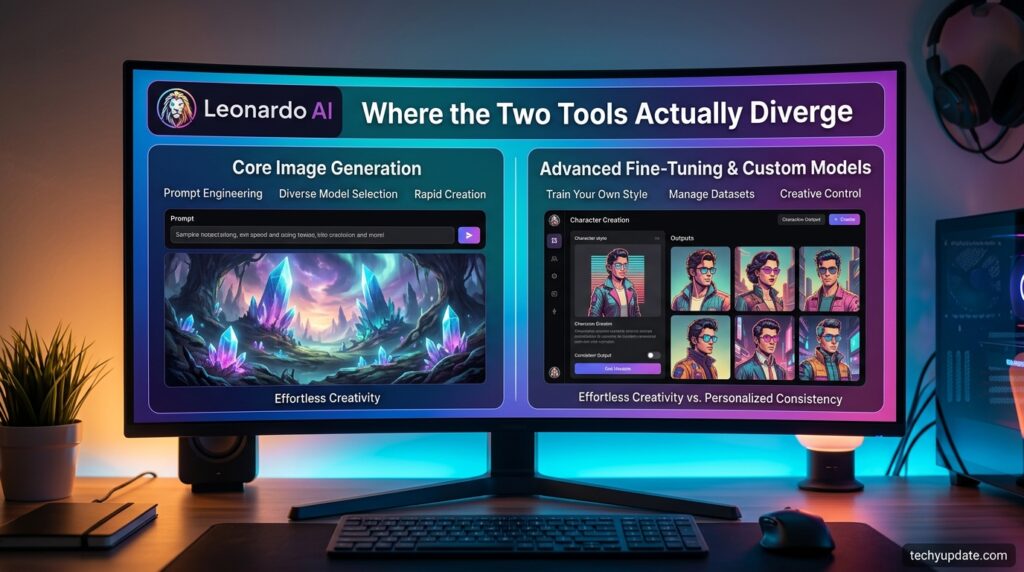
Leonardo has bet on the opposite structure: rather than one model doing everything, it built a marketplace where hundreds of narrow, purpose-trained models coexist alongside its own Phoenix foundation model, and then layered real editing tools on top so users aren’t just re-rolling prompts hoping for a better result. The tradeoff is that Leonardo’s “default” output is less predictable as a single aesthetic — it depends entirely on which model you picked — but the ceiling for a user willing to learn the tool is arguably higher, because you’re not limited to what one house style can produce.
Neither approach is a mistake. Midjourney’s bet pays off for users who want minimal decision fatigue and maximum default polish. Leonardo’s bet pays off for users who have a specific style in mind and want direct editing control once the first draft comes back close but not quite right.
Quick Comparison Table
| Category | Leonardo.Ai | Midjourney |
|---|---|---|
| Free tier | Yes, daily token allowance | No |
| Entry paid price | ~$10–12/mo | ~$10/mo (Basic) |
| Editing canvas | Yes (AI Canvas, in/out-painting) | Limited (no comparable canvas) |
| Model variety | Very high (many fine-tuned models) | Single house model per version |
| Default artistic quality | Strong, more neutral | Very strong, distinctive |
| Video generation | Yes (own + third-party) | Yes (Midjourney Video) |
| Interface | Web app | Web app (formerly Discord-first) |
| Private generations | Paid tiers only | Pro/Mega tiers only |
| API access | Yes (higher tiers) | Limited |
Feature-by-Feature Breakdown
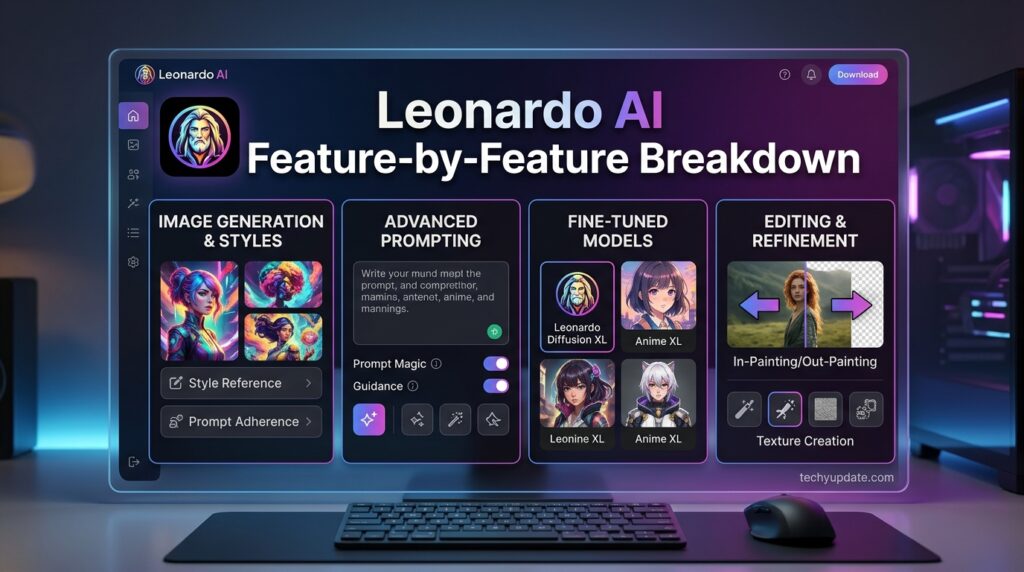
Model selection. Leonardo’s biggest structural advantage is choice — dozens of fine-tuned community and first-party models covering everything from anime to photoreal to game textures, alongside its flagship Phoenix model. Midjourney, by contrast, offers one evolving house model per version (currently in the V7/V8 range), which simplifies the decision but removes the option to reach for a purpose-built style.
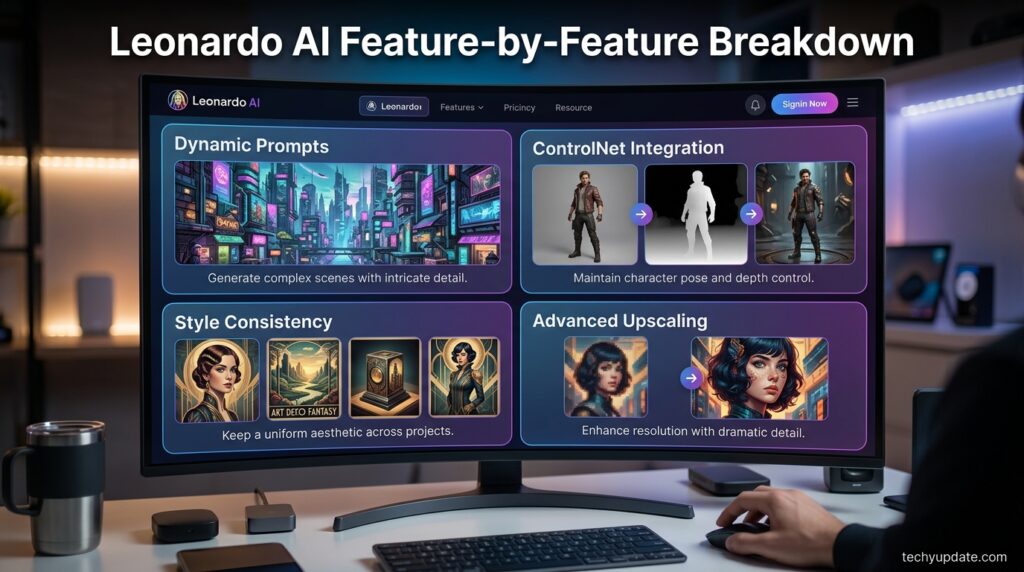
Editing tools. Leonardo’s AI Canvas offers genuine Photoshop-adjacent control: selective regeneration, outpainting, and layered composition. Midjourney’s editing tools have historically been thinner, centered more on variations and light re-rolls than deep compositional editing, though it has added incremental in-painting-style features over time.
Prompt adherence and text rendering. Phoenix was specifically built to improve prompt adherence and legibility of in-image text, two areas where diffusion models traditionally struggle, and it performs well in both. Midjourney has improved text rendering in recent versions, too, but reviewers still generally rate Leonardo’s Phoenix as more literal and instruction-following, while Midjourney leans more interpretive.
Video generation. Both platforms now offer video tools. Leonardo blends its own tools with select third-party video models for flexibility; Midjourney’s dedicated video feature is tightly integrated with its core image pipeline and praised for smooth motion quality on animated stills.
Community and gallery culture. Midjourney’s Discord-rooted community and public gallery remain a major part of its identity and discovery loop. Leonardo has its own community model-sharing culture, which is arguably more practically useful (you can actually use other users’ trained models) even if it’s less of a social hub in the traditional sense.
Ecosystem integration. Leonardo’s ownership by Canva is a growing structural advantage for anyone already working inside Canva, with tighter workflow integration likely to deepen over time. Midjourney remains a standalone product with no parent company in the design suite.
Pricing Comparison
At the entry tier, the two tools are close in price — Leonardo’s ~$10–12/month roughly matches Midjourney’s $10 Basic plan. The meaningful difference is structural: Leonardo has a real free tier, and Midjourney has none, which makes Leonardo strictly cheaper for anyone not ready to commit money on day one.
At the top end, Midjourney’s Mega plan reaches $120/month for its heaviest users, while Leonardo’s Ultimate tier tops out at around $60/month. For pure image generation at moderate volume, per-image cost is roughly comparable between the two at matching tiers; for heavy video users, Leonardo’s broader feature bundling at its top tier tends to pull ahead on value.
Performance Comparison
Speed. Both platforms offer tiered generation speed, with faster processing unlocked at higher subscription levels and slower “relaxed” queues available once fast allowances are exhausted. Neither has a decisive, consistent speed advantage over the other at comparable tiers — both are competitive with modern diffusion-based generation times.
Long-use handling. Leonardo’s token rollover system rewards users who don’t max out their allowance each month, allowing unused tokens to roll over within a cap. Midjourney’s GPU-hour model resets each cycle without the same rollover mechanic, meaning unused fast hours are simply lost, which can feel less forgiving for users with inconsistent monthly usage patterns.
Ease of Use
Midjourney’s interface is famously simple once learned — type a prompt, get four variations, upscale or vary — but its GPU-hour billing concept has a real learning curve for new users trying to understand what they’re actually paying for. Leonardo’s interface offers more surface area (model selection, Canvas tools, presets), which means a slightly steeper initial learning curve but significantly more room to grow into advanced workflows without switching tools.
For a total beginner who just wants one good image fast, Midjourney is marginally more approachable on day one; for someone planning to go deeper over time, Leonardo’s extra complexity pays off.
The Ecosystem Factor: Canva’s Growing Shadow

One variable that didn’t exist a few years ago, and that most older comparisons of these two tools simply can’t account for, is Leonardo’s ownership by Canva. Since the 2024 acquisition, Canva has been gradually integrating Leonardo’s technology, including the Phoenix model, into its Magic Studio suite of AI tools, which are used by well over 100 million Canva users.
For anyone already working inside Canva for layout, branding, or presentation design, that relationship is a quiet but real structural advantage: assets generated in Leonardo can move into a Canva workflow with less friction than moving between two fully unrelated companies’ products, and future integration is likely to deepen rather than shrink.
Midjourney has no equivalent parent-company relationship. It remains a standalone, independently operated product, which has its own upside — a singular focus on the image-generation experience without a parent company’s broader roadmap pulling engineering attention elsewhere — but it also means Midjourney users don’t get the kind of “it just plugs into the design tool I already use” convenience that Leonardo increasingly offers.
This isn’t a decisive factor for every user, but it’s a genuinely underrated one for marketing teams, agencies, and solo creators who already build finished designs in Canva rather than delivering raw generated images as the final product.
Best-For Split

Leonardo.Ai is the better fit for game developers, marketers seeking Canva-adjacent workflows, creators who need many distinct art styles, and anyone who wants a free tier to test before paying.
Midjourney is the better fit for users who want the most artistically striking default output with the least prompt engineering, as well as for creators building a public portfolio in an active, gallery-driven community.
Persona Verdicts
Students are generally better served by Leonardo.Ai, primarily because of the free tier — a real budget consideration — combined with enough model variety to support a range of class projects without requiring multiple tool subscriptions.
Working professionals doing regular client or brand work will likely lean toward Leonardo.Ai’s Premium tier for its editing canvas and model flexibility, though professionals whose work is purely about striking, portfolio-ready imagery may still prefer Midjourney’s house aesthetic.
Small businesses producing ongoing marketing content will typically get more practical value from Leonardo.Ai, especially if they’re already inside the Canva ecosystem, thanks to the combination of API/Blueprint support, private generations on paid tiers, and tighter design-suite integration.

Real-World Workflow Comparison
Picture the same assignment run through both tools: a small business needs six on-brand social graphics by Friday. On Midjourney, the workflow is fast and linear — write a prompt, generate four options, pick the best, upscale, done, repeat six times. It’s efficient precisely because there are few decisions to make beyond the prompt itself, and the output usually looks polished without much extra work.
On Leonardo, the same assignment starts with a choice most Midjourney users never have to make: which model? A marketing team might pick Phoenix for general-purpose polish, then reach for the AI Canvas to out-paint a background to a wider format for a banner, or in-paint a logo-adjacent area that needs to stay clean of AI artifacts. It takes a few more minutes per asset, but the result is often closer to “launch-ready” without requiring a separate design pass, especially for teams that don’t have Photoshop access or in-house skill.
Neither workflow is strictly faster in every case — Midjourney wins on raw speed-to-first-good-result, while Leonardo wins on speed-to-final-deliverable once editing is factored in, particularly for anyone who’d otherwise need to hop into a separate image editor after generating.
Total Cost of Ownership Beyond the Subscription
Sticker price rarely tells the whole story, and that’s true for both tools. Midjourney users who want private generations must reach the Pro tier at $60/month — there’s no way to get privacy at a lower price point, which effectively raises the real cost of “serious” Midjourney use well above its advertised $10 entry price. Leonardo, by contrast, unlocks private generations at its very first paid tier, priced at around $10–12/month, which significantly lowers the real cost of privacy-conscious use.
On the other side of the ledger, Leonardo’s token system means heavy users of premium presets or third-party video models can face top-up purchases that Midjourney’s flatter GPU-hour model doesn’t have an exact equivalent for, though Midjourney users who blow through fast hours face their own version of this problem by needing to upgrade a full tier rather than buying a small add-on. Both systems have a version of “the advertised price isn’t the ceiling,” just structured differently.
Security & Privacy Comparison
Both platforms gate private generation behind paid tiers — free-tier work on Leonardo is public, and Midjourney’s Stealth Mode (private generations) is similarly restricted to its higher Pro and Mega tiers. Leonardo’s paid-tier ownership terms grant subscribers full ownership and IP rights over their generations, a standard and competitive position in the category. Midjourney applies a broadly similar approach, with commercial usage rights generally extended to paying subscribers. Neither platform is meaningfully more or less secure than the other in day-to-day use; the real privacy lever for both is simply which plan tier you’re on.
Customer Support Comparison
Midjourney’s support has historically leaned on its Discord community and moderator team, which works well for fast peer troubleshooting but can feel less formal than a traditional support ticket system. Leonardo operates a more conventional web-based support and help center alongside its own community spaces, which tends to feel more familiar to users coming from typical SaaS products than from community-first tools.
Pros & Cons of Each Tool
| Leonardo.Ai | Midjourney | |
|---|---|---|
| Pros | Real free tier; deep model variety; AI Canvas editing; Canva integration; API/Blueprints | Distinctive default artistic quality; strong community; polished video feature |
| Cons | Confusing token system; recent plan renaming causes outdated info online | No free tier; thinner editing tools; GPU-hour billing has a learning curve |
What Neither Tool Solves Perfectly
It’s worth being honest: switching between these two tools doesn’t magically fix the problems either one has on its own. Character and style consistency across a large batch of separate generations remains genuinely difficult on both platforms without careful seed management, reference images, or (on Leonardo) sticking to the same fine-tuned model throughout a project.
Hands, dense text layouts, and complex overlapping objects can still produce artifacts on both tools at default settings, though both have improved substantially over the last two years. And neither platform fully replaces a human illustrator or designer for work that requires precise, non-negotiable specifications — both are best understood as powerful drafting and ideation tools that still benefit from a skilled human doing final quality control before anything ships to a client.
Migrating Between the Two
For creators who decide to use both tools rather than choosing one exclusively, the practical workflow that tends to work best is using Midjourney for early-stage concept exploration — where its strong default aesthetic helps quickly find a visual direction — and then bringing that direction into Leonardo for refinement, editing, and asset variation, where the AI Canvas and broader model library allow for more granular control over the final deliverables.
This hybrid approach costs more in subscription fees but is increasingly common among professional creators who don’t want to compromise on either strength.
Read more: Leonardo AI Review 2026
Read more: Leonardo AI Pricing 2026: Plans & Alternatives
Frequently Asked Questions
Which is better, Leonardo AI or Midjourney?
Neither is objectively better — Leonardo wins on model variety, editing control, and a real free tier, while Midjourney wins on distinctive default artistic output with minimal prompt effort; the right choice depends on your workflow.
Is Leonardo AI cheaper than Midjourney?
At the entry tiers, prices are similar, but Leonardo’s free plan makes it the cheaper starting point overall, since Midjourney requires payment for the first generation.
Can I use both Leonardo AI and Midjourney together?
Yes, many professional creators use both, leaning on Midjourney for quick striking concepts and Leonardo’s Canvas for deeper editing, compositing, and style-specific work.
Does Midjourney have a free plan like Leonardo?
No, as of 2026, Midjourney requires a paid subscription starting at its Basic tier, with no standing free plan comparable to Leonardo’s daily token allowance.
Conclusion
Choosing between Leonardo.Ai and Midjourney really comes down to what you value more: control and variety, or default artistic polish. Leonardo.Ai wins decisively on model selection, editing depth via the AI Canvas, pricing accessibility thanks to its free tier, and growing ecosystem value through the Canva acquisition — making it the stronger all-around pick for most creators, especially those doing varied or ongoing work.
Midjourney still holds a real edge for users who want the single most striking image with the least effort and don’t mind paying from day one. For students, small businesses, and anyone still deciding, Leonardo.Ai’s free tier makes it the lower-risk place to start — you can always add Midjourney to the toolkit later if its specific aesthetic proves worth the extra subscription cost.
1 Comment
Pingback: Leonardo AI Review 2026: Is It Legit?