

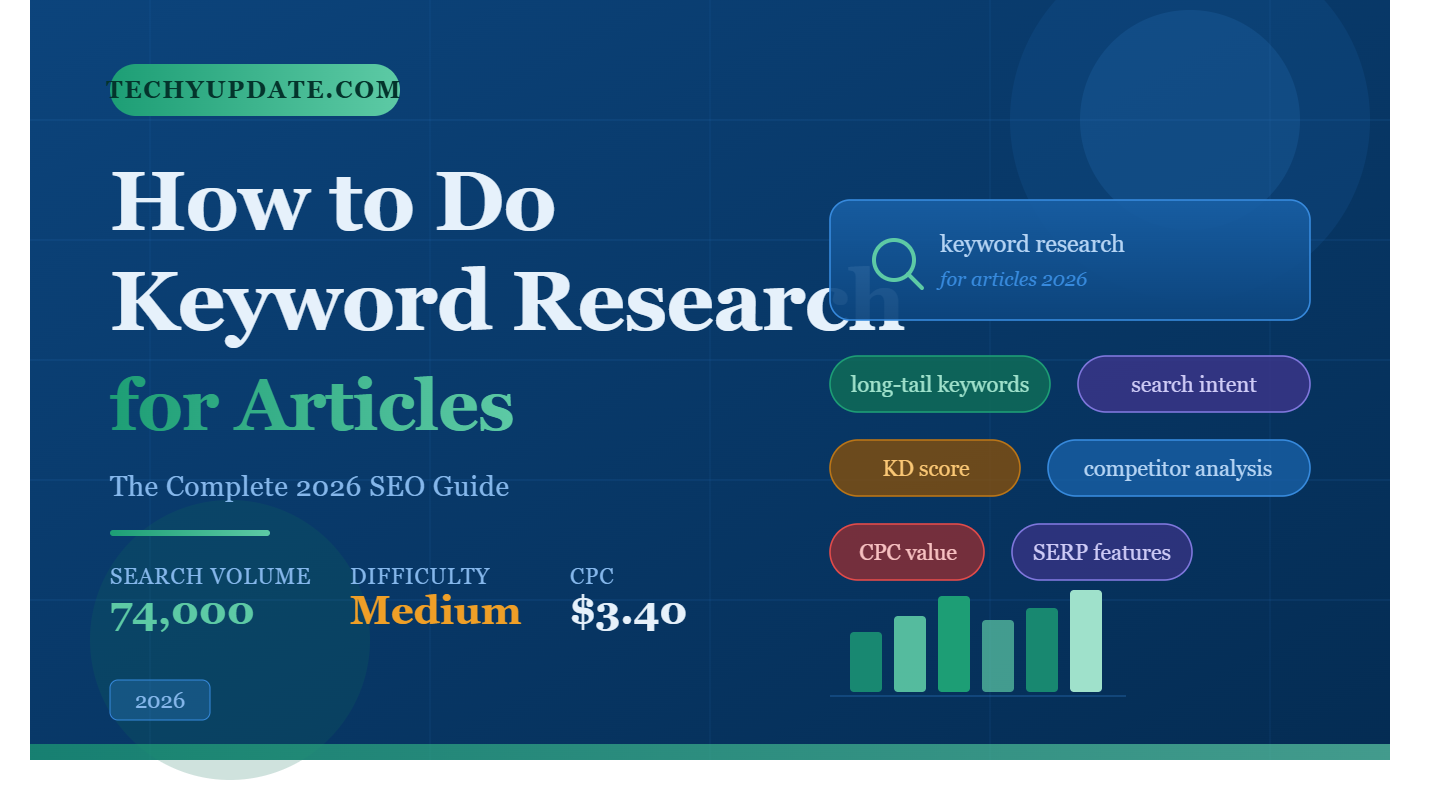
Keyword research is the backbone of every successful SEO strategy. Without proper keyword research, even the best-written articles fail to attract traffic. In 2026, search engines will have become smarter with AI-driven algorithms, making keyword research more important than ever.
We must understand not just keywords, but also user intent, semantic meaning, and how content aligns with search behavior. Whether we are students, bloggers, or beginners, mastering keyword research helps us unlock organic traffic keywords that bring consistent visitors.
In this guide, we walk step-by-step through the entire keyword research process, using modern tools, AI insights, and proven SEO keyword strategy techniques. By the end, we will know how to find the right keywords, analyze competition, and use them naturally in our content.
Table of Contents
- What is Keyword Research?
- Why Keyword Research is Important in 2026
- Types of Keywords You Must Know
- Step-by-Step Keyword Research Process
- Keyword Research Productivity and Time Management
- Best Keyword Research Tools in 2026
- Keyword Research Coding and Technical Skills
- How to Use Keywords in Articles
- Pro Tips to Maximize AI Tools
- Common Mistakes Students Make with AI
- Expert Insights on AI Learning Trends
- Quick Summary
- FAQs
What is Keyword Research?
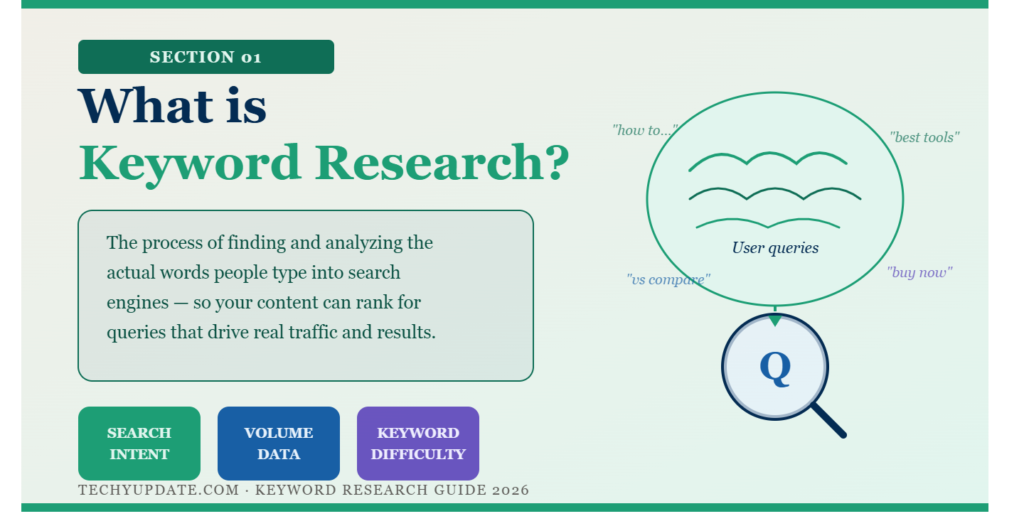
Keyword research is the process of finding and analyzing search terms that users enter into search engines. These keywords help us understand what people are searching for and how to create content that matches their needs.
Keyword research is like learning your audience’s language before you speak to them. It’s the process of discovering the exact words and phrases people use when they search online for answers, products, or ideas.
Instead of guessing what to write, keyword research gives you real insight into what people actually care about, how they phrase their questions, and what topics are already in demand. When done right, it becomes the foundation of content that attracts the right visitors, ranks higher on search engines, and truly connects with readers.
Keyword Research
In the modern digital ecosystem, keyword research stands as the foundation of every successful SEO and content strategy. Without a structured keyword research process, even the most well-written content struggles to gain visibility. We rely on keyword research to identify what users are actively searching for, how they phrase their queries, and which topics hold the highest potential for organic traffic growth.
Keyword research is not merely about selecting popular terms. It is a strategic process that involves keyword analysis, evaluation of search intent, and assessment of competition. By mastering keyword research, we position our content to rank higher on search engines, attract targeted audiences, and convert visitors into engaged users.
Definition of Keyword Research
Keyword research is the systematic process of discovering, analyzing, and selecting specific words and phrases that users enter into search engines like Google. These keywords represent real user intent and guide the creation of content that aligns with those searches.
At its core, keyword research includes:
- Identifying SEO keywords relevant to a topic
- Conducting search volume analysis to measure popularity
- Evaluating keyword competition and difficulty
- Understanding user intent behind search queries
- Selecting keywords that align with content goals
For example, a broad keyword such as “SEO” may attract massive search volume but is highly competitive. In contrast, a more targeted keyword, such as “keyword research for beginners step by step,” offers better ranking opportunities and more qualified traffic.
We treat keyword research as a data-driven approach that transforms assumptions into actionable insights. It ensures that every piece of content is aligned with real-world search behavior.
READ MORE: How to Create a Free Website with Free Hosting and a Domain
Importance of Keyword Research in SEO and Content Writing
The importance of keyword research cannot be overstated. It directly influences how search engines interpret content and how users discover it. Without keyword research, content becomes disconnected from user needs and fails to achieve visibility.
1. Aligns Content with User Intent
Keyword research allows us to understand what users truly want. By analyzing search intent, we can create content that answers specific questions, solves problems, or fulfills needs. This alignment increases engagement and reduces bounce rates.
2. Enhances Content Strategy
A strong content strategy is built on reliable data. Keyword research provides insights into trending topics, frequently searched queries, and gaps in existing content. This enables us to plan articles that are both relevant and competitive.
3. Improves Search Engine Rankings
Search engines rely heavily on keywords to determine the relevance of content. By strategically incorporating SEO keywords, we signal to search engines what our content is about. This improves indexing and ranking potential.
4. Drives Targeted Organic Traffic
Not all traffic is valuable. Keyword research ensures we attract users genuinely interested in our content. By targeting organic traffic keywords, we attract visitors more likely to engage and convert.
5. Supports Long-Term Growth
Keyword research is not a one-time task. It is an ongoing process that evolves with search trends and user behavior. Consistent keyword optimization leads to sustained growth and long-term SEO success.
Importance in SEO and Content Writing
Without keyword research, content lacks direction. It ensures:
- Content matches user queries
- Articles rank on search engines
- Organic traffic keywords drive consistent visitors
How Keyword Research Impacts Rankings and Traffic
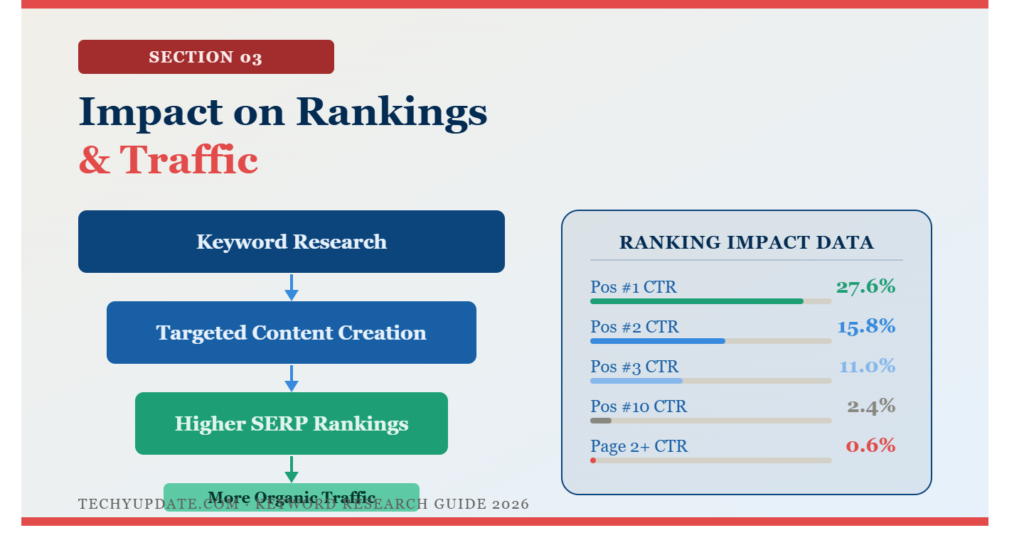
The impact of keyword research on rankings and traffic is both direct and measurable. It determines how content performs in search engine results pages (SERPs) and how effectively it reaches the target audience.
1. Improves Search Visibility
By targeting the right keywords, we increase the chances of appearing in top search results. High visibility leads to more clicks, impressions, and brand exposure.
For example:
- A generic keyword may place us on page 5
- A well-researched long-tail keyword can rank on page 1
This difference dramatically affects traffic.
2. Boosts Click-Through Rates (CTR)
Keyword research helps craft compelling titles and meta descriptions that match user queries. When users see relevant keywords in search results, they are more likely to click.
3. Enhances Content Relevance
Search engines prioritize content that closely matches user queries. By using semantic keywords and keyword variations, we improve content relevance and depth.
4. Reduces Competition Barriers
Keyword research allows us to identify low-competition opportunities. Instead of competing with high-authority websites, we can target niche keywords with better ranking potential.
5. Increases Conversion Rates
Traffic alone is not enough. Keyword research ensures that visitors arrive with a clear purpose. When content aligns with intent, users are more likely to take action, whether it’s subscribing, purchasing, or sharing.
How It Impacts Rankings and Traffic
Keyword research directly influences:
- Search rankings
- Click-through rates
- Audience targeting
For example, targeting “best laptops” is highly competitive, while “best laptops for students under $500” is a long tail keyword with higher conversion potential.
Strategic Approach to Effective Keyword Research
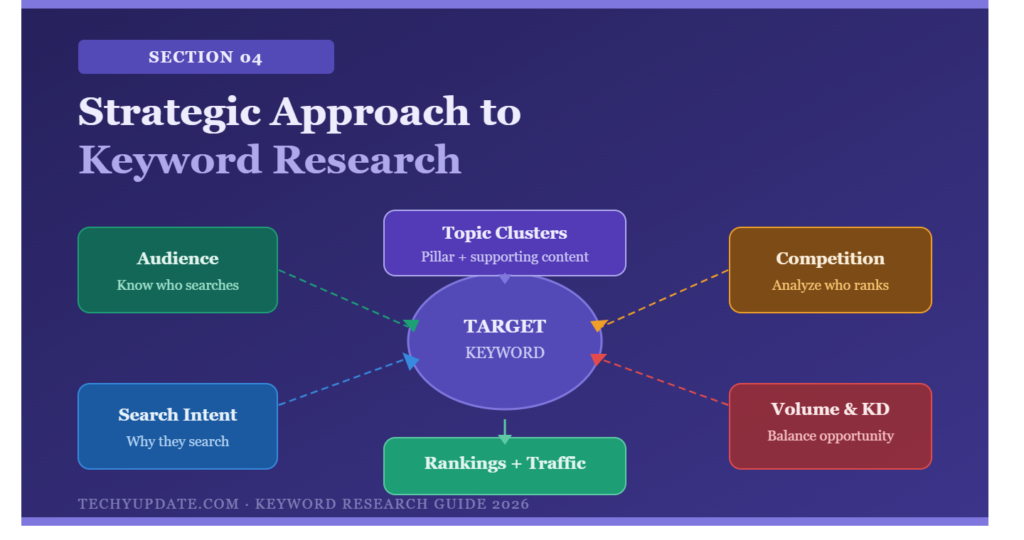
To maximize results, we adopt a structured keyword research strategy that integrates multiple elements:
- Primary Keywords: Main focus terms with high relevance
- Secondary Keywords: Supporting terms that add depth
- Long-Tail Keywords: Specific phrases with higher conversion rates
- LSI Keywords: Contextual terms that enhance semantic relevance
This layered approach ensures comprehensive coverage of a topic while maintaining natural readability.
Real-World Example of Keyword Research in Action
Consider a blog focused on digital marketing. Without keyword research, we might create generic content like “Marketing Tips.” However, with proper keyword research, we identify:
- “keyword research for blog posts”
- “SEO keyword strategy for beginners”
- “How to find organic traffic keywords.”
By targeting these specific queries, we create content that directly addresses user needs. The result is higher rankings, increased traffic, and better engagement.
Advanced Keyword Research Insights
Modern keyword research extends beyond basic metrics. It incorporates advanced techniques such as:
- Search intent clustering
- Topic modeling and semantic analysis
- Competitor keyword gap analysis
- Trend forecasting using AI tools
These advanced strategies enable us to stay ahead of competitors and adapt to evolving search algorithms.
Why Keyword Research is Important in 2026
In 2026, keyword research has evolved into a critical pillar of modern SEO, driven by advancements in artificial intelligence, search personalization, and user behavior analysis. Search engines no longer rely solely on matching keywords they now interpret context, intent, and semantic meaning. This shift makes keyword research more strategic and data-driven than ever before.
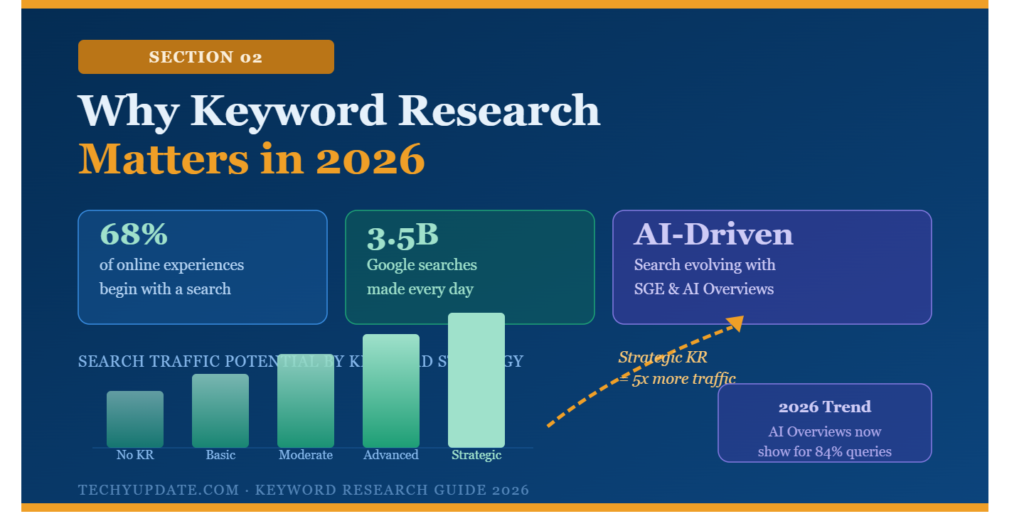
We no longer focus only on finding popular terms. Instead, we identify high-intent, contextually relevant keywords that align with how users interact with AI-powered search engines. By mastering keyword research in 2026, we ensure that our content is discoverable, relevant, and optimized for both traditional search results and AI-generated responses.
Role in Google AI Search (SGE)
Google’s Search Generative Experience (SGE) has transformed how results are displayed. Instead of listing only links, Google now provides AI-generated summaries, direct answers, and conversational responses. This means our content must be optimized not just for ranking, but for being selected and featured by AI systems.
Keyword research plays a crucial role in this environment:
- It helps identify question-based queries that trigger AI summaries
- It supports content structured for featured snippets and voice search
- It enables the use of semantic keywords that match AI understanding
For example, instead of targeting a simple keyword like “keyword research,” we now optimize for queries like:
- “How to do keyword research step by step.”
- “best keyword research methods for beginners”
These natural, conversational queries align with how users interact with AI search, increasing the likelihood that our content will be featured.
Google’s Search Generative Experience (SGE) uses AI to deliver direct answers. Keyword research helps us structure content for:
- Featured snippets
- Voice search queries
- AI-generated summaries
Helps Target User Intent
User intent is the core of SEO in 2026. Every search query reflects a specific goal, and keyword research helps us accurately decode that intent. Without understanding intent, even well-optimized content fails to engage users.
There are three primary types of intent we focus on:
- Informational Intent: Users want to learn something
- Navigational Intent: Users want to find a specific website
- Transactional Intent: Users are ready to take action
Keyword research helps us match content with these intents. For instance:
- “What is keyword research?” → informational
- “Best keyword research tools” → commercial
- “Buy SEO tools subscription” → transactional
Modern SEO focuses on intent:
- Informational (learn something)
- Transactional (buy something)
- Navigational (find a site)
Keyword research ensures we target the right audience at the right stage.
By targeting the right intent, we create content that satisfies user expectations, increases engagement, and improves ranking signals such as dwell time and click-through rate.
Improves Content Visibility
In an increasingly competitive digital space, visibility depends on how well our content aligns with search queries. Keyword research ensures that our content is optimized for discoverability across multiple search formats, including:
- Traditional search results
- Featured snippets
- Voice search
- AI-generated answers
Using organic traffic keywords, long-tail phrases, and semantic variations enhances content reach. Instead of relying on a single keyword, we build a network of related terms that strengthen topical authority.
For example, a well-optimized article on keyword research may include:
- keyword analysis
- search volume analysis
- SEO keyword strategy
- content optimization keywords
By using semantic keywords and NLP techniques, we increase:
- Content relevance
- Search engine understanding
- Ranking potential
This layered approach signals relevance to search engines and increases the chances of ranking for multiple queries.
Types of Keywords You Must Know
To build a powerful SEO keyword strategy, we must understand the different types of keywords and how they function within search engines. Each keyword type serves a unique purpose, from driving broad visibility to targeting highly specific user intent. By combining multiple keyword types, we create content that is both discoverable and conversion-focused.
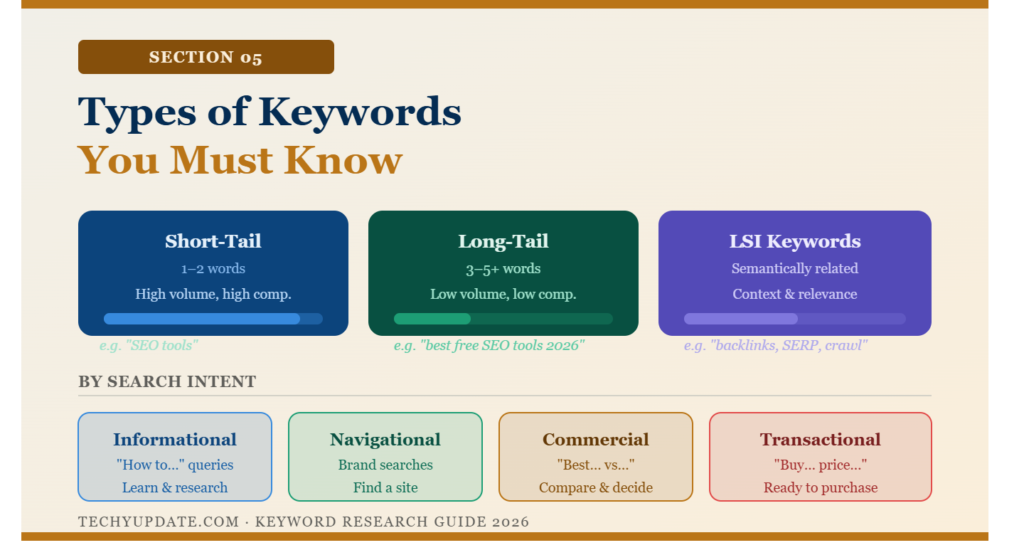
Effective keyword research is not about choosing one keyword it is about creating a balanced mix of short-tail, long-tail, LSI, and intent-based keywords. This approach strengthens content relevance, improves rankings, and attracts the right audience.
Understanding keyword types is essential for building a strong SEO keyword strategy.
Short-Tail Keywords
Short-tail keywords are broad, generic search terms usually consisting of one or two words, such as “SEO,” “blogging,” or “keyword research.” These keywords have extremely high search volume, making them attractive for visibility.
However, they also come with intense competition, making it difficult for new or smaller websites to rank. Additionally, short-tail keywords often lack clear intent. For example, someone searching for “SEO” could be looking for a definition, tools, or services.
We use short-tail keywords primarily for:
- Building brand awareness
- Supporting broader content themes
- Targeting high-level topics
Short-tail keywords are broad search terms like “SEO” or “keyword research.” They have:
- High search volume
- High competition
- Low conversion rate
They are useful for brand awareness but difficult to rank. Despite their limitations, they are essential in establishing topical authority when combined with more specific keywords.
Long-Tail Keywords
Long-tail keywords are more specific phrases, typically containing three or more words, such as “keyword research for beginners step by step” or “best SEO tools for students 2026.”
These keywords have:
- Lower search volume
- Lower competition
- Higher conversion rates
Long-tail keywords are highly valuable because they reflect clear user intent. Users searching with detailed queries are often closer to taking action, whether it’s learning, subscribing, or purchasing.
We prioritize long-tail keywords to:
- Rank faster on search engines
- Attract targeted traffic
- Improve engagement and conversions
Long-tail keywords are more specific phrases, such as “keyword research for beginners 2026.” They offer:
- Lower competition
- Higher conversion
- Better targeting
These are the backbone of organic traffic keywords. They are the backbone of organic traffic keywords and are essential for sustainable SEO growth.
LSI Keywords (Latent Semantic Indexing Keywords)
LSI keywords are contextually related terms that help search engines understand the meaning of content. They are not exact synonyms but closely associated phrases.
For example, for the main keyword “keyword research,” LSI keywords include:
- keyword analysis
- search volume analysis
- SEO keyword strategy
- content optimization keywords
Using LSI keywords improves:
- Content relevance
- Semantic depth
- Ranking potential
They improve content relevance and ranking. Search engines like Google use these keywords to determine whether content fully covers a topic. By naturally integrating LSI keywords, we signal expertise and authority.
Transactional vs Informational Keywords
Understanding user intent is critical, and this is where transactional and informational keywords come into play.
Informational keywords are used when users want to learn something. Examples include:
- “What is keyword research?”
- “How to do keyword research.”
These keywords are ideal for blog posts, guides, and tutorials.
Transactional keywords indicate that users are ready to take action. Examples include:
- “Buy SEO tools.”
- “best keyword research tools pricing”
These keywords are used for product pages, landing pages, and sales content.
A strong SEO strategy balances both types:
- Informational keywords attract traffic
- Transactional keywords drive conversions
By effectively combining these keyword types, we create a content ecosystem that captures users at every stage of their journey.
Step-by-Step Keyword Research Process
Keyword research becomes easier when we follow a structured process. A structured keyword research process ensures we consistently discover high-value opportunities that drive rankings and organic traffic. By following a clear framework, we avoid guesswork and build a reliable SEO keyword strategy that aligns with user intent, competition levels, and search demand. Below is a practical, step-by-step approach that we can apply to any niche or content type.
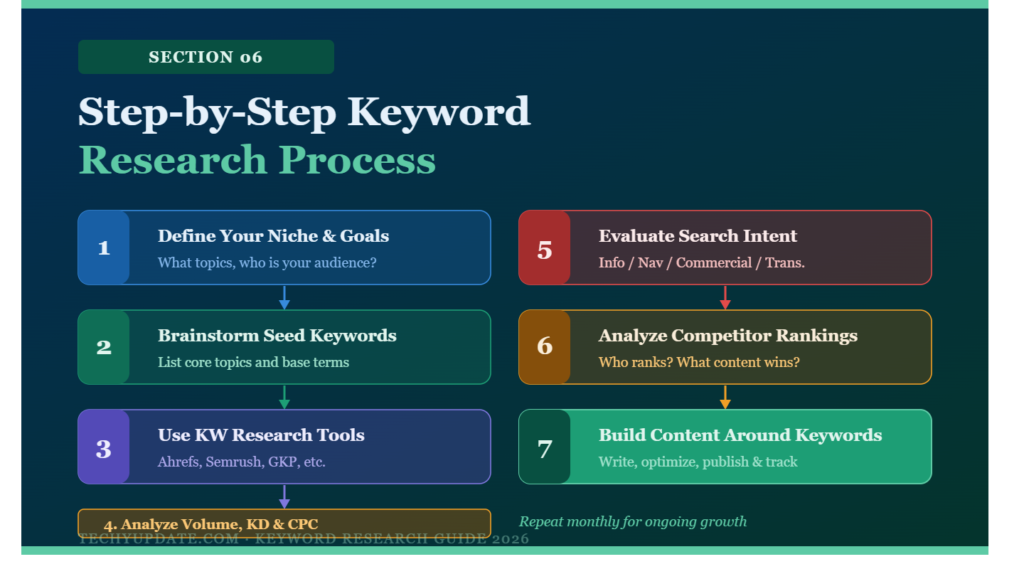
1 – Identify Your Topic
The foundation of keyword research begins with selecting a clear, niche-relevant topic. Instead of starting with random keywords, we define the core subject our audience cares about. This keeps our research focused and prevents wasting time on irrelevant queries.
We start by asking:
- What problems does our audience want to solve?
- What questions are frequently asked in our niche?
- What topics align with our content goals?
Understanding audience intent is critical at this stage. For example, students searching for “keyword research” may want a beginner-friendly guide rather than advanced technical details.
To refine the topic:
- Analyze forums, blogs, and Q&A platforms
- Review competitor content
- Identify gaps where content is missing or weak
A well-defined topic ensures that every keyword we find later is relevant and valuable.
2 – Find Keyword Ideas
Once the topic is clear, we expand it into multiple keyword possibilities. This is where we generate a wide list of SEO keywords and content ideas.
We use a combination of methods:
- Keyword research tools to discover related terms
- Google autocomplete to see real-time search suggestions
- “People also ask” and related searches for additional ideas
For example, entering “keyword research” in Google may reveal:
- keyword research tools
- keyword research for beginners
- keyword research process
These variations help us understand how users phrase their queries.
We also explore:
- Synonyms and semantic keywords
- Question-based queries
- Long-tail variations
At this stage, the goal is quantity, not filtering. We gather as many relevant keyword ideas as possible before narrowing them down.
3 – Analyze Search Volume
After collecting keyword ideas, we evaluate their search volume, which indicates how often a keyword is searched for each month. This step helps us prioritize keywords with real traffic potential.
Key considerations include:
- High search volume:
- More traffic potential
- Higher competition
- Low search volume:
- Easier to rank
- More targeted audience
We aim for a balance between volume and competition. A keyword with moderate search volume and lower competition often provides the best results.
Search volume analysis also helps us:
- Identify trending topics
- Avoid keywords with no demand
- Focus on scalable traffic opportunities
By combining search volume data with keyword relevance, we ensure that our content targets terms that can actually bring visitors.
4 – Check Keyword Difficulty
Keyword difficulty measures how hard it is to rank for a specific keyword. This step is essential for realistic planning, especially for new or low-authority websites.
We analyze competition by looking at:
- Top-ranking pages
- Domain authority of competitors
- Backlink profiles
- Content quality
If the first page is dominated by high-authority websites, ranking becomes challenging. Instead, we look for keywords where:
- Competitors have weaker content
- Domain authority is moderate
- Opportunities for improvement exist
We also consider our own website’s strength. A new site should target low- to medium-difficulty keywords first, gradually moving to more competitive terms.
This step ensures that our keyword research strategy is practical and achievable, not just ambitious.
5 – Understand Search Intent
Search intent defines the purpose behind a user’s query. Matching intent is critical because search engines prioritize content that directly satisfies user needs.
There are three main types of intent:
- Informational:
Users want to learn something
Example: “What is keyword research?” - Navigational:
Users want to find a specific site
Example: “Ahrefs keyword tool login” - Transactional:
Users are ready to take action
Example: “buy keyword research tool subscription”
We align our content format with intent:
- Blog posts for informational queries
- Landing pages for transactional queries
- Brand pages for navigational queries
Ignoring search intent leads to poor rankings, even with strong keywords. Proper intent matching increases engagement, dwell time, and conversions.
6 – Select Long-Tail Keywords
The final step is selecting the most valuable long-tail keywords from our research. These keywords are specific, less competitive, and highly targeted.
Long-tail keywords convert better because:
- They reflect clear user intent
- They attract qualified visitors
- They face less competition
Examples:
- Broad keyword: “keyword research.”
- Long-tail keyword: “keyword research for beginners step by step 2026.”
We use long-tail keywords to:
- Rank faster on search engines
- Build niche authority
- Capture highly relevant traffic
Best practices include:
- Using long-tail keywords in headings
- Integrating them naturally into content
- Combining them with LSI keywords for depth
By focusing on long-tail keywords, we create content that not only ranks but also delivers real value to users.
Best Keyword Research Tools in 2026 (Free vs Paid, Features & Trends Explained)
In 2026, keyword research tools will have become smarter, faster, and more AI-driven than ever before. Modern SEO is no longer about guessing keywords it is about using data-backed platforms that analyze search intent, competition, and organic traffic keywords with precision. Choosing the right tool directly impacts how well our content performs in Google’s AI-powered search ecosystem.
We can divide keyword research tools into free tools for beginners and paid tools for advanced SEO professionals, each offering different levels of accuracy, depth, and scalability.
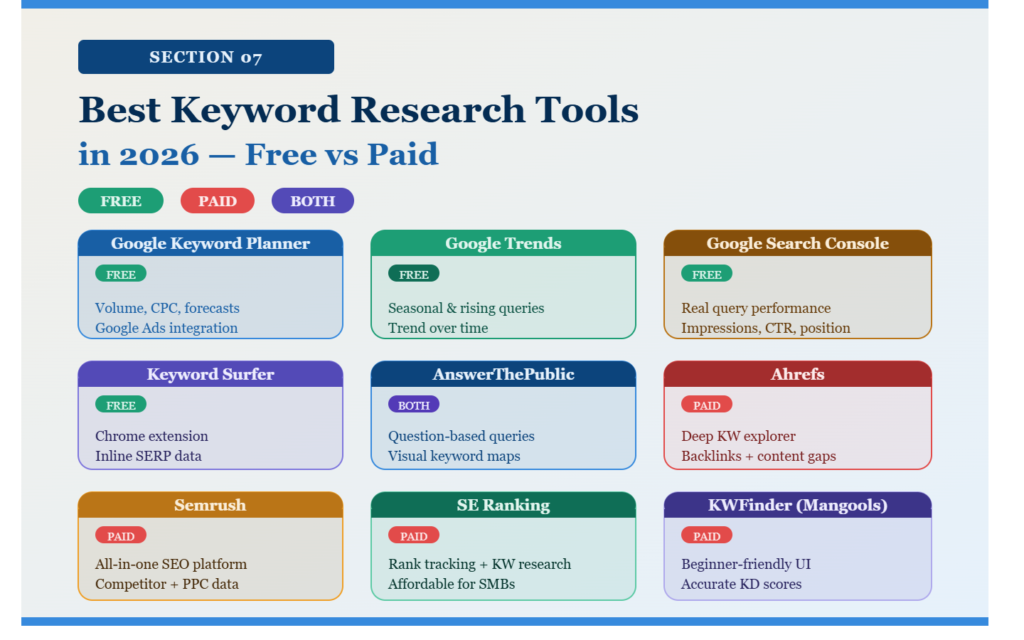
Free vs Paid Keyword Research Tools
Free Keyword Research Tools
Free tools are ideal for beginners, students, and small websites. They provide basic but valuable insights into keyword ideas and search trends.
Popular free tools include:
- Google Keyword Planner
- Google Trends
- Google Search Console
- Keyword Surfer extension
- AnswerThePublic
These tools help us:
- Discover keyword ideas
- Analyze basic search volume
- Identify trending topics
- Understand audience queries
However, free tools often lack:
- Accurate keyword difficulty scoring
- Deep competitor analysis
- Advanced SERP insights
Despite limitations, they are powerful for starting keyword research for content creation.
Paid Keyword Research Tools
Paid tools offer advanced features that are essential for scaling SEO strategies and competing in saturated markets.
Top paid tools include:
- Ahrefs
- Semrush
- SE Ranking
- KWFinder (Mangools)
These platforms provide:
- Deep keyword analysis
- Competitor keyword tracking
- Backlink and SERP data
- AI-powered content suggestions
For example, Ahrefs and Semrush are widely used because they combine keyword research, competitor analysis, and content optimization in one system.
Paid tools are essential when we want to:
- Scale organic traffic
- Target competitive keywords
- Build long-term SEO authority
Features to Look for in Keyword Research Tools
Not all keyword tools are equal. In 2026, the best tools must go beyond simple keyword suggestions and offer intelligent SEO insights.
1. Accurate Search Volume Data
Search volume analysis is critical for identifying demand. A good tool should show:
- Monthly search volume
- Regional trends
- Seasonal fluctuations
Accurate data ensures we target keywords that actually bring traffic.
2. Keyword Difficulty Score
Keyword difficulty helps us understand how hard it is to rank. Strong tools analyze:
- Domain authority of competitors
- Backlink strength
- SERP competitiveness
This helps us avoid wasting time on impossible keywords.
3. Search Intent Analysis
Modern keyword tools now classify intent:
- Informational
- Transactional
- Navigational
This is crucial for aligning content with user expectations and improving engagement.
4. Keyword Suggestions & Clustering
Advanced tools group keywords into clusters such as:
- Topic clusters
- Semantic keywords
- Long-tail variations
This improves SEO keyword strategy and helps build authority around topics.
5. Competitor Analysis Features
The best tools allow us to:
- Analyze competitor rankings
- Find keyword gaps
- Identify content opportunities
This gives us a strategic advantage in competitive niches.
Accuracy and Trends in Keyword Research Tools (2026 Update)
In 2026, keyword research tools will be heavily influenced by AI and machine learning. This has improved accuracy but also changed how data should be interpreted.
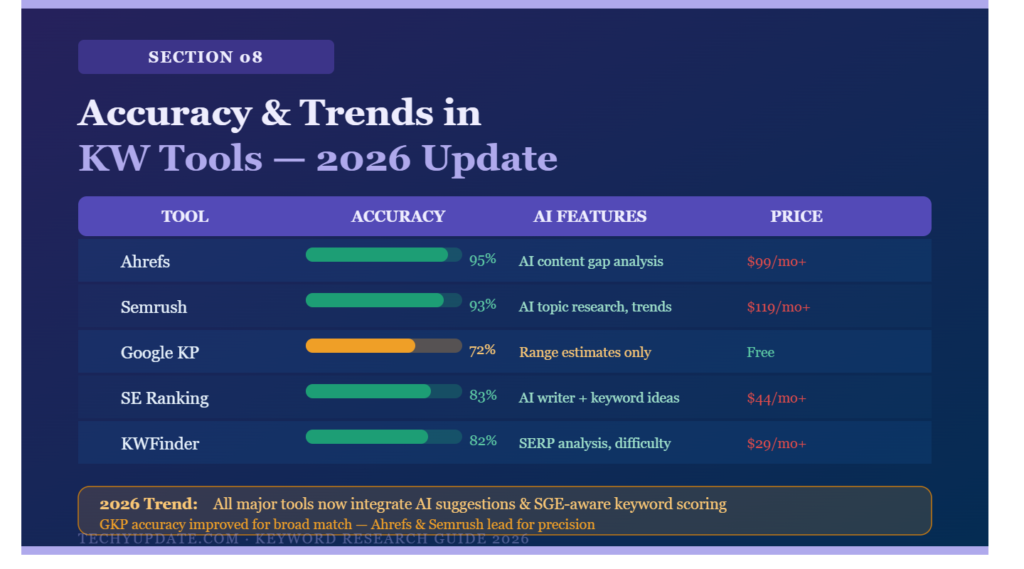
Improved Accuracy with AI Integration
Modern tools now use AI to:
- Predict keyword trends
- Analyze user behavior
- Detect SERP changes
Tools like Semrush and Ahrefs are leading this shift by offering deeper insights into organic traffic keywords and search patterns.
Trend-Based Keyword Discovery
Instead of relying only on static data, tools now focus on:
- Rising search queries
- Emerging topics
- Real-time search behavior
This helps us stay ahead of competitors by targeting keywords before they peak.
Shift from Keywords to Topics
Search engines now prioritize topic authority over individual keywords. This means keyword tools must support:
- Topic clustering
- Semantic SEO
- Content mapping
For example, instead of targeting just “keyword research,” we build content around:
- keyword analysis
- SEO keyword strategy
- search volume analysis
- content optimization keywords
Keyword Research Productivity and Time Management
Efficient keyword research saves time and improves results. Many beginners spend hours analyzing keywords without a clear system. We must use a structured workflow to stay productive.
Start by setting a clear goal for each session. For example, we can aim to identify 10–15 high-quality organic traffic keywords rather than analyzing hundreds of irrelevant terms. This focused approach improves efficiency.
Time management strategies include:
- Allocate 30–60 minutes per keyword research session
- Use templates to track keywords
- Prioritize high-impact keywords
- Avoid over-analyzing low-value keywords
Batch processing is also powerful. Instead of researching one topic at a time, we can analyze multiple related topics together. This helps identify patterns and keyword clusters.
Using keyword research tools with filters reduces manual effort. We can sort keywords by:
- Search volume
- Keyword difficulty
- Competition level
This allows faster decision-making.
Consistency matters more than perfection. Spending small, focused sessions daily is more effective than occasional long sessions. Over time, this builds a strong database of SEO keywords.
How to Use Keywords in Articles (SEO Optimization Guide for 2026)
Using keywords correctly inside an article is just as important as finding them. Even the best keyword research strategy will fail if keywords are not placed naturally and strategically within content. In 2026, search engines prioritize context, semantic relevance, and user experience, so keyword placement must feel natural rather than forced.
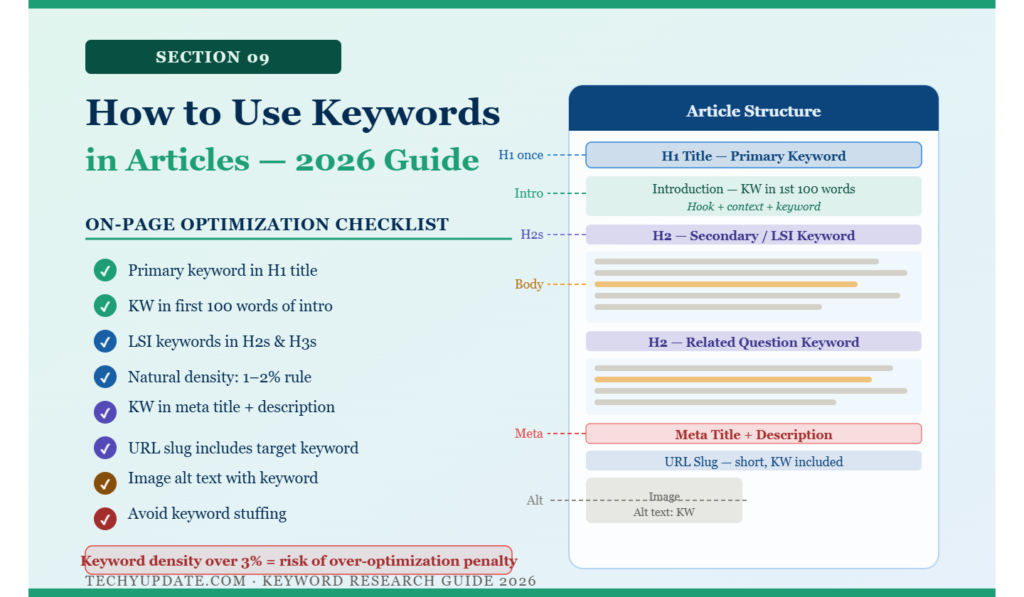
We focus on integrating SEO and organic traffic keywords to improve rankings while maintaining readability and trust.
Title Optimization
The article title is one of the strongest ranking signals in SEO. It tells both users and search engines what the content is about.
To optimize titles effectively, we must:
- Include the primary keyword near the beginning
- Keep the title clear and engaging
- Avoid keyword stuffing
- Add emotional or value-driven language when possible
For example:
- Weak: “SEO Guide Article”
- Strong: “How to Do Keyword Research for Articles in 2026 (Step-by-Step Guide)”
A well-optimized title improves click-through rate (CTR) and increases visibility in search results.
Meta Descriptions
Meta descriptions act as a short summary of the content in search results. While they do not directly impact rankings, they significantly influence CTR.
To optimize meta descriptions, we should:
- Include the primary keyword naturally
- Keep it between 150–160 characters
- Clearly explain what users will gain
- Use action-oriented language
Example:
“Learn how to perform keyword research using proven SEO strategies to increase organic traffic and improve Google rankings in 2026.”
Well-written meta descriptions help attract more qualified visitors by matching search intent.
Headings (H1, H2, H3)
Headings structure content and help search engines understand topic hierarchy. Proper heading optimization improves both SEO and readability.
H1 (Main Title)
- Should contain the primary keyword
- Used only once per article
- Must clearly define the topic
H2 (Main Sections)
- Include secondary keywords or variations
- Break content into logical sections
- Improve scannability
H3 (Subsections)
- Support H2 topics
- Add depth and detail
- Include LSI keywords naturally
For example:
- H1: Keyword Research for Articles
- H2: Step-by-Step Keyword Research Process
- H3: How to Find Keyword Ideas
This structure strengthens keyword analysis and SEO keyword strategy while improving user experience.
Natural Keyword Placement
In 2026, search engines prioritize natural language processing (NLP), meaning keyword usage must feel organic and contextual.
To achieve natural placement, we should:
- Use the primary keyword in the introduction
- Spread keywords evenly throughout the content
- Include variations and synonyms
- Avoid repeating the same phrase unnaturally
Instead of forcing exact matches like “keyword research” repeatedly, we can use:
- keyword analysis
- SEO keyword strategy
- search volume analysis
- organic traffic keywords
Best Practices for Natural Usage
- Write for humans first, search engines second
- Use keywords where they naturally fit in sentences
- Combine short-tail and long-tail keywords
- Add semantic context around keywords
Example:
Forced: “keyword research keyword research keyword research is important.”
Natural: “Effective keyword research helps us identify valuable organic traffic keywords that improve search rankings.”
Keyword Research, Coding, and Technical Skills
Keyword research is not only about tools, it also benefits from technical understanding. Basic coding and data analysis skills can improve efficiency and accuracy.
We can use simple techniques like:
- Exporting keyword data into spreadsheets
- Using filters and formulas
- Automating keyword grouping
For advanced users, programming languages like Python help:
- Scrape search data
- Analyze keyword trends
- Cluster keywords automatically
Technical SEO also plays a role. Understanding:
- URL structure
- Schema markup
- Page speed
enhances keyword performance.
Even without coding, learning basic technical skills improves our ability to execute keyword research effectively. Students should focus on combining SEO knowledge with simple technical workflows.
Common Keyword Research Mistakes You Must Avoid in 2026
Even with the best keyword research strategy, many beginners fail to achieve rankings because they repeat avoidable mistakes. In 2026, search engines are smarter than ever, focusing on user intent, semantic relevance, and content quality rather than simple keyword repetition. Understanding these mistakes helps us build stronger SEO foundations and improve the performance of organic traffic keywords.
Keyword Stuffing
One of the most damaging mistakes in SEO is keyword stuffing, overloading content with the same keyword unnaturally. While older SEO techniques rewarded repetition, modern algorithms penalize it heavily.
Keyword stuffing leads to:
- Poor readability
- Lower user engagement
- Reduced trust signals
- Possible ranking drops
For example, repeating “keyword research” in every sentence makes content look robotic and spammy. Instead, we should use semantic keywords like:
- keyword analysis
- SEO keyword strategy
- search volume analysis
Natural language improves both readability and rankings, especially in AI-driven search systems.
Ignoring Search Intent
Another major mistake is ignoring search intent. Many articles fail because they target keywords without understanding why users are searching them.
Search intent can be:
- Informational
- Navigational
- Transactional
For example, targeting “keyword research tools” requires understanding whether users want:
- A list of tools
- A comparison
- A buying guide
If content does not match intent, users leave quickly, increasing bounce rate and reducing rankings. Proper keyword research for content creation always starts with intent analysis.
Choosing High Competition Keywords Only
Many beginners assume that high-volume keywords guarantee traffic. However, targeting only competitive keywords is a common SEO mistake.
High competition keywords:
- Are dominated by authority websites
- Require strong backlinks
- Take longer to rank
Instead, we should focus on:
- Long-tail keywords
- Low competition opportunities
- Niche-specific phrases
For example:
- “keyword research” (high competition)
- “keyword research for beginners step by step 2026” (low competition)
A balanced SEO keyword strategy includes both competitive and long-tail keywords for sustainable growth.
Pro Tips for Better Keyword Research
To improve results, we must move beyond basic keyword selection and apply advanced optimization strategies. These pro tips help us build stronger content that ranks faster and performs better.
Focus on User Intent
User intent is the foundation of modern SEO. Every keyword must align with what the user actually wants.
To improve intent matching:
- Analyze SERP results before creating content
- Identify whether users want information or action
- Structure content accordingly
For example:
- Informational intent → blog guides
- Transactional intent → landing pages
When we match intent correctly, engagement increases, and rankings improve.
Use Semantic Keywords
Search engines now rely heavily on semantic SEO. This means they understand context rather than just exact keywords.
We should include related terms such as:
- keyword analysis
- search volume analysis
- content optimization keywords
- organic traffic keywords
Semantic keywords:
- Improve topical authority
- Strengthen content relevance
- Help AI search systems understand context
Instead of repeating one keyword, we build a keyword ecosystem.
Update Keyword Strategy Regularly
Keyword trends change constantly. A keyword that performs well today may lose value in months.
To stay competitive, we should:
- Monitor search trends
- Refresh old content
- Add new long-tail keywords
- Remove outdated terms
Regular updates ensure that our keyword research strategy remains effective and aligned with current search behavior.
Expert Insights on AI Learning Trends
Experts agree that AI is reshaping keyword research. According to industry leaders and platforms like Google and OpenAI, future SEO focuses on:
- Intent-based search
- Conversational queries
- Semantic understanding
Students should adapt by:
- Learning NLP-based keyword strategies
- Focusing on user experience
- Creating value-driven content
Quick Summary
- Keyword research is essential for SEO success
- Focus on long tail keywords for better results
- Use keyword research tools wisely
- Understand search intent
- Optimize content naturally
Conclusion
Effective keyword research is the foundation of successful SEO and content marketing. Throughout this guide, we explored how keyword research works, how to apply it, and how to avoid common mistakes that reduce rankings and traffic.
To summarize the key steps:
- Identify your topic and audience intent
- Generate keyword ideas using tools and Google suggestions
- Analyze search volume and competition
- Understand search intent deeply
- Select long-tail and semantic keywords
- Optimize content naturally across titles, headings, and body
The success of any SEO campaign depends on consistency, testing, and continuous improvement. Keyword research is not a one-time task it is an ongoing process that evolves with search trends and user behavior.
By applying a strong SEO keyword strategy, focusing on organic traffic keywords, and avoiding common mistakes, we can build content that consistently ranks, attracts traffic, and delivers long-term digital growth.
Keyword research is the driving force behind effective SEO and content marketing. It transforms content from guesswork into a precise, data-backed strategy. By understanding search behavior, analyzing competition, and targeting the right keywords, we create content that ranks, attracts, and converts.
We leverage keyword research to build authority, increase visibility, and achieve sustainable organic growth. Every successful article begins with a strong keyword foundation, making keyword research an essential skill for anyone aiming to dominate search engine rankings.
A step-by-step keyword research process transforms content creation into a strategic system. By identifying topics, generating keyword ideas, analyzing data, and selecting the right keywords, we build a strong foundation for SEO success and sustainable traffic growth.
The best keyword research tools in 2026 are no longer just data providers they are AI-powered SEO assistants. Free tools are perfect for beginners, but paid tools are essential for serious growth and competitive ranking.
Choosing tools that offer accuracy, intent analysis, and trend forecasting, we can build a powerful keyword research strategy that drives consistent organic traffic and long-term SEO success.
Using keywords in articles is no longer about repetition it is about strategic placement, semantic relevance, and readability. When we optimize titles, meta descriptions, headings, and content naturally, we create SEO-friendly articles that perform well in both traditional search and AI-driven search engines.
A strong keyword placement strategy ensures higher rankings, better engagement, and long-term organic traffic growth.
Frequently Asked Questions (FAQs) About Keyword Research
What is keyword research in SEO?
Keyword research in SEO is the process of finding and analyzing the search terms people use on search engines like Google. It helps us understand what users are looking for and how we can create content that matches those queries. Through keyword analysis, we identify high-value terms, evaluate competition, and select keywords that improve visibility and drive organic traffic to our website.
How do beginners start keyword research?
Beginners should start keyword research by choosing a clear topic and using simple tools like Google Autocomplete, Google Keyword Planner, or free SEO tools. The process includes:
- Brainstorming basic ideas
- Expanding them into keyword variations
- Checking search volume and competition
- Focusing on long-tail keywords
Starting small and focusing on low-competition keywords helps beginners rank faster and build confidence in SEO.
What are long-tail keywords, and why are they important?
Long-tail keywords are longer and more specific search phrases, such as “keyword research for beginners step by step.” They are important because they:
- Have lower competition
- Attract highly targeted traffic
- Convert better than broad keywords
These keywords are essential for building a strong SEO strategy and improving the ranking potential of new websites.
Which tools are best for keyword research in 2026?
In 2026, some of the best keyword research tools include:
- Google Keyword Planner (free)
- Google Trends (free)
- Ahrefs (paid)
- Semrush (paid)
- Ubersuggest (freemium)
These tools help with search volume analysis, keyword difficulty, and competitor research, making them essential for modern SEO.
How do I find low-competition keywords?
To find low-competition keywords, we should:
- Target long-tail keyword variations
- Use keyword research tools to filter difficulty
- Analyze competitor pages
- Look for niche-specific queries
Low-competition keywords are easier to rank and are a key part of successful keyword research for content creation.
What is keyword difficulty in SEO?
Keyword difficulty is a metric that shows how hard it is to rank for a specific keyword. It depends on factors like:
- Domain authority of competitors
- Backlink strength
- Content quality of ranking pages
Lower keyword difficulty means easier ranking opportunities, especially for new websites.
How many keywords should I use in an article?
There is no fixed number, but a balanced approach works best:
- 1 primary keyword
- 3–8 secondary keywords
- Multiple semantic keywords
The focus should always be on natural keyword placement, not keyword stuffing, to maintain readability and SEO performance.
What is search intent in keyword research?
Search intent is the purpose behind a user’s query. It is divided into:
- Informational (learning something)
- Navigational (finding a website)
- Transactional (making a purchase)
Understanding intent helps us create content that aligns with user expectations and improves search rankings.
Can I rank without keyword research?
It is possible, but highly unlikely, to achieve consistent results. Without keyword research, content lacks direction and may not match what users are searching for. Keyword research ensures we target relevant SEO keywords that improve visibility and organic traffic.
How often should I update my keyword strategy?
We should update our keyword strategy regularly, ideally every 3–6 months. Search trends, competition, and user behavior change frequently. Updating ensures we stay relevant and continue targeting high-performing organic traffic keywords for long-term SEO success.
What is keyword research in simple words?
Keyword research is the process of finding words and phrases that people search online. It helps us create content that matches user queries and ranks on search engines.
Why are long tail keywords important?
Long-tail keywords are specific and easier to rank for. They attract targeted traffic and have higher conversion rates compared to broad keywords.
How many keywords should I use in one article?
Use one primary keyword and several related keywords naturally. Avoid keyword stuffing and focus on readability.
How does keyword research improve SEO?
It helps target the right audience, improves content relevance, and increases search engine rankings.
Can I do keyword research without tools?
Yes, using Google autocomplete and related searches can help, but tools provide better data and insights.