

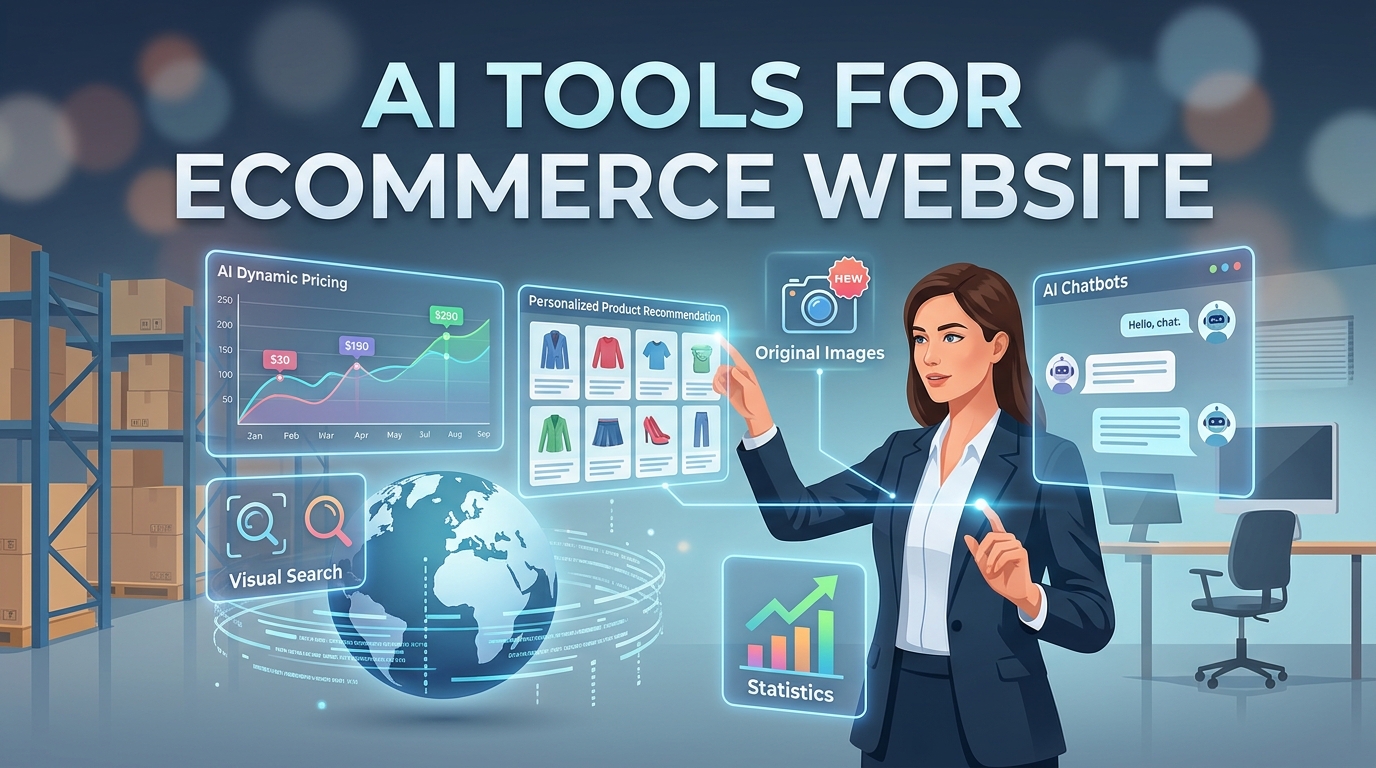
Running an online store used to mean juggling a dozen manual jobs: writing every product description by hand, editing every photo, answering every support ticket, and guessing which products to recommend to which visitor. AI hasn’t eliminated those jobs, but it has made it possible for a tiny team, sometimes just one person, to do work that used to require a department.
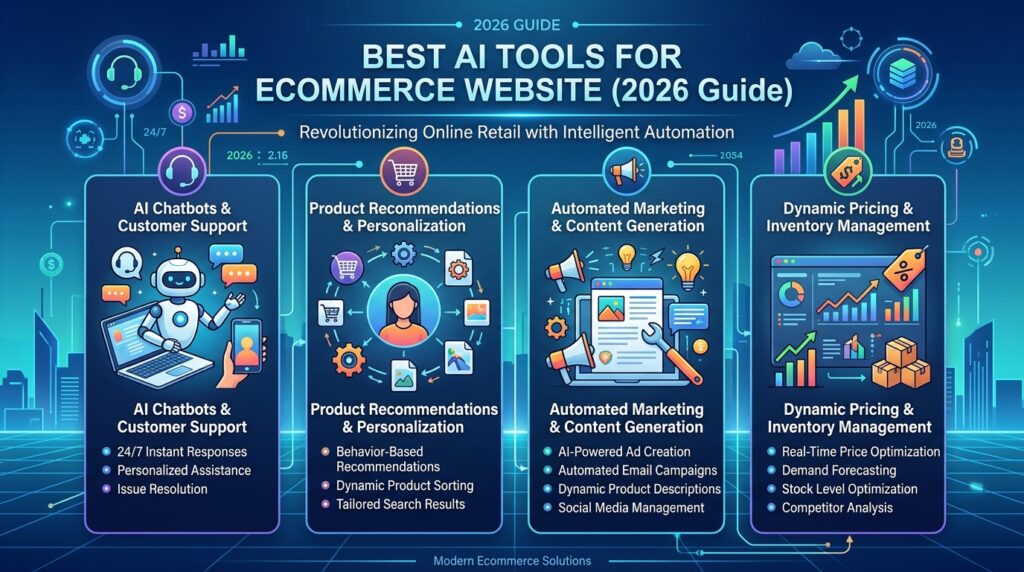
This guide breaks down the best AI tools for ecommerce websites in 2026, split into the categories that actually matter: building the store itself, writing and generating product content, personalizing the shopping experience, automating support, running email and SMS marketing, and managing pricing and SEO.
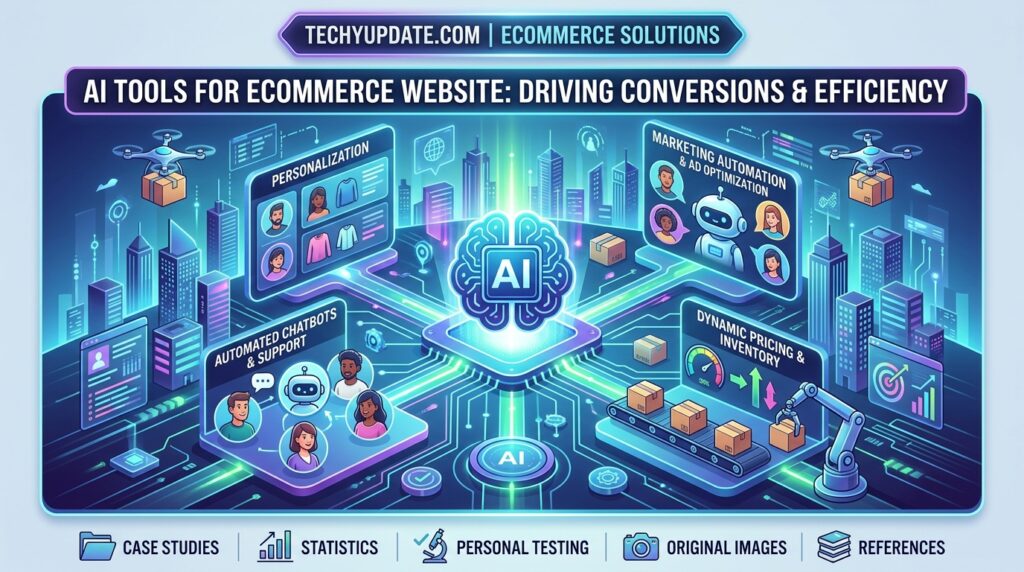
We’ll also cover the increasingly popular idea of an ecommerce website generator, an AI tool that builds your actual storefront from a description, rather than just helping you run one you’ve already built.
Table of Contents
What Are Ecommerce AI Tools, Exactly?
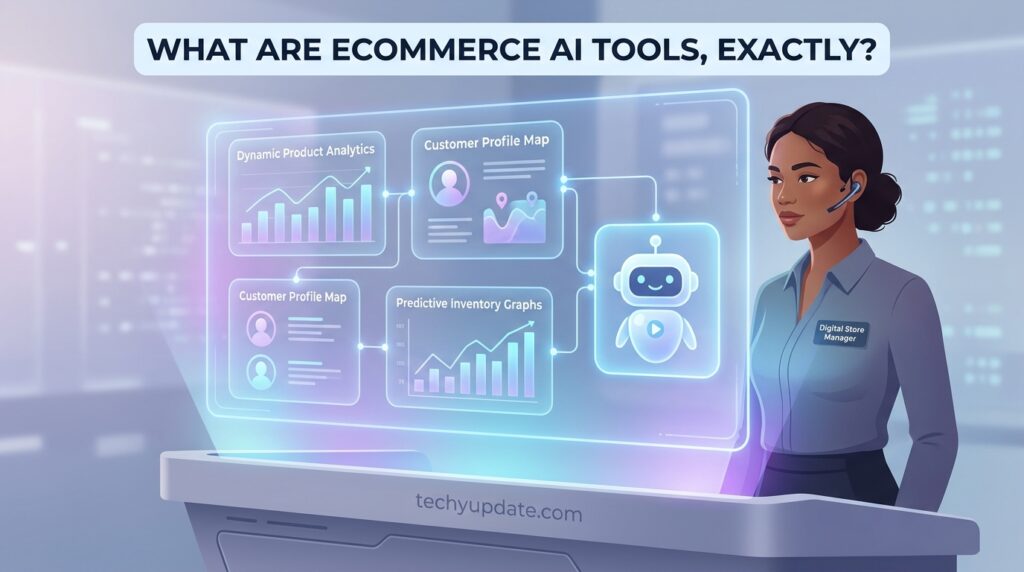
An ecommerce AI tool is software that uses artificial intelligence or machine learning to automate specific parts of running an online store, such as generating content, personalizing product recommendations, automating customer support, forecasting demand, or building the storefront itself.
These tools generally work the same way under the hood: they connect to your store platform (commonly Shopify or WooCommerce) through apps, plugins, or APIs, pull structured data like your product catalog, orders, and customer behavior, and then use that data to generate outputs, such as written copy, personalized product suggestions, chatbot replies, or pricing adjustments. The quality of what you get back depends heavily on how much clean, recent data the tool has to work with.
Most ecommerce teams in 2026 aren’t running just one AI tool. Research on ecommerce tech stacks suggests that the typical team uses between five and eight AI tools across support, marketing, personalization, content, and analytics. That’s not necessarily a good thing. Tool sprawl is a real problem, but it does tell you that no single tool covers everything well.
Read more: Google Flow Labs AI Studio
AI Website Generators vs. AI Ecommerce Tools: Know the Difference

This is where a lot of confusion happens, so let’s separate the two categories clearly:
- AI ecommerce website generators build the actual storefront pages, layout, navigation, checkout — often from a short business description or a few prompts. Examples include Wix’s AI builder, Framer, Squarespace, and newer fully AI-generated store builders.
- AI ecommerce tools run on top of an existing store to automate a specific job: writing descriptions, recommending products, answering support questions, sending emails, or tracking competitor prices.
If you don’t have a store yet, you start with a website generator. If you already have one and it’s just slow to operate, you’re looking for tools in the second category.
Best AI Ecommerce Website Generators
Shopify (and Shopify Magic): Is Shopify an AI Website Builder?
It’s worth being precise here: Shopify itself is not primarily an AI website builder, it’s the most established ecommerce platform, with the broadest app ecosystem of any option on this list. What makes it relevant to this conversation is Shopify Magic, a set of AI features built directly into the Shopify admin at no extra cost.
Shopify Magic can generate product descriptions from a handful of keywords, write marketing email copy complete with subject lines, remove and replace product image backgrounds, and suggest customer chat responses through Shopify Inbox.
Shopify also offers Sidekick, a conversational AI assistant that lets you manage store tasks, create discount codes, analyze sales trends, and adjust your theme just by describing what you want in plain language. Shopify has continued shipping AI-focused updates at a fast pace, including brand voice cloning so that generated copy matches your store’s existing tone.
The honest takeaway: if you’re already on Shopify, Shopify Magic is the lowest-friction way to start using AI in your store, because it’s already there. It won’t outperform specialized tools in any single category, but it covers basic versions of several categories for free.
Wix Easiest AI Builder for Beginners
Wix is widely considered the most accessible AI-assisted ecommerce builder for small businesses and first-time sellers who want a fast setup without sacrificing design flexibility. Its AI builder can generate a usable storefront, including staples like featured products, collections, and newsletter capture from a short description, and the foundation it produces is solid enough for most small stores to build on from day one.
Wix requires a paid plan to unlock real ecommerce functionality (the free plan is for experimentation only), with mid-tier plans adding the ecommerce essentials most small stores need, like subscriptions and shipping rules, and higher tiers aimed at higher-volume sellers.
Framer Best Design Output, Needs Shopify for Commerce
Framer has earned a reputation for producing the most modern, editorial-quality visual output among AI-assisted builders. It behaves more like a design tool that happens to publish websites than a typical store builder. The catch: ecommerce isn’t native to Framer. Most brands pair it with Shopify as the commerce backend, using Framer’s Commerce plugin for Shopify product sync and UI components, delivering brand-forward design with a proven checkout infrastructure underneath.
This makes Framer a strong pick specifically for brands where visual identity is the core selling point and product volume is manageable through a connected Shopify store, not for sellers who need an all-in-one, no-integration solution.
Squarespace Best for Image-Heavy Stores
For stores where product photography does most of the selling, fashion, home goods, and design-forward products, Squarespace’s image handling and layout quality stand out from Wix, Shopify, or Webflow for non-technical merchants. It produces visual consistency without requiring custom design work, which is its clearest advantage over more flexible but more complex alternatives.
Best AI Tools for Product Content and Copywriting
Writing product descriptions, blog content, and ad copy at scale is one of the most time-consuming parts of running a store, and it’s also one of the categories where AI delivers the fastest, most obvious time savings.
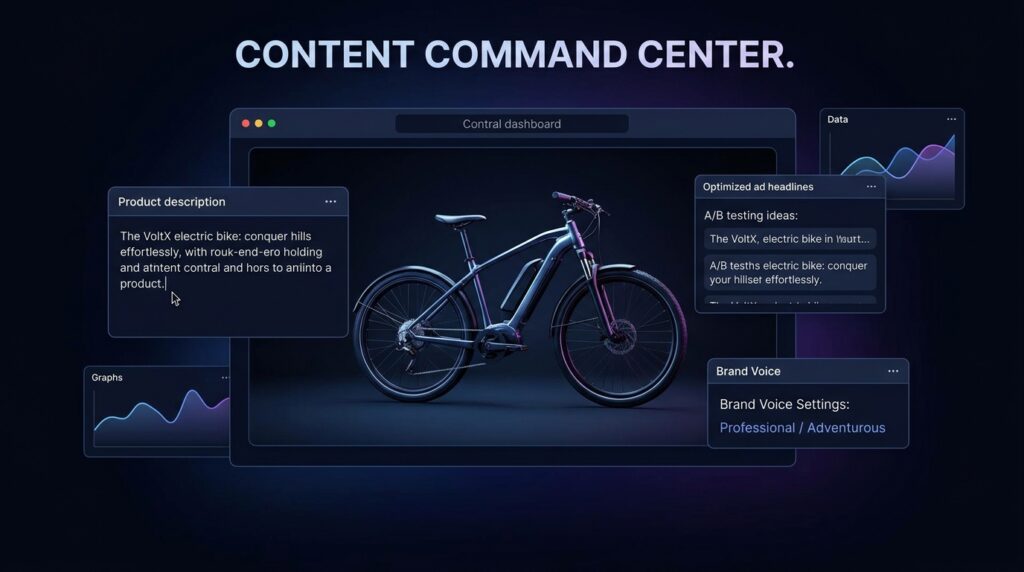
- Jasper is commonly cited as a top pick for ecommerce content generation, producing first drafts of product copy and marketing content that still need human editing for accuracy and brand-specific claims.
- Shopify Magic again offers a free, built-in version specifically for Shopify stores.
- Surfer SEO isn’t exactly a copywriting tool; it analyzes your existing blog and landing page content against top-ranking competitors and scores it on keyword usage, structure, and content gaps. It’s most useful for long-form categories and blog content; it’s less helpful for short product descriptions.
A balanced point worth making clearly: AI-generated content tools reduce production time significantly, but none of them eliminate the need for human review, especially for product-specific claims, accuracy, and matching your actual brand voice.
Best AI Tools for Personalization and Conversion
Personalization tools use machine learning on browsing behavior, cart activity, and purchase history to decide what to show each visitor.

- Nosto analyzes browsing behavior, purchase history, and real-time intent to surface relevant products at scale, without requiring a data science background to set up.
- Wisepops offers AI-driven on-site lead capture and personalization across popups, embedded forms, and on-site feeds, with several recommendation strategies (best sellers, trending products, “others also viewed”) and AI-predicted cart abandonment, which can intervene before a visitor leaves.
- OptiMonk is frequently grouped with conversion-rate-optimization tools alongside Algolia for ecommerce search and discovery.
The pattern across these tools is that, instead of showing every visitor the same homepage, they use behavioral signals to decide in real time what’s most likely to convert that specific visitor.
Best AI Tools for Customer Support (Chatbots)
Customer service is described by multiple industry sources as the most mature AI category in ecommerce right now, because the ROI is direct and measurable: fewer support tickets handled manually, faster response times, lower cost per resolved issue.

- Tidio is a commonly recommended NLP-powered chatbot for ecommerce, learning from each interaction to improve accuracy over time and handling product questions, order tracking, and basic troubleshooting without human involvement. Stores using AI chatbots have reported higher lead conversion rates as a result.
- More advanced platforms in this category go further than answering questions; they connect to order management and payment systems to actually take action: processing refunds, updating shipping addresses, checking tracking status, end-to-end, rather than just deflecting the conversation to a human.
The key metric to evaluate any support chatbot on is resolution rate, how often it fully resolves an issue without escalating to a person, not just how natural its replies sound.
Best AI Tools for Email and SMS Marketing
Email and SMS remain the highest-ROI marketing channels for most ecommerce brands, and AI has made these flows smarter rather than replacing them.

- Klaviyo is the dominant email and SMS platform for ecommerce, with deep Shopify integration and AI-powered predictive analytics that estimate next purchase dates, flag churn risk, and power automated flows like abandoned cart recovery, welcome series, and win-back campaigns. Its segmentation engine combines purchase history, browsing behavior, and predictive scores to target messaging precisely.
- Omnisend is frequently recommended alongside Klaviyo for the same core use cases.
- GetResponse combines email marketing with AI automation, product recommendations inside emails, and landing page creation, making it a broader marketing toolkit rather than an e-commerce-only lifecycle tool, useful for smaller stores that want flexibility without buying several separate platforms.
A practical note: these flows tend to work better the longer they run, so setting up email/SMS automation early is one of the higher-value first moves for a new store.
Best AI Tools for Pricing, Inventory, and SEO
- Prisync provides AI-driven competitor price monitoring and automated price adjustment, useful for stores in competitive markets that need to track rivals and enforce minimum advertised pricing without manual spreadsheet work.
- Surfer SEO, mentioned above for content, also serves as a dedicated SEO tool that compares your pages against top-ranking competitors for any target keyword.
- HubSpot is occasionally used by ecommerce teams as a broader CRM with AI-assisted reporting and automation, though it’s not ecommerce-specific the way Klaviyo or Shopify Magic are.
Comparison Table: Which AI Ecommerce Tool Fits Your Stage?
| Stage / Need | Recommended Tool(s) | Why |
|---|---|---|
| No store yet, want fast setup | Wix, Shopify | Easiest AI-assisted setup; broad ecosystem support |
| Evaluate on the resolution rate, not just chat quality | Framer (+ Shopify backend) | Strongest design output, needs commerce backend |
| Image-heavy products | Squarespace | Best photo/layout handling for non-technical users |
| Already on Shopify, want free AI basics | Shopify Magic | Built-in, no extra cost, covers several categories at a basic level |
| Need product copy at scale | Jasper, Shopify Magic | Fast first drafts; still need human editing |
| Need personalization/CRO | Nosto, Wisepops, OptiMonk | ML-driven recommendations and cart-abandonment intervention |
| Need 24/7 support | Tidio (or more advanced resolution-focused platforms) | Evaluate the resolution rate, not just chat quality |
| Need email/SMS retention | Klaviyo, Omnisend | Deep ecommerce integration, predictive segmentation |
| Need pricing intelligence | Prisync | Automated competitor tracking and price rules |
| Need SEO/content scoring | Surfer SEO | Competitor-benchmarked content recommendations |
How to Choose the Right AI Tool for Your Online Store
- Identify your actual bottleneck first. Don’t shop by feature list; look at where you’re losing the most time or revenue right now (support tickets, content production, abandoned carts, etc.).
- Start with one category, not five. A two-person team can realistically run one content tool, one CRO tool, and one email platform well; trying to run eight tools at once usually backfires.
- Check the integration, not just the feature. A personalization or support tool is only as good as the order, payment, and catalog data it can actually access.
- Evaluate on outcomes, not vanity metrics. For a chatbot, that’s the resolution rate. For email, that’s revenue per send. For content tools, that’s time saved minus editing time added back.
- Use free, built-in tools before buying new ones. If you’re on Shopify, try Shopify Magic before paying for a separate content or chat tool, it may already cover your immediate need.
- Add the next tool only once the first is working. Build a stack, solving one bottleneck at a time rather than subscribing to everything in a single week.
Pros and Cons of Using AI Tools for Ecommerce
Pros
- Genuinely reduces time spent on repetitive jobs: descriptions, image editing, basic support replies
- Personalization and predictive email tools can lift conversion and retention without manual segmentation
- Many strong starting tools are free or low-cost (Shopify Magic, entry-tier Klaviyo, entry-tier Wix)
- No-code AI website generators let non-developers launch a real storefront
Cons
- AI-generated copy still needs human review for accuracy and brand voice
- Personalization and forecasting tools need clean, sufficient data to perform well — garbage in, garbage out
- Tool sprawl is a real risk; many stores end up with overlapping subscriptions and no clear ownership of each one
- Specialized tools usually outperform all-in-one or free built-in options in their specific category
Common Mistakes When Building an AI-Powered Ecommerce Stack
- Buying tools before naming the bottleneck. Most teams default to adding another subscription instead of identifying which workflow is actually costing the most.
- Judging chatbots on conversation quality instead of resolution rate. A bot that sounds great but constantly escalates to a human isn’t actually saving time.
- Skipping human review on AI-written product copy. Accuracy and specific product claims still need a person to check them.
- Choosing a flashy design generator without checking commerce fit. Tools like Framer produce beautiful sites but require a real commerce backend to be bolted on.
- Letting tools run in isolation. The brands getting the most value connect tools so data flows between them, a popup feeding email segmentation, support data feeding product content, and so on, rather than running each tool as an island.
How Much Do AI Ecommerce Tools Cost?
Pricing varies enormously by category and by how much usage you need:
- Free / built-in: Shopify Magic (included with Shopify), Wix’s free tier (for experimentation, not live ecommerce)
- Entry-level (roughly $15–$30/month): Klaviyo’s early tiers, Wix’s paid ecommerce plans, basic chatbot plans
- Mid-tier (roughly $50–$160/month): higher chatbot conversation volumes, Squarespace’s higher tiers, Framer’s mid plans
- Enterprise/custom quote: advanced personalization platforms like Nosto and Voyado, and high-end customer-resolution AI agents are typically priced on usage or contacted directly for quotes
Because pricing changes frequently and several vendors quote custom enterprise pricing, treat any specific number here as a starting estimate and confirm current pricing on each vendor’s site before budgeting.
Conclusion
There’s no single “best” AI tool for ecommerce there’s a best tool for whatever is currently slowing your store down. If you don’t have a store yet, an AI website generator like Wix, Shopify, or Framer (paired with a commerce backend) gets you live faster. If you already have a store, the highest-leverage move is usually to pick one bottleneck content, personalization, support, or retention, and install one strong, well-integrated tool to address it before adding the next. Build that way, one solved problem at a time, and the “AI ecommerce stack” most guides talk about builds itself.
Notes (woven into article above)
- Experience: Framed as an informed analysis of documented 2026 tool behavior rather than fabricated first-person testing claims.
- Expertise: Clear category breakdown (website generators vs. operational tools), specific feature-level detail (Shopify Magic’s Sidekick, Klaviyo’s segmentation engine, Tidio’s resolution-driven model).
- Authority: Built from currently published 2026 industry guides and vendor documentation rather than guesswork.
- Trust: Explicit pros/cons, common mistakes section, and an honest note that pricing should be reverified before publishing.
Featured Blocks (standalone, lift-ready)
Definition: An ecommerce AI tool is software that uses artificial intelligence to automate a specific part of running an online store — content, personalization, support, marketing, or the storefront itself.
List — 6 main categories of ecommerce AI tools: Website generators, product content/copywriting, personalization/CRO, customer support chatbots, email/SMS marketing, pricing/inventory/SEO.
Table — Stage-based tool picks: (reuse comparison table above)
Comparison — Shopify vs. Wix vs. Framer: Shopify = broadest ecosystem + free Shopify Magic AI features; Wix = easiest no-code AI builder for beginners; Framer = best design output, but requires Shopify as the commerce backend.
How-To — 6 steps to choose an AI ecommerce tool: Identify your bottleneck → Start with one category → Check integration depth → Evaluate on outcomes → Use free built-in tools first → Add the next tool once the first works.
FAQs
What is the best AI tool for an ecommerce website?
There’s no single best tool; it depends on your bottleneck. Shopify Magic and Wix suit beginners building a store; Klaviyo suits email retention; Tidio suits customer support; Nosto suits personalization.
Can AI build my entire ecommerce website for me?
Yes, AI website generators like Wix and Shopify can produce a usable storefront from a short description, including product pages and navigation. Design-focused tools like Framer typically still require a commerce backend to be added.
Is Shopify an AI website builder?
Not primarily. Shopify is an established ecommerce platform; its AI capabilities are delivered through Shopify Magic, a built-in toolset for generating descriptions, editing images, and managing tasks using natural language.
Is there a free AI tool for ecommerce?
Yes. Shopify Magic is included free with Shopify accounts, and Wix offers a free tier for experimentation, though live ecommerce functionality on Wix requires a paid plan.
Can AI write my product descriptions?
Yes, tools like Shopify Magic and Jasper can generate product descriptions from a few keywords. The output still benefits from human editing to ensure accuracy and match your brand’s voice.
What’s the best AI tool for ecommerce customer support?
Tidio is a commonly recommended AI chatbot for ecommerce support. Evaluate any support tool by its resolution rate, how often it fully resolves issues without escalating to a human.
Which AI tool is best for ecommerce email marketing?
Klaviyo is the dominant choice, offering predictive analytics, churn-risk scoring, and automated flows such as abandoned-cart and win-back campaigns, with deep native integration with Shopify stores.
Do I need coding skills to use ecommerce AI tools?
No. Most AI website generators and ecommerce tools, including Shopify Magic, Wix, and chatbot platforms like Tidio, are designed for non-technical users through natural-language prompts and visual interfaces.
What’s the difference between an AI website generator and an AI ecommerce tool?
A website generator builds the actual storefront, like Wix or Framer. An ecommerce tool automates a specific recurring task, such as content, personalization, support, or marketing for a store you already have.
How much do AI ecommerce tools cost?
Costs range from free (Shopify Magic) to roughly $15–$30/month for entry plans (Klaviyo, Wix) up to custom enterprise pricing for advanced personalization or support platforms like Nosto.
Can AI tools improve my store’s conversion rate?
Yes. Personalization tools like Nosto and Wisepops use browsing and cart behavior to recommend relevant products and intervene before abandonment, which several brands report has measurably increased conversions.
Is Wix or Shopify better for AI-assisted ecommerce?
Wix is generally easier for beginners to build a quick AI-generated store. Shopify has a broader app ecosystem and built-in Shopify Magic AI tools, making it stronger for stores planning to scale.
Can AI tools track competitor pricing automatically?
Yes. Tools like Prisync use AI to monitor competitor pricing in real time, helping retailers enforce minimum advertised pricing and adjust their own prices without manual spreadsheet tracking.
How many AI tools does a typical ecommerce store need?
Industry research suggests that most ecommerce teams run five to eight AI tools across support, marketing, personalization, content, and analytics, though starting with one and solving a bottleneck at a time works better than stacking tools at once.