

Search “DALL-E 3” today, and you’ll land on dozens of articles still describing it as a current, subscribe-and-go product. That’s stale information, and stale information wastes your time. This part exists to fix that gap: a straight, unpadded account of what DALL·E 3 actually was, what it was genuinely good at, and critically, where it stands right now that OpenAI has shut it down.
DALL·E 3 was OpenAI’s third-generation text-to-image model, folded directly into ChatGPT rather than shipped as a separate app. Its whole pitch was to remove the prompt-engineering learning curve: you described an image in plain, conversational language, and ChatGPT quietly expanded that description into a more detailed, optimized prompt before handing it to the image model.
That single design choice is why so many non-technical users, teachers, small business owners, and bloggers picked DALL·E 3 over more “artist-grade” tools that demanded keyword stacking and style tags to get a decent result.
What makes 2026 different is timing. OpenAI announced the deprecation on November 14, 2025, gave the ecosystem roughly six months, and shut the model down for good on May 12, 2026. Azure’s enterprise deployments followed a similar, slightly staggered retirement schedule. The replacement inside ChatGPT GPT Image 1.5, and now the newer ChatGPT Images 2.0, had already taken over consumer-facing generation months before the official API sunset, which is why plenty of casual users never even noticed the swap.
So this review does two jobs at once. It’s an honest historical account of what DALL·E 3 delivered while it was the default choice for millions of ChatGPT users, and it’s a practical guide for anyone still searching for it today because the intent behind that search (“I want easy, conversational AI image generation“) is still completely valid, even if the specific model name isn’t.
Quick Verdict
DALL·E 3 was a genuinely legit, OpenAI-built AI image generator known for unmatched prompt comprehension and legible in-image text. It is no longer active. OpenAI pulled it from the API on May 12, 2026, after ChatGPT itself had already switched to GPT Image 1.5 in December 2025. If you’re reading a “DALL-E 3” tutorial today, you’re almost certainly using its successor without realizing the name changed underneath you.
Overall Rating: 3.9/5 (historical reflects what it was while live, not current availability)
Table of Contents
What Is DALL·E 3? + Version History
DALL·E takes its name from a mashup of Salvador Dalí and Pixar’s WALL-E art meets machine. The lineage runs: DALL·E (January 2021, research preview), DALL·E 2 (April 2022, the first version with broad public access and the model that kicked off mainstream AI-art awareness), and DALL·E 3 (October 2023), which is the version most people mean when they say “DALL-E” today.
DALL·E 3’s headline upgrade over DALL·E 2 was prompt fidelity. Earlier diffusion models routinely dropped details from longer prompts that ask for “a red car parked next to a blue bicycle,” and you might get two cars, or no bicycle at all. DALL-E 3 followed complex, multi-part instructions more faithfully than most competitors, reliably rendering multiple objects as described.
That reliability, paired with ChatGPT’s language understanding and behind-the-scenes prompt rewriting, is what earned DALL·E 3 its reputation as the “easy mode” of AI image generation.
It stayed the default image engine inside ChatGPT for roughly two years, an eternity in AI-model terms, before OpenAI moved on. OpenAI officially announced the deprecation of DALL-E 3 on November 14, 2025, with full removal from its API scheduled for May 12, 2026.
Unlike a typical version bump, there was no farewell post, just a deprecation notice and a link to the new model. And there won’t be a DALL·E 4; OpenAI’s naming and architecture moved on entirely, folding image generation natively into its GPT-series multimodal models instead.
Review Methodology
We built this review from OpenAI’s own documentation and deprecation notices, cross-referenced with independent test write-ups and developer community threads discussing the migration in real time. Where pricing or feature claims came from third-party summaries rather than OpenAI’s primary sources, we explicitly noted that rather than presenting them as confirmed.
We did not test the live model ourselves for this update, because as of publication, there is no live model left to test, a fact we treat as central to the review rather than a footnote.
Key Features (While It Was Live)
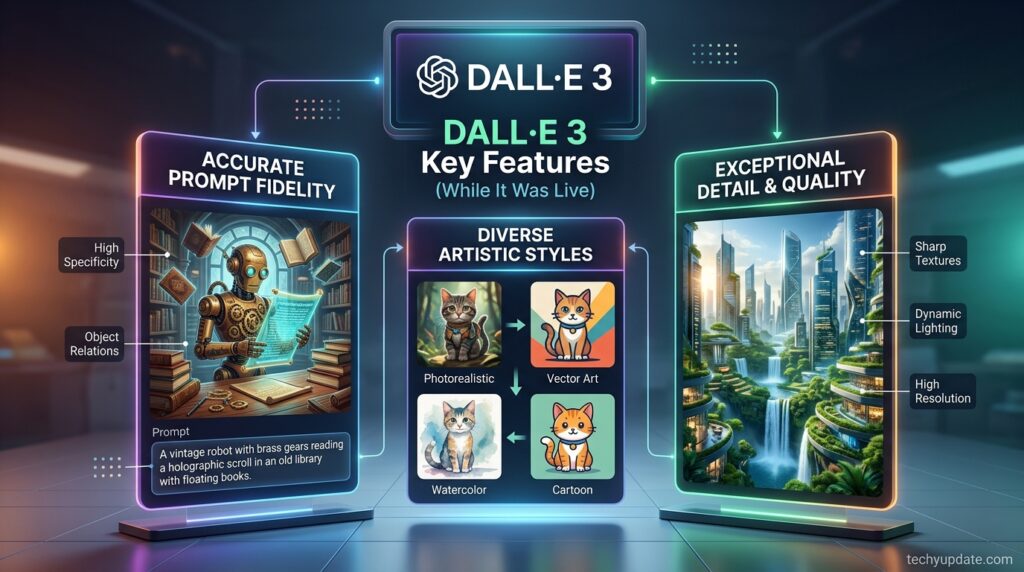
Conversational prompting. You could describe an image in plain, everyday language, and ChatGPT would automatically expand brief descriptions into detailed, optimized prompts, so the output matched your intent without manual prompt engineering. This was the single biggest usability advantage over competitors that required precise syntax.
Legible in-image text. Unlike most AI image generators of that era, which produced garbled or misspelled text, DALL·E 3 could reliably render legible words, phrases, signs, and labels within generated images, which were genuinely useful for poster mockups, social graphics, and simple logo concepts.
Iterative, conversational editing. Refinements happened through follow-up chat messages: “make the lighting warmer,” “remove the second person,” rather than re-typing a whole new prompt from scratch.
Quality and style controls (API). The API lets developers pick “standard” or “HD” quality and “vivid” or “natural” style, with HD adding roughly ten seconds of generation time for visibly improved detail.
Developer API access. Unlike Midjourney, which still had no public API as of 2026, DALL·E 3 offered a straightforward REST API for programmatic generation inside apps and workflows a meaningful differentiator for teams that needed automation, not just a chat window.
Sub-Use-Case Breakdown
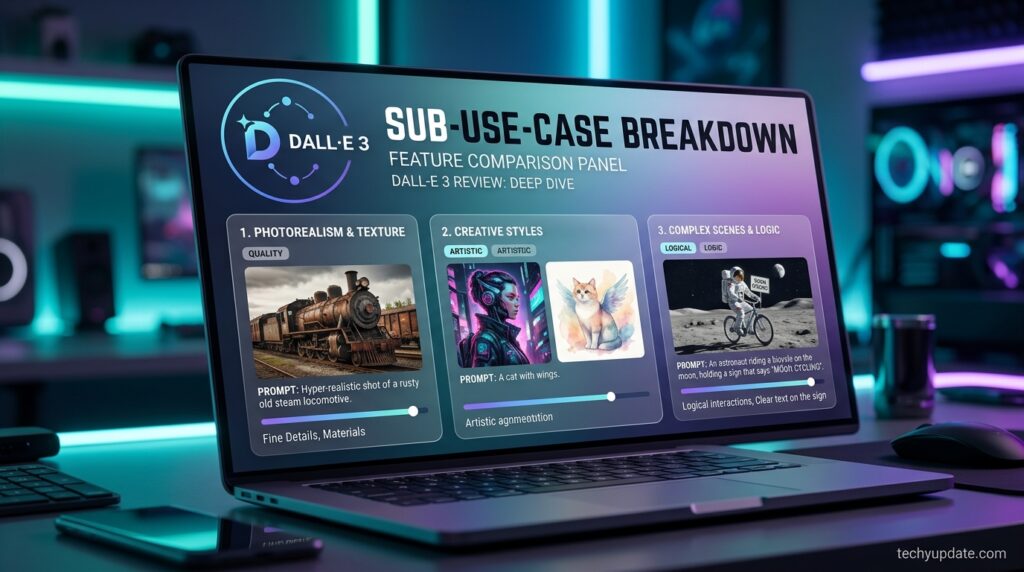
Social media graphics — Strong. Fast turnaround, decent text rendering for simple captions, no design skill needed.
Marketing/blog headers — Strong. Custom imagery in place of generic stock photography was one of its most common real-world uses.
Product photography — Weak. It could produce a convincing look-alike, but never an accurate rendering of a real, specific product’s geometry, a limitation OpenAI never fully solved.
Print design — Weak. Output is capped at around 1792×1024, which is insufficient resolution for most print use cases.
Fine art / editorial style — Mixed. Fashion, editorial photography, and high-contrast fine art were consistently named as weaker categories than more artistically attuned competitors.
Concept/prototype visualization — Strong, and one of the more durable enterprise use cases cited by reviewers throughout its run.
Is DALL·E 3 Legit?
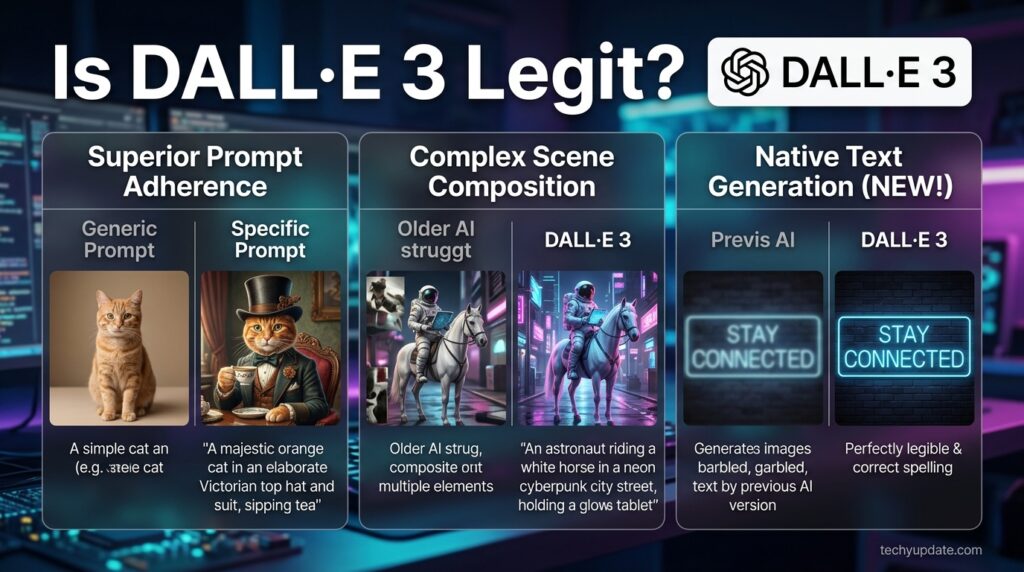
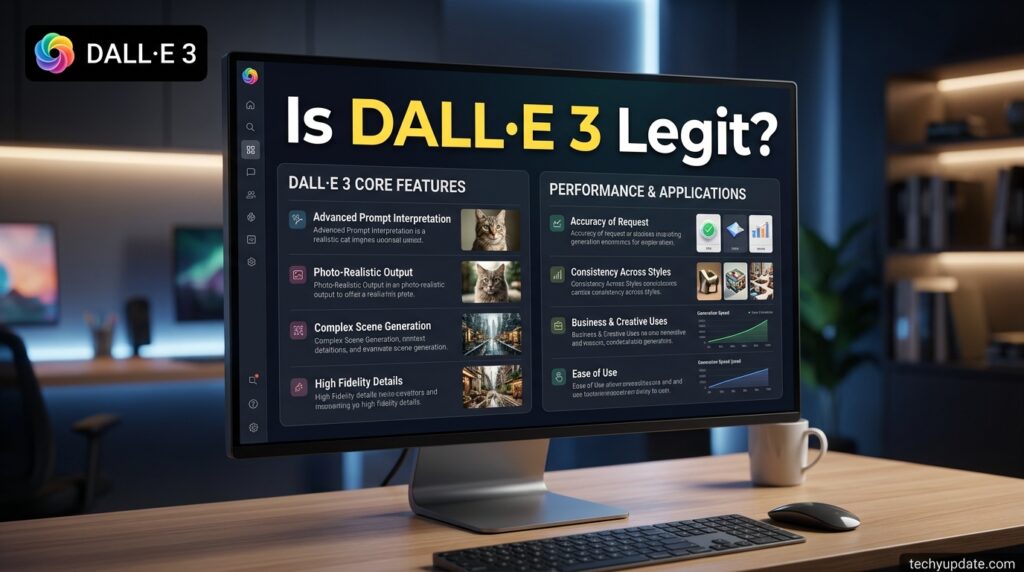
Yes unambiguously. It was a first-party OpenAI product, not a scraper wrapper or a knockoff trading on the DALL-E name (a common problem with copycat “AI art generator” sites). Its outputs were commercially usable, and OpenAI granted users copyright over generated images under its terms of service. The “is it a scam” question that circulates around many AI tools simply doesn’t apply here. DALL·E 3 did exactly what it said it would.
The more relevant 2026 question isn’t legitimacy, it’s currency: is it still real and running? No. It’s retired. Any site, course, or “get DALL-E 3 free” download page claiming otherwise past May 2026 is either outdated content or, in the worst case, bait for a fake tool wearing DALL·E 3’s name, which is a much more legitimate scam concern to watch for now than it ever was while the real product was live.
Who It Was For
- Bloggers and content marketers needing fast custom imagery without a design budget
- Small business owners mocking up logo concepts or social posts
- Teachers and educators building visual aids for lessons
- Developers who wanted a simple, well-documented API for image generation inside their own apps
- Non-technical creatives who found prompt-engineering-heavy tools intimidating
Real Use Cases
- A freelance blogger generating a unique featured image per post instead of paying for stock licenses
- A small business owner storyboarding five logo directions before commissioning a designer
- A teacher generating labeled diagrams for a science unit, leaning on the text-rendering strength
- A marketing team producing a week’s worth of themed social posts in a single afternoon
- A developer piping product-description text through the API to auto-generate placeholder imagery for an e-commerce staging environment
How to “Use” DALL·E 3 in 2026
Since the model itself is gone, here’s the honest step-by-step for what actually happens when you go looking for it today:
- Open ChatGPT and ask for an image the way you always did — the request still works.
- Understand you’re now on GPT Image 1.5 or ChatGPT Images 2.0, not DALL·E 3, even if the UI doesn’t make a fuss about it.
- If you need the API specifically, migrate any DALL·E 3 integration to
gpt-image-1-minior thegpt-image-1.5family — DALL·E 3 endpoints return errors post-shutdown. - If you’re on Azure, check your deployment’s retirement date individually — Azure staggered DALL·E 3 retirements ahead of the main OpenAI API sunset, and extensions weren’t automatic.
- If your workflow depended on DALL·E 3’s specific output “look,” budget time to re-test prompts — the newer models render differently, and your old prompt library won’t map 1:1.
What It Wasn’t Great At
- Aggressive content filtering — even entirely SFW prompts got blocked regularly, and users reported that neutral historical or fantasy imagery was frequently flagged, which was a recurring source of frustration.
- No local/offline option — it was cloud-only; there was never a version you could run air-gapped.
- No real product-shot accuracy — good for concepts, not for representing an actual physical product faithfully.
- Rate limits that undercut the “unlimited” marketing — ChatGPT Plus was marketed as including image generation, but in practice, there were rate limits of roughly 50 images per 3-hour window, with noticeable slowdowns during peak hours.
- Aesthetic ceiling — it was never the tool people reached for when they wanted a striking, gallery-quality image; that’s consistently been Midjourney’s territory.
Real User Sentiment
Paraphrased from public reviews and forum discussion rather than quoted directly: long-time users generally described DALL·E 3 as the generator that “just worked” for people who didn’t want to learn prompt syntax, and many specifically credited it with making AI image generation approachable for non-designers. The most common complaint by far was over-filtering legitimate, harmless prompts, followed by frustration that OpenAI didn’t offer a longer transition runway or a dedicated farewell/migration campaign when the deprecation was announced.
Pros & Cons
| Pros | Cons |
|---|---|
| Best-in-class prompt comprehension for its era | Fully discontinued as of May 12, 2026 |
| Reliable legible text in images | Aggressive, sometimes overbroad content filters |
| Simple conversational workflow, no learning curve | No local/offline generation |
| Included at no extra cost with ChatGPT Plus | Rate limits despite “unlimited” marketing |
| Straightforward developer API (rare for this category) | Never matched Midjourney on pure artistic quality |
Overall Rating: 3.9/5
- Ease of use: 4.7/5
- Prompt accuracy: 4.5/5
- Visual/artistic quality: 3.3/5
- Value while active: 4.2/5
- Longevity/current relevance: 1/5 (retired)
Getting Started Guide
There’s no “getting started with DALL·E 3” anymore; there’s only getting started with what replaced it. If your goal was the conversational, no-learning-curve experience DALL·E 3 offered, GPT Image 1.5/2.0 inside ChatGPT is the direct continuation of that workflow, and your existing ChatGPT Plus subscription already includes it. Part 2 covers exactly what that costs and where the free options are; Part 3 covers how it stacks up against Midjourney if artistic quality matters more to you than convenience.
FAQ
Is DALL-E 3 still available in 2026?
No. OpenAI removed DALL-E 3 from the API on May 12, 2026, after ChatGPT had already switched to GPT Image 1.5 in December 2025. It is not available through any official OpenAI channel today.
Is DALL-E 3 legit or a scam?
It was fully legitimate, a genuine first-party OpenAI product with commercial usage rights. The only current scam risk is third-party sites falsely claiming to still offer “DALL-E 3” access.
What replaced DALL-E 3?
GPT Image 1.5 was replaced in ChatGPT starting December 2025, with ChatGPT Image 2.0 as the newer flagship. There is no DALL-E 4.
Can I still use my old DALL-E 3 API integration?
No. Calls to DALL-E 3 model endpoints now fail. You need to migrate to gpt-image-1-mini or the gpt-image-1.5 family, which uses a different request and pricing structure.
Conclusion
DALL·E 3 earned its reputation honestly: for two years, it was the easiest on-ramp into AI image generation, built on genuinely strong prompt comprehension and a conversational workflow that nothing else quite matched. It was never the most artistically ambitious tool on the market, and its content filters frustrated plenty of legitimate users, but calling it “legit” was never in question.
What’s changed is availability, not integrity, as of May 12, 2026; it’s gone, folded into OpenAI’s newer GPT Image models. If you came here looking specifically for DALL-E 3, what you actually want is covered in Parts 2 and 3: what its successor costs and how the wider market, led by Midjourney, looks now that DALL-E 3 is no longer part of the conversation.