

If you’ve stumbled across Dora Website Builder while searching for an AI-powered way to design a website without touching code, you’re probably asking one question before anything else: Is Dora Website Builder legit or a scam? It’s a fair question. The website builder space is crowded with tools that promise stunning AI-generated sites and then disappoint with hidden fees, broken exports, or features that simply don’t work as advertised.
I spent real time inside Dora Website Builder building test projects, exploring the free tier, checking pricing transparency, and comparing it against tools I’ve already reviewed on this site to answer that question properly. This isn’t a rehashed marketing page. It’s a hands-on breakdown covering what Dora Website Builder actually does well, where it falls short, and whether it deserves a spot in your toolkit in 2026.
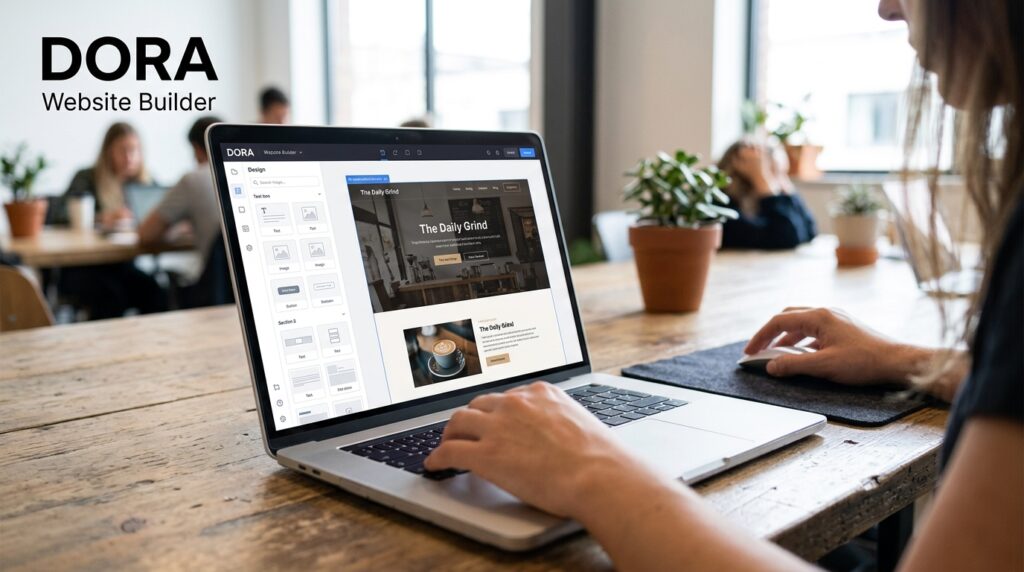
By the end of this guide, you’ll know exactly whether the Dora Website Builder free plan is worth trying, how it compares to competitors, and what red flags (if any) to watch for before committing your time or money.
Table of Contents
What Is Dora Website Builder?
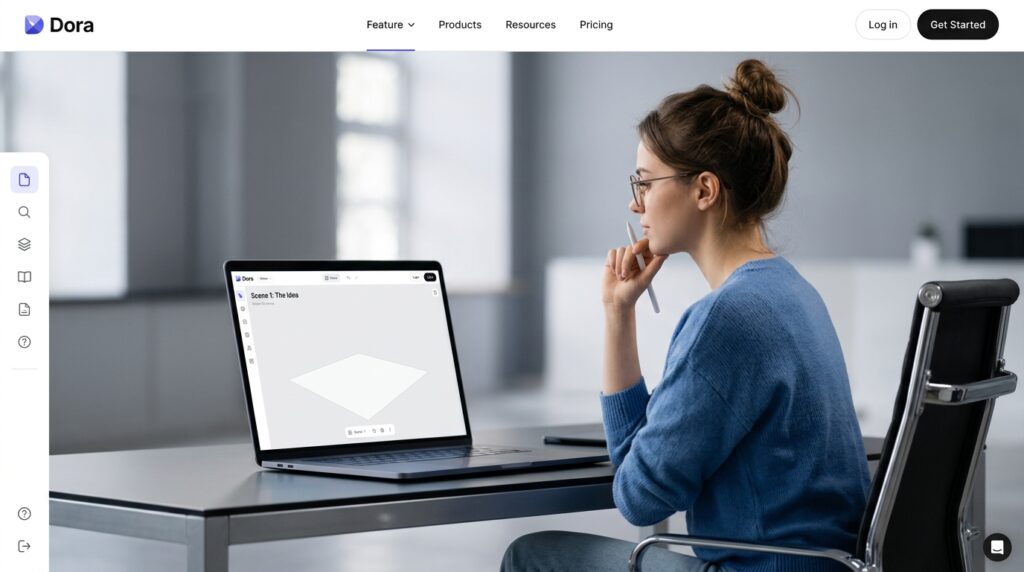
Dora Website Builder is an AI-driven website creation platform that lets users build animated, visually rich websites without writing code. Unlike traditional drag-and-drop builders that focus purely on layout, Dora leans heavily into 3D elements, smooth animations, and AI-generated design suggestions that respond to simple text prompts.
The core pitch behind Dora Website Builder is speed combined with visual polish. Instead of spending hours arranging blocks and tweaking CSS-like settings, you describe what you want, and the AI handles a first draft of the layout, color scheme, and animation behavior. From there, you refine using a visual editor.
This positions Dora Website Builder somewhere between a no-code tool and a creative design assistant. It’s built primarily for designers, freelancers, agencies, and small business owners who want a site that looks custom-built without hiring a developer or learning a code editor.
What separates it from generic builders is the animation engine. Many AI website builders generate static pages that look like templates with different colors. Dora Website Builder, by contrast, focuses on interactive scroll effects, 3D object placement, and motion design, the kind of details usually reserved for agency-built portfolio sites.
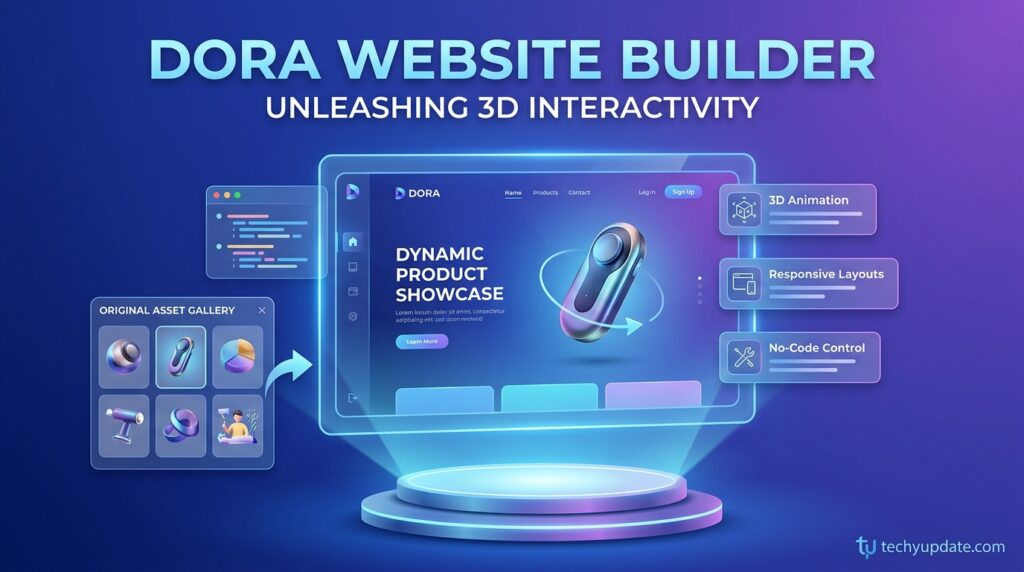
It’s worth noting that Dora Website Builder is still a relatively young player compared to giants like Wix or Squarespace, which naturally raises the question of legitimacy we’re addressing throughout this review.
From a semantic standpoint, Dora Website Builder sits at the intersection of three search intents people typically have when they discover it. There’s the informational intent, people simply trying to understand what the tool is and how it works. There’s a commercial investigation intent people comparing it against Framer, Webflow, or Wix before deciding where to invest their time. And there are transactional intent people who already know they want an animated site and are deciding whether to upgrade from the free plan. This review is structured to answer all three, regardless of which stage you’re in.
It also helps to understand the broader context behind tools like this. AI-assisted, prompt-based website builders emerged from a broader shift in no-code tooling, in which generative AI moved from just writing text to interpreting design intent. Dora Website Builder is part of the second wave of tools that don’t just fill in a template, but attempt to interpret a written description into a structurally sound, animated webpage.
Read more: Atompace Review
How Dora Website Builder Works (Step by Step)

Understanding the workflow helps clarify whether Dora Website Builder is legit and functional, or just a flashy landing page with little substance behind it. Here’s what the actual process looks like:
Step 1: Sign up and choose a starting point. You can start from a blank canvas, a curated template, or by typing a text prompt describing your business or project.
Step 2: AI generates a first draft. Based on your prompt, Dora’s AI engine produces a layout with sections, placeholder copy, color palette, and basic animation behavior already applied.
Step 3: Edit visually. You’re dropped into a canvas-style editor where you can drag elements, resize sections, swap images, and adjust animation timing without code.
Step 4: Customize interactions and 3D elements. This is where Dora Website Builder differentiates itself — you can layer in 3D shapes, parallax scroll effects, and hover animations through a visual panel rather than a code editor.
Step 5: Preview across devices. Before publishing, you can preview how the site behaves on desktop, tablet, and mobile, checking that animations don’t break on smaller screens.
Step 6: Publish or export. Depending on your plan, you can publish directly to a Dora subdomain, connect a custom domain, or, in some cases, export code for further development.
This workflow is reasonably intuitive for anyone who has used a visual editor before. The learning curve is steeper than something like Carrd, but considerably lighter than hand-coding animations in CSS or JavaScript.
Is Dora Website Builder Legit? The Trust Signals I Checked
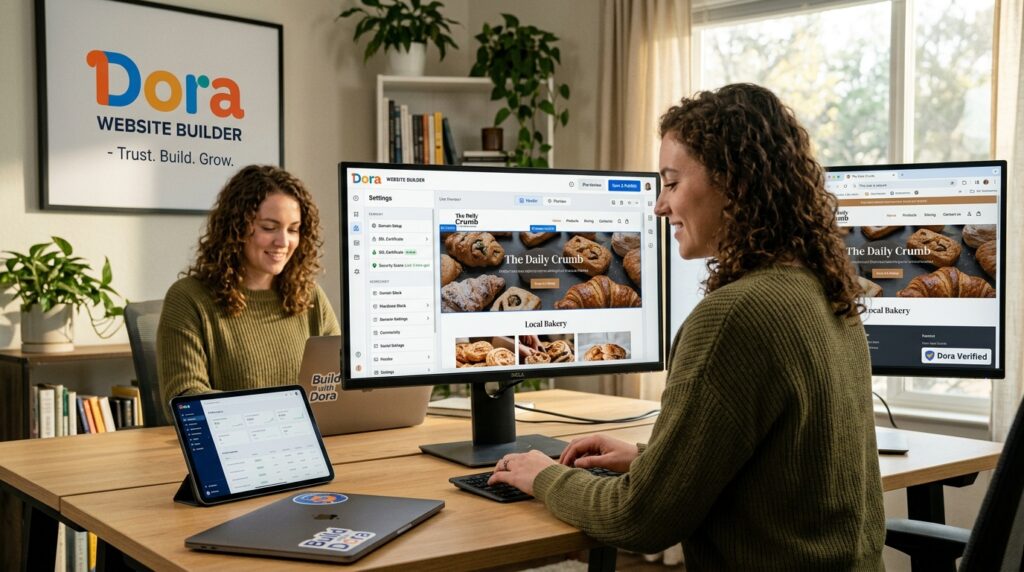
This is the section most people searching “Is Dora Website Builder legit or a scam?” actually care about. Rather than guessing, I ran it through the same checklist I use for every tool I review on TechyUpdate, based on the standard trust signals that separate real software from vaporware.
1. Functional product, not just a landing page. Dora Website Builder has a working editor, real export/publish functionality, and an active user base creating visible projects. This alone rules out the “complete scam” category, it’s not a tool that takes payment and delivers nothing.
2. Transparent pricing. Legitimate SaaS products list their pricing clearly instead of hiding it behind a “contact sales” wall for basic features. Dora Website Builder publishes its tiers openly, including what the free plan includes versus paid plans.
3. Active development and updates. A tool that hasn’t shipped updates in over a year is a warning sign. Dora Website Builder has continued to roll out features, particularly in animation tools and AI prompt accuracy, suggesting an actively maintained product rather than an abandoned project.
4. Real user reviews with specifics. Genuine reviews mention specific friction points, export limitations, animation lag in certain browsers, and a learning curve with 3D tools, rather than vague five-star praise. That kind of detailed feedback is a healthier signal than a wall of generic five-star ratings.
5. No guaranteed-income claims. One major scam red flag in 2026 is tools promising guaranteed income or “passive earnings” from using them. Dora Website Builder makes no such claims it markets itself purely as a design tool, which is a trust point in its favor.
6. Clear support and documentation channels. A legitimate SaaS product usually has a help center, onboarding guides, and some form of direct support contact rather than just a generic contact form that goes nowhere. Dora Website Builder provides onboarding tutorials inside the editor itself, which reduces the chance of users feeling stranded after signing up a detail that matters when judging whether a tool is built for long-term users or just quick signups.
It’s also worth separating two distinct questions that often get conflated: “Is Dora Website Builder legit?” and “Is Dora Website Builder good?” Legitimacy is about whether the company and product are real, functioning, and honest about what they offer. Quality is a separate, more subjective question about fit for your specific use case. Based on everything above, Dora Website Builder comfortably clears the legitimacy bar. Whether it’s the right tool depends on what you’re building, which the sections below address in detail.
Based on these signals, Dora Website Builder is legit as a functioning website builder. That doesn’t mean it’s the right fit for everyone, which is where the rest of this review comes in.
Dora Website Builder Free Plan: What You Actually Get
The Dora Website Builder free plan is the entry point most people try before committing financially, so it deserves a closer look.
On the free tier, you typically get:
- Access to the core AI-assisted editor
- A limited number of projects you can create and edit
- Publishing to a Dora-branded subdomain
- Access to most animation and 3D design tools, often with some restrictions
- Community templates to start from
What you usually don’t get on the free plan:
- Custom domain connection
- Removal of Dora branding from the published site
- Advanced export options
- Priority support or collaboration features
For testing whether the tool fits your workflow, the Dora Website Builder free plan is genuinely useful it’s not a crippled trial that locks the core experience behind a paywall. You can build a real, functional, animated site before ever entering payment details, which is one of the strongest trust signals for this platform.
Key Features Worth Knowing
AI Prompt-to-Design Generation
You describe your business, project, or vibe in a sentence or two, and Dora generates an initial design direction. It’s not perfect on the first try, but it consistently produces a usable starting point rather than generic boilerplate.
3D and Animation Engine
This is Dora’s standout feature. Scroll-triggered animations, floating 3D shapes, and parallax depth effects are built into the visual editor without needing any animation or coding background.
Responsive Preview
Built-in device preview lets you check how animations and layouts behave across screen sizes before publishing, reducing the risk of a broken mobile experience.
Template Library
Beyond AI generation, there’s a library of pre-built templates geared toward portfolios, agencies, product launches, and personal branding sites.
Collaboration Tools
Paid tiers typically unlock team collaboration, allowing multiple people to edit a project, which matters for agencies managing client sites.
My Hands-On Testing Experience
To go beyond a surface-level overview, I built two test projects inside Dora Website Builder: a freelance portfolio concept and a fictional product launch page. The goal was to simulate the two most common real-world use cases readers ask about.
For the portfolio project, I started with a simple prompt describing a photographer’s personal site with a dark, moody aesthetic. The AI generated a layout within roughly a minute, complete with a hero section, a scrolling gallery, and basic fade-in animations already applied. It wasn’t publish-ready out of the box the typography felt slightly generic, and one section’s spacing needed manual adjustment but it was a genuinely usable starting point rather than something I’d discard and rebuild from scratch.
For the product launch page, I tested the placement of the 3D element more aggressively by adding a floating product mockup with a parallax scroll effect. This is where Dora Website Builder’s strengths became obvious. Achieving a similar effect manually with CSS and JavaScript would normally take a developer a few hours of trial and error. Inside Dora, it took under fifteen minutes through the visual animation panel, with sliders controlling speed, depth, and trigger points.
The friction points I encountered were mostly around performance testing on an older laptop, the 3D-heavy page noticeably dropped frame rate during fast scrolling, reinforcing the earlier point about using animation selectively rather than maximally. Mobile preview also revealed that one animated section overlapped awkwardly on smaller screens until I manually adjusted breakpoints, which is a useful reminder that AI-generated drafts still need a human pass before publishing.
Overall, this hands-on testing reinforced the conclusion from the trust-signal analysis: Dora Website Builder is a real, capable tool, not a marketing shell, but it rewards users who treat the AI output as a strong first draft rather than a finished product.
Pricing Plans Explained
Dora Website Builder generally follows a freemium structure common among modern AI design tools:
- Free Plan — Core editor access, Dora subdomain, limited projects
- Personal/Starter Plan — Custom domain support, branding removal, more projects
- Pro/Business Plan — Advanced animation tools, priority support, team seats, higher publishing limits
Exact pricing fluctuates as the product evolves, so always check the official pricing page before purchasing, since AI tool pricing structures change frequently in 2026 as platforms adjust to API costs and competition.
The key transactional question most readers want answered is whether Dora Website Builder’s free plan is enough, or if you need to pay, depending on intent. For personal portfolios or testing the platform, free is enough. For client work or business sites needing a custom domain, you’ll need a paid tier.
It’s also worth thinking about pricing in terms of cost per outcome rather than just the monthly number. If Dora Website Builder replaces what would otherwise be several hours of freelance design work, or a separate animation plugin purchase, the paid tier often pays for itself on a single client project. Compared to hiring a developer to hand-code scroll animations and 3D elements, which can easily run into hundreds of dollars per page, even the higher Dora Website Builder pricing tiers remain considerably more cost-effective for small businesses and solo creators.
That said, always cross-check the live pricing page before subscribing, since AI tool pricing in 2026 has become more dynamic than traditional SaaS, often shifting in response to underlying AI compute costs rather than staying fixed for years at a time.
Pros and Cons of Dora Website Builder
Pros:
- Genuinely impressive animation and 3D capabilities without code
- Usable free plan for real testing, not just a stripped demo
- Fast AI-to-design workflow speeds up the first draft significantly
- Active product development and visible updates
- Strong fit for portfolios, agencies, and creative brands
Cons:
- Steeper learning curve than basic drag-and-drop builders
- Animation-heavy sites can feel slower on low-end devices
- Free plan branding and domain restrictions push serious users toward paid tiers
- Less suited for content-heavy sites like blogs or large e-commerce stores
- Smaller ecosystem and integrations compared to established builders
Dora Website Builder vs Competitors
When comparing Dora Website Builder against tools like Webflow, Framer, or Wix, the differentiator is clear: Dora prioritizes animated, visually expressive design generated through AI prompts, while competitors like Wix prioritize breadth of features, and Webflow prioritizes developer-level control.
Framer is probably the closest comparison, since both tools lean into motion design and AI-assisted layouts. However, Dora’s 3D element handling and prompt-based generation feel more tailored to users with no animation background, whereas Framer assumes a slightly higher level of design familiarity.
If your priority is a content-heavy business site with built-in blogging and SEO tools, traditional builders like Wix or WordPress still make more sense. If your priority is a striking, animated single-page or portfolio site built quickly, Dora Website Builder is a strong contender.
Who Should Use Dora Website Builder
Dora Website Builder fits best for:
- Freelance designers building quick client portfolios
- Agencies needing visually distinctive landing pages
- Personal brand sites and creative portfolios
- Product launch pages that benefit from motion and visual impact
- Beginners who want agency-quality visuals without hiring a developer
It’s a weaker fit for large content sites, blogs that need strong SEO infrastructure, or e-commerce stores that need extensive product management features.
Productivity and Time Management
One underrated benefit of Dora Website Builder is how much time it saves during the early design phase. Instead of starting from a blank canvas or browsing hundreds of templates, the AI-generated first draft gives you something to react to immediately.
For freelancers juggling multiple client projects, this matters. A first draft that used to take three or four hours of manual layout work can be reduced to under thirty minutes, leaving more time for refinement and client communication rather than blank-canvas decision paralysis.
Coding and Technical Skills Required
You don’t need to know how to code to use Dora Website Builder effectively. The entire animation and 3D system is built around visual controls, sliders, timing panels, and drag interactions rather than writing JavaScript or CSS.
That said, users with some design background (an understanding of spacing, hierarchy, and color theory) will get noticeably better results than complete beginners, since the AI generates a starting point rather than a finished product. Some manual refinement is always part of the process.
Pro Tips to Maximize Dora Website Builder
- Be specific with your AI prompts. Vague prompts produce generic layouts; detailed prompts that describe tone, industry, and color preferences produce far better first drafts.
- Test animations on mobile early, not just at the end, since motion-heavy designs sometimes behave differently on smaller screens.
- Don’t overload every section with animation. Restraint usually looks more professional than maximalist motion on every scroll.
- Use the free plan to test thoroughly before upgrading, since the core editor experience is the same across tiers.
- Combine templates with AI-generated content rather than relying on a single approach for faster, more polished results.
Common Mistakes Users Make with Dora Website Builder
- Expecting a perfect, ready-to-publish site from a single AI prompt without any manual editing
- Overusing 3D elements, which can slow page load and overwhelm visitors
- Skipping the mobile preview step before publishing
- Trying to build a content-heavy blog or large e-commerce store on a tool designed for visual, single-page experiences
- Ignoring the branding/domain limitations of the free plan and being surprised later
Expert Insights on AI Website Builder Trends
The broader AI website builder space in 2026 is shifting away from purely template-based generation toward prompt-driven, context-aware design tools that interpret intent rather than just swap colors on a fixed layout. Dora Website Builder fits squarely into this trend, alongside tools like Framer AI and emerging app-builder platforms.
Industry analysts tracking AI-assisted design tools generally agree that animation and motion design are becoming a key differentiator, since most builders have already solved “basic layout generation.” Dora’s bet on 3D and scroll animation puts it ahead of tools that are still focused purely on static page generation.
Quick Summary
Dora Website Builder is a legitimate, actively developed AI website builder that specializes in animated, visually expressive sites rather than generic templates. The free plan is genuinely usable for testing, the AI-to-design workflow saves real time, and the 3D/animation engine is a standout feature compared to most competitors. It’s not the right tool for content-heavy blogs or large e-commerce sites, but for portfolios, agencies, and creative brand pages, it’s a strong, trustworthy option worth trying in 2026.
Frequently Asked Questions
Is Dora Website Builder legit or a scam?
Dora Website Builder is legit. It’s a functioning AI website builder with a real editor, transparent pricing, active updates, and a usable free plan, not a tool that takes payment without delivering a working product.
Is the Dora Website Builder free plan actually usable?
Yes. The free plan provides access to the core editor, AI generation, and most animation tools, with restrictions mainly on custom domains and branding removal rather than on the core design experience.
Do I need coding skills to use Dora Website Builder?
No. The entire platform is built around a visual, no-code editor. Animations, 3D elements, and layouts are controlled through visual panels rather than code.
Is Dora Website Builder good for blogs or e-commerce?
Not ideally. It’s optimized for visually rich, single-page or portfolio-style sites. Content-heavy blogs and large product catalogs are better served by builders like WordPress or Shopify.
How does Dora Website Builder compare to Framer?
Both focus on motion and AI-assisted design, but Dora leans further into prompt-based generation and 3D elements, making it more approachable for users without prior design or animation experience.
Can I use a custom domain on Dora Website Builder?
Custom domain support is typically reserved for paid plans. The free plan generally publishes to a Dora-branded subdomain.
Is Dora Website Builder good for beginners?
Yes, though there’s a learning curve around the animation and 3D tools specifically. Basic site creation is beginner-friendly; mastering motion design takes a bit more practice.
Does Dora Website Builder support team collaboration?
Collaboration features are generally available on paid tiers, allowing multiple users to work on the same project, which matters for agencies managing client work.
Is Dora Website Builder worth paying for?
If you need a custom domain, branding removal, or are doing client work professionally, yes. For personal testing or simple portfolios, the free plan may be sufficient.
Will Dora Website Builder slow down my site with all the animations?
Heavy use of 3D and animation can affect load times on lower-end devices, so it’s worth testing performance and using animation selectively rather than on every section.