


Ahrefs is an SEO and digital marketing platform designed to help website owners, marketers, content teams, agencies, and SEO professionals research search demand, analyze competitors, investigate backlinks, audit websites, track rankings, and measure visibility across search and AI platforms. Its core tools include Site Explorer, Keywords Explorer, Site Audit, Rank Tracker, and Content Explorer, alongside newer capabilities for AI visibility and content optimization.
The platform is particularly useful when you need more than data from your own website. For example, Google Search Console provides first-party performance information for a site you control, while Ahrefs is designed to provide competitive and broader web intelligence, including competitor keywords, backlinks, ranking information, and search opportunities.
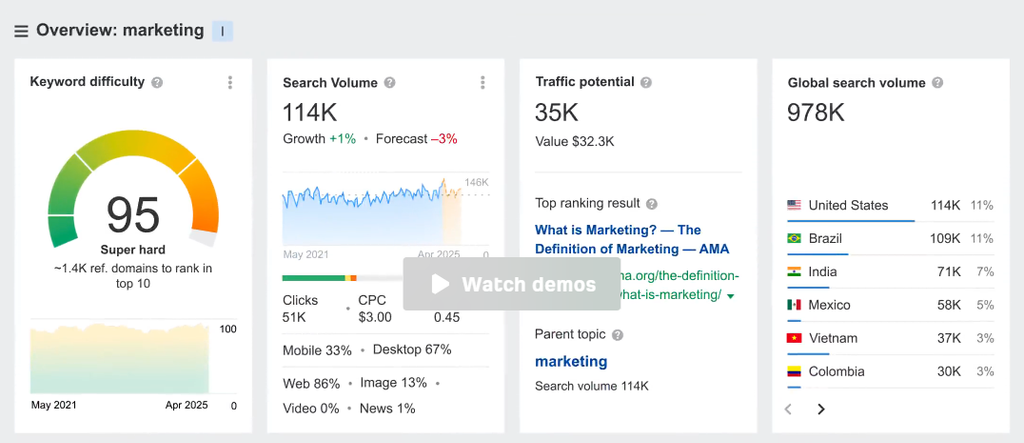
Ahrefs can therefore be useful at several stages of an SEO workflow. A beginner may use it to find keyword ideas and identify technical problems. A content marketer can research competitors and discover topics that already attract search traffic. An SEO professional can investigate backlink profiles, monitor rankings, analyze SERPs, and evaluate opportunities across multiple websites.
However, Ahrefs is not simply a database of SEO metrics. The usefulness of the platform depends on understanding what its data means and how much confidence to place in estimates such as search volume, traffic, or keyword difficulty.
This guide explains what Ahrefs is, how its major SEO features work, what type of data it provides, its current pricing structure, practical use cases, limitations, and which users can benefit most from it.
Read more: TechyHitTools.org Review: Best Free Online Toolkit for SEO and Content Tasks?
Table of Contents
What Is Ahrefs?
Ahrefs is a marketing and SEO platform that provides tools for researching search demand, analyzing websites and competitors, auditing technical SEO, monitoring rankings, studying backlinks, researching content, and measuring visibility in search and AI environments. Ahrefs says its platform is built on large-scale web crawl and search data.
The platform is best understood as a collection of connected SEO research tools rather than a single feature.
For example:
- Site Explorer helps investigate websites, competitors, backlinks, organic keywords and traffic estimates.
- Keywords Explorer helps research keywords and associated SEO metrics.
- Site Audit identifies technical and on-page SEO issues.
- Rank Tracker monitors keyword positions.
- Content Explorer helps find content and link opportunities.
- Brand Radar focuses on visibility in AI-generated search experiences.
This makes Ahrefs useful for both research and ongoing SEO management.
A website owner can start by finding opportunities, publish content, monitor rankings, identify technical problems, and then investigate competitors or backlinks as the site develops.

How Does Ahrefs Work?
At a high level, Ahrefs collects and processes large amounts of web and search-related data and turns that information into reports and SEO metrics.
Its crawler continuously discovers webpages and links across the web. Ahrefs says Site Explorer is supported by a large search and backlink index, while its platform also uses historical data and keyword databases for SEO research.
The important distinction is that many Ahrefs numbers are estimates or third-party measurements, not direct measurements from Google.
For example, a competitor’s estimated organic traffic is not the same thing as the actual traffic recorded in that competitor’s analytics account.
This matters when interpreting SEO data.
Ahrefs can help you identify patterns such as:
- Which keywords a competitor appears to rank for
- Which pages attract estimated organic traffic
- Which websites link to a domain
- Which keywords appear to have ranking opportunities
- Which technical issues exist on your website
- How keyword rankings change over time
The data is most valuable when several metrics are considered together rather than when a single number is treated as absolute.
Ahrefs Site Explorer
Site Explorer is one of Ahrefs’ central competitor research tools.
It can be used to investigate a website’s backlink profile, organic search visibility, top-performing pages, organic keywords, paid traffic and other website-level information. Ahrefs also now presents search and AI visibility information through its platform.
For SEO research, Site Explorer can answer questions such as:
Which pages bring competitors search traffic?
You can investigate pages that appear to perform well in organic search and study the topics, keywords and links associated with them.
Which websites link to a competitor?
Backlink reports can reveal referring domains and individual links that may help explain how a competing site has built authority.
What keywords does a competitor rank for?
This can reveal topics that you may not have considered when building your own content strategy.
What content appears to perform well?
Looking at competitor pages can help identify content gaps and opportunities rather than simply copying existing articles.
One important limitation is that traffic estimates should not be treated as exact analytics data.
Ahrefs Keywords Explorer
Keywords Explorer is designed for keyword research and search-demand analysis.
Ahrefs says the tool can analyze billions of keywords and provide SEO metrics intended to help users identify valuable search opportunities.
Typical keyword research involves examining factors such as:
- Search volume
- Keyword difficulty
- Traffic potential
- Search intent
- SERP results
- Related keyword ideas
- Keyword variations
- Ranking opportunities
The value of keyword research is not simply finding keywords with the largest search volume.
A keyword with high volume can be extremely competitive or poorly aligned with your website.
For a newer website, a more practical strategy can be finding specific queries with clear search intent, reasonable competition, and strong relevance to the site’s expertise.
For example, instead of targeting a broad phrase such as SEO, a website might research more specific topics around technical SEO audits, keyword clustering, competitor keyword research, or SEO tools for small websites.
The right keyword depends on the site’s authority, audience, content quality and business objective.
Ahrefs Site Audit
Site Audit focuses on technical and on-page SEO.
Ahrefs says Site Audit can identify more than 170 predefined SEO issues, including problems involving titles, meta descriptions, H1 tags, duplicate content, indexability, links, redirects, images, JavaScript, CSS, robots directives and sitemaps.
This makes Site Audit useful for finding problems that may be difficult to identify manually across a large website.
A technical SEO audit can help identify:
- Broken links
- Missing or problematic metadata
- Duplicate pages
- Indexability problems
- Redirect issues
- Internal linking problems
- Image-related issues
- Sitemap and robots-related issues
- Certain performance-related problems
However, an SEO audit should not be treated as an automatic list of changes that must all be implemented.
Some warnings may have little practical impact on a particular website.
A good SEO workflow prioritizes problems based on their effect on crawling, indexing, user experience, search visibility and the site’s objectives.

Ahrefs Rank Tracker
Rank Tracker monitors keyword positions over time.
This is useful because SEO is not simply about publishing a page and checking its ranking once.
You may want to know whether a page is:
- Moving from page two toward page one
- Losing visibility
- Gaining rankings for additional queries
- Performing differently across locations
- Changing position after a content update
Ahrefs currently lists weekly Rank Tracker updates across its main paid plans, with keyword limits depending on the subscription.
Rank tracking is especially useful for established content strategies because it provides a way to measure changes rather than relying only on occasional manual Google searches.
Ahrefs Content Explorer
Content Explorer is designed for content research.
It can help marketers investigate existing content, identify topics and discover potential link opportunities.
Instead of asking only:
What keyword should I target?
You can ask:
What type of content is already attracting attention in this topic?
That distinction is important.
A strong content strategy considers:
- Existing search results
- Content formats
- Topic coverage
- Backlinks
- Search intent
- Competing pages
- Missing information
- Opportunities to provide something genuinely better
This can help prevent the creation of another generic article that adds little value to existing search results.
Ahrefs Backlink Analysis
Backlink analysis is one of Ahrefs’ long-standing strengths.
A backlink is a link from another website to a page on your website.
SEO professionals analyze backlinks because links can provide useful information about how websites are connected and which pages attract references from other sites.
Ahrefs’ Site Explorer allows users to examine backlink profiles and referring domains.
Backlink research can be useful for:
- Competitor analysis
- Link prospecting
- Finding broken-link opportunities
- Identifying pages that naturally attract links
- Understanding competitor authority signals
- Investigating changes in a website’s link profile
But backlink quantity alone is not a reliable measure of SEO quality.
A large number of low-value or irrelevant links does not automatically make a website stronger than a site with fewer but more relevant references.
Ahrefs Data and SEO Metrics
Ahrefs provides numerous metrics that help users interpret search and website data.
Some commonly encountered concepts include:
Domain Rating (DR): A metric used by Ahrefs to represent the strength of a website’s backlink profile relative to other websites in its database.
URL Rating (UR): A metric focused on the backlink strength of an individual URL.
Keyword Difficulty: An Ahrefs estimate intended to indicate how difficult it may be to rank for a keyword.
Organic keywords: Search queries for which a website or page is estimated to appear in organic search results.
Traffic potential: An estimate intended to help users understand the broader traffic opportunity associated with ranking for a topic or keyword.
These metrics are useful for comparison and research, but they are Ahrefs metrics, not official Google ranking scores.
That distinction is important.
Google does not publish an SEO score called Domain Rating, for example. DR is an Ahrefs-created metric based on its own backlink data and methodology.
Ahrefs for Competitor Analysis
Competitor research is one of the most practical uses of Ahrefs.
Instead of guessing what competitors are doing, you can investigate their visible search performance and backlink profiles.
A basic competitor workflow can look like this:
Find relevant competitors
Choose websites that compete with you for the same search audience rather than simply businesses that sell similar products.
Analyze their organic keywords
Look for topics and queries where competitors appear to have visibility.
Review top pages
Study which pages attract the most estimated organic traffic.
Analyze backlinks
Identify websites and pages that link to successful competitor content.
Look for content gaps
Ask which useful questions competitors have not answered well.
Build a differentiated strategy
Use the research as input rather than copying competitor content.
This approach is more useful than simply trying to reproduce a competitor’s keyword list.
Ahrefs for Keyword Research
Ahrefs can be particularly useful when building a new content strategy.
A practical workflow is to begin with a broad topic and then identify specific search intents around it.
For example, a technology website researching SEO tools might separate searches into:
- What is an SEO tool?
- Best SEO tools for beginners
- Ahrefs vs Semrush
- How to use Ahrefs for keyword research
- Ahrefs pricing
- Free Ahrefs alternatives
- How to analyze backlinks
- How to perform a technical SEO audit
These searches represent different user needs.
Rather than publishing multiple articles that answer essentially the same question, the content strategy should identify meaningful differences in intent and information value.
That helps reduce unnecessary topic overlap and creates a more coherent topical structure.
Ahrefs for Technical SEO
Technical SEO teams can use Ahrefs Site Audit to identify problems across websites.
This becomes particularly useful on larger websites where manually checking every page is unrealistic.
For example, a crawl might reveal hundreds of pages with missing metadata or broken internal links.
Instead of checking pages individually, the audit groups issues so the SEO team can investigate patterns.
The important step is prioritization.
A website should not blindly fix every warning. Some issues are more important than others, and some may be intentional.

Ahrefs for Content Strategy
Ahrefs can support the complete content planning process.
A marketer can use it to:
- Research a topic.
- Analyze relevant search queries.
- Study competing pages.
- Identify content gaps.
- Examine backlinks.
- Build a content plan.
- Publish useful content.
- Track rankings.
- Review performance.
- Update content when necessary.
This creates a research-to-measurement workflow rather than treating SEO as a one-time keyword exercise.
For content teams, the biggest benefit is often the ability to connect search demand, competition, content and backlinks in one workflow.
Ahrefs and AI Search Visibility
Ahrefs has expanded beyond traditional Google-focused SEO into AI search visibility.
Its current platform includes Brand Radar, which is designed to monitor how brands appear in AI-generated answers. Ahrefs says Brand Radar tracks AI visibility across multiple AI indexes and platforms.
This reflects an important change in search behavior.
Users increasingly ask AI systems questions instead of only typing keywords into a traditional search engine.
For marketers, that creates new questions:
- Does my brand appear in AI answers?
- Which competitors are mentioned?
- Which sources are being referenced?
- What topics generate brand visibility?
- How does visibility differ between AI platforms?
Ahrefs’ AI-focused tools are intended to help answer some of these questions.
However, AI visibility measurement should be viewed as a developing area rather than a replacement for conventional SEO measurement.
Ahrefs Pricing
Ahrefs currently offers several subscription levels, including Starter, Lite, Standard, Advanced and Enterprise, as well as a free account with more limited capabilities. Pricing and included limits can change, so users should verify the current plan before purchasing.
The current listed starting prices for the main paid plans are:
| Plan | Listed price | General positioning |
|---|---|---|
| Starter | $29/month | Beginners who need more than the free account |
| Lite | $129/month | Small businesses and personal projects |
| Standard | $249/month | Freelance SEOs and marketing consultants |
| Advanced | $449/month | In-house marketing teams |
| Enterprise | $1,499/month | Larger organizations with advanced requirements |
Ahrefs lists these prices on its current pricing page, while plan limits vary substantially.
The Starter plan includes tools such as Site Explorer, Keywords Explorer, Site Audit and Rank Tracker, but with significantly lower limits than higher tiers.
The free account provides access to selected capabilities, including limited Site Explorer data, Site Audit for verified websites, Web Analytics, Social Media Manager and limited AI Content Helper access.
Because Ahrefs changes features and limits, pricing should be checked directly before making a purchase decision.
Is Ahrefs Free?
Yes, Ahrefs has a free account, but it does not provide the same level of access as its paid plans.
Ahrefs says its free account can provide Site Explorer and Site Audit access for verified websites, alongside Web Analytics, Social Media Manager, AI Content Helper and its SEO Toolbar.
There are also standalone free tools with limited functionality.
The free account can therefore be useful for:
- Small website owners
- Beginners learning SEO
- Basic technical audits
- Monitoring a website you control
- Exploring Ahrefs before subscribing
Users who need extensive competitor keyword research, larger datasets, broader historical information or more advanced reporting will generally need a paid plan.
Who Should Use Ahrefs?
Ahrefs is particularly useful for:
SEO professionals
They can use its keyword, backlink, competitor and technical SEO capabilities as part of broader SEO workflows.
Content marketers
Content teams can use keyword and competitor research to identify topics and content gaps.
Website owners
Small website owners can use Site Audit and search research to understand problems and opportunities.
Agencies
Agencies can use Ahrefs to research multiple clients, monitor rankings and produce SEO reports, subject to plan limits.
Businesses
Companies competing in organic search can use competitor intelligence to understand the search landscape around their products and services.
Who May Not Need Ahrefs?
Ahrefs may be unnecessary if you only need basic information about your own website.
For example, a new website owner may get substantial value from Google Search Console and Google Analytics before paying for a comprehensive SEO platform.
Ahrefs becomes more compelling when you need competitive intelligence that first-party tools cannot provide.
It may also be excessive for someone who rarely works with SEO data.
The question is not simply whether Ahrefs is powerful.
The better question is whether you will use enough of its data and tools to justify the cost.
Ahrefs vs Google Search Console
Ahrefs and Google Search Console serve different purposes.
| Factor | Ahrefs | Google Search Console |
|---|---|---|
| Own-site search data | Estimated/third-party research plus connected data | First-party Google data |
| Competitor research | Strong | Very limited |
| Keyword research | Extensive | Limited to your site’s performance |
| Backlink research | Extensive | Basic |
| Technical auditing | Site Audit | Search-related reports |
| Rank tracking | Dedicated tool | Performance reporting |
| Search performance | Competitive and estimated data | Actual Google Search performance |
| Cost | Paid plans plus free options | Free |
Google Search Console provides first-party information such as actual clicks and impressions for your site, while Ahrefs is more focused on broader competitive and SEO intelligence.
For many serious SEO workflows, they are complementary rather than direct replacements.
Pros & Cons of Ahrefs
| Pros | Cons |
|---|---|
| Strong keyword and competitor research | Paid plans can be expensive |
| Extensive backlink analysis | Many advanced capabilities have usage limits |
| Useful technical SEO auditing | Some traffic and SEO metrics are estimates |
| Rank tracking and historical data | Can be overwhelming for beginners |
| Content research capabilities | Full value depends on regular SEO usage |
| Increasing focus on AI visibility | Features and pricing can change over time |
| Free account available for selected capabilities | Higher-level research can require a more expensive plan |
Comparison Table
| Factor | Ahrefs | Google Search Console | Google Analytics |
|---|---|---|---|
| Main purpose | SEO and marketing research | Google Search performance | Website analytics |
| Competitor analysis | Yes | No | No |
| Keyword research | Extensive | Limited | No |
| Backlink research | Extensive | Basic | No |
| Technical SEO | Yes | Partly | No |
| Actual site clicks | No, not as first-party search data | Yes | Traffic/session analytics |
| Rank monitoring | Dedicated Rank Tracker | Performance reports | No |
| Best use | SEO intelligence | Measuring Google Search performance | Understanding website behavior |
Alternatives
Semrush
Semrush is a broad digital marketing and SEO platform covering areas such as keyword research, competitor analysis, site auditing and marketing workflows.
Main strength: Broad marketing and SEO feature set.
Main limitation: Its breadth can make the platform complex and costly depending on the user’s needs.
Best for: Marketing teams that want SEO alongside broader digital marketing capabilities.
Moz Pro
Moz Pro provides SEO tools for keyword research, site auditing, rank tracking and link analysis.
Main strength: Accessible SEO workflow and established SEO tooling.
Main limitation: Advanced users may prefer platforms with broader datasets or different competitive-analysis capabilities.
Best for: Businesses and SEO users looking for a structured SEO platform.
Google Search Console
Google Search Console is Google’s free service for monitoring a website’s presence and performance in Google Search.
Main strength: First-party Google Search performance data.
Main limitation: It is not designed to provide comprehensive competitor intelligence.
Best for: Every website owner who wants to understand their own Google Search performance.
FAQs
What is Ahrefs used for?
Answer: Ahrefs is used for SEO research, keyword research, competitor analysis, backlink analysis, technical SEO auditing, rank tracking, content research and AI visibility monitoring.
Is Ahrefs free?
Answer: Ahrefs offers a free account with limited access to selected tools and data. Paid plans provide broader access, higher limits and additional capabilities.
Is Ahrefs good for keyword research?
Answer: Yes. Keywords Explorer is specifically designed for keyword research and provides metrics and related information that can help users evaluate search opportunities.
What is Ahrefs Site Explorer?
Answer: Site Explorer is an Ahrefs research tool used to analyze websites, including organic search visibility, backlinks, top pages and competitor information.
What is Ahrefs Site Audit?
Answer: Site Audit crawls websites and identifies technical and on-page SEO issues. Ahrefs currently says it checks for more than 170 predefined issues.
Is Ahrefs better than Google Search Console?
Answer: Neither is universally better. Google Search Console provides first-party Google Search performance data for your website, while Ahrefs is stronger for competitor research, keyword analysis, backlink research and broader SEO intelligence.
Is Ahrefs worth paying for?
Answer: It can be worthwhile for SEO professionals, agencies, content teams and businesses that regularly need keyword, competitor, backlink and technical SEO research. For a very small or new website, the free account and Google Search Console may be enough initially.
Does Ahrefs track AI search visibility?
Answer: Yes. Ahrefs currently offers Brand Radar for monitoring brand visibility in AI-generated answers across supported AI indexes and platforms.
Quick Take
Main point: Ahrefs is a comprehensive SEO and marketing research platform built around keyword, backlink, competitor, technical SEO and search-visibility data.
Best use case: Competitor research, keyword research, backlink analysis and ongoing SEO strategy.
Main advantage: It brings multiple SEO research workflows into one platform and provides extensive competitive data.
Main limitation: Paid access can be expensive, and many metrics are estimates rather than first-party Google data.
Best alternative: Google Search Console is the essential free complement for first-party Google Search performance; Semrush is a broader paid alternative for users wanting a different all-in-one marketing platform.
Conclusion
Ahrefs is worth considering if SEO is an important part of your website or marketing strategy.
Its strongest value comes from answering questions that basic analytics platforms cannot easily answer: what competitors rank for, which pages attract search visibility, who links to them, which keywords may offer opportunities, and what technical problems exist on your own website.
For beginners, Ahrefs can initially feel more complex than necessary. Starting with Google Search Console and the free Ahrefs capabilities can be a sensible way to learn how SEO data works before paying for a larger plan.
For SEO professionals, agencies and content teams, the platform becomes more useful because keyword research, competitor analysis, backlink research, technical auditing and rank tracking can form one connected workflow.
The most important takeaway is that Ahrefs should be treated as a research and decision-making platform, not as a guarantee of rankings. Its metrics can help identify opportunities, but strong SEO still depends on useful content, technical quality, relevant search intent, a good user experience and a sustainable strategy.
Author Bio
TechyUpdate Editorial Team covers practical technology, AI tools, apps, software and digital productivity, with a focus on clear, useful and independently researched guides.
3 Comments
Pingback: How to Use Ahrefs for Keyword Research & Content Planning
Pingback: Ahrefs Pricing and Plans: Which Features Are Worth Paying For?
Pingback: How to Use Ahrefs for SEO Audits & Competitor Research