


Arkham Intelligence is a blockchain intelligence platform that turns raw on-chain activity into more understandable information about wallets, entities, transactions and fund flows. Instead of viewing a blockchain only as a collection of long wallet addresses, Arkham combines on-chain data with entity labels, tags, analytics and investigative tools to help users understand who may be behind blockchain activity and how funds move.
Arkham is useful because public blockchain data is transparent but often difficult to interpret. A blockchain can show that one address sent cryptocurrency to another address, but the addresses themselves may not tell you whether they belong to an exchange, institution, trader, fund, government wallet or another type of entity.
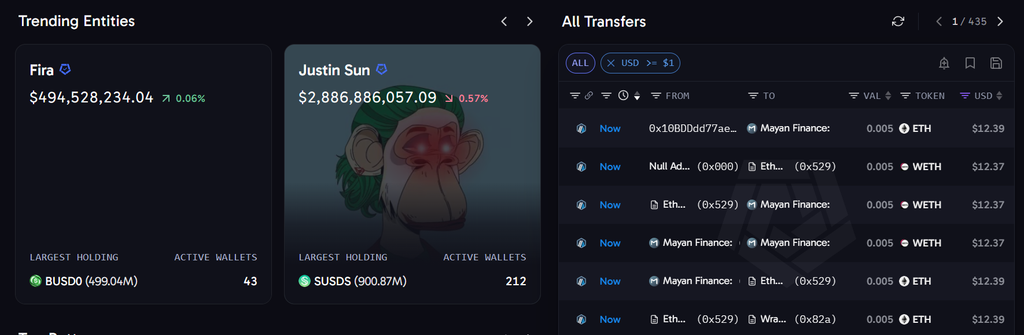
Arkham’s approach is to organize this information around entities, labels and tags. Its systems combine AI, analyst research and community intelligence to associate blockchain addresses with identifiable entities and describe relevant on-chain behavior.
The platform now extends beyond basic wallet investigation. Arkham provides blockchain exploration, transaction analysis, fund-flow visualization, alerts, dashboards, market information, an API and other intelligence products. Its API can integrate Arkham’s entity labels and fund-flow data into external applications and workflows.
For beginners, the easiest way to understand Arkham is this: it is a research and intelligence layer built on top of blockchain data.
Read more: Is Qofib.com Legit? What We Found Investigating This Site
Table of Contents
What Is Arkham Intelligence?
Arkham Intelligence is a multi-chain blockchain intelligence platform focused on making on-chain activity easier to investigate and interpret.
Traditional blockchain explorers are generally designed to show transactions, balances, contracts and addresses. Arkham adds another layer of context by attempting to associate addresses with real-world entities and by organizing blockchain activity into searchable intelligence.
Arkham describes its platform as combining a blockchain explorer, entity intelligence, analytics, transaction tracing, visualization, dashboards, alerts and API access.
This makes Arkham useful for questions such as:
- Who controls a particular wallet?
- What wallets are associated with an organization?
- Where did a large transfer go?
- What assets does an entity hold?
- How have an entity’s holdings changed?
- Which wallets are interacting with a token?
- What are specific traders doing on-chain?
- Can a transaction flow be visualized?
- Can blockchain intelligence be integrated into another application?
The important distinction is that Arkham does not make blockchains private or reveal every wallet owner’s identity with certainty. Its entity attributions are based on available evidence, analysis and Arkham’s intelligence systems.
How Does Arkham Work?
At a high level, Arkham takes raw blockchain information and adds layers of context.
A simplified workflow looks like this:
Blockchain activity → addresses → address relationships → entity attribution → labels/tags → searchable intelligence
Arkham says its AI systems use machine learning and pattern recognition to analyze on-chain behavior. It also combines on-chain information with off-chain sources such as public records, news and social information, alongside research from its internal analysts and community contributors.
This is important because blockchain addresses are usually pseudonymous rather than naturally readable identities.
For example, seeing:
0x7a...91F
does not immediately tell a researcher whether the address belongs to an exchange, whale, trader or institution.
An intelligence platform can add context around that address.
Arkham’s Three Important Data Concepts
Arkham uses entities, labels and tags as different layers of metadata.
Entities represent groups of addresses associated with an individual, organization or institution.
Labels identify individual addresses within that broader context.
Tags describe characteristics or behaviors associated with addresses or entities.
Arkham’s own explanation gives the distinction simply: entities help answer who, labels identify a particular address, and tags describe what the address has done or what type of actor it represents.
That structure is one of the most important concepts to understand before using Arkham.
What Data Does Arkham Provide?
Arkham works with several categories of blockchain information.
Wallet and Address Data
Users can investigate individual blockchain addresses and examine associated balances, transfers and other activity.
This is useful when you already have a wallet address and want to understand its history.
Entity Data
Instead of analyzing one address at a time, users can investigate a broader entity where Arkham has grouped associated addresses.
This can make research easier when a company, exchange or other organization controls many wallets.
Transaction Data
Arkham provides transaction and transfer information that can be investigated through its explorer and related tools.
Its current platform also supports transaction analysis designed to make complex blockchain activity easier to interpret.
Fund-Flow Data
Fund-flow analysis helps users follow assets between addresses and entities.
This can be useful for tracing movements between exchanges, wallets, protocols and other counterparties.
Market Data
Arkham’s current platform also incorporates market information, including data relevant to traders and derivatives users. Its own documentation describes market-data capabilities involving areas such as open interest, funding, options and other metrics.
Key Arkham Features
Arkham has developed into a broader ecosystem rather than a single blockchain explorer.

1. Entity Profiles
Entity profiles are central to Arkham’s approach.
Instead of treating every address as completely separate, Arkham attempts to organize known addresses around entities.
A profile can help researchers examine an entity’s holdings, transaction activity and historical information.
Arkham’s mobile announcement also describes entity and address portfolios showing crypto holdings and balance history.
2. Blockchain Explorer
Arkham provides a multi-chain explorer for searching blockchain activity.
Users can search for addresses, entities, tokens and transactions rather than relying only on a conventional block explorer.
The current Arkham platform describes itself as a place to search entities, addresses, tokens and markets.
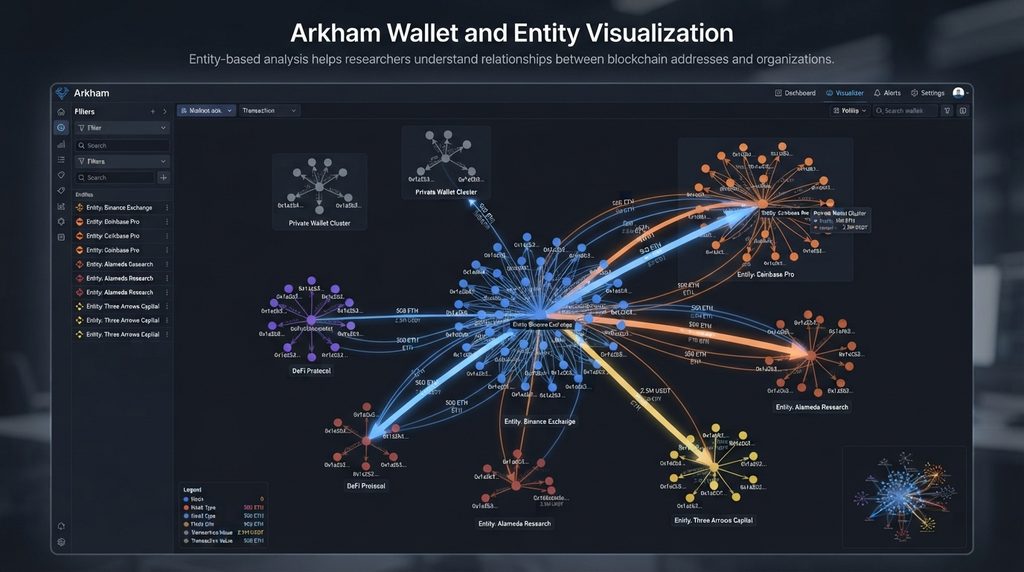
3. Visualizer
Arkham Visualizer is designed to turn transaction relationships into a visual representation.
Instead of reading a long list of transfers, users can use connected nodes and relationships to understand how funds move between addresses and entities.
This can be particularly useful for investigating complex transactions involving multiple counterparties.
4. Transaction Tracer
Tracer focuses on following fund movements.
A researcher investigating a suspicious or unusual transfer can use tracing tools to follow how assets move through connected addresses.
This can help with blockchain investigations, although the results still need careful interpretation.
5. Alerts
Arkham allows users to create alerts around blockchain activity.
For example, a user may want to monitor activity involving:
- A wallet
- An entity
- A token
- A transaction
- A particular type of movement
Arkham’s current platform positions alerts as a way to monitor relevant on-chain activity without manually checking addresses continuously.
6. Dashboards
Dashboards provide a way to organize blockchain information into customized views.
Arkham describes dashboard components that can cover address and entity intelligence, token information, general charts, futures-related information and options data.
This makes dashboards more useful for people who monitor the same categories of data repeatedly.
7. Tags and Labels
Tags and labels make Arkham’s data easier to search and interpret.
Tags can describe behaviors or categories associated with an address, while labels identify particular addresses.
Arkham says its tagging system is produced through a combination of its AI systems, internal analysts and community contributions through the Intel Marketplace.
8. Arkham API
The Arkham API is important for developers and organizations that want to use Arkham’s intelligence outside the normal web interface.
Arkham announced a new full-fledged Intel API in February 2026, with endpoints for integrating entity labels and fund-flow data into external workflows and products.
Its current API documentation covers authentication, rate limits, pagination and Arkham’s data model for addresses, entities, labels and tags.
In September 2026, Arkham also announced that its address-intelligence updates endpoint had become real-time, with new, updated and deleted intelligence reflected within minutes rather than once per day.
9. Risk Scores
Arkham has also introduced Risk Scores for its API.
The system assigns an address or entity a score from 0 to 100 based on exposure to illicit activity and provides a risk briefing explaining the assessment. Arkham states that Risk Scores are available as a paid add-on to an API subscription.
This capability is particularly relevant to businesses working on counterparty risk, compliance and transaction monitoring.
10. Mobile App
Arkham also offers a mobile experience.
Its 2026 mobile announcement says users can access entity labels, addresses, portfolios, transactions and related intelligence from mobile devices.
For people who monitor markets or wallets away from a desktop, mobile access can make continuous tracking more convenient.
What Is Arkham’s AI Used For?
AI is an important part of Arkham’s data-processing system.
Arkham says its AI technology helps connect wallet addresses with real-world entities by analyzing patterns in blockchain behavior. Its systems also work with off-chain information and analyst research.
The practical benefit is context.
A raw blockchain transaction might show:
Address A → Address B → 500 ETH
An intelligence platform attempts to provide additional context around those addresses and the transaction.
That does not mean every attribution should automatically be treated as fact.
Researchers should distinguish between:
- Blockchain-confirmed transaction activity
- Arkham’s entity attribution
- Analyst interpretation
- Community-submitted intelligence
- Their own conclusions
This distinction is particularly important when investigating individuals or organizations.
What Is the ARKM Token?
ARKM is the native token associated with the Arkham ecosystem.
One important use is connected to the Arkham Intel Exchange, where users can contribute blockchain intelligence and participate in a marketplace for intelligence.
Arkham says community contributions can include address labels, entity attributions and supporting information, with contributors able to receive ARKM rewards in the relevant marketplace system.
ARKM should not be confused with Arkham’s underlying blockchain data itself.
The platform’s intelligence products and the ARKM token are related parts of the wider Arkham ecosystem, but they serve different purposes.
What Is the Arkham Intel Marketplace?
The Intel Marketplace is designed around buying, selling and contributing blockchain intelligence.
A user can seek information about an address or entity, while researchers can contribute intelligence that helps expand the platform’s knowledge base.
This creates a community component around Arkham’s proprietary data and analyst research.
The model is particularly interesting because blockchain intelligence can sometimes depend on information that is difficult to discover through automated blockchain analysis alone.
Best Uses for Arkham
Arkham can be useful for several different types of users.
Crypto Traders
Traders can monitor large wallets, known entities and transaction flows.
For example, someone researching a token may want to understand how large holders are moving their assets.
Arkham can provide context that is difficult to obtain from a price chart alone.
Investors
Investors can use on-chain intelligence to research activity involving exchanges, institutions, funds, whales and other market participants.
This should complement rather than replace traditional investment research.
Blockchain Researchers
Researchers can investigate transaction histories, entity relationships and fund movements.
The Visualizer and Tracer are particularly relevant when the objective is understanding relationships between addresses.
Security and Compliance Teams
Businesses can use blockchain intelligence for transaction monitoring, counterparty research and risk analysis.
Arkham’s API Risk Scores are specifically positioned for use cases such as counterparty risk and compliance workflows.
Developers
Developers can integrate Arkham intelligence into their own systems through the API.
Potential applications include:
- Custom blockchain dashboards
- Wallet monitoring systems
- Compliance tools
- Trading analytics
- Research applications
- Automated alerts
Arkham’s API documentation is specifically designed for integrating its intelligence into products, pipelines and workflows.
Journalists and Investigators
Blockchain transactions can provide evidence for investigating fund movements.
Arkham’s entity and label system can help researchers move from raw addresses toward a more understandable picture of who may be involved.
However, attribution should always be independently evaluated before being presented as a confirmed identity.
How to Use Arkham for Wallet Research
A simple research workflow can look like this:
Step 1: Start with an Address, Entity or Token
Search for the wallet address, entity or token you want to investigate.
Arkham’s current platform supports searches across entities, addresses, tokens and markets.
Step 2: Review the Entity Information
If Arkham has identified the address as belonging to an entity, examine the associated information.
Pay attention to whether the information is a label, entity attribution or behavioral tag.
Step 3: Check Portfolio and Activity
Review holdings, transfers and historical activity.
This can help establish what assets the wallet controls and how its activity changes over time.
Step 4: Follow Fund Flows
Use transaction tracing or visualization when you need to understand where funds came from or where they went.
Step 5: Set an Alert
If the address or entity is important to your research, an alert can reduce the need for manual monitoring.
Step 6: Verify Important Conclusions
Do not treat a platform label as proof of identity by itself.
For important research, compare Arkham’s attribution with blockchain transactions and reliable public evidence.
Arkham’s Biggest Strength: Adding Context to Blockchain Data
The strongest reason to use Arkham is not simply that it shows blockchain transactions.
Many blockchain explorers already do that.
Arkham’s differentiator is the context layer it places around those transactions.
Knowing that a wallet moved cryptocurrency is useful.
Knowing that the wallet is associated with a particular entity, that it belongs to a broader group of addresses, and that its transaction history connects to other known entities can make the information substantially easier to investigate.
That is where Arkham becomes more than a conventional block explorer.
Limitations and Risks
Arkham is useful, but it should not be treated as an infallible source of identity.
Entity Attribution Can Require Judgment
A wallet address is not inherently a person’s name.
Arkham’s attribution process uses AI, analyst research and other evidence, but users should still distinguish between verified blockchain facts and inferred ownership.
Blockchain Data Can Be Complex
A transaction can involve smart contracts, bridges, exchanges, automated systems and multiple intermediate addresses.
A simple-looking transfer does not necessarily explain the entire economic activity behind it.
More Data Does Not Automatically Mean Better Decisions
Arkham can provide a large amount of information.
The difficult part is deciding which information actually matters.
Traders should avoid treating whale movements or wallet activity as automatic trading signals.
Privacy Considerations
Arkham’s core concept involves connecting pseudonymous blockchain addresses with real-world entities.
That can be useful for transparency and investigations, but it also raises legitimate privacy considerations.
Users should understand what information is public on-chain and what information represents an attribution or interpretation added by an intelligence platform.
Is Arkham Free?
Arkham provides access to its intelligence platform, but the availability of particular capabilities, API access and specialized products can differ.
Some features are available through the platform itself, while more advanced data access can involve API subscriptions or paid services.
For example, Arkham states that Risk Scores are a paid add-on to an Arkham API subscription.
Because Arkham’s product structure continues to evolve, users should check its current platform and API documentation before assuming that a specific feature is free.

Who Should Use Arkham?
Arkham is most useful for people who need to understand who is moving crypto, where funds are going, and how blockchain entities are connected.
It is particularly suitable for:
- Crypto researchers
- Professional traders
- Investors
- Blockchain investigators
- Compliance teams
- Security researchers
- Journalists
- Developers
- Crypto businesses
- On-chain analysts
Who May Not Need Arkham?
You probably do not need a specialized blockchain intelligence platform if you only want to:
- Check a transaction hash
- View a wallet balance
- Look up a token contract
- Confirm whether a transaction succeeded
A conventional block explorer may be sufficient for those simple tasks.
Arkham becomes more valuable when your question involves relationships, attribution, historical behavior, fund flows or ongoing monitoring.
Pros & Cons Table
| Pros | Cons |
|---|---|
| Adds entity context to raw blockchain activity | Entity attribution is not the same as cryptographic proof of identity |
| Useful for wallet and fund-flow investigations | Complex blockchain activity can still require expert interpretation |
| Provides Visualizer, Tracer, alerts and dashboards | Advanced API capabilities may involve paid access |
| Supports multiple blockchain intelligence workflows | Large amounts of data can be overwhelming for beginners |
| API enables integration into external applications | Privacy implications deserve careful consideration |
| AI, analyst and community intelligence expand the data layer | Users should independently verify important investigative conclusions |
| Useful for traders, researchers, developers and compliance teams | Some capabilities are more valuable to professional users than casual crypto users |
Comparison Table — only if relevant
| Factor | Arkham | Traditional Block Explorer |
|---|---|---|
| Basic transaction lookup | ✓ | ✓ |
| Wallet balances | ✓ | ✓ |
| Multi-chain investigation | ✓ | Depends on explorer |
| Entity attribution | ✓ | Usually limited |
| Labels and behavioral tags | ✓ | Limited |
| Fund-flow investigation | ✓ | Basic to moderate |
| Visual transaction analysis | ✓ | Usually limited |
| Wallet/entity alerts | ✓ | Varies |
| Custom dashboards | ✓ | Usually limited |
| API | ✓ | Depends on provider |
| Best for | Blockchain intelligence and investigation | Basic blockchain verification |
| Main limitation | Attribution requires interpretation | Less contextual intelligence |
This comparison is intentionally broad. Different block explorers offer different capabilities, so it should not be interpreted as a universal comparison of every explorer.
Alternatives — only if relevant
Nansen
Nansen is another blockchain analytics platform focused heavily on wallet intelligence, token flows and on-chain research.
Main strength: Strong wallet and on-chain analytics workflows.
Main limitation: Product features and data coverage differ from Arkham.
Best for: Traders and researchers who want an alternative source of wallet intelligence.
Etherscan
Etherscan is a widely used Ethereum block explorer.
Main strength: Direct Ethereum transaction, contract and address information.
Main limitation: It generally provides less of the broader entity-intelligence layer associated with Arkham.
Best for: Verifying Ethereum transactions, contracts and wallet activity.
DeBank
DeBank focuses on wallet portfolios and DeFi activity.
Main strength: Portfolio and DeFi-focused wallet tracking.
Main limitation: It is not a direct substitute for every Arkham investigation workflow.
Best for: Users primarily interested in DeFi wallets and portfolio activity.
Dune
Dune is a blockchain analytics platform that allows users to query and visualize blockchain datasets.
Main strength: Custom SQL-based blockchain analytics and dashboards.
Main limitation: Requires more analytical effort for users who want ready-made entity intelligence.
Best for: Analysts and researchers building custom blockchain queries.
FAQs
What is Arkham in crypto?
Answer: Arkham is a blockchain intelligence platform that organizes on-chain data around wallets, entities, labels, tags, transactions and fund flows. It helps users investigate blockchain activity and understand the entities associated with addresses.
What is Arkham Intelligence used for?
Answer: Arkham can be used for wallet research, entity tracking, fund-flow analysis, transaction investigation, alerts, market research, blockchain compliance and developer applications through its API.
Is Arkham a blockchain?
Answer: No. Arkham is a blockchain intelligence platform and data ecosystem. It analyzes information from blockchain networks rather than being a blockchain network itself.
What is ARKM?
Answer: ARKM is the native token associated with the Arkham ecosystem. It is used in areas including the Arkham Intel Exchange, where participants can contribute and exchange blockchain intelligence.
Can Arkham identify crypto wallet owners?
Answer: Arkham attempts to associate wallet addresses with real-world entities using AI, analyst research, on-chain patterns and off-chain information. However, an attribution should not automatically be treated as absolute proof of ownership.
Is Arkham free?
Answer: Arkham provides access to its platform, but specific capabilities and advanced products can have different access requirements. API features and specialized services may require paid access.
What is Arkham Visualizer?
Answer: Arkham Visualizer is a tool for representing relationships between addresses and entities so users can more easily understand transaction and fund-flow connections.
Who should use Arkham?
Answer: Arkham is particularly useful for crypto traders, investors, blockchain researchers, investigators, compliance teams, journalists and developers who need more context than a basic blockchain explorer provides.
Quick Take
Main point: Arkham is a blockchain intelligence platform that adds context to raw on-chain data.
Best use case: Investigating wallets, entities, transactions and fund flows.
Main advantage: Its combination of entity attribution, labels, tags, visual investigation tools, alerts and API access.
Main limitation: Entity attribution requires interpretation and should not automatically be treated as definitive proof of identity.
Best alternative: Nansen for another wallet-intelligence-focused workflow; Etherscan for straightforward blockchain verification; Dune for custom blockchain analytics.
Conclusion
Arkham is best understood as an intelligence layer for blockchain data rather than simply another block explorer.
Its value comes from connecting raw wallet activity with contextual information about entities, labels, tags and fund flows. Tools such as Visualizer, Tracer, alerts, dashboards and the Arkham API make the platform useful for both individual research and larger analytical workflows.
For casual crypto users who only need transaction verification, a standard block explorer may be enough. For researchers, traders, investigators, developers and compliance teams who need to understand relationships between wallets and entities, Arkham can be considerably more useful.
The most important takeaway is to distinguish on-chain facts from entity attribution and interpretation. Arkham can make blockchain data easier to understand, but important conclusions should still be independently verified.
Author Bio
TechyUpdate Editorial Team covers practical technology, AI tools, apps, software and digital productivity, with a focus on clear, useful and independently researched guides.
2 Comments
Pingback: How to Use Arkham for Crypto & On-Chain Research
Pingback: Arkham Data Explained: Prices, Charts, Metrics & Alerts