


Ahrefs can turn keyword research from a simple search-volume exercise into a broader process for finding, evaluating, grouping, and prioritizing content opportunities. Its Keywords Explorer can generate keyword ideas and provide metrics such as Search Volume, Keyword Difficulty, Traffic Potential, Parent Topic, SERP data, and search-intent attributes.
The important part is knowing how to interpret those metrics. A keyword with high search volume is not automatically a good target. Competition, search intent, traffic potential, business relevance, existing rankings, and the type of content already appearing in Google all matter.

Ahrefs can also help with the next stage: turning keyword research into a content plan. You can use competitor research and Content Gap to discover queries other websites rank for but your site does not. Ahrefs’ Content Gap tool supports comparisons involving multiple competitors and can filter opportunities by factors such as keyword difficulty, traffic, location, and ranking positions.
This guide explains a practical Ahrefs workflow from the first seed keyword to a structured content calendar. You will learn how to find keyword ideas, evaluate them, understand search intent, use Parent Topic and Traffic Potential, analyze competitors, identify content gaps, cluster related keywords, and decide which topics deserve their own pages.
The goal is not to publish the largest number of articles possible. It is to identify meaningfully different search intents and valuable topics, then create focused content that answers those needs better than competing pages.
Read more: What Is Ahrefs? SEO Features, Data, and Best Use Cases
Table of Contents
Start With a Clear Content Goal
Before opening Keywords Explorer, define what you want the content to achieve.
Your objective could be:
- Attract organic search traffic
- Build topical authority
- Generate product leads
- Support an existing product page
- Answer beginner questions
- Reach users with commercial intent
- Build an informational content cluster
- Find opportunities around an existing article
This matters because the “best” keyword depends on the goal.
A keyword with substantial search volume may be less useful than a smaller query that closely matches your product, audience, or expertise.
For example, a technology website might be interested in the broad topic AI writing tools.
Instead of immediately targeting the broad phrase, you could investigate searches such as:
- What are AI writing tools?
- Best AI writing tools
- AI writing tools for students
- ChatGPT vs Gemini for writing
- AI writing tools for blog posts
- How to use AI for content writing
These represent different information needs.
The first step is therefore not finding keywords. It is defining what type of visitor you want to attract and what that visitor should accomplish.
Build a Seed Keyword
A seed keyword is the starting topic you give Ahrefs to generate related keyword ideas.
Good seed keywords are usually broad enough to produce useful variations but specific enough to remain relevant.
For example:
SEO tools
could generate a wide range of related opportunities.
For a more focused technology website, you might start with:
AI SEO tools
or:
SEO tools for bloggers
The seed does not need to be the keyword you ultimately target.
It is simply the starting point for discovering the search landscape.
Use Ahrefs Keywords Explorer
Open Keywords Explorer and enter your seed keyword.
Ahrefs says Keywords Explorer can generate keyword ideas from its large keyword database and provides reports for different types of keyword discovery. Its keyword-idea reports include matching terms, related terms, search suggestions and other sources of ideas.
The basic workflow is:
Seed keyword → Keyword ideas → Filtering → SERP analysis → Search-intent evaluation → Keyword grouping → Content planning
Do not immediately export thousands of keywords.
Start by understanding the topic.
Look at the different ways people search for the subject and identify recurring concepts, questions, modifiers, and use cases.
Explore Different Keyword Ideas
Ahrefs provides several ways to discover related queries.
Matching Terms
Matching terms help you find keywords containing words from your seed phrase.
This is useful for discovering variations and modifiers around the same subject. Ahrefs provides both terms-match and phrase-match modes.
For example, a seed such as:
keyword research
could lead to searches involving:
- keyword research tools
- keyword research guide
- keyword research for beginners
- free keyword research
- keyword research for SEO
- keyword research strategy
The purpose is not to collect every variation.
The purpose is to discover meaningful topics and search intents.
Related Terms
Related terms can reveal queries that are conceptually connected to the seed keyword even when they do not contain exactly the same words.
This is particularly useful for semantic SEO because users often describe the same problem in different ways.
Search Suggestions
Ahrefs can also provide keyword ideas based on Google’s autocomplete suggestions.
These can be useful for discovering how people phrase questions and longer searches.
Filter the Keyword List
A raw keyword database is not a content strategy.
You need to reduce the list.
Ahrefs allows users to filter keyword data using metrics and attributes such as Search Volume, Keyword Difficulty, Traffic Potential and search intent.
Useful filters include:
- Keyword Difficulty
- Search Volume
- Traffic Potential
- Search Intent
- Country
- SERP features
- Word count
- Click-related metrics where available
The exact thresholds should depend on your website.
A new website should not automatically use the same Keyword Difficulty threshold as an established domain with strong topical authority and backlinks.
Understand Keyword Difficulty
Keyword Difficulty (KD) is one of Ahrefs’ most recognizable metrics.
Ahrefs describes KD as an estimate of how difficult it may be to rank in Google’s top 10 results for a keyword. Its calculation is based on the referring domains pointing to the top-ranking pages. KD ranges from 0 to 100.
This makes KD useful, but it should not be treated as a complete ranking prediction.
Ahrefs specifically notes that KD does not account for on-page SEO factors.
For that reason, do not make a decision such as:
“KD is high, so we cannot target this keyword.”
Instead, inspect the SERP.
Look at:
- The strength of ranking domains
- The quality of the ranking pages
- Search intent
- Content depth
- Backlink profiles
- Relevance
- Whether smaller or weaker websites already rank
- Whether the current results actually satisfy the query
A difficult keyword can sometimes be worth targeting as part of a long-term strategy.
Do Not Judge Keywords by Search Volume Alone
Search Volume tells you how often a keyword is searched, but it does not tell the complete story.
Ahrefs reports Search Volume as an average monthly number for a keyword in a particular country, using a 12-month average.
Consider two keywords:
| Keyword | Search Volume | Difficulty | Business Relevance |
|---|---|---|---|
| Broad topic | High | High | Medium |
| Specific problem | Lower | Lower | High |
The second keyword could be more valuable if it attracts people who closely match your target audience.
Search volume is therefore a decision input, not the decision itself.
Use Traffic Potential
Traffic Potential can provide a different perspective.
Ahrefs defines Traffic Potential as the organic traffic received by the current #1 ranking page for the keyword from all the keywords that page ranks for.
This is useful because a page can rank for many related searches.
Imagine one keyword has:
Search Volume: 1,000
while another has:
Search Volume: 500
The second topic could still have greater Traffic Potential if the top-ranking page attracts traffic from many related queries.
This is one reason it can be dangerous to choose topics using search volume alone.
Check Parent Topic
Ahrefs’ Parent Topic feature can help determine whether a keyword can be targeted as part of a broader topic.
Ahrefs identifies the Parent Topic using the query that sends the most search traffic to the top-ranking page for the target keyword.
This is useful when deciding whether several keywords deserve separate pages.
For example, you may discover several searches that appear different but have highly overlapping search results.
Instead of creating three thin articles, you may be better off creating one comprehensive page that addresses the broader topic and naturally covers the related queries.
This is especially important for avoiding unnecessary keyword cannibalization and repetitive content.
Analyze Search Intent Before Choosing a Keyword
Search intent answers a basic question:
What does the searcher actually want?
Ahrefs provides intent attributes that can be used to filter keywords, including informational, navigational, commercial and transactional intent.
Common intent categories include:
Informational: The user wants information or an answer.
Navigational: The user is looking for a particular website, brand or destination.
Commercial: The user is researching products, services or options before making a decision.
Transactional: The user is closer to taking an action such as buying or signing up.
The intent should influence the content format.
For example:
“What is keyword research?”
is likely informational.
“Best keyword research tools”
has commercial investigation intent.
“Ahrefs pricing”
is strongly navigational/commercial.
“Ahrefs login”
is primarily navigational.
Do not force a long-form guide onto a query that clearly expects a simple answer or product page.
Check the Actual SERP
One of the most important steps in Ahrefs keyword research is opening the current SERP.
Metrics can help you narrow the list, but the search results tell you what Google is currently rewarding.
Examine:
- Search result titles
- Content formats
- Ranking domains
- Page types
- Featured snippets
- Videos
- Forums
- Product results
- People Also Ask results
- AI search features where visible
- Depth and angle of competing content
Then ask:
Can my website create something genuinely useful for this search?
If every result is a dedicated product page, a generic informational article may struggle to satisfy the same intent.
If the results are mostly outdated guides, there may be an opportunity for a better-maintained resource.
Study Competitors in Site Explorer
Once you have a topic, move beyond Keywords Explorer and investigate competing websites with Site Explorer.
Look for:
- Their top organic pages
- Keywords generating visibility
- Pages with strong traffic estimates
- Backlink patterns
- Content topics
- Ranking opportunities
The purpose is not to copy a competitor’s content.
Instead, identify patterns.
For example, if several competitors receive search visibility from closely related topics, that can indicate an established area of demand.
You can then investigate whether your site has something useful and distinctive to contribute.
Use Content Gap to Find Missing Topics
Ahrefs’ Content Gap tool is particularly useful for content planning.
It compares keywords that competitors rank for against keywords your target website ranks for. The result can expose search terms where competitors have visibility but your site does not.
A practical workflow is:
- Enter your website.
- Add relevant competitors.
- Compare keyword rankings.
- Filter the results.
- Look for repeated opportunities.
- Open the ranking pages.
- Determine the search intent.
- Decide whether the topic deserves a new page or an existing-content update.
Ahrefs allows multiple competitor URLs to be compared in Content Gap, with its current help documentation describing comparisons involving up to 10 competitors.
The important part is not publishing an article for every gap.
Some keywords may be irrelevant to your audience.
Others may belong to the same topic as an article you already have.
Content Gap is an opportunity-discovery tool, not an automatic publishing queue.
Find Striking-Distance Opportunities
Content Gap can also be useful for finding keywords where your website already ranks relatively close to the first page.
For example, a page ranking around positions 11–20 may need less work to improve than a brand-new page targeting a highly competitive topic.
Ahrefs’ own Content Gap guidance describes using target positions 11–20 alongside competitors ranking in the top 10 to identify such opportunities.
These opportunities can be valuable because improving existing content may sometimes be more efficient than creating another page.
Before making changes, inspect:
- Whether the page matches search intent
- Content quality
- Internal links
- Title and headings
- Missing subtopics
- Backlink profile
- SERP changes
- Whether the page is actually the right URL for the query
Use Content Explorer for Content Planning

Content Explorer can help you investigate existing content around a topic.
Ahrefs describes it as a content discovery tool for finding content and potential link prospects, with filters based on SEO and content metrics.
This can help answer questions such as:
- What content already exists?
- Which pages attract organic traffic?
- Which pages have referring domains?
- Which topics have produced successful content?
- Are there older pages that could be improved?
- What formats appear repeatedly?
Use this research to identify patterns, not to reproduce competitors.
Group Keywords Into Topics
After filtering your keyword list, group related queries.
You can organize keywords by:
- Parent Topic
- Search intent
- User journey
- Product category
- Problem
- Audience
- Geographic location
- Content format
Ahrefs’ keyword research guidance recommends grouping keywords using factors such as Parent Topic, user intent and business value.
For example:
| Keyword Group | Likely Page |
|---|---|
| What is keyword research | Beginner guide |
| How to do keyword research | How-to guide |
| Keyword research tools | Comparison/list |
| Ahrefs keyword research | Tool-specific tutorial |
| Keyword research for ecommerce | Specialized guide |
| Free keyword research | Resource/comparison |
This prevents the common mistake of treating every keyword variation as a separate article.
Decide When Keywords Need Separate Pages
This is one of the most important content-planning decisions.
Two keywords should not automatically produce two articles simply because their wording is different.
Check whether:
- The search intent is different.
- The SERPs are substantially different.
- The user expects a different answer.
- The audience is different.
- The content format is different.
- The topic requires substantially different information.
If the same page could satisfy both searches naturally, combining them may be better.
If the searches represent genuinely different needs, separate pages can make sense.
This approach helps build a cleaner site architecture and reduces repetitive content.
Build a Keyword-to-URL Map
Once your topics are grouped, create a simple keyword map.
| Primary Topic | Supporting Keywords | Intent | Proposed URL |
|---|---|---|---|
| Keyword Research Guide | keyword research, SEO keyword research | Informational | /keyword-research-guide/ |
| Ahrefs Keyword Research | use Ahrefs for keywords, Ahrefs Keywords Explorer | How-to | /how-to-use-ahrefs-keyword-research/ |
| Keyword Research Tools | best keyword research tools | Commercial | /best-keyword-research-tools/ |
| Long-Tail Keywords | long-tail SEO keywords | Informational | /long-tail-keywords/ |
The exact structure should reflect the website.
The important principle is to assign each meaningful search intent a logical destination.
Turn Keywords Into a Content Brief
A keyword list is not yet an article.
For each priority topic, create a content brief containing:
Primary topic
The main subject the page should satisfy.
Supporting queries
Related questions and subtopics that genuinely belong on the page.
Search intent
What the searcher wants to accomplish.
SERP observations
What formats and angles appear in current results.
Unique value
What your article can explain better or differently.
Internal links
Relevant existing pages that should support the article.
Potential external sources
Official documentation and authoritative references.
Conversion goal
What useful next action should be available if appropriate.
This produces a much stronger foundation than simply instructing a writer to “use these keywords.”
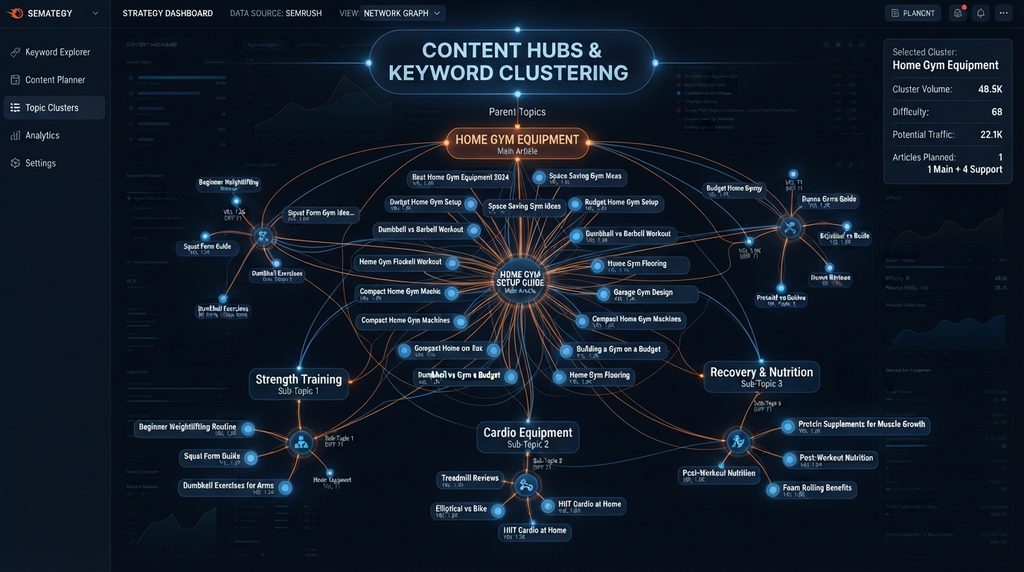
Create Topic Clusters
After mapping individual pages, organize them into broader topic clusters.
For example:
SEO Keyword Research
could become the central topic with supporting pages about:
- Keyword research basics
- Long-tail keywords
- Search intent
- Keyword clustering
- Competitor keyword research
- Keyword research tools
- Ahrefs keyword research
- Content gap analysis
The exact number of pages should depend on whether each topic represents a meaningful standalone information need.
Do not create dozens of near-identical pages simply to increase the number of URLs.
Prioritize Your Content Opportunities
You now need to decide what to publish first.
A useful prioritization model considers:
Relevance
Does the topic directly relate to your audience and site?
Search demand
Is there evidence that people search for it?
Competition
How difficult is the current SERP?
Traffic potential
Could one page rank for a broader set of related searches?
Business value
Could the visitors become readers, subscribers, customers or users?
Content quality opportunity
Can you produce something meaningfully better?
Existing authority
Does your website already have relevant content or expertise around the topic?
You can then classify opportunities as:
High priority: Strong relevance + clear intent + realistic opportunity.
Medium priority: Useful topic but more competitive or less commercially important.
Low priority: Weak relevance, unclear intent or little strategic value.
A Simple Ahrefs Content Planning Workflow
A repeatable workflow can look like this:
Step 1: Define your audience and content goal.
Step 2: Enter a broad seed keyword into Keywords Explorer.
Step 3: Generate keyword ideas.
Step 4: Filter obvious irrelevant keywords.
Step 5: Evaluate Search Volume, KD and Traffic Potential.
Step 6: Check search intent.
Step 7: Inspect the current SERP.
Step 8: Review Parent Topic and related queries.
Step 9: Analyze relevant competitors in Site Explorer.
Step 10: Run a Content Gap analysis.
Step 11: Group related keywords.
Step 12: Decide which keywords belong to existing pages and which justify new pages.
Step 13: Create content briefs.
Step 14: Prioritize topics by relevance, opportunity and business value.
Step 15: Publish, monitor rankings and update content based on evidence.
This workflow turns Ahrefs from a keyword database into a content decision system.
Common Ahrefs Keyword Research Mistakes
Choosing only high-volume keywords
High search volume does not guarantee useful traffic.
Treating KD as a ranking guarantee
KD is an Ahrefs metric based primarily on backlink-related competitiveness. It does not measure every ranking factor.
Ignoring search intent
A keyword can look attractive in a spreadsheet but be completely wrong for your planned content.
Creating one article for every keyword
Many closely related keywords can belong to one comprehensive page.
Copying competitors
Competitor research should identify opportunities and gaps, not produce duplicate content.
Ignoring existing content
Before creating a new URL, check whether an existing article could be improved.
Treating Ahrefs estimates as first-party analytics
Ahrefs provides valuable SEO estimates and research data, but your own first-party analytics and Google Search Console data remain important when evaluating your actual website performance.

How Often Should You Repeat Keyword Research?
Keyword research should not be a one-time task.
Search demand, competitors, SERPs and your website’s own performance change over time.
Ahrefs says SERPs in Keywords Explorer and Site Explorer are automatically updated based on keyword popularity, while Search Volume and CPC are updated periodically.
A practical approach is to revisit important topics when:
- Search rankings change significantly
- A competitor publishes major new content
- Search intent appears to shift
- Your business changes
- A new product or feature launches
- An article stops attracting traffic
- Search results change substantially
You do not need to rebuild your entire keyword strategy every week.
Focus on strategically important topics.
Best Way to Use Ahrefs for Content Planning
The strongest workflow is not:
Find keyword → write article → repeat
A better process is:
Understand audience → research topics → analyze intent → study SERPs → evaluate competition → identify gaps → group keywords → map topics to URLs → create useful content → measure results
Ahrefs provides data for many of these stages, but the editorial decision remains yours.
The tool can show that competitors rank for a keyword.
It cannot automatically determine whether that keyword deserves a new article on your website.
That decision requires context.
Pros & Cons Table
| Pros | Cons |
|---|---|
| Generates large numbers of keyword ideas | Large datasets can become overwhelming |
| Provides KD, Search Volume and Traffic Potential | Metrics are estimates and should not be treated as guarantees |
| Parent Topic helps with broader topic targeting | Keyword grouping still requires editorial judgment |
| Search-intent filtering helps classify opportunities | SERP analysis is still necessary |
| Content Gap reveals competitor keyword opportunities | Not every competitor gap is relevant to your site |
| Content Explorer supports content research | More advanced workflows can require paid access |
| Useful for connecting keyword research with content planning | Beginners may need time to learn the interface |
Comparison Table
| Factor | Ahrefs | Google Search Console | Google Keyword Planner |
|---|---|---|---|
| Keyword idea generation | Strong | Limited | Strong |
| Competitor keyword research | Yes | No | Limited |
| Keyword Difficulty | Yes | No | No equivalent |
| Traffic Potential | Yes | No | No equivalent |
| Search intent filtering | Yes | No | Limited |
| Existing-site performance | Limited compared with first-party data | Strong | No |
| Backlink research | Strong | Basic | No |
| Content Gap research | Yes | No | No |
| Cost | Free and paid options | Free | Free with Google Ads account |
| Best use | SEO research and content planning | Measuring your Google Search performance | Keyword discovery and advertising research |
Alternatives
Google Search Console
What it is: Google’s first-party tool for monitoring how your website performs in Google Search.
Main strength: Actual Search performance data for your property.
Main limitation: It is not designed for comprehensive competitor keyword research.
Best for: Every website owner who wants first-party Google Search data.
Semrush
What it is: A broad SEO and digital marketing platform with keyword, competitor, content and site-analysis capabilities.
Main strength: Broad marketing toolkit.
Main limitation: The breadth of features can make it complex for users who only need basic keyword research.
Best for: SEO and marketing teams wanting a broad all-in-one platform.
Google Keyword Planner
What it is: Google’s keyword research tool within Google Ads.
Main strength: Direct connection to Google’s advertising ecosystem.
Main limitation: It is primarily designed for advertising research rather than the full competitor/content workflow provided by dedicated SEO platforms.
Best for: Advertisers and marketers researching search terms and paid-search opportunities.
FAQs
How do I start keyword research in Ahrefs?
Answer: Start with a relevant seed keyword in Keywords Explorer, review keyword ideas, filter them using metrics such as KD and Search Volume, then inspect search intent and the current SERPs before selecting targets.
What Ahrefs metric should I use first?
Answer: There is no single best metric. Start with relevance and search intent, then use Keyword Difficulty, Search Volume and Traffic Potential to compare realistic opportunities.
Is Ahrefs Keyword Difficulty accurate?
Answer: KD is useful for estimating backlink-related competition, but it is not a complete ranking prediction. Ahrefs calculates KD from the referring domains of top-ranking pages and does not include on-page SEO factors in the score.
What is Traffic Potential in Ahrefs?
Answer: Traffic Potential estimates the organic traffic received by the current top-ranking page from all keywords for which it ranks. It can reveal opportunities that search volume alone may miss.
What is Parent Topic in Ahrefs?
Answer: Parent Topic helps identify whether a keyword can potentially be targeted through a broader topic rather than requiring its own separate page. Ahrefs derives it from the query sending the most search traffic to the top-ranking page.
How does Ahrefs Content Gap help with content planning?
Answer: Content Gap identifies keywords competitors rank for that your website does not. You can then evaluate those opportunities and decide whether they represent useful new topics or gaps in existing content.
Should every Ahrefs keyword become an article?
Answer: No. Closely related keywords may belong to the same page, while some keywords may be irrelevant to your audience. Search intent, SERP overlap, topic relevance and content value should determine whether a separate page is justified.
Is Ahrefs enough for content planning?
Answer: Ahrefs provides valuable research data, but effective content planning also requires audience knowledge, editorial judgment, first-party performance data, search-intent analysis and a clear content strategy.
Quick Take
Main point: Ahrefs is most useful when keyword research is treated as a decision-making process rather than a search-volume collection exercise.
Best use case: Finding realistic keyword opportunities and turning them into focused content topics.
Main advantage: Keywords Explorer, competitor research and Content Gap can connect search research with practical content planning.
Main limitation: Ahrefs metrics are not guarantees of rankings or traffic, so SERP analysis and editorial judgment remain essential.
Best alternative when relevant: Google Search Console is the essential companion for first-party performance data from your own website.
Conclusion
Ahrefs can make keyword research much more systematic, but the best results come from using its data selectively.
Start with a clear audience and content goal. Use Keywords Explorer to discover ideas, then evaluate Search Volume, Keyword Difficulty, Traffic Potential and Parent Topic. Check the actual SERP to understand intent before deciding what to target.
For content planning, competitor research and Content Gap can reveal topics your website may be missing. But those findings should be filtered through your own audience, expertise and business goals.
The most important lesson is simple: do not build a content calendar from keyword volume alone.
Use Ahrefs to discover opportunities, understand the competitive landscape and organize topics. Then use editorial judgment to decide which searches deserve a dedicated page, which belong together, and where your website can provide genuinely useful information.
Author Bio
TechyUpdate Editorial Team covers practical technology, AI tools, apps, software and digital productivity, with a focus on clear, useful and independently researched guides.
1 Comment
Pingback: How to Use Ahrefs for SEO Audits & Competitor Research