

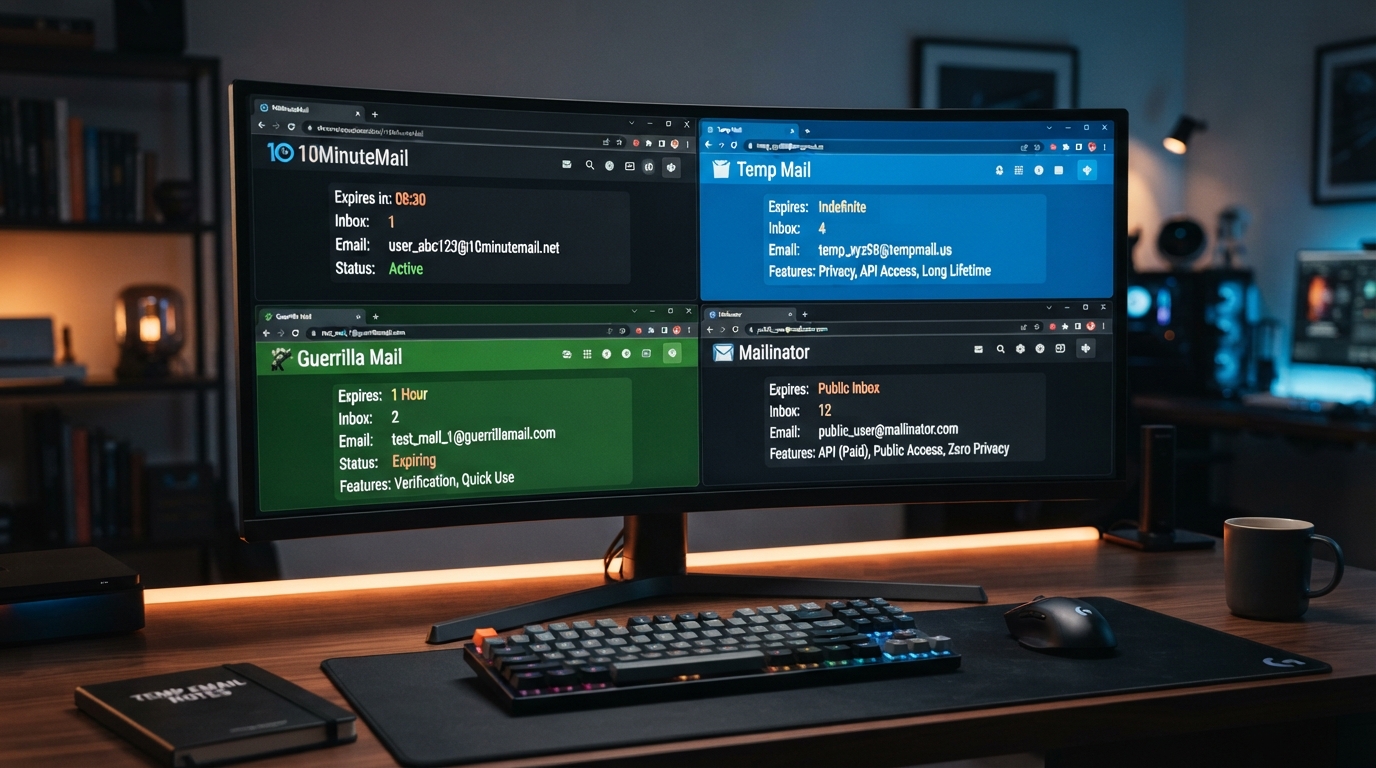
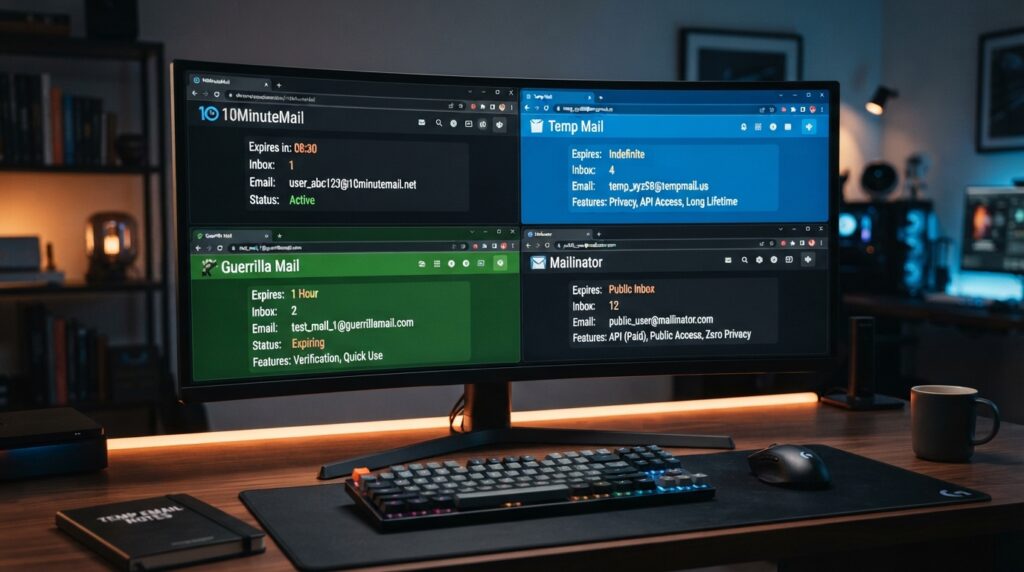
10MinuteMail alternatives are temporary or disposable email services that provide a similar way to receive email without relying on your primary inbox. They become useful when you need a longer-lived temporary address, want to send or reply to messages, need an API for testing, or simply find that a particular disposable-email domain is not accepted by a website.
10MinuteMail is built around a very short-lived inbox. Its official service provides a temporary address and allows users to extend the session when necessary.
That simplicity is useful for a quick verification email, but it is not ideal for every situation. A signup might take longer than expected, a verification message may be delayed, or a developer may need to create temporary accounts programmatically rather than manually opening an inbox.
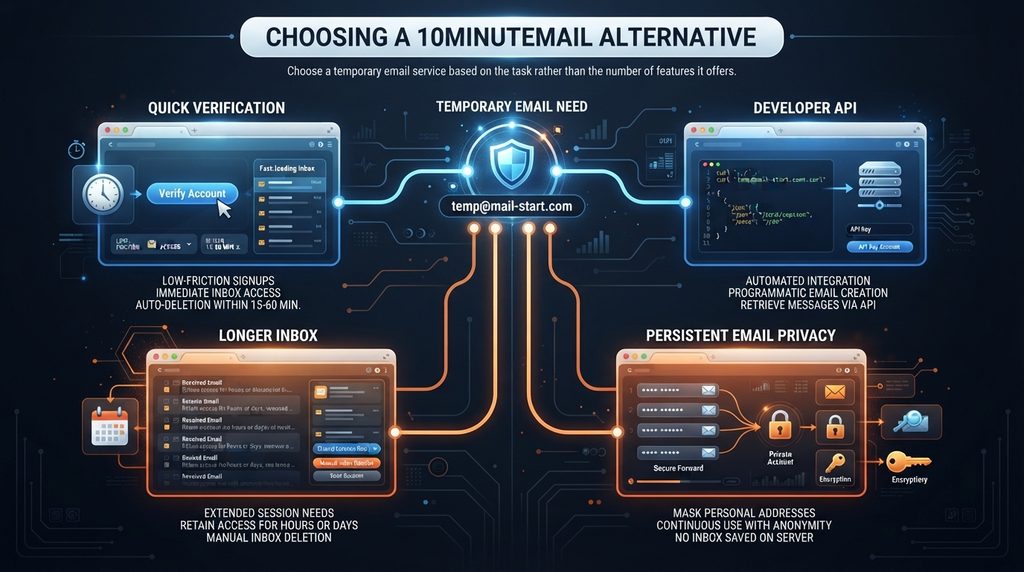
The best 10MinuteMail alternative therefore depends on what you actually need.
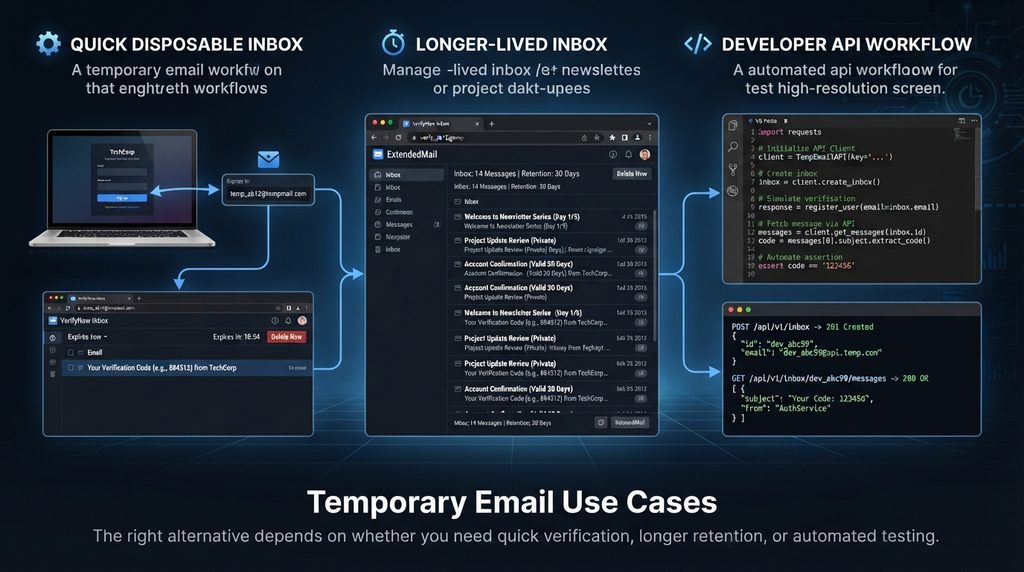
For a straightforward temporary mailbox, Temp Mail is a natural alternative. For users who need to send or reply to email, Guerrilla Mail offers functionality beyond simple receiving. For developers, Mail.tm provides a documented REST API without requiring an API key. YOPmail is another option when a longer-lived disposable inbox is more important than private inbox access.
This guide compares the most useful options and explains where each one fits, rather than treating every temporary email service as interchangeable.
Read more: 10MinuteMail Free: Features, Limits, and What You Can Do Without Paying
Table of Contents
Why Look for a 10MinuteMail Alternative?
10MinuteMail works well when the task is genuinely short-lived.
However, users may look for an alternative because:
- Ten minutes is not enough.
- A verification email arrives too late.
- A website rejects a disposable domain.
- They need to send or reply to email.
- They want an API for automated testing.
- They want a reusable temporary address.
- They need mobile access.
- They want a different privacy model.
- They need an inbox that remains available longer.
There is no temporary email service that is guaranteed to work with every website. Disposable-email domains can be blocked individually by websites and platforms, and those rules can change over time. Current comparison research also notes that domain acceptance is not a permanent property of any provider.
Best 10MinuteMail Alternatives at a Glance
| Service | Best for | Main difference from 10MinuteMail | Signup |
|---|---|---|---|
| Temp Mail | General temporary email | Longer-lasting inbox options and mobile apps | No for basic use |
| Guerrilla Mail | Sending and replying | Supports composing and replying | No |
| Mail.tm | Developers and automation | Free documented API | Account creation for API |
| YOPmail | Longer-lived disposable inbox | Longer retention | No |
| Maildrop | Testing and shared inbox workflows | Session/shared-inbox approach | No |
| EmailOnDeck | Simple temporary email | Longer-than-10-minute sessions | No |
| SimpleLogin | Long-term privacy | Persistent email aliases rather than disposable inboxes | Account-based |
The services are not identical. Some are genuine temporary inboxes, while services such as SimpleLogin solve a different problem by creating aliases that can remain useful for longer-term privacy.
Temp Mail
Best for: General-purpose temporary email
Temp Mail is one of the closest alternatives to 10MinuteMail because it provides disposable email addresses for short-term registrations and incoming messages.
Its official FAQ describes the service as a free temporary email service that does not require registration for basic disposable-email use.
One major difference is that Temp Mail also has a premium ecosystem with features such as custom domains, multiple mailboxes, additional storage, and other options.
The free service is therefore useful if you want something similar to 10MinuteMail but want access to a broader temporary-email platform.
Main strength: Familiar temporary-email workflow with web and mobile availability.
Main limitation: Some advanced features are tied to premium access.
Best for: Users who want a mainstream alternative to 10MinuteMail.
Guerrilla Mail
Best for: Sending, replying, and a more flexible temporary inbox
Guerrilla Mail is a long-running disposable email service with functionality that goes beyond simply receiving a verification message.
Its current interface includes Email, Compose, Tools, and About sections, and the service provides temporary addresses without requiring traditional registration.
Guerrilla Mail also documents replying and forwarding messages. Its current inbox information says emails are deleted after one hour.
That makes it particularly useful when 10 minutes is too short or when you need more than simple message reception.
Main strength: Supports composing, replying, and forwarding.
Main limitation: The inbox is still temporary, and messages are deleted after the stated retention period.
Best for: Users who need more email functionality than a basic throwaway inbox.
Mail.tm
Best for: Developers and automated testing
Mail.tm is particularly interesting if your goal is not simply to open a temporary inbox manually.
Its official documentation provides a REST API for creating temporary email accounts and receiving messages. The API documentation states that access is free, requires no API key, and has an 8-requests-per-second general quota per IP address.
The workflow allows developers to retrieve available domains, create an account, obtain a token, and fetch incoming messages programmatically.
This makes Mail.tm substantially different from a basic consumer-focused service.
Main strength: Documented API access for automated workflows.
Main limitation: It is more technical than simply opening a temporary inbox in a browser.
Best for: Developers, QA engineers, and automated email testing.
YOPmail
Best for: Longer-lived disposable email
YOPmail is another established disposable-email option.
It can make sense when your main reason for leaving 10MinuteMail is its short lifespan. Current 2026 comparisons report that YOPmail provides substantially longer inbox retention than 10MinuteMail.
However, longer availability should not automatically be interpreted as stronger privacy. Public or predictable inbox models can create different privacy considerations from session-bound private inboxes.
Main strength: Longer retention than very short-lived services.
Main limitation: Its inbox model is not appropriate for sensitive information.
Best for: Short-term tasks where you need more time than a 10-minute session provides.
Maildrop
Best for: Simple testing and disposable inbox workflows
Maildrop is another option worth considering when you need a lightweight disposable inbox.
Current comparison sources describe Maildrop as a service with session-based or reusable public-inbox characteristics, making it more suitable for casual testing than sensitive communications.
Because public-inbox services can have different privacy characteristics from private temporary inboxes, users should never place confidential information in them.
Main strength: Simple access for testing and temporary messages.
Main limitation: Public/shared inbox characteristics can make it unsuitable for private information.
Best for: Developers and users performing low-risk email testing.
EmailOnDeck
Best for: Users who simply need more than ten minutes
EmailOnDeck positions itself around temporary email sessions that last longer than the classic 10-minute model. Current comparison research identifies it as an option for users whose main problem with 10MinuteMail is the short session window.
Its appeal is straightforward: if your verification email arrives after the 10-minute window, a longer session can make the process less frustrating.
Main strength: Longer-than-10-minute temporary email sessions.
Main limitation: Exact retention details are not as clearly documented as some other services.
Best for: One-time tasks where ten minutes is simply too short.
SimpleLogin
Best for: Long-term email privacy
SimpleLogin is different from the temporary inbox services above.
Instead of creating an inbox that disappears after a short period, an email alias can provide a layer between your real email address and online services.
That makes it more appropriate when you want to use a service repeatedly but do not want to expose your primary email address.
The trade-off is that an alias is not the same thing as a disposable inbox. If your goal is a single verification email and then automatic expiration, a traditional temporary email service is simpler.
Main strength: Better suited to persistent privacy.
Main limitation: More account-oriented than a quick anonymous temporary inbox.
Best for: Users who want ongoing email privacy rather than a ten-minute address.
Read more: How to Use 10MinuteMail Online: Step-by-Step Guide
10MinuteMail vs Its Alternatives
| Service | Temporary | Longer than 10 minutes | Send/reply | API | Best use |
|---|---|---|---|---|---|
| 10MinuteMail | Yes | Limited extension | Limited | No documented API | Very quick verification |
| Temp Mail | Yes | Yes | Limited | Premium/API options | General temporary email |
| Guerrilla Mail | Yes | Yes | Yes | API available | Temporary send/reply |
| Mail.tm | Yes | Yes | API-focused | Yes | Developer testing |
| YOPmail | Yes | Yes | Service-dependent | No | Longer disposable access |
| Maildrop | Yes | Yes | No | Available for testing | Developer/testing use |
| EmailOnDeck | Yes | Yes | No | Not a core feature | Longer short-term sessions |
| SimpleLogin | Alias-based | Persistent | Forwarding model | Service-dependent | Long-term privacy |
The table should be treated as a use-case comparison rather than a universal ranking. Features and availability can change, particularly for free services.
Which 10MinuteMail Alternative Is Best for You?
The right choice depends on why you are leaving 10MinuteMail.
If you need a quick verification email
Temp Mail is a straightforward alternative.
It follows the same basic idea: obtain a disposable address and use it for a short-term online task.
If ten minutes is not enough
Consider Guerrilla Mail, YOPmail, or another service with a longer retention window.
Guerrilla Mail currently states that emails are retained for one hour, making its default window substantially longer than 10MinuteMail.
If you need to send or reply
Guerrilla Mail is the stronger choice among these options because its interface explicitly provides composing, replying, and forwarding functionality.
If you are a developer
Mail.tm is the standout option because its official documentation provides a REST API for creating accounts and retrieving messages.
If you need a persistent privacy solution
Consider an email alias service such as SimpleLogin rather than a disposable inbox.
This is a different approach: instead of letting the address disappear, the alias can remain useful for ongoing communication.
Why No Temporary Email Service Works Everywhere
One common mistake is assuming that changing from 10MinuteMail to another disposable email provider will automatically solve every registration problem.
It may not.
Websites can block known disposable-email domains. Domain reputation can also change, meaning a domain accepted today may be rejected later.
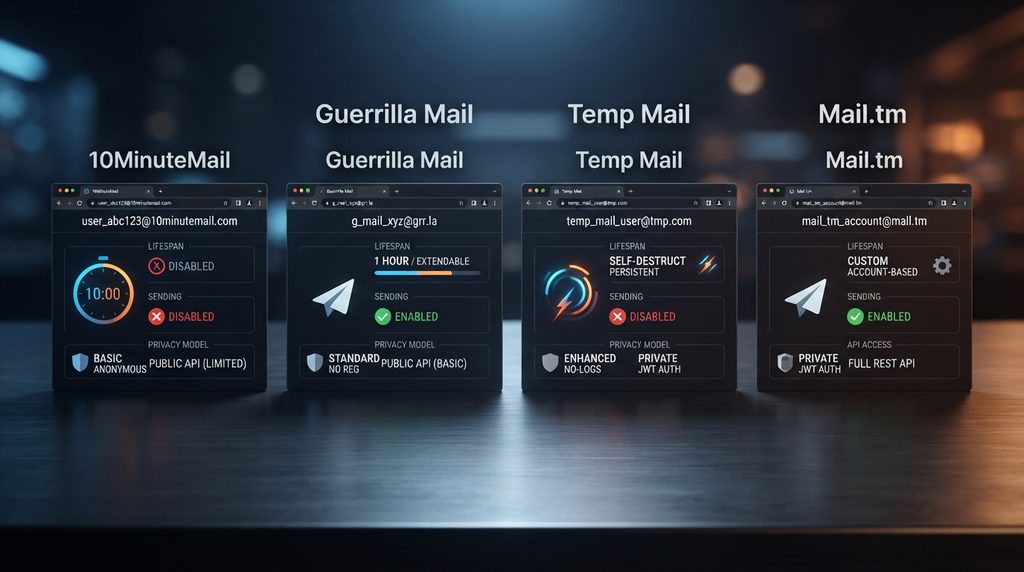
Recent industry comparisons specifically warn that domain acceptance varies by platform and should not be treated as a permanent property of a service.
If a legitimate website requires a permanent email address, use an email account or alias that you control instead of attempting to bypass the site’s registration restrictions.
Are 10MinuteMail Alternatives Safe?
Temporary email can reduce exposure of your primary inbox, but temporary does not automatically mean private or secure.
The privacy model varies significantly between services.
A private session-based inbox is different from a public inbox where someone who knows or guesses the address may be able to access messages.
For example, current comparison research distinguishes public-inbox services from private or session-scoped services.
Never use a disposable or public temporary inbox for:
- Banking information
- Healthcare information
- Government accounts
- Password recovery
- Sensitive business information
- Confidential documents
- Important personal accounts
Use a permanent email address that you control whenever future access matters.
When Should You Stay With 10MinuteMail?
You do not necessarily need an alternative.
10MinuteMail remains a sensible choice when:
- You need one verification email.
- The website accepts the address.
- Ten minutes is enough.
- You do not need long-term access.
- You want a simple browser-based workflow.
Its biggest advantage is also its defining limitation: the service is intentionally temporary.
If the task is genuinely a one-time event, moving to a more complicated service may not provide any meaningful benefit.
When Should You Switch to an Alternative?
Consider another service when your requirements have changed.
A switch makes sense if:
- The timer is too short.
- You need to reply to messages.
- You need automated email testing.
- You need an API.
- You need a longer-lived inbox.
- You need a persistent email alias.
- A website rejects the current disposable domain.
The best alternative is therefore not necessarily the service with the most features. It is the one that solves the specific limitation you are experiencing.
Pros & Cons Table
| Pros | Cons |
|---|---|
| Several alternatives cover different use cases | No temporary email service works on every website |
| Longer-lived options are available | Some services have public or less-private inbox models |
| Developer-focused services offer APIs | API-based services can be more complicated for beginners |
| Some alternatives support sending and replying | Additional functionality may come with different restrictions |
| Email aliases provide longer-term privacy | Aliases are not the same as disposable inboxes |
Comparison Table
| Service | Main Strength | Main Limitation | Best For |
|---|---|---|---|
| Temp Mail | General temporary email | Some advanced features are premium | Everyday disposable email |
| Guerrilla Mail | Send and reply | Temporary retention | Flexible temporary email |
| Mail.tm | Free documented API | More technical setup | Developers |
| YOPmail | Longer retention | Different privacy model | Longer temporary use |
| Maildrop | Testing | Public/shared inbox concerns | Low-risk testing |
| EmailOnDeck | Longer sessions | Less clearly documented retention | Users needing more time |
| SimpleLogin | Persistent privacy | Not a traditional disposable inbox | Long-term email aliases |
Alternatives
Temp Mail
A close general-purpose alternative with temporary addresses and mobile support.
Best for: Everyday disposable email use.
Guerrilla Mail
A more flexible temporary email service that supports composing and replying.
Best for: Users who need more than receiving messages.
Mail.tm
A developer-friendly temporary email platform with a documented free API.
Best for: Automated testing and development workflows.
YOPmail
A disposable email option focused on longer access than ultra-short-lived inboxes.
Best for: Tasks that require more time.
SimpleLogin
An email-alias service rather than a traditional temporary inbox.
Best for: Long-term privacy and separating your real email from online services.
Read more: What Is 10MinuteMail? Features, Uses, and Who Should Use It
FAQs
What is the best 10MinuteMail alternative?
There is no single best option for everyone. Temp Mail is a straightforward general alternative, Guerrilla Mail is more suitable when sending or replying matters, and Mail.tm is particularly useful for developers who need an API.
Is Temp Mail better than 10MinuteMail?
It depends on the task. Temp Mail offers a broader temporary-email ecosystem, while 10MinuteMail is particularly simple for short-lived one-time use. Neither is universally better.
Which 10MinuteMail alternative lasts longer?
Several alternatives provide longer retention than the standard 10-minute model. Guerrilla Mail, for example, currently states that its emails are deleted after one hour.
Which alternative is best for developers?
Mail.tm is a strong choice when automated testing matters because its official documentation provides a REST API for creating temporary accounts and retrieving messages.
Can I send emails from a 10MinuteMail alternative?
Some services support sending or replying while others are primarily receive-only. Guerrilla Mail’s current interface includes Compose and its documentation supports replying and forwarding.
Are temporary email alternatives anonymous?
Not necessarily. Privacy depends on the provider’s architecture, policies, and inbox model. A public temporary inbox can have very different privacy characteristics from a private session-based mailbox.
Can I use temporary email for important accounts?
It is generally a poor choice. If you might need password recovery or ongoing notifications, use a permanent email address or a persistent alias that you control.
Why does a website reject temporary email?
Some websites block disposable-email domains as part of their registration policies. Switching services may or may not help because domain acceptance varies between platforms and can change over time.
Quick Take
Main point: 10MinuteMail is useful for very short-lived email tasks, but alternatives can provide longer retention, sending, APIs, mobile access, or persistent aliases.
Best general alternative: Temp Mail
Best for sending/replying: Guerrilla Mail
Best for developers: Mail.tm
Best for longer temporary access: YOPmail or Guerrilla Mail
Best for persistent privacy: SimpleLogin
Main limitation: No disposable-email service is guaranteed to work with every website.
Conclusion
10MinuteMail remains useful when you need a temporary address for a quick verification or one-time registration. Its simple, short-lived model is actually an advantage when you do not need the address again.
However, the best 10MinuteMail alternative depends on the limitation you are trying to solve. Temp Mail is a practical general-purpose option, Guerrilla Mail adds sending and replying, Mail.tm is much more useful for developers who need API access, and an alias service such as SimpleLogin makes more sense when you need longer-term privacy.
The most important takeaway is to choose based on the task rather than simply looking for the service with the most features. A ten-minute inbox is perfectly adequate for a quick verification email; a developer testing an automated signup flow needs something very different.
For important accounts, avoid disposable email altogether and use an address you control permanently.
Author Bio
TechyUpdate Editorial Team covers practical technology, AI tools, apps, software and digital productivity, with a focus on clear, useful and independently researched guides.